Lines 1 to 4: identifying information
Name, taxpayer identification number, the type of filer (specified individual, partnership, corporation or trust) and, for an entity, the specified individual or beneficiary behind it.
8938
Statement Of Specified Foreign Financial Assets
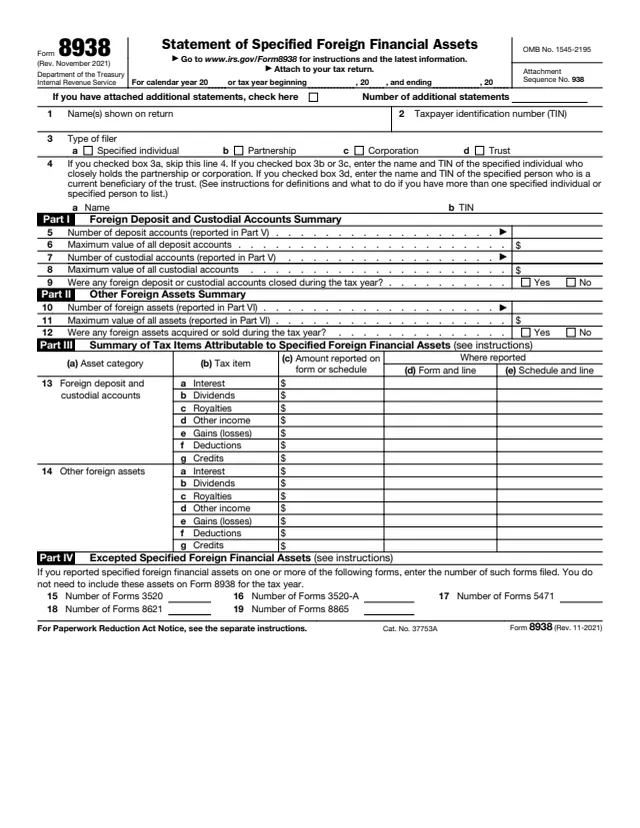
Form 8938 is the statement of specified foreign financial assets. The About page says to use it to report your specified foreign financial assets if the total value of all the specified foreign financial assets in which you have an interest is more than the appropriate reporting threshold.
Specified foreign financial assets include financial accounts at a foreign financial institution and, when held for investment outside such an account, foreign stock or securities, interests in foreign entities and contracts with a foreign issuer or counterparty. The form is attached to an annual return such as Form 1040, 1041, 1065 or 1120. The instructions say not to send it to the IRS unless it is attached to an annual or amended return.
The instructions also say filing Form 8938 does not replace FinCEN Form 114 (FBAR) for anyone otherwise required to file it. Form 8938 is a continuous-use form, revised November 2021. You can fill it out free in your browser on this page and download the result without an account.
Name, taxpayer identification number, the type of filer (specified individual, partnership, corporation or trust) and, for an entity, the specified individual or beneficiary behind it.
Part I counts foreign deposit and custodial accounts and their maximum values. Part II counts other foreign assets and their maximum value, with yes or no questions on accounts closed and assets bought or sold.
Lines 13 and 14 list interest, dividends, royalties, other income, gains, deductions and credits from the assets, with the form, schedule and line where each was reported.
Lines 15 to 19 take the number of Forms 3520, 3520-A, 5471, 8621 and 8865 filed that already report the assets.
Lines 20 to 28 describe each deposit or custodial account: account number, opened or closed boxes, maximum value, currency exchange rate, and the financial institution's name, GIIN and address.
Lines 29 to 36 describe each other asset: description, identifying number, dates acquired or disposed of, a value range or amount, exchange rate, and the foreign entity, issuer or counterparty.
Fill in the tax year at the top. Enter the name and TIN as shown on the annual return, check one box on line 3, and complete line 4 only for a partnership, corporation or trust.
Enter each foreign deposit or custodial account with its maximum value. For more than one account, the instructions say to attach copies of page 2 and enter the number of additional statements on page 1.
Describe each other asset, for example the class of shares held. Line 32 has value ranges up to $200,000 and a line for a larger value. Enter "Various" for several dates in one year.
The instructions say to use the U.S. Treasury Bureau of the Fiscal Service rate on the last day of the tax year, or name another publicly available rate on lines 25 or 34 when none is provided.
Total the accounts in Part I and the other assets in Part II, list related tax items and where they were reported in Part III, and count any excepted forms in Part IV.
Attach the finished form, with any extra page 2 statements, to the annual return it relates to.
You get the real form, filled in a browser tab, with nothing standing between you and the finished PDF.
The instructions say to attach Form 8938 to the annual return and file by the due date (including extensions) for that return.
For specified individuals: more than $50,000 on the last day of the tax year or more than $75,000 at any time, unmarried or filing separately; $100,000 or $150,000 on a joint return.
Taxpayers who meet a presence abroad test: more than $200,000 on the last day or $300,000 at any time, or $400,000 or $600,000 on a joint return. Specified domestic entities: $50,000 or $75,000.
The instructions list a $10,000 failure-to-file penalty, an additional $10,000 for each 30-day period after 90 days from an IRS notice up to $50,000, and a 40% accuracy-related penalty.
Filing Form 8938 does not relieve the requirement to file FinCEN Form 114 for anyone otherwise required to file it.
Leaving the tax year blank, listing U.S. accounts such as IRAs, forgetting to check the additional statements box, and using an exchange rate other than the last day of the tax year.
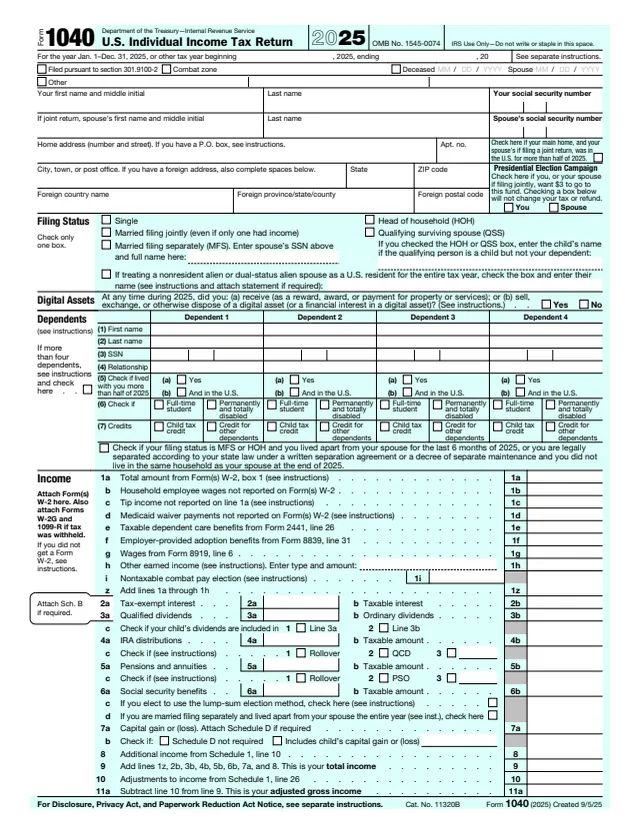
1040
199 fields, 2 pages
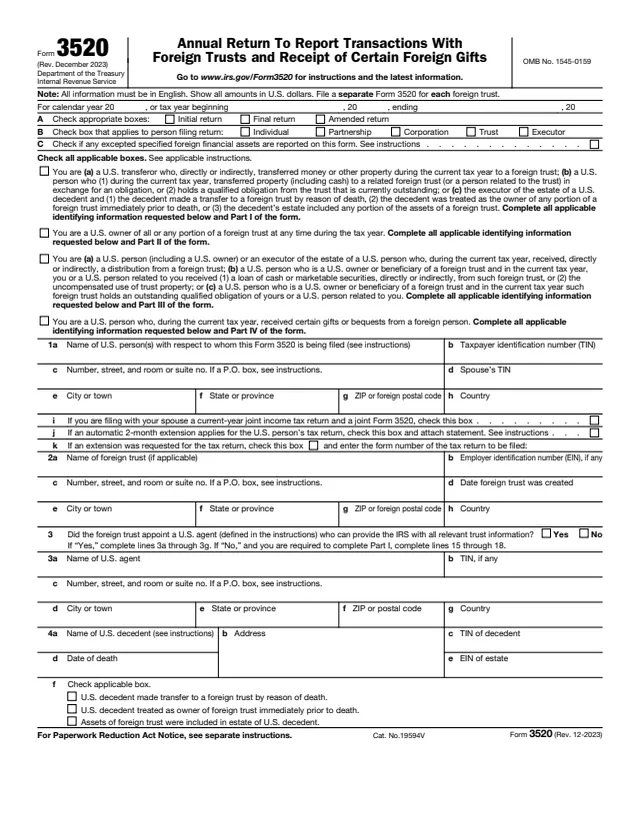
3520
462 fields, 6 pages
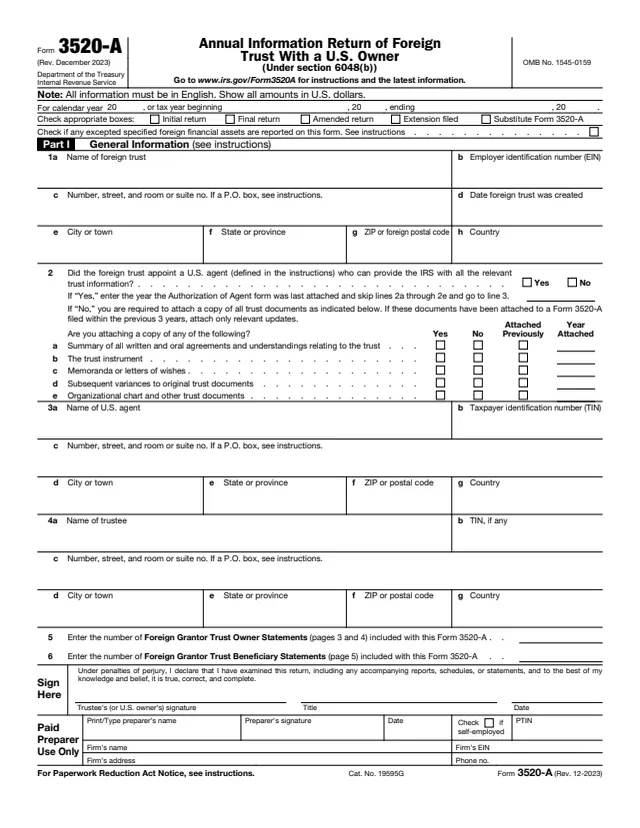
3520-A
386 fields, 5 pages
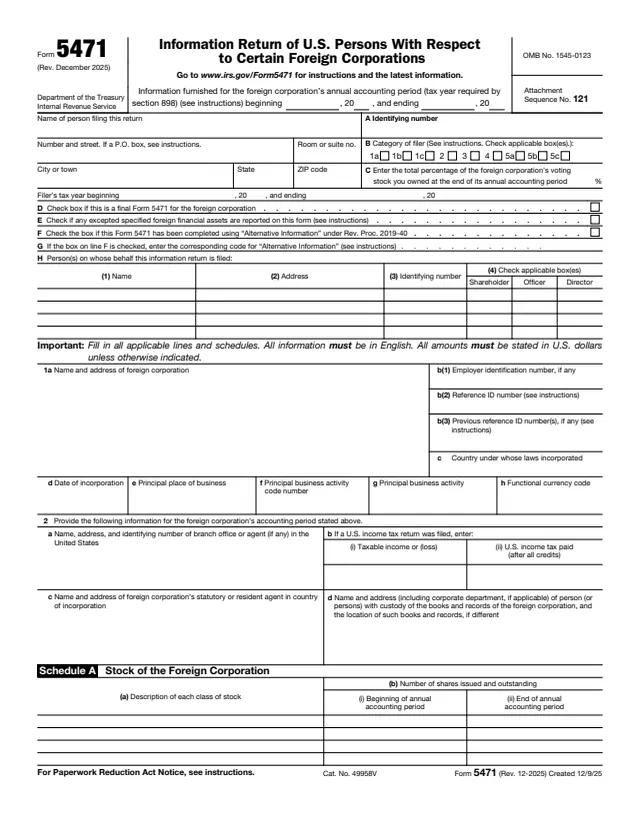
5471
437 fields, 6 pages
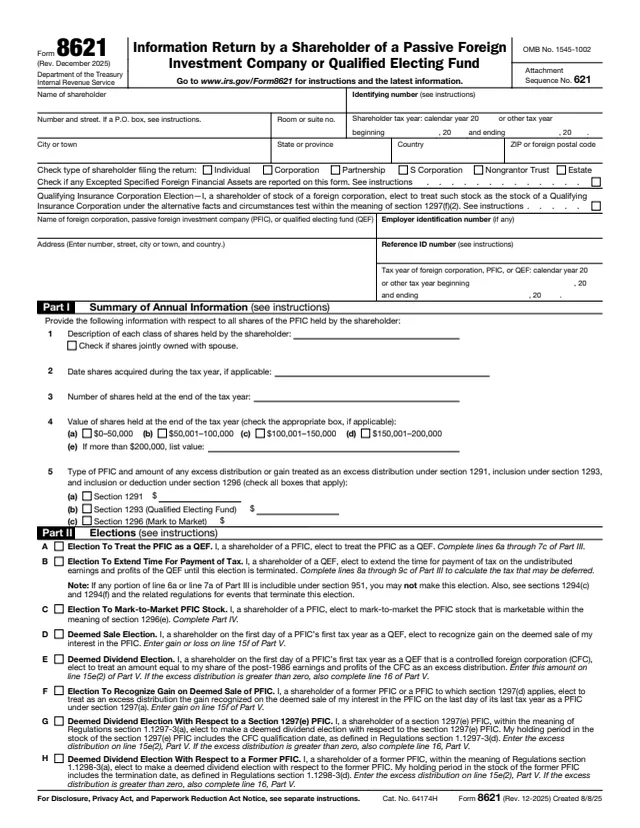
8621
151 fields, 4 pages
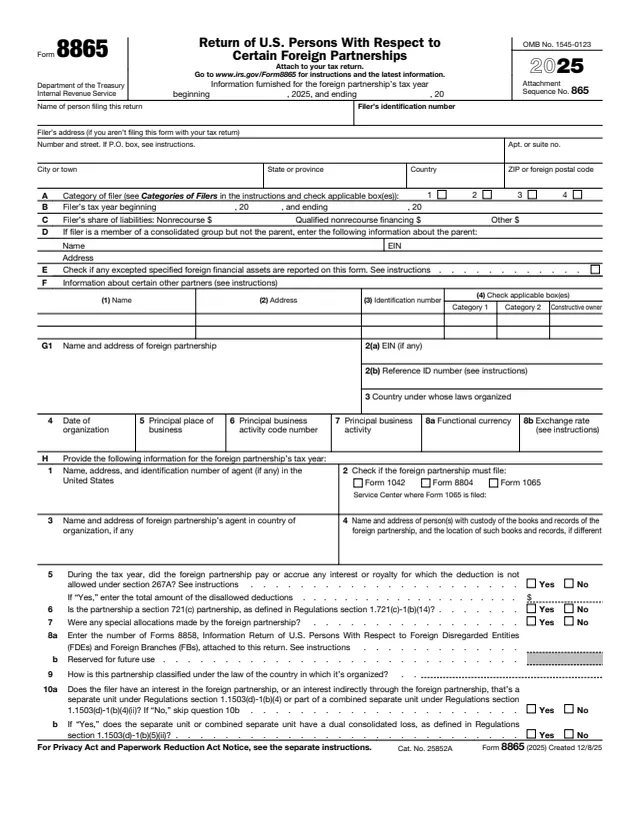
8865
461 fields, 6 pages
The instructions say a specified person with an interest in specified foreign financial assets above the applicable reporting threshold files the form, unless an exception applies. Without an income tax return to file for the year, no Form 8938 is filed.
No tool matches that search.
No. The instructions say filing Form 8938 does not relieve the requirement to file FinCEN Form 114, Report of Foreign Bank and Financial Accounts, if that is otherwise required.
No. The instructions say not to send it unless it is attached to an annual return or an amended return.
The instructions say that without an income tax return to file for the year, Form 8938 is not filed, even if the assets are above the threshold.
Assets reported on a timely Form 3520, 3520-A, 5471, 8621 or 8865 for the same year are not listed again. The number of those forms goes in Part IV.
The instructions say spouses filing a joint return report a jointly held account once on one Form 8938. Spouses filing separately each report its maximum value on their own form.
The form marks it optional. The instructions say there is no penalty for a wrong or blank GIIN.