Pick the other format
Choose the source format in the converter above. The target is already set to WOFF, so you only add the file.
WOFF converter
Drop a .ttf file here or click to upload
WOFF (Web Open Font Format) is the standard wrapper for delivering fonts to web browsers. It is not really a new font format, it is a compressed envelope that contains a TrueType or OpenType font plus some lightweight metadata. Every browser released since 2010 supports WOFF natively, which made @font-face truly portable for the first time. WOFF is what put high-quality custom typography on the web at scale, and it remains a useful fallback for legacy browser environments.
Choose the source format in the converter above. The target is already set to WOFF, so you only add the file.
Drop a font on the box or browse for one. A progress row shows while the job runs.
When the job finishes you see the new file name. Download it, or convert another font straight away.
Compress
Repack the font into a smaller, browser-ready container.
Decompress
Unpack a compressed web font back to its raw outline data.
Subset
Ship only the glyphs a page actually uses.
Pick the format of the font you have. WOFF is already the target.
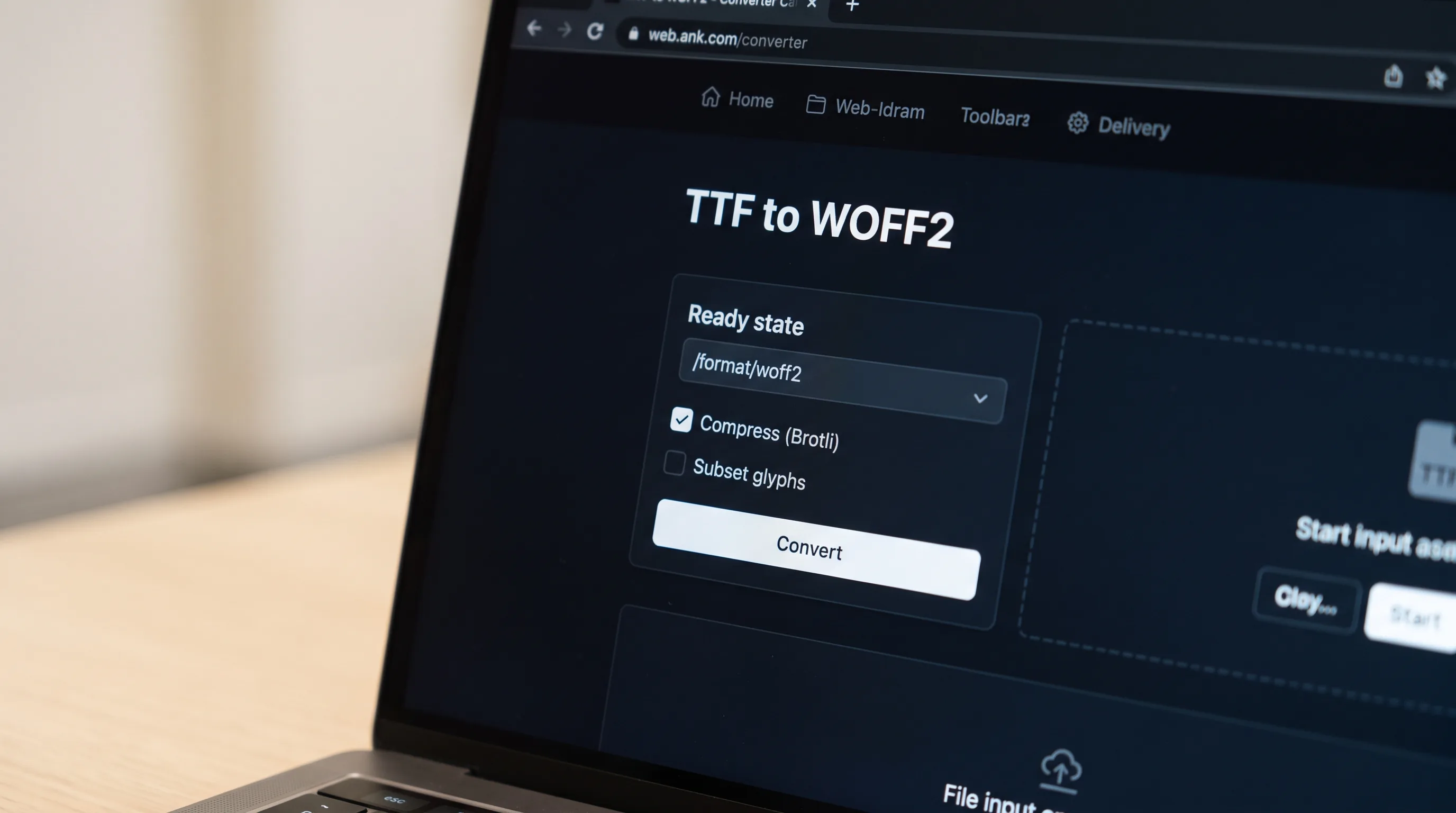
Drop the file on the upload box or click to browse, then press Convert to WOFF.
Wait for the result, then download it. Free-tier files are deleted automatically.
Erik van Blokland, Tal Leming, and Jonathan Kew designed WOFF in 2009 and Mozilla shipped support in Firefox 3.6 in early 2010. Microsoft, Apple, Google, and Opera all followed within the year, making WOFF the first universally supported web font format. The W3C made WOFF a Recommendation in December 2012. Before WOFF, designers either embedded fonts via proprietary services like Typekit or shipped raw .ttf and .otf files, which made copyright-conscious foundries refuse to license their fonts for the web. WOFF's lightweight metadata block changed that, by 2014 hundreds of foundries had opened web licences, and the era of generic web typography ended. Today WOFF survives mainly as a compatibility fallback inside @font-face src chains, sitting between modern WOFF2 and ancient raw TTF for the narrow slice of browser versions that fall between the two thresholds. Designers building for the public internet rarely ship it any more; designers building corporate intranets ship it constantly.
The upload box shows the live size limit before you add a file. Signing in raises it, and paid plans raise it further.
WOFF converts to and from the other seven public font formats. The lists further down the page link to each pair.
Files are uploaded to Cloudflare R2 storage for processing and are encrypted in transit.
Free-tier files are deleted automatically after the job finishes. Signed-in output stays in your history for your plan's retention period.
Inspect a font for free in the font workspace, then convert it.
Open the font workspaceFor PDFs, Word, PowerPoint and scans, AI Extract turns documents into clean Markdown or JSON, tables, layout and reading order preserved.
Open AI Extract →

Turn the font a designer sent into a file you can load with @font-face.
Convert a web font back into one you can install, when its licence allows it.

Move an old font on an older site into a format current browsers open.
No tool matches that search.
Probably not for the public internet, every browser released since 2018 supports WOFF2, which is smaller. WOFF is still useful for corporate environments running pinned older browsers, or as a fallback inside a @font-face src chain.
WOFF compresses the underlying font with zlib (deflate). WOFF2 uses Brotli, which is roughly 30 percent more efficient on font payloads. Functionally they carry the same TrueType or OpenType data inside; only the compression envelope differs.
Most modern font editors (Glyphs, FontLab, RoboFont, FontForge) can open WOFF directly. If yours cannot, convert WOFF to TTF or OTF first using our online converter.
Yes. Free conversions need no signup and add no watermark.
No. You can convert a font without signing up. Signed-in conversions use credits, and the result stays in your history.
Yes. Every pair has its own page. The links under the conversion lists open them.
Converting a file does not change its licence. Check that the licence lets you convert the font and embed it on the web before you publish it.