Start from a file or a sample
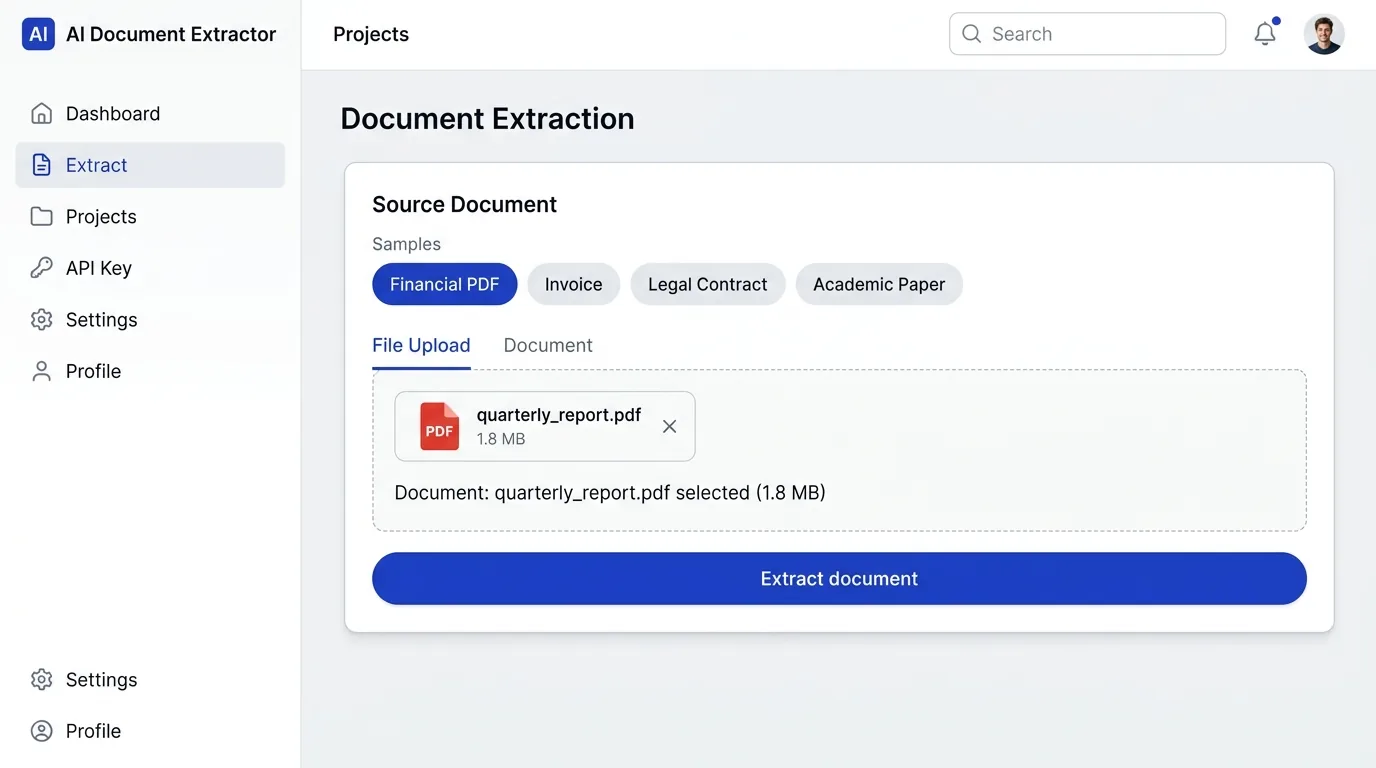
Drop a file on the source box, click to browse, or pick a sample: a financial PDF, a scanned receipt, a multi-column paper or a contract. A chip shows which file is loaded, and you can remove it and start over.
AI Extract: layout-aware document extraction
No extractions yet
No document yet
Drop a file on the left or pick a sample to see the structured output here.
AI Extract reads a PDF, Word file, PowerPoint, spreadsheet, HTML page or image and returns its structure as Markdown, JSON or tables. Headings, reading order and table cells stay in place, so the output is ready for a language model, a search index or a script. Pick a sample in the box above or drop in your own file, choose a format and press Extract document. The size and page limit shows in the source box before you start, and the samples run without signing in.
Drop a file on the source box, click to browse, or pick a sample: a financial PDF, a scanned receipt, a multi-column paper or a contract. A chip shows which file is loaded, and you can remove it and start over.
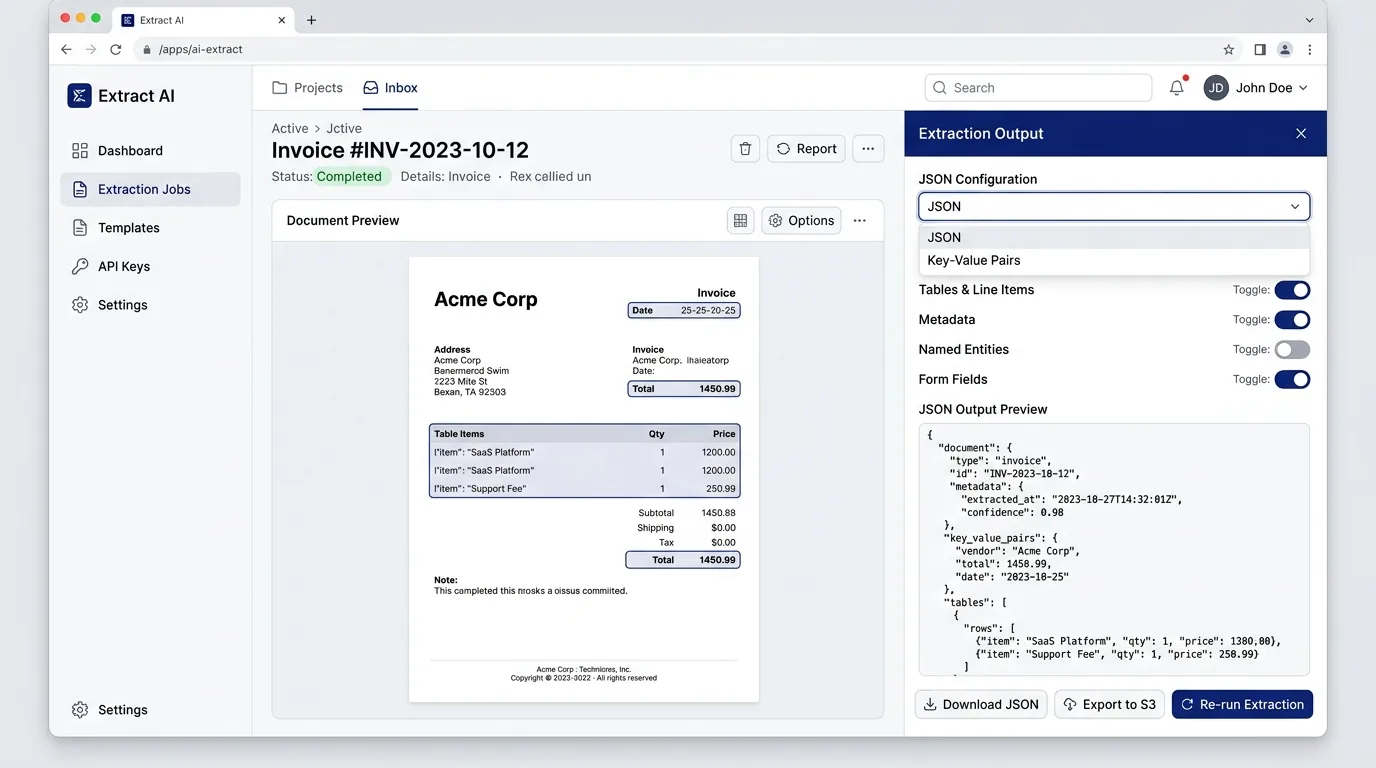
Output comes as Markdown, JSON, HTML or Tables. Switches control table structure, OCR for scans, reading order, code and formulas, and picture export. The OCR switch is marked as costing credits and code detection as slower.
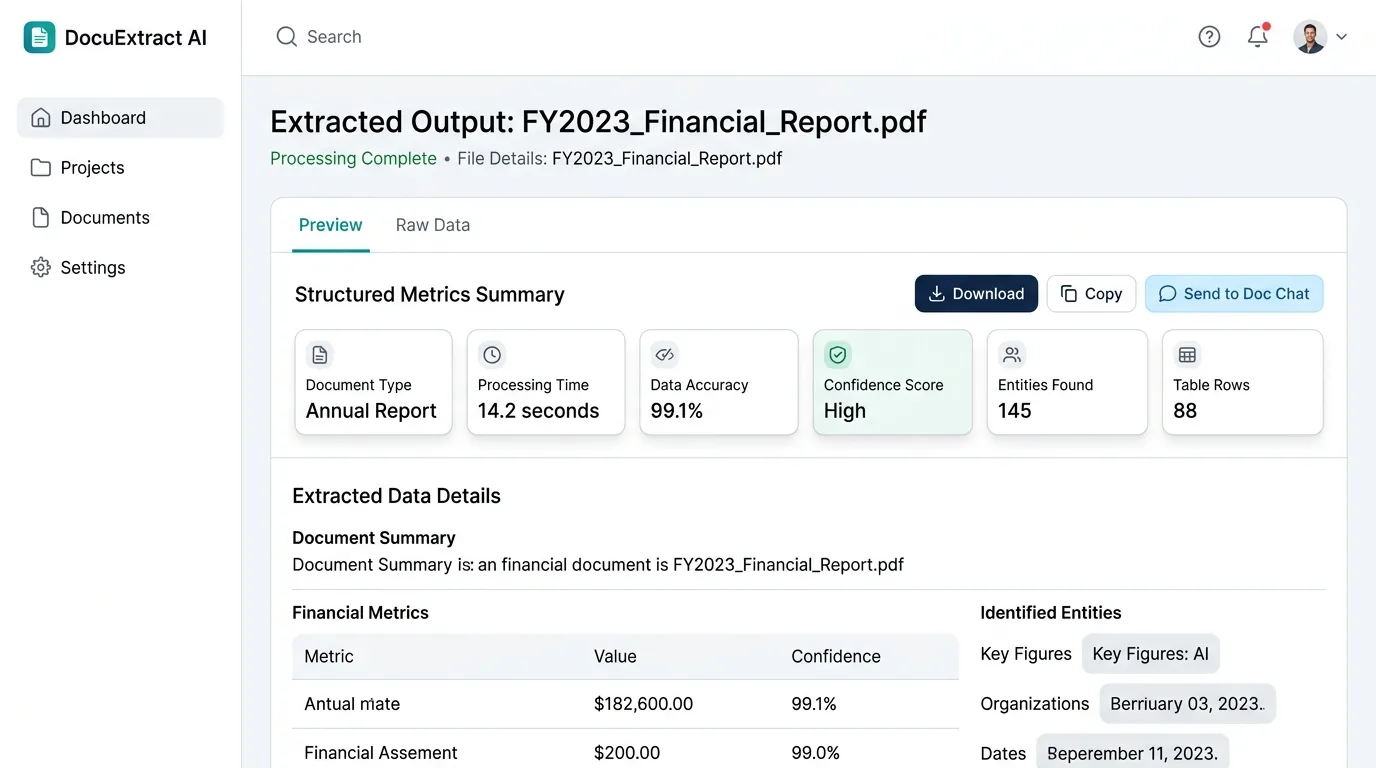
The output pane has Markdown, JSON and Preview tabs, with page, table, figure and parse-time counts under it. Download the file, copy it or send it to Doc Chat.
What it captures
It reads the document the way a person does, keeping what plain text extraction throws away.
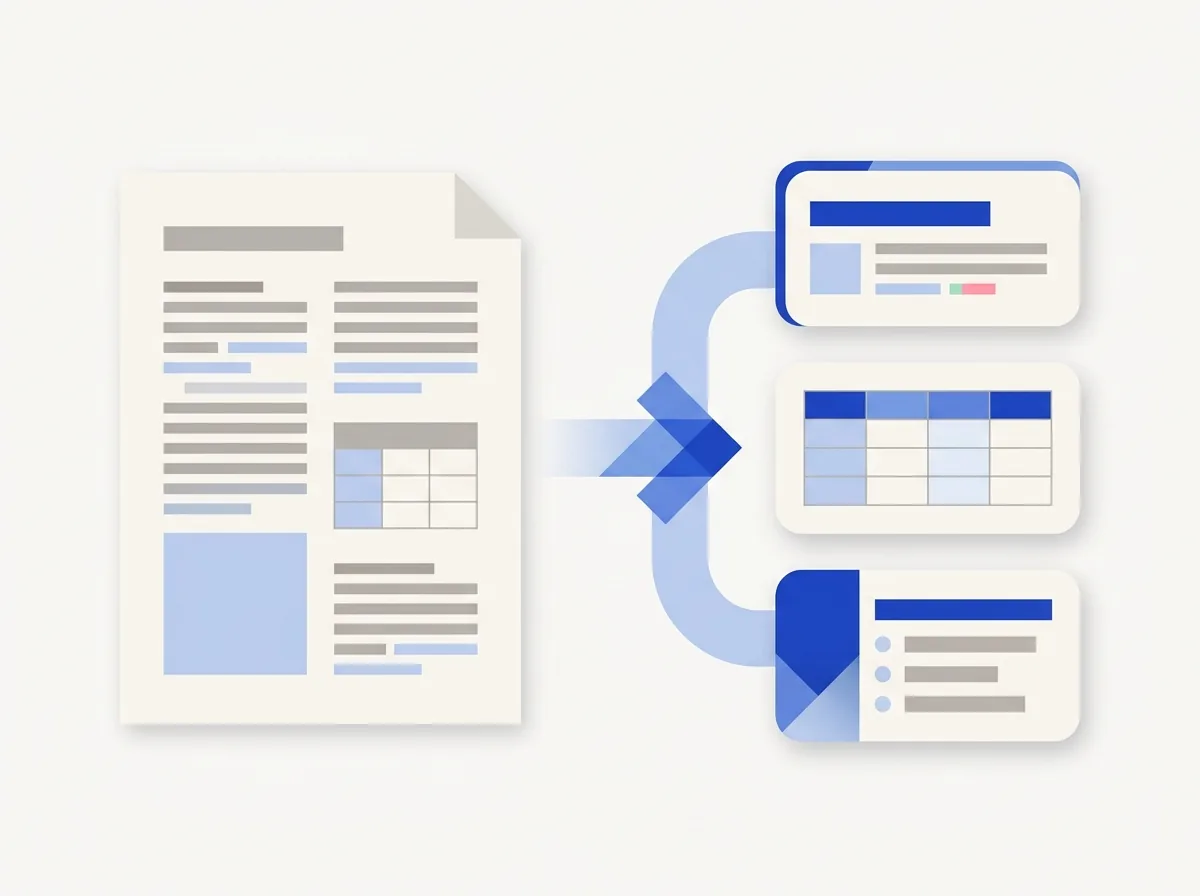
Cells, headers and spans recovered into real tables.
Multi-column pages re-sequenced into logical flow.
Hierarchy kept intact for clean chunking.
Plain text vs structured
Same PDF. Left: what a vanilla text extractor returns. Right: what AI Extract sees.
Quarterly Report 2026
Revenue by region
Region   Q1   Q2  Americas
4.20M  4.85M EMEA 3.10M
3.42M APAC 2.05M 2.61M
Summary Total revenue grew 14.6%
quarter over quarter, led by the
APAC segment...
chart
# Quarterly Report 2026 ## Revenue by region | Region | Q1 | Q2 | |----------|-------|-------| | Americas | 4.20M | 4.85M | | EMEA | 3.10M | 3.42M | | APAC | 2.05M | 2.61M | ## Summary Total revenue grew 14.6%… 
Drop a PDF, Office file, HTML page or image on the source box, or pick one of the samples.
Select Markdown, JSON, HTML or Tables, then switch on the table, OCR and reading-order options you need.
Press Extract document. When parsing finishes, copy or download the output, or send it to Doc Chat.
The extractor reads the layout of each page, not only its text, so tables stay tables and headings keep their level. You choose the output format, and the same extraction is available from the API for pipelines.
Pages without a text layer. A scan or a photo has no text layer, so switch on OCR and the page is read as an image first. A very blurry or low-contrast scan can still come back incomplete.
Complicated layouts. Unusual layouts, stacked tables and handwriting can be misread. Open the output next to the source before you rely on a table or a figure.
What the output is. AI Extract returns the structure it finds. It does not summarize, correct or rewrite your document, and the output is not a certified copy.
Your file. Files are processed on indox infrastructure, are not used to train models and are removed from storage automatically. Retention depends on your plan and is listed in the limits docs.
Go beyond AI Extract: ask the extracted document questions in Doc Chat, translate it, or convert it to another format.
Developer API
One endpoint. Returns Markdown or JSON. Async by default, poll for the result.
curl -X POST https://indox.org/docs/api/v1/extract/ \
  -H "Authorization: Bearer $INDOX_TOKEN" \
  -F "[email protected]" \
  -F "format=markdown" \
  -F "ocr=true"

# → 202 { "extract_id": "ex_8f3k…", "status": "queued" }
# Poll GET /docs/api/v1/extract/ex_8f3k…/ until status=succeeded
Convert document libraries into clean Markdown chunks ready for embedding.
Recover P&L tables and regional breakdowns from earnings PDFs.
Preserve clause numbering, defined terms and signature blocks.
Inline code and math detected and labelled.
Pictures exported and referenced in place.
Image-only PDFs run through OCR first.
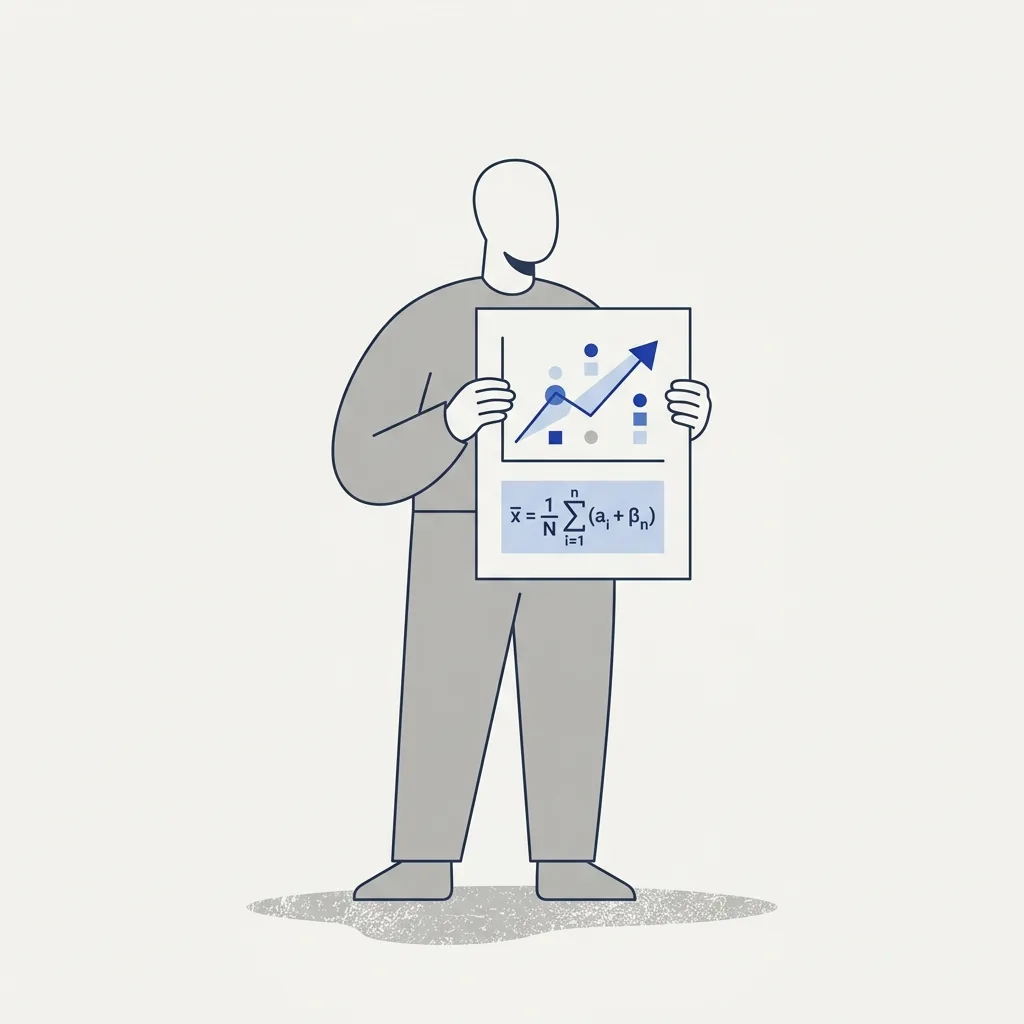
Keep figure captions, citations and equations tied to their sections.
PDF, DOCX, PPTX, XLSX, HTML and images. Scanned PDFs are read with OCR when the OCR option is on.
Converters reproduce a document in another format. AI Extract reads its structure, such as tables, headings and reading order, into machine-readable Markdown or JSON.
English, Spanish, French, German, Persian and Arabic are among them. Scanned pages go through OCR when you switch the option on.
The page and size limit that applies to you shows in the source box. For larger libraries, call the API once per file and poll each job. There is no batch endpoint yet.
Files are processed on indox infrastructure and removed from storage automatically. How long they stay depends on your plan and is listed in the limits docs.
Files are processed in region and are not used to train models. Self-hosting is not offered.
No. The samples in the box above run without signing in, so you can see a result before you upload anything of your own.
Markdown, JSON, HTML and Tables. The output pane also has a rendered Preview tab, and you can copy or download what you see.
Yes. After an extraction, Send to Doc Chat opens the extracted document in a chat so you can ask questions about it.
AI Extract is an API endpoint that accepts a file, returns a job and lets you poll for the result. The Developer API block above shows curl, Python and Node examples.
No tool matches that search.