Decedent information and notes
The decedent's name as it appears on Form 706 and Social Security number, followed by notes on Schedule PC, Schedule W and the Form 1041 waiver for commissions and fees.
706 Sch. J
Funeral Expenses and Expenses Incurred in Administering Property Subject to Claims
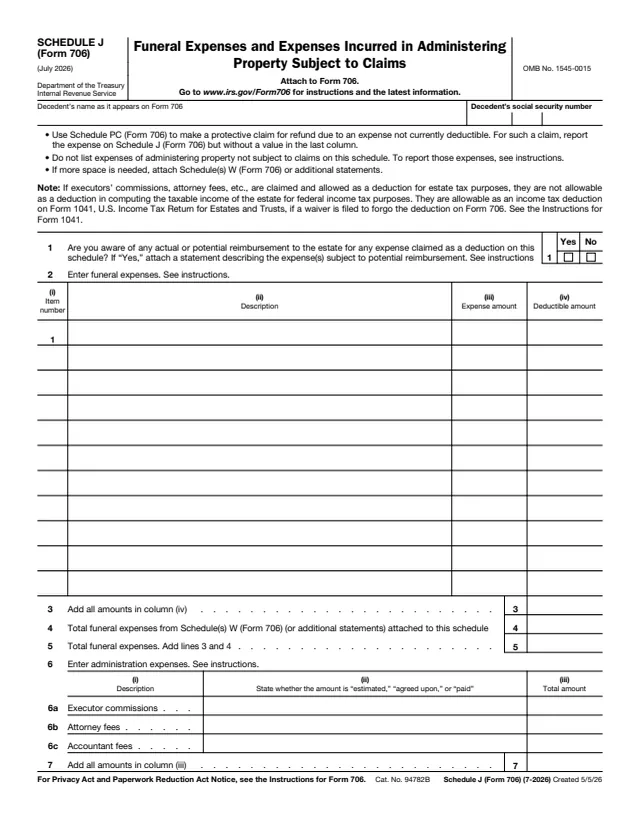
Schedule J (Form 706) itemizes funeral expenses and expenses incurred in administering property subject to claims for a decedent's estate tax return. The About Form 706 page says to use this schedule to itemize funeral and property expenses during administration that are subject to claims. It is attached to Form 706, the return the executor of a decedent's estate uses to figure the estate tax.
The Instructions for Form 706 say to complete and file Schedule J if the estate claims a deduction on Form 706, Part V, item 14, and line 12 of the schedule carries the total there. The July 2026 schedule asks about expected reimbursements, lists funeral expenses with an expense amount and a deductible amount, and lists executor commissions, attorney fees, accountant fees and miscellaneous administration expenses.
You can fill out Schedule J (Form 706) free in your browser on this page and download it without an account.
The decedent's name as it appears on Form 706 and Social Security number, followed by notes on Schedule PC, Schedule W and the Form 1041 waiver for commissions and fees.
A yes or no question on any actual or potential reimbursement to the estate for an expense claimed on the schedule. A yes calls for an attached statement describing those expenses.
A table with item number, description, expense amount and deductible amount, then the column (iv) total, any Schedule W total, and total funeral expenses on line 5.
Line 6a executor commissions, 6b attorney fees and 6c accountant fees, each marked as "estimated," "agreed upon" or "paid," totaled on line 7.
A table with item number, description and expense amount, the column (iii) total on line 9 and any Schedule W total on line 10.
Line 11 adds lines 7, 9 and 10 for total administration expenses. Line 12 adds lines 5 and 11 and goes to Form 706, Part V, item 14.
Check yes or no. If yes, the schedule says to attach a statement describing the expenses subject to potential reimbursement.
The instructions say to list each funeral expense in column (iii), deduct amounts that were reimbursed, such as death benefits payable by the SSA or the Veterans Administration, and list the deductible amount in column (iv).
Enter commissions paid or expected to be paid. The instructions say not to deduct commissions if none will be collected, and that a bequest made instead of commissions is not deductible.
Enter fees paid or reasonably expected to be paid. The instructions say attorney fees incidental to litigation incurred by the beneficiaries are not deducted.
The instructions name appraiser's fees, certain court costs, and costs of storing or maintaining assets of the estate, and limit selling expenses to sales needed to pay debts, expenses or taxes, preserve the estate or carry out distribution.
Total lines 3, 7 and 9, bring in any Schedule W totals on lines 4 and 10, add lines 5 and 11 on line 12, and enter it on Form 706, Part V, item 14.
You get the real form, filled in a browser tab, with nothing standing between you and the finished PDF.
The schedule says "Attach to Form 706." Line 12 is entered on Form 706, Part V, item 14.
The Form 706 instructions say Form 706 is filed within 9 months after the date of the decedent's death, and Form 4768 is used to apply for an automatic 6-month extension of time to file.
The Form 706 instructions give Department of the Treasury, Internal Revenue Service, Kansas City, MO 64999. The About page points to Filing estate and gift tax returns for the latest address.
The instructions say administration expenses deducted on the estate tax return cannot also be deducted on a Form 1041 filed for the estate. The schedule notes they are allowable on Form 1041 if a waiver is filed to forgo the deduction on Form 706.
If commissions or fees claimed are unpaid at the final examination, the instructions say the amount is supported by an affidavit or statement signed under penalties of perjury that it has been agreed upon and will be paid.
The schedule says to attach Schedule(s) W (Form 706) or additional statements if more space is needed, with their totals on lines 4 and 10.
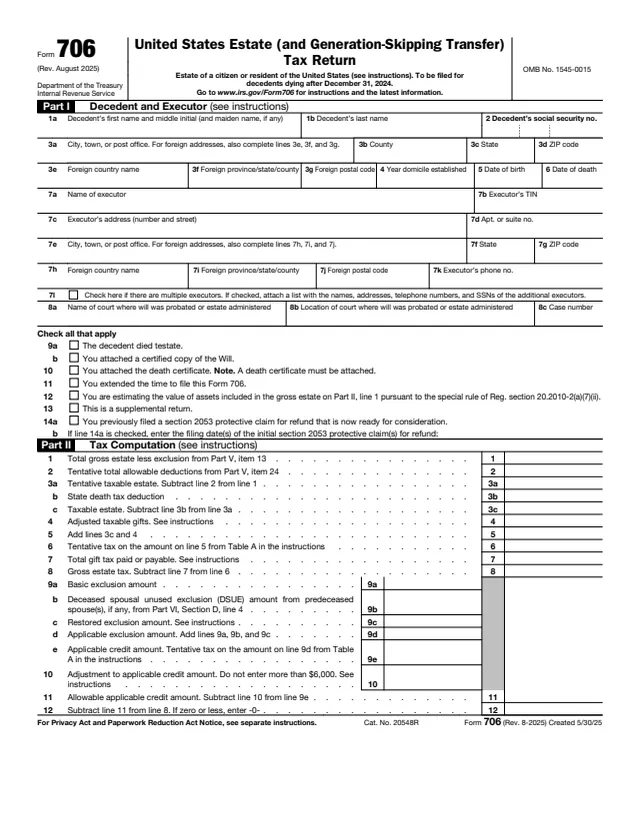
706
316 fields, 5 pages
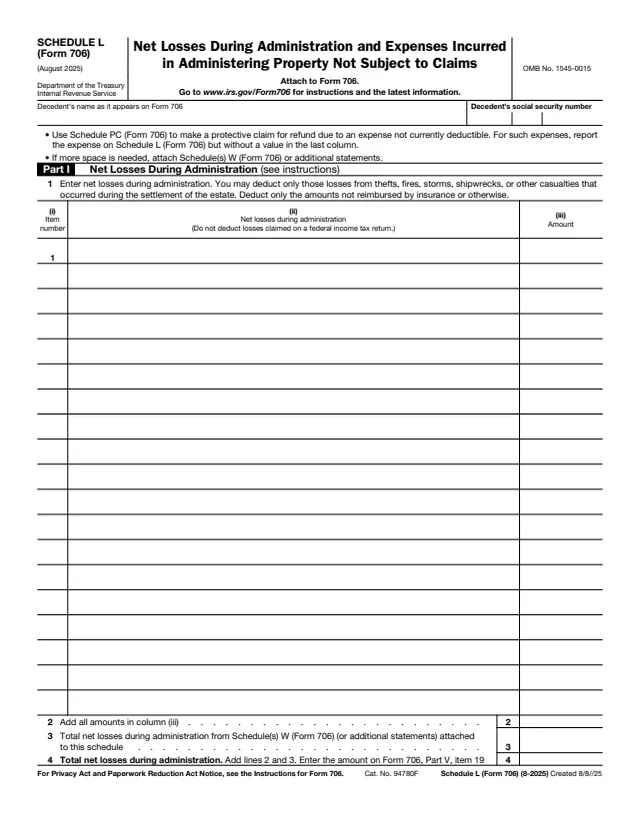
706 Sch. L
137 fields, 2 pages
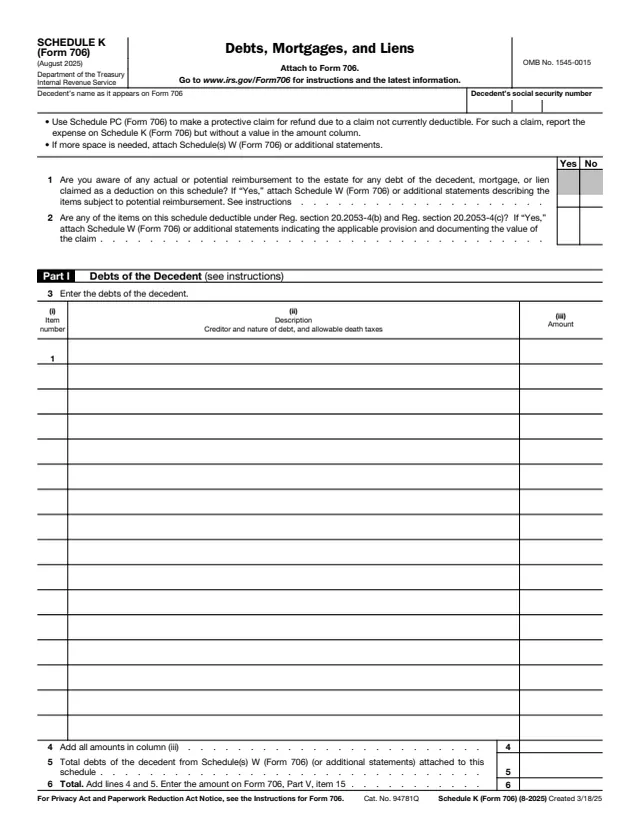
706 Sch. K
132 fields, 2 pages
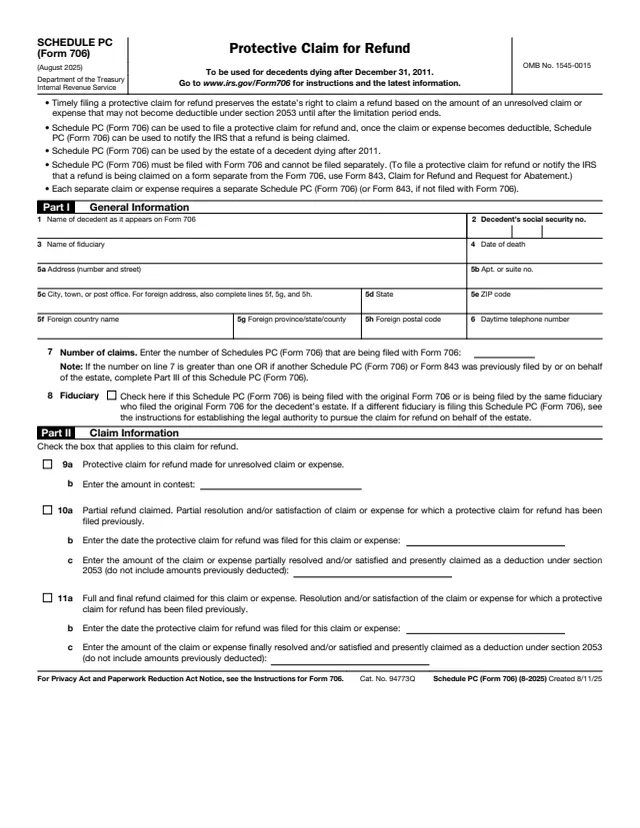
706 Sch. PC
354 fields, 3 pages
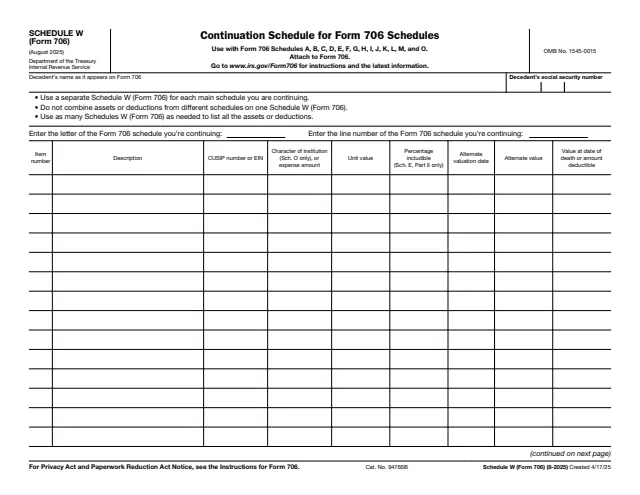
706 Sch. W
303 fields, 2 pages
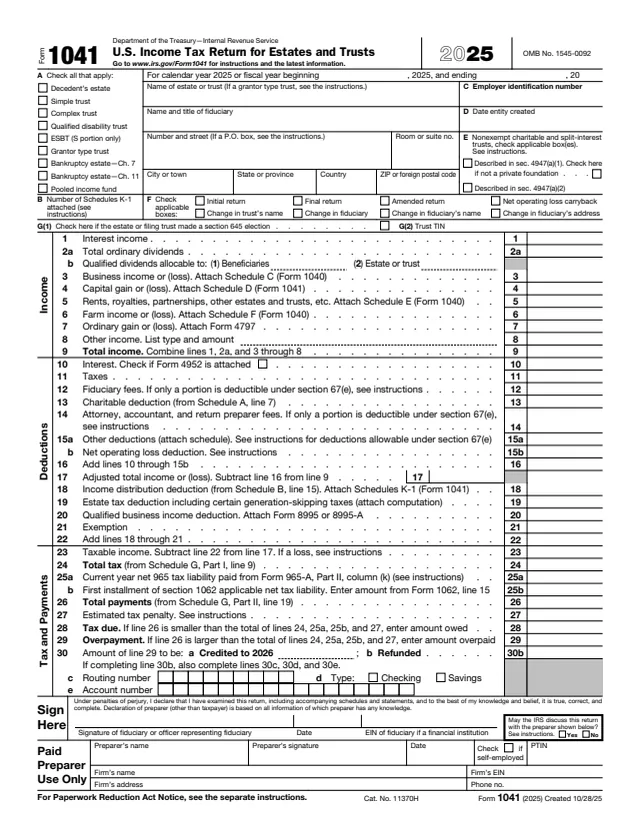
1041
173 fields, 3 pages
The schedule is completed for a decedent's estate as part of Form 706 and goes to the IRS with that return. It is not an individual income tax form.
No tool matches that search.
The About Form 706 page says it is used to itemize funeral and property expenses during administration that are subject to claims.
Schedule J covers expenses of administering property subject to claims. The instructions say expenses of administering property not subject to claims go on Schedule L (Form 706).
The instructions say funeral expenses are only deductible on the estate tax return.
The instructions say to deduct reimbursed amounts, such as death benefits payable by the SSA or the Veterans Administration, and enter the deductible amount in column (iv). Line 1 asks about any actual or potential reimbursement.
The instructions say executors' commissions are taxable income to the executors and are included as income on their individual income tax return.
The schedule says to use Schedule PC (Form 706) for a protective claim for refund and to report the expense on Schedule J without a value in the last column.
Line 12 is entered on Form 706, Part V, item 14.