Items A to G: the entity
Boxes for the type of entity, such as decedent's estate, simple or complex trust, ESBT, grantor type trust or bankruptcy estate, plus the name, fiduciary, EIN, date created, return type and a section 645 election box.
1041
U.S. Income Tax Return for Estates and Trusts
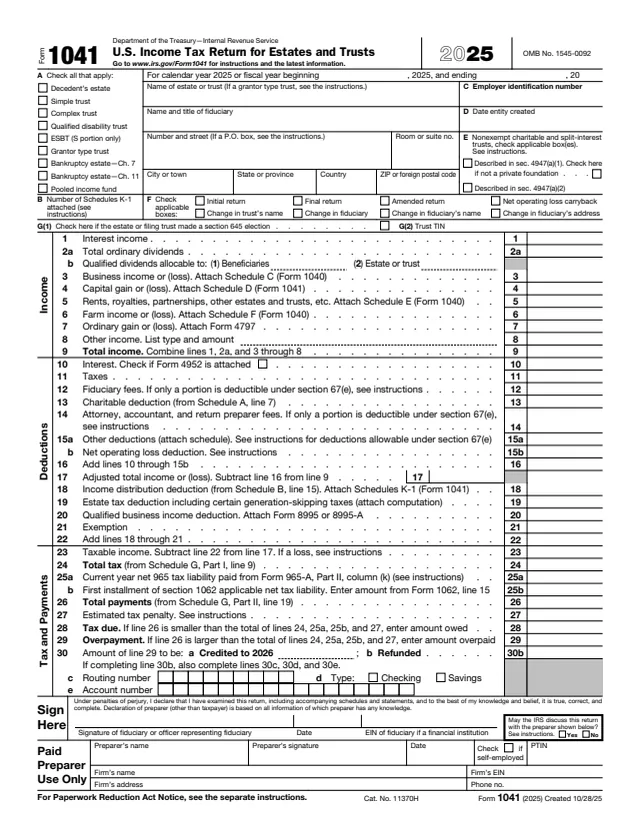
Form 1041 is the U.S. Income Tax Return for Estates and Trusts. The IRS About Form 1041 page says the fiduciary of a domestic decedent's estate, trust, or bankruptcy estate files it to report the income, deductions, gains and losses of the estate or trust, the income accumulated or distributed to beneficiaries, any income tax liability, and employment taxes on wages paid to household employees.
The instructions say a trust or decedent's estate is a separate legal entity for federal tax purposes and is allowed an income distribution deduction for distributions to beneficiaries, figured on Schedule B. Schedule K-1 (Form 1041) tells each beneficiary the amounts to include on their own return. The 2025 form has three pages: income, deductions, tax and payments on page 1, Schedules A, B and G, and Other Information questions.
You can fill out Form 1041 free in your browser on this page and download it without an account.
Boxes for the type of entity, such as decedent's estate, simple or complex trust, ESBT, grantor type trust or bankruptcy estate, plus the name, fiduciary, EIN, date created, return type and a section 645 election box.
Interest, dividends, business income, capital gains, rents and royalties, farm income, ordinary gains and other income, with the schedules or forms to attach named on each line.
Interest, taxes, fiduciary fees, the charitable deduction, professional fees, other deductions, the income distribution deduction, estate tax deduction, qualified business income deduction, exemption and taxable income.
Total tax and payments from Schedule G, the estimated tax penalty, tax due or overpayment, and whether an overpayment is credited to 2026 or refunded by direct deposit.
Schedule A figures the charitable deduction, Schedule B figures distributable net income and the income distribution deduction, and Schedule G computes the tax, credits and payments.
Questions 1 to 15, mostly Yes or No, including tax-exempt income, foreign accounts and trusts, the section 663(b) and 643(e)(3) elections, an estate open more than 2 years, and digital assets.
Check the boxes for the type of entity in item A, enter the estate or trust name, the fiduciary's name and title, the address, the EIN and the date the entity was created, and the number of Schedules K-1 attached.
Report each type of income and attach what each line names, such as Schedule D (Form 1041) for capital gains or Schedule E (Form 1040) for rents and royalties.
The instructions say to first figure accounting income under the will or trust instrument and local law. Schedule B then figures distributable net income on line 7 and the income distribution deduction on line 15, carried to page 1, line 18.
The instructions give $600 for a decedent's estate, $300 for a trust required to distribute all income currently, $5,100 for a qualified disability trust, and $100 for all other trusts.
Figure the tax and credits in Schedule G, Part I, and payments in Part II, then carry them to page 1, lines 24 and 26. Enter the tax due on line 28 or the overpayment on line 29.
Answer questions 1 to 15. The instructions say the fiduciary or an authorized representative signs, and only one of joint fiduciaries is required to sign. A paid preparer completes the preparer area.
You get the real form, filled in a browser tab, with nothing standing between you and the finished PDF.
The instructions say calendar year estates and trusts file Form 1041 and Schedule(s) K-1 by April 15, 2026. Fiscal-year estates and trusts file by the 15th day of the 4th month after the tax year closes.
The instructions say Form 7004 is used to apply for an automatic 5½-month extension of time to file.
The address depends on location and whether a check or money order is enclosed: Kansas City, MO 64999-0048 or 64999-0148, Ogden, UT 84201-0048 or 84201-0148, or P.O. Box 409101, Ogden, UT 84409 for a foreign country or U.S. territory.
The instructions say qualified fiduciaries or transmitters may be able to file Form 1041 electronically, and Form 8879-F lets the return be signed with a PIN.
To treat estimated tax payments as made by beneficiaries, the instructions say Form 1041-T is filed by the 65th day after the tax year closes, which is March 6, 2026, for calendar-year estates and trusts.
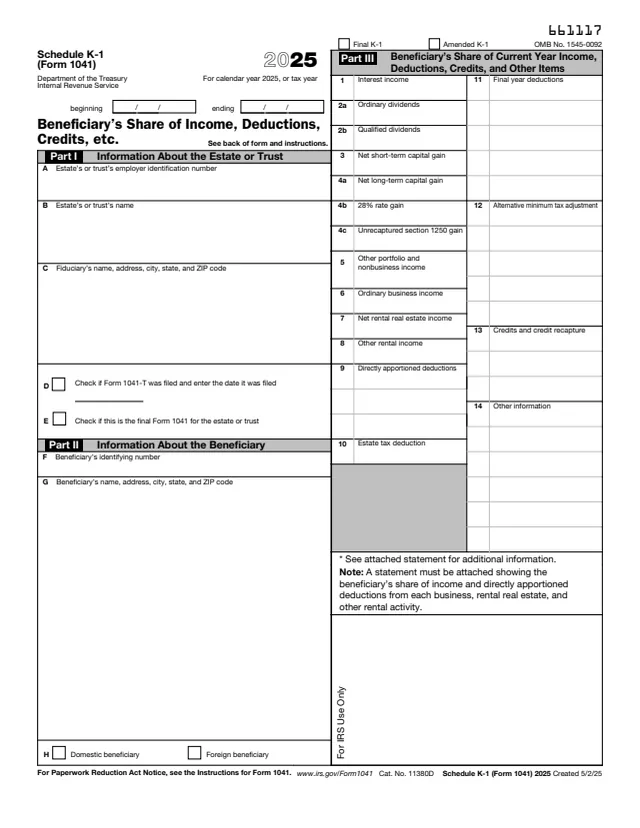
1041
74 fields, 2 pages
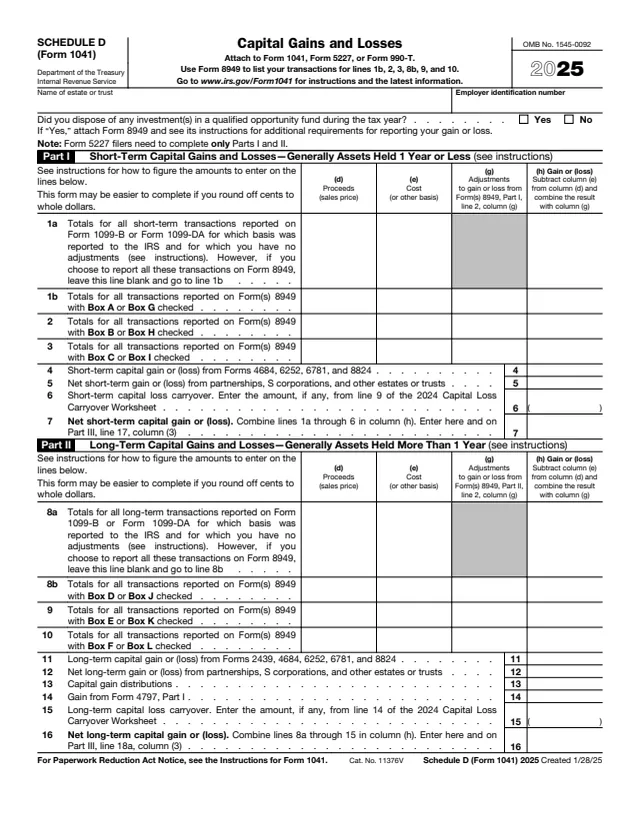
1041
87 fields, 2 pages
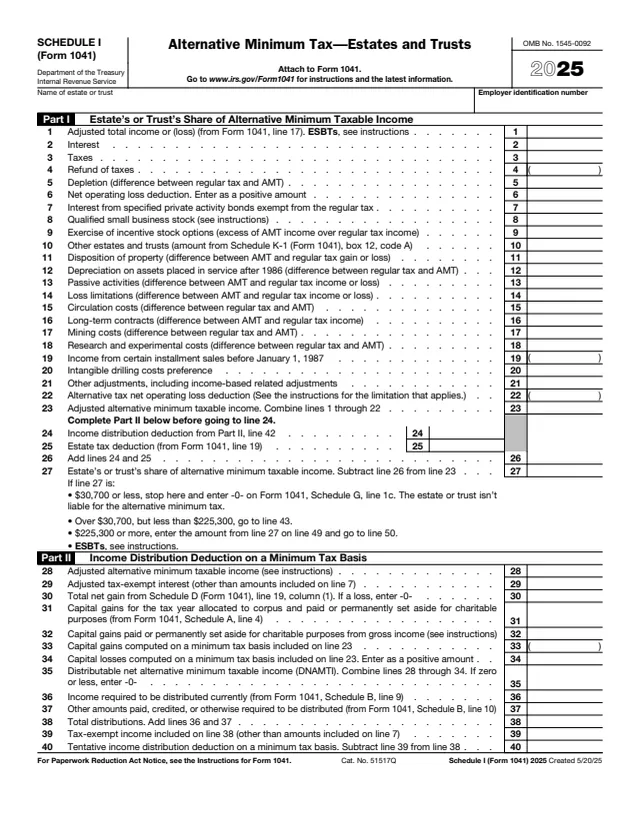
1041
85 fields, 3 pages
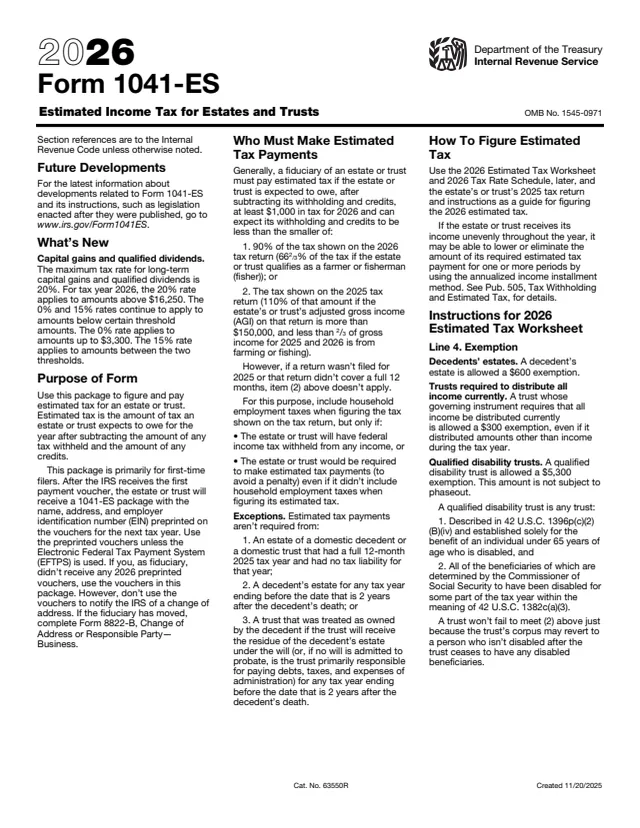
1041-ES
116 fields, 7 pages
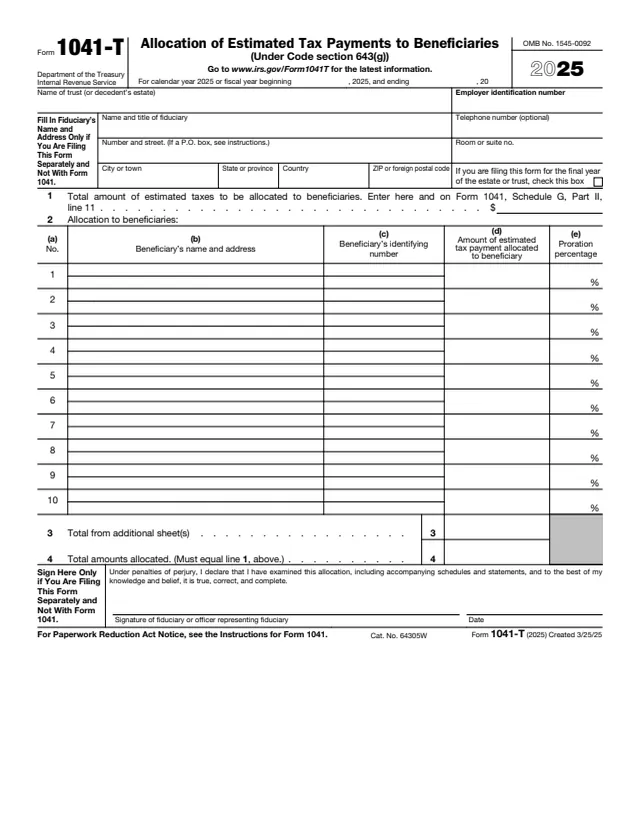
1041-T
57 fields, 2 pages
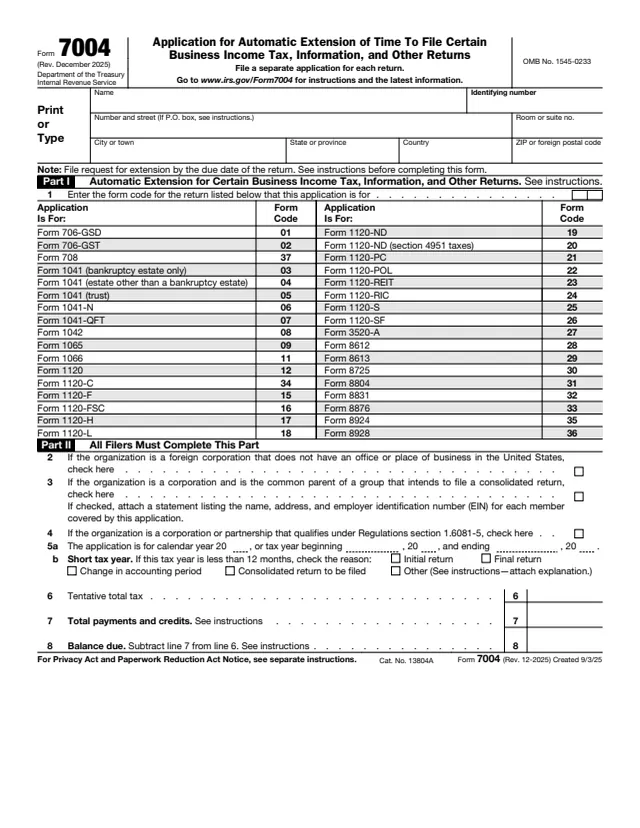
7004
26 fields, 1 page
The return is filed by the fiduciary of an estate or trust, not by the beneficiaries. The instructions say a fiduciary is a trustee of a trust, or an executor, administrator, personal representative or person in possession of property of a decedent's estate.
No tool matches that search.
The About page says the fiduciary of a domestic decedent's estate, trust, or bankruptcy estate files it. Beneficiaries receive Schedule K-1 (Form 1041) instead.
The instructions say April 15, 2026, for calendar year estates and trusts, and the 15th day of the 4th month after the tax year closes for fiscal-year ones.
The instructions say the beneficiary, and not the trust or decedent's estate, pays income tax on their distributive share of income.
The instructions say a decedent's estate is allowed a $600 exemption on line 21. Trusts get $300, $5,100 or $100 depending on their type.
The instructions say a revocable living trust is treated as a grantor type trust and point to the Optional Filing Methods for Certain Grantor Type Trusts.
No. The instructions say that if there are joint fiduciaries, only one is required to sign the return.