Part I: the estate or trust
Items A to E: the estate's or trust's EIN and name, the fiduciary's name and address, a box to show Form 1041-T was filed and its date, and a box for the final Form 1041.
1041
Beneficiary's Share of Income, Deductions, Credits, etc.
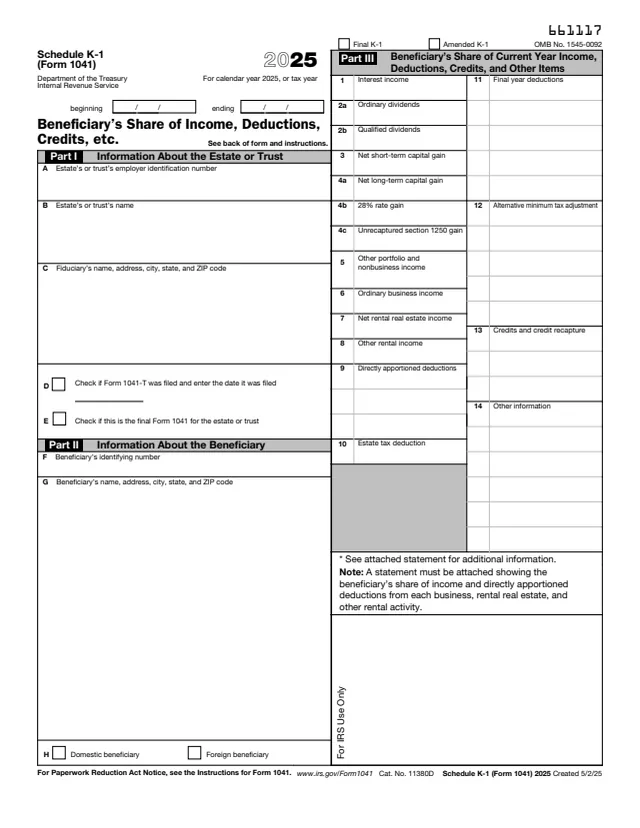
Schedule K-1 (Form 1041) reports a beneficiary's share of the income, deductions, credits and other items of a trust or a decedent's estate. The Instructions for Form 1041 say the fiduciary, or one of the joint fiduciaries, files it: a copy of each beneficiary's Schedule K-1 is attached to the Form 1041 filed with the IRS, and each beneficiary is given a copy of their own.
The beneficiary then uses the amounts on their own return. The beneficiary instructions say to keep the schedule for your records and not to file it with your tax return, unless backup withholding was reported in box 13, code B. Page 2 of the schedule lists where a beneficiary who files Form 1040 or 1040-SR reports each box and code.
This page covers the 2025 schedule, for calendar year 2025 or the fiscal tax year entered at the top. You can fill out the PDF free in your browser on this page and download it without an account.
Items A to E: the estate's or trust's EIN and name, the fiduciary's name and address, a box to show Form 1041-T was filed and its date, and a box for the final Form 1041.
Items F to H: the beneficiary's identifying number, name and address, and whether the beneficiary is domestic or foreign.
Interest, ordinary and qualified dividends, net short-term and long-term capital gain, 28% rate gain, unrecaptured section 1250 gain, other portfolio and nonbusiness income, ordinary business income and rental income.
Directly apportioned depreciation, depletion and amortization, the estate tax deduction, and final year deductions such as excess deductions and capital loss or net operating loss carryovers.
Box 12 holds alternative minimum tax items with codes A to J, box 13 credits and credit recapture, and box 14 other information such as tax-exempt interest, foreign taxes and section 199A information.
A list of every box and code with the Form 1040 or 1040-SR line, schedule or worksheet where a beneficiary reports it, or a pointer to the beneficiary's instructions.
For a fiscal year or short tax year, fill in the tax year space at the top. Check Final K-1 if this is the final Schedule K-1 for the beneficiary, and Amended K-1 on an amended schedule.
Enter the name, address and identifying number of the estate or trust and the name and address of the fiduciary. Check item D and add the date if Form 1041-T was filed, and item E in the final year.
Complete one schedule for each beneficiary with their name, address and identifying number. The instructions allow truncating the number on the copy sent to the beneficiary, but not on the copy filed with the IRS.
Enter the beneficiary's share of each item of income, deduction and credit. The instructions say no negative amounts are shown for any class of income in boxes 1 through 8.
In box 9 and boxes 11 through 14, enter a code to the left of each amount. Add an asterisk after the code for an item with an attached statement, and STMT in the amount space when it can't be one dollar figure.
The Instructions for Form 1041 say each beneficiary is provided the Instructions for Schedule K-1 (Form 1041) for a Beneficiary Filing Form 1040 or 1040-SR, or other prepared instructions for each item.
These steps follow the fiduciary's instructions in the Instructions for Form 1041.
You get the real form, filled in a browser tab, with nothing standing between you and the finished PDF.
A copy of each beneficiary's Schedule K-1 is attached to the Form 1041 filed with the IRS, each beneficiary is given their copy, and one copy is kept for the fiduciary's records.
The Instructions for Form 1041 say Schedule K-1 is provided, on or before the day Form 1041 is required to be filed, to each beneficiary who receives a distribution of property or an allocation of an item of the estate.
The Instructions for Form 1041 say a $340 penalty may be imposed for each failure to provide Schedule K-1 when due or to include all required information, up to $4,098,500 for all such failures in a calendar year.
The beneficiary instructions say to keep it for your records and not to file it with your tax return, unless backup withholding was reported in box 13, code B. Then a copy is attached to the return.
A beneficiary who believes there is an error notifies the fiduciary and asks for an amended or corrected Schedule K-1, without changing items on their copy. Form 8082 covers treatment that differs from the estate's or trust's return.
No IRS approval is needed for a substitute that is an exact copy, with the same box numbers, titles, order and format, and the OMB number and six-digit form ID code in the upper right corner.
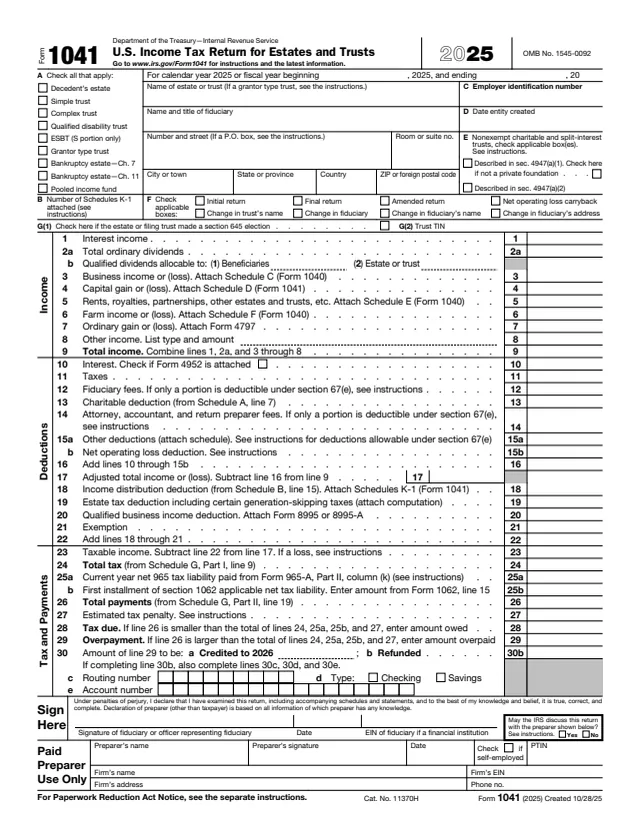
1041
173 fields, 3 pages
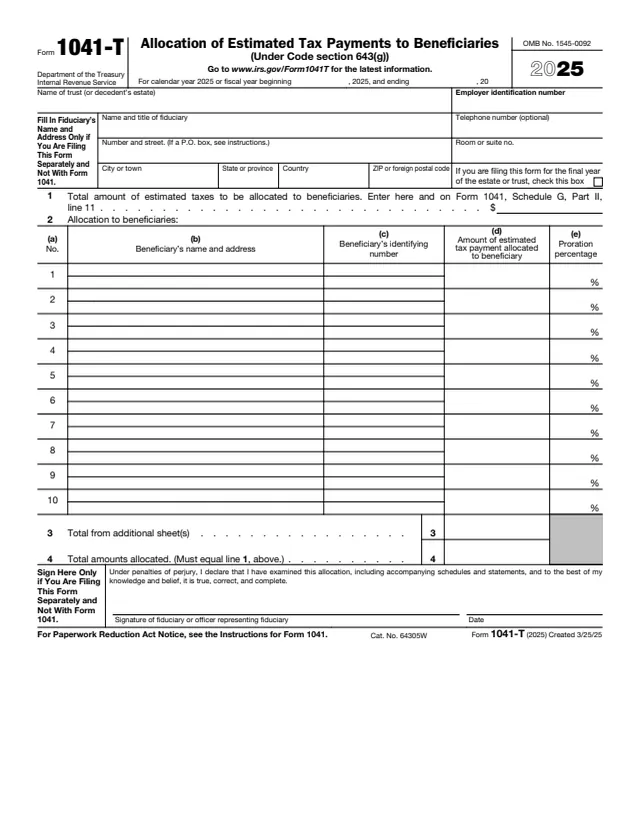
1041-T
57 fields, 2 pages
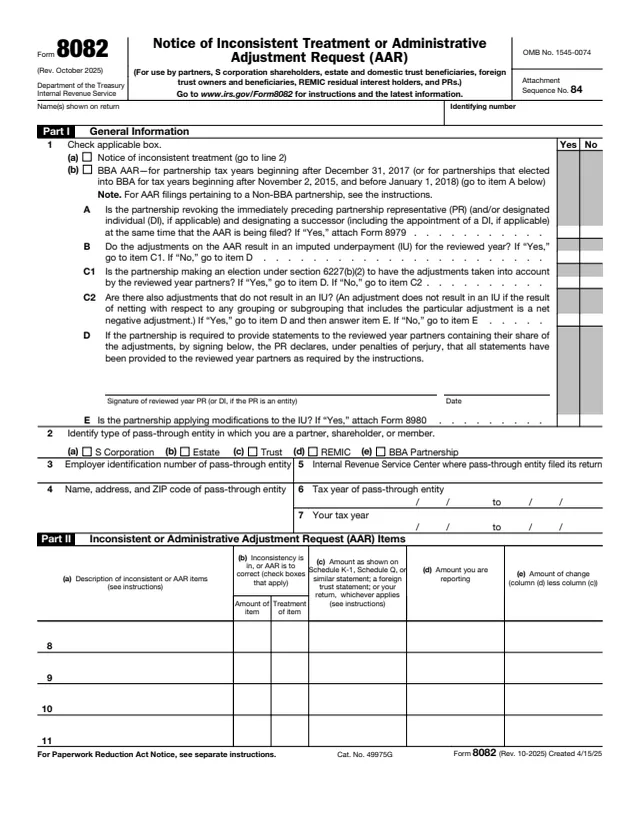
8082
59 fields, 2 pages
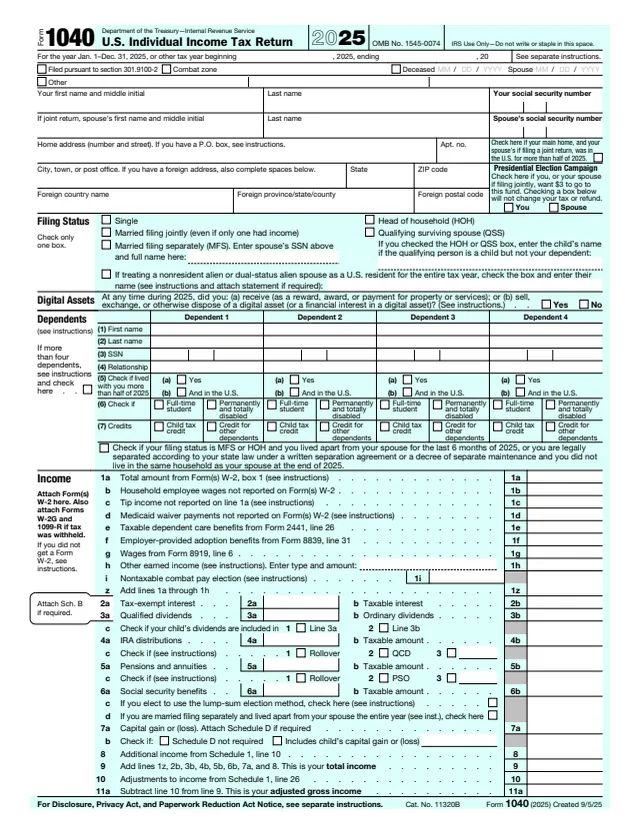
1040
199 fields, 2 pages
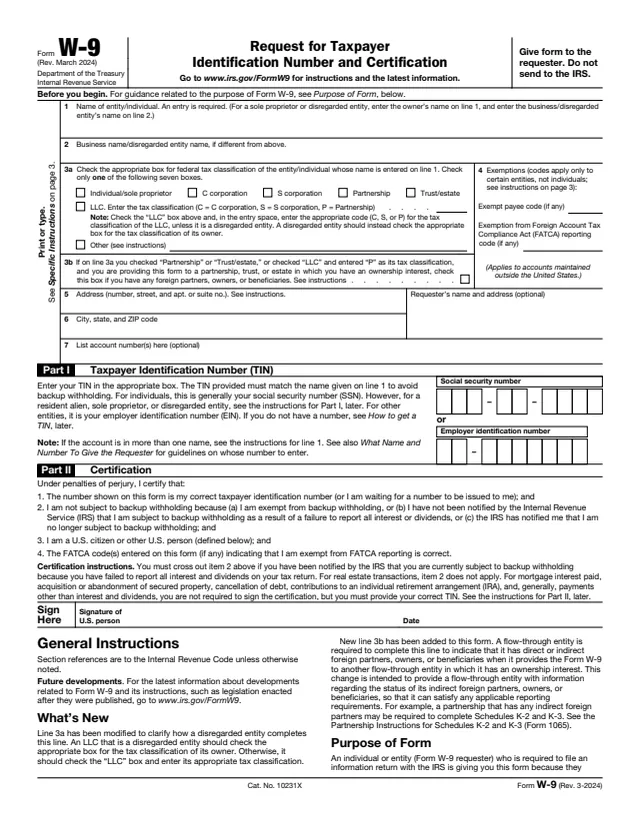
W-9
23 fields, 6 pages
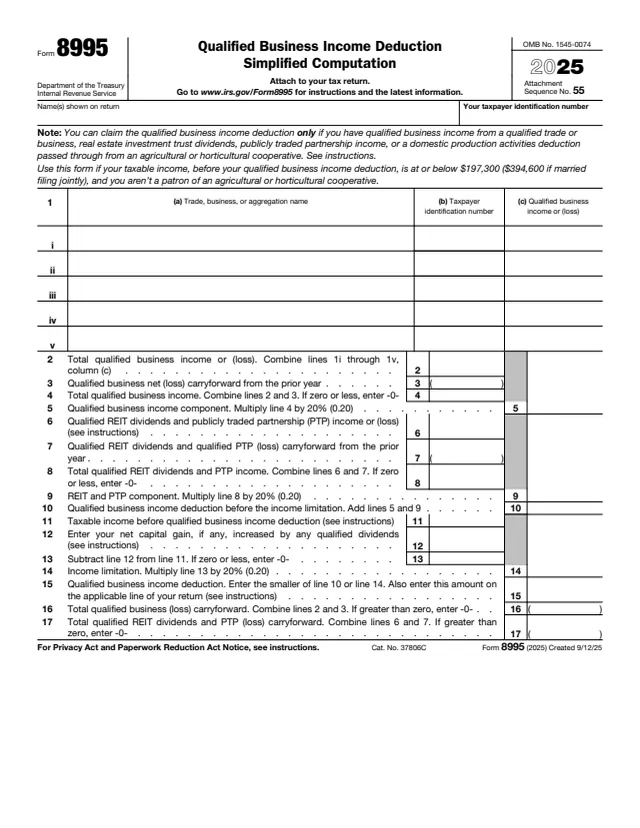
8995
33 fields, 1 page
The fiduciary of the estate or trust completes the schedule. Each beneficiary receives a copy and reads it when preparing their own return.
No tool matches that search.
The fiduciary of the estate or trust. The Instructions for Form 1041 say the fiduciary, or one of the joint fiduciaries, files it with Form 1041 and gives each beneficiary a copy.
The beneficiary instructions say to keep it for your records and not to file it with your return, unless backup withholding was reported in box 13, code B. In that case a copy is attached.
The beneficiary instructions say the schedule may show only the last four digits of your identifying number, but the estate or trust has reported the complete number to the IRS.
The beneficiary instructions say to notify the fiduciary and ask for an amended or corrected Schedule K-1, and not to change any items on your copy. If no agreement is reached, they point to Form 8082.
The beneficiary instructions say a checked item E means this is the final year of the estate or trust, and a checked Final K-1 box means this is the final return for the beneficiary.
The fiduciary attached a statement with more information for that item. An asterisk after the code also marks an item with an attached statement.