Header and note
The name or names shown on the return, the taxpayer identification number, and a note on what income qualifies and who uses this form.
8995
Qualified Business Income Deduction Simplified Computation
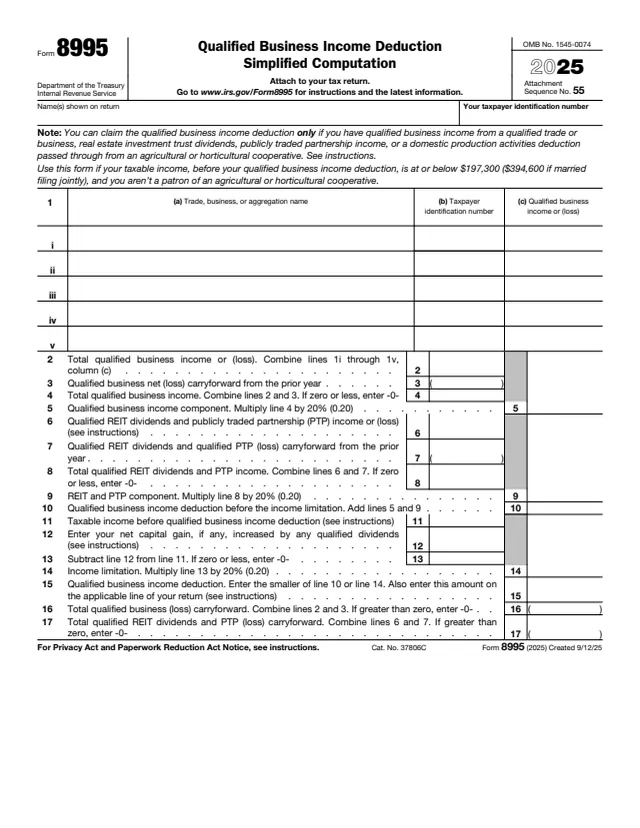
Form 8995, Qualified Business Income Deduction Simplified Computation, is used to figure the qualified business income (QBI) deduction. This is the 2025 form, and it is attached to the tax return.
The instructions say individuals and some trusts and estates may be entitled to a deduction of up to 20% of their net QBI from a trade or business, including income from a pass-through entity but not from a C corporation, plus 20% of qualified real estate investment trust (REIT) dividends and qualified publicly traded partnership (PTP) income. The total deduction is limited to 20% of taxable income figured before the QBI deduction, minus net capital gain (increased by any qualified dividends).
The form says to use it if taxable income before the QBI deduction is at or below $197,300 ($394,600 if married filing jointly) and the filer isn't a patron of an agricultural or horticultural cooperative. Otherwise the instructions point to Form 8995-A. You can fill out Form 8995 free in your browser on this page and download the result without an account.
The name or names shown on the return, the taxpayer identification number, and a note on what income qualifies and who uses this form.
Five rows, i through v, each with (a) trade, business or aggregation name, (b) taxpayer identification number and (c) qualified business income or (loss).
Total QBI, the qualified business net (loss) carryforward from the prior year, the combined total, and 20% (0.20) of that total.
Qualified REIT dividends and PTP income or (loss), the prior-year (loss) carryforward, the combined total, and 20% (0.20) of it.
The deduction before the income limitation, taxable income before the QBI deduction, net capital gain plus qualified dividends, the 20% income limitation, and the deduction itself.
The total qualified business (loss) carryforward and the total qualified REIT dividends and PTP (loss) carryforward to the next year.
Enter each trade or business, its EIN (or SSN or ITIN if there is no EIN) and its net QBI or loss. The instructions say an aggregation is entered by group name, such as Aggregation 1, with 1(b) left blank and Schedule B (Form 8995-A) attached.
Combine line 1 column (c). The instructions say to attach a statement for more than five businesses. Line 3 holds the qualified portion of a prior loss carryforward. Line 4 is zero if zero or less, and line 5 is 20% of line 4.
Enter qualified REIT dividends and PTP income as a positive number and losses as a negative number. The instructions say qualified REIT dividends are reported on Form 1099-DIV, line 5. Line 9 is 20% of line 8.
Add lines 5 and 9. Enter taxable income figured before any QBI deduction on line 11, as the instructions describe, and net capital gain increased by qualified dividends on line 12. Line 14 is 20% of line 13.
Enter the smaller of line 10 or line 14. The instructions say this goes on Form 1040, 1040-SR or 1040-NR, line 13a, or Form 1041, line 20, among other returns.
Combine lines 2 and 3, and lines 6 and 7, entering zero if the result is greater than zero. The instructions say these losses carry forward to offset QBI or REIT and PTP income in later years.
You get the real form, filled in a browser tab, with nothing standing between you and the finished PDF.
The form says to attach it to your tax return. Line 15 carries the deduction to the return.
The instructions point to Form 8995-A when taxable income before the QBI deduction is above $197,300 ($394,600 if married filing jointly) or the filer is a patron in a specified agricultural or horticultural cooperative.
The IRS About page lists "Corrections to the instructions on how to calculate the taxable income before QBI deduction for Form 8995" dated 13-FEB-2026. That is the figure entered on line 11.
The instructions list items not included, such as wage income (except statutory employees), reasonable compensation from an S corporation, guaranteed payments, capital gains or losses, dividends, qualified REIT dividends and qualified PTP income.
The instructions say the Form 8995 for an ESBT's S portion is attached as a PDF to the ESBT tax worksheet filed with Form 1041, with "ESBT" written in the top margin.
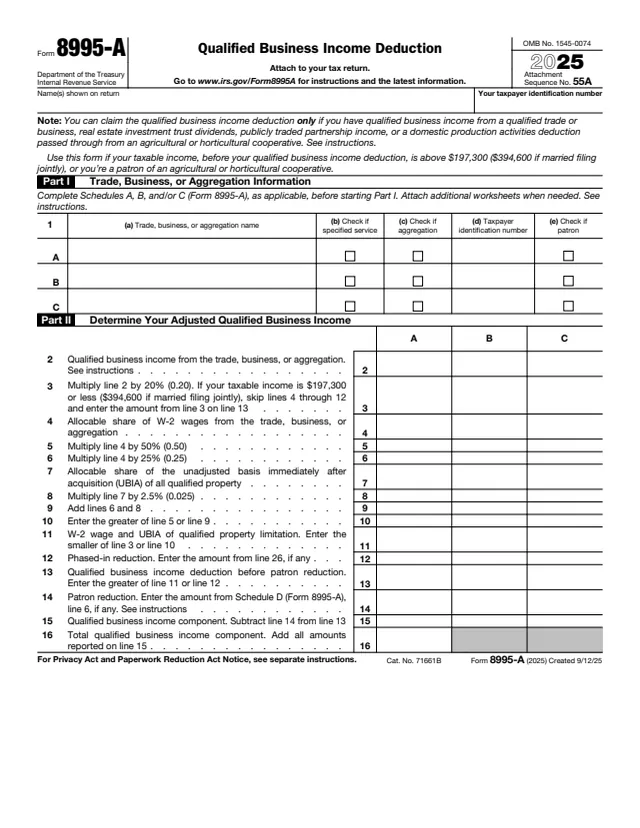
8995-A
111 fields, 2 pages
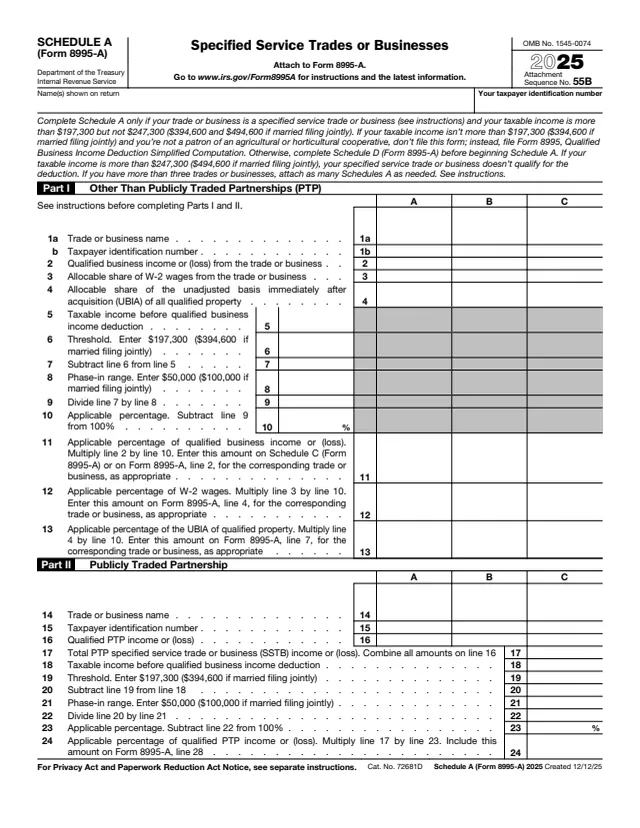
8995-A
67 fields, 1 page
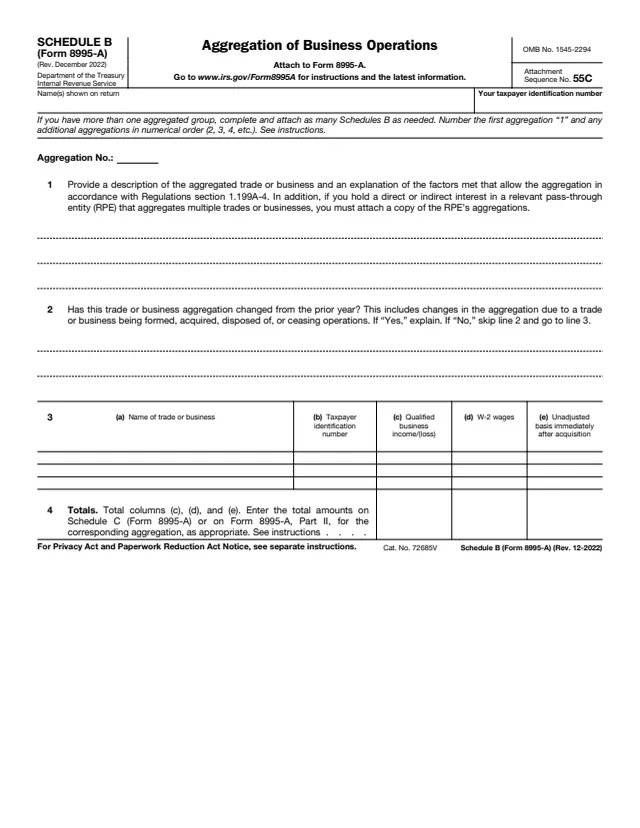
8995-A Sch. B
27 fields, 1 page
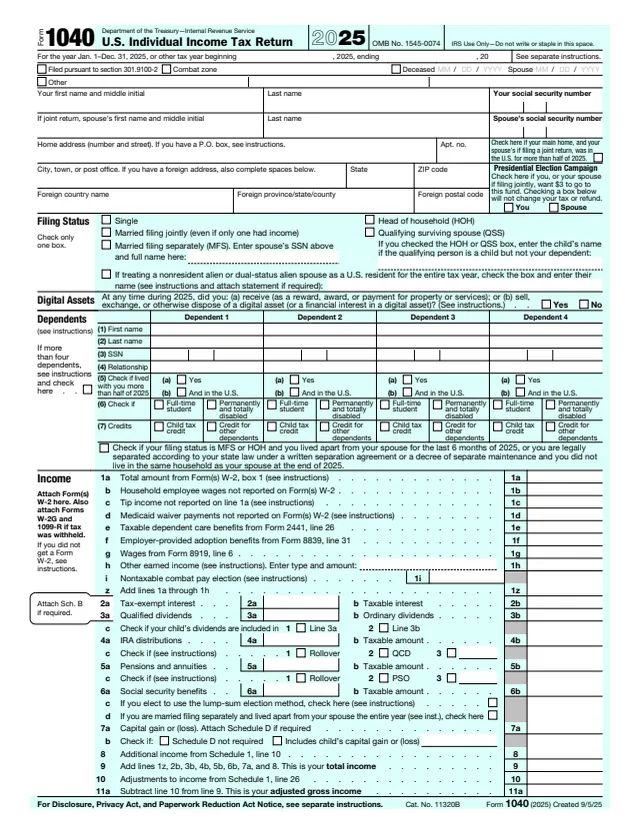
1040
199 fields, 2 pages
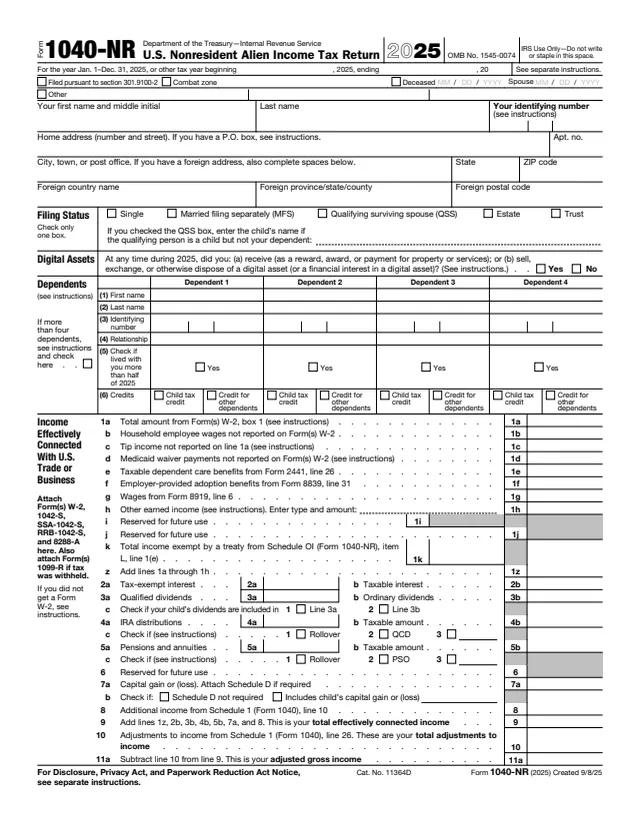
1040-NR
171 fields, 2 pages
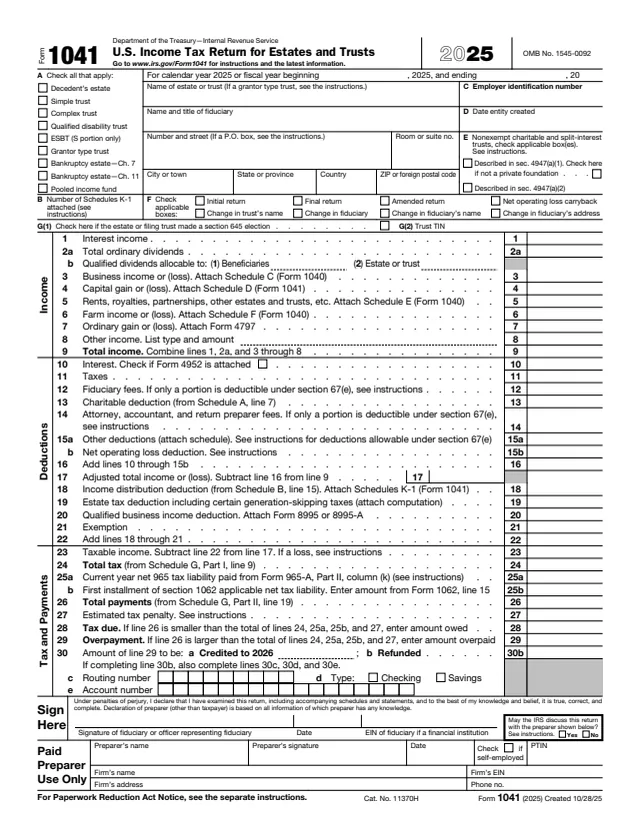
1041
173 fields, 3 pages
The instructions say individuals and eligible estates and trusts that have QBI use Form 8995 when the conditions below are met.
No tool matches that search.
The instructions say individuals and eligible estates and trusts with QBI, qualified REIT dividends or qualified PTP income, whose 2025 taxable income before the QBI deduction is $197,300 or less ($394,600 if married filing jointly), and who aren't patrons in a specified agricultural or horticultural cooperative.
The instructions say to use Form 8995-A, Qualified Business Income Deduction, instead.
The instructions describe up to 20% of net QBI plus 20% of qualified REIT dividends and qualified PTP income, limited to 20% of taxable income before the QBI deduction minus net capital gain (increased by qualified dividends).
No. The instructions say they aren't eligible, but pass the needed information to shareholders or partners on an attachment to Schedule K-1.
The instructions say amounts in Form W-2, box 1, aren't QBI, except when the Statutory Employee box in box 13 is checked.
The instructions name Form 1040, 1040-SR or 1040-NR, line 13a, and Form 1041, line 20, along with lines on Forms 1041-N and 990-T and the ESBT worksheet.
The instructions say a qualified business net loss for the year is carried forward to the next year on line 16, and it will offset QBI in later years even if the business that generated it no longer exists.