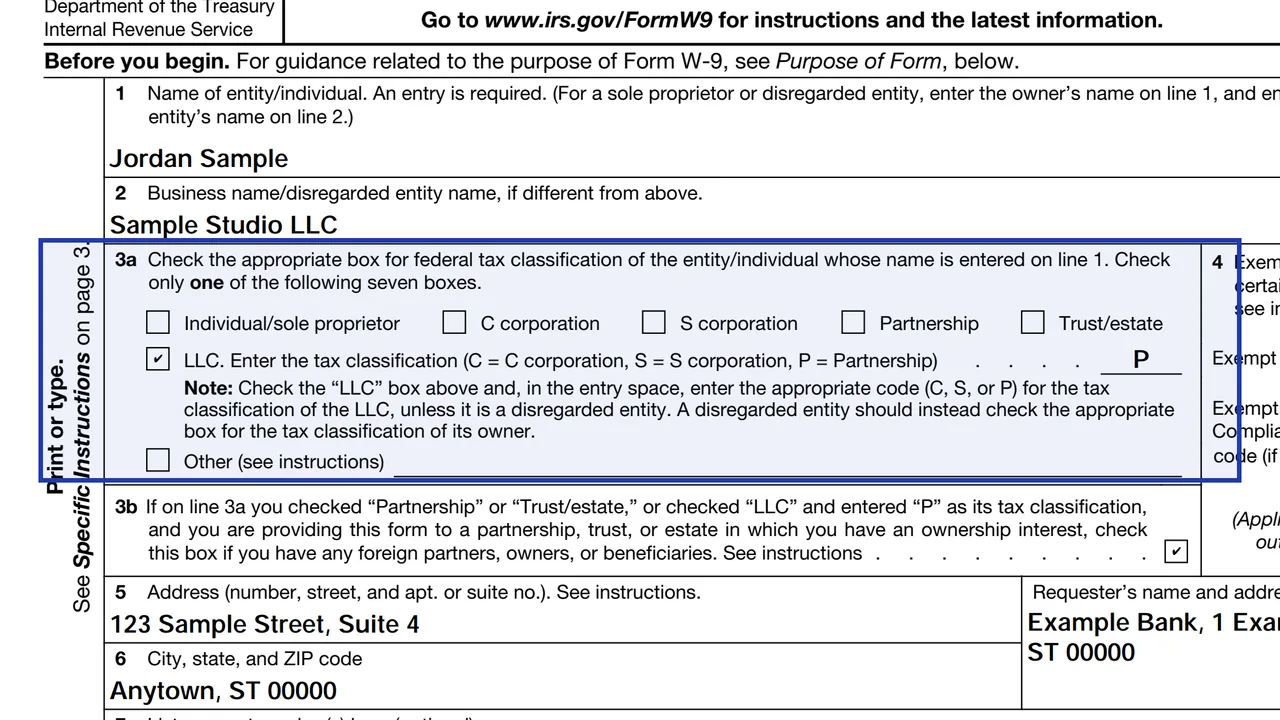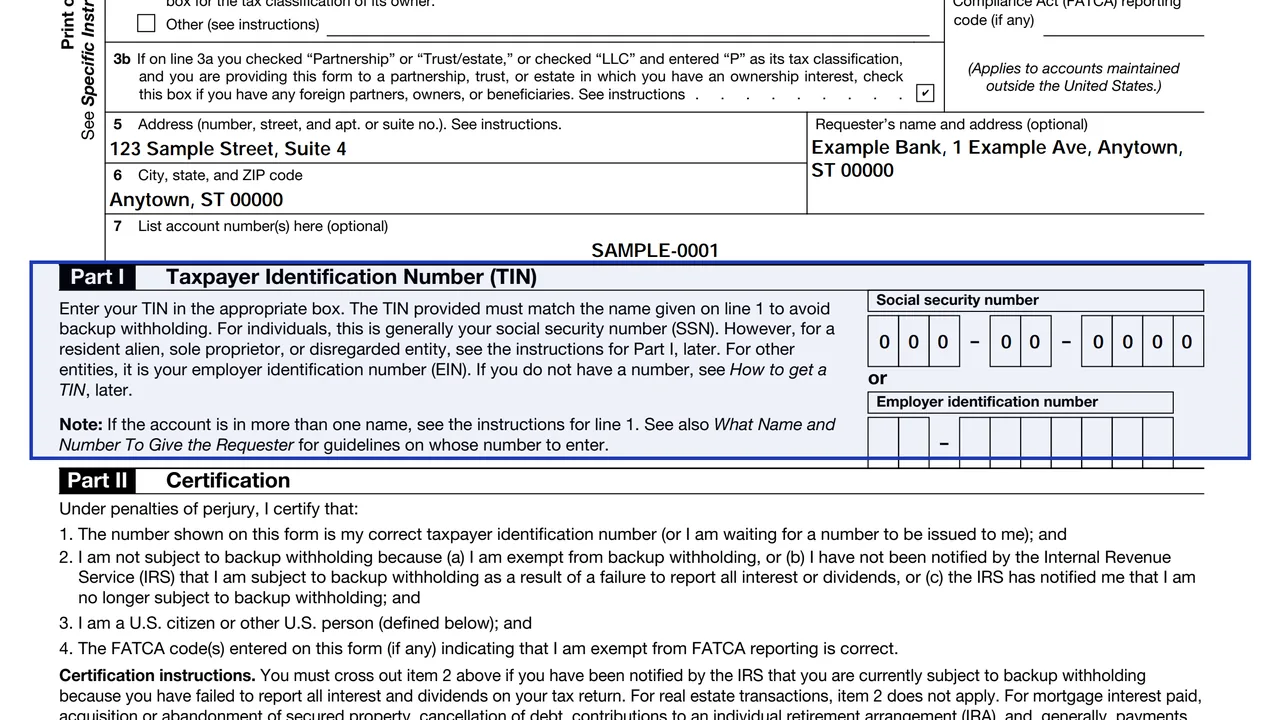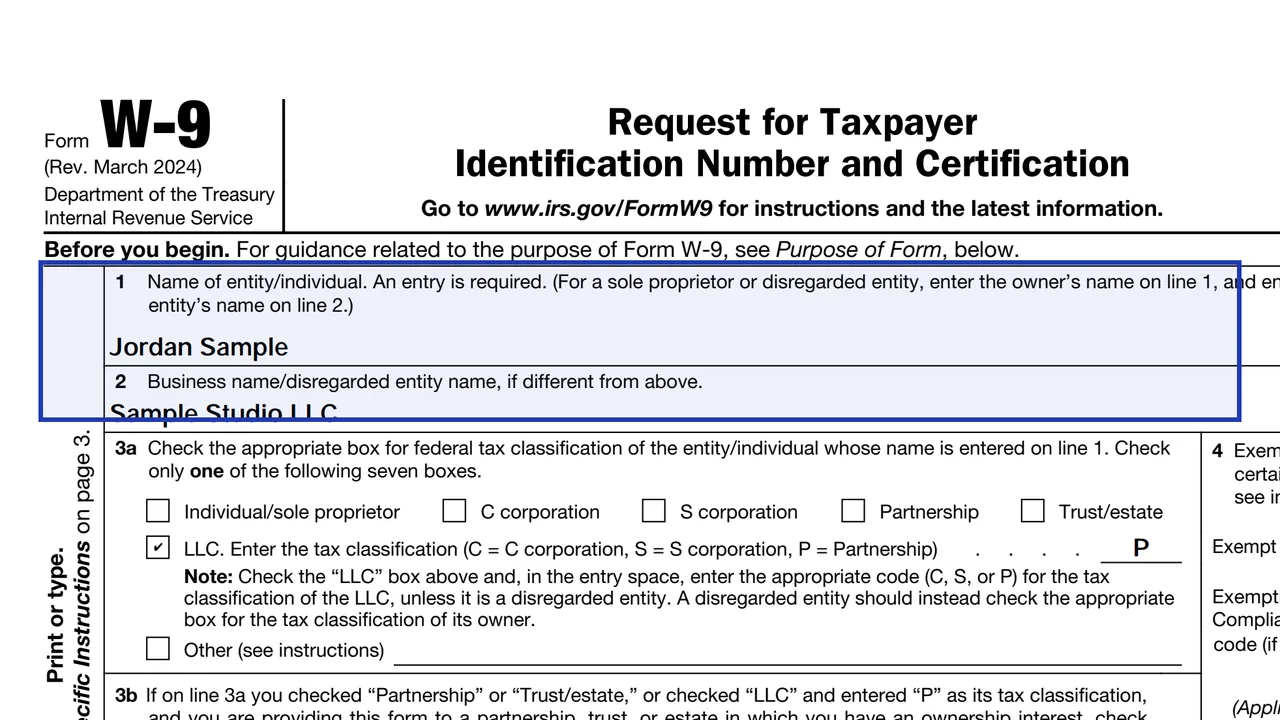
Lines 1 and 2: name
Line 1 is required and holds the name that matches your tax return. Line 2 holds a business, trade, DBA or disregarded entity name if you have one.
W-9
Request for Taxpayer Identification Number and Certification
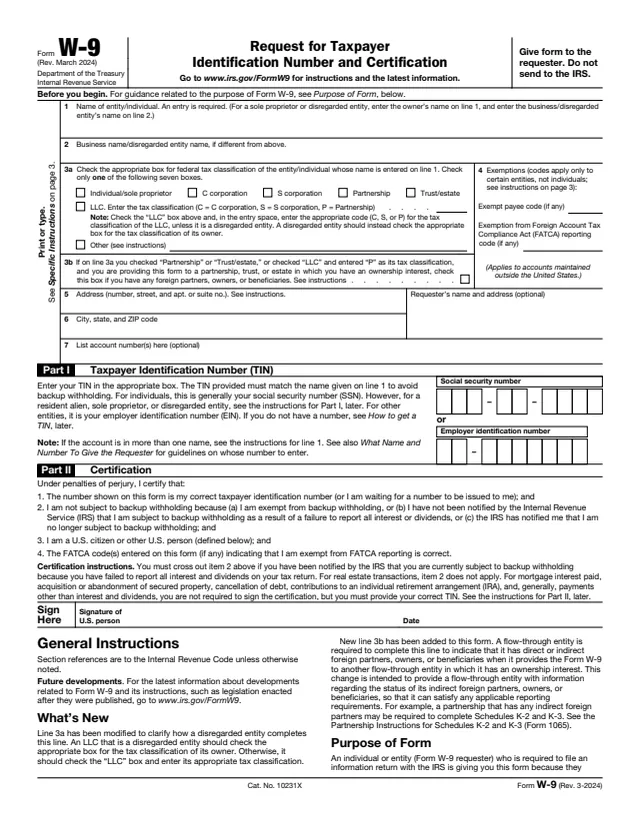
Form W-9 is how you give your correct taxpayer identification number (TIN) to a person or company that has to report payments to you on an information return. The TIN can be a Social Security number (SSN), an individual taxpayer identification number (ITIN), an adoption taxpayer identification number (ATIN) or an employer identification number (EIN). The IRS lists examples such as Form 1099-NEC for contractor pay, 1099-INT for interest, 1099-DIV for dividends, 1099-S for real estate sales and 1098 for mortgage interest.
You usually see this form when you start freelance or contract work, open an interest-bearing or brokerage account, or sell property. The company that asks for it is called the requester. You give the completed form to the requester. The form says "Do not send to the IRS."
If you do not give the requester a correct TIN, the payments you receive can be subject to backup withholding. The form is for U.S. persons only. You can fill it out free in your browser on this page and download the result without an account.
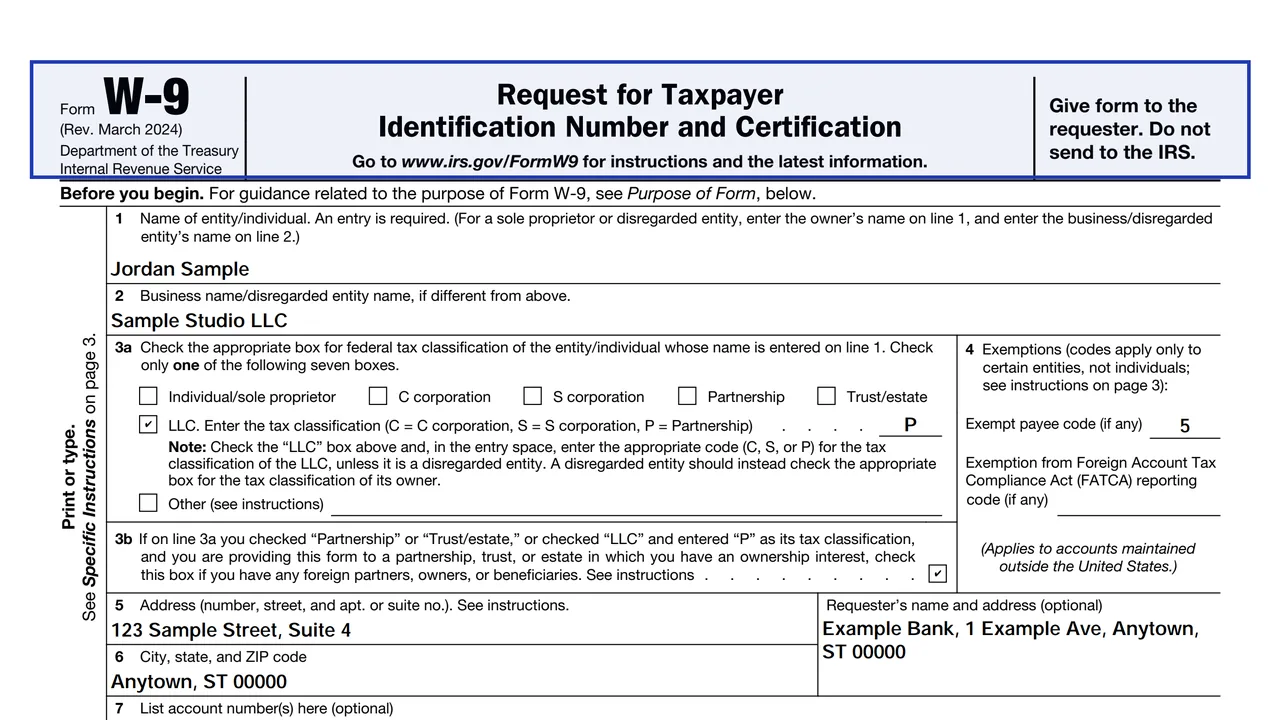
Line 1 is required and holds the name that matches your tax return. Line 2 holds a business, trade, DBA or disregarded entity name if you have one.
Seven boxes: individual/sole proprietor, C corporation, S corporation, partnership, trust/estate, LLC with a tax code, and other. You check only one.
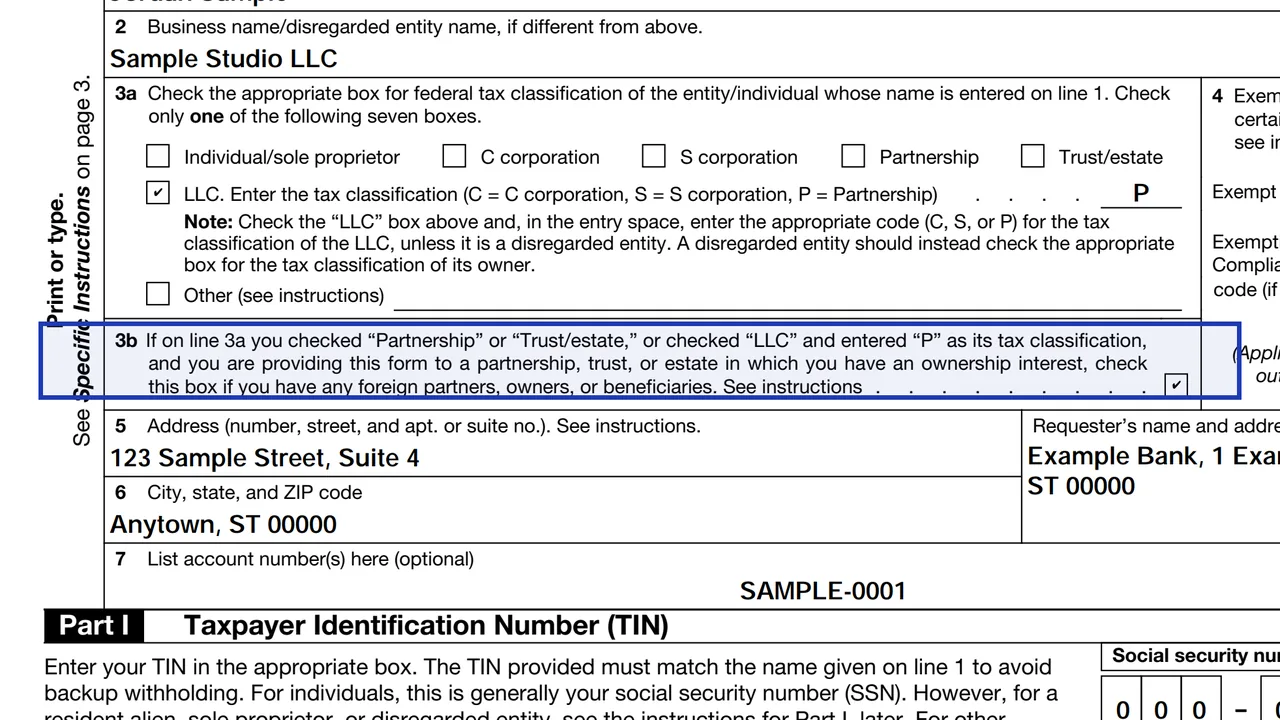
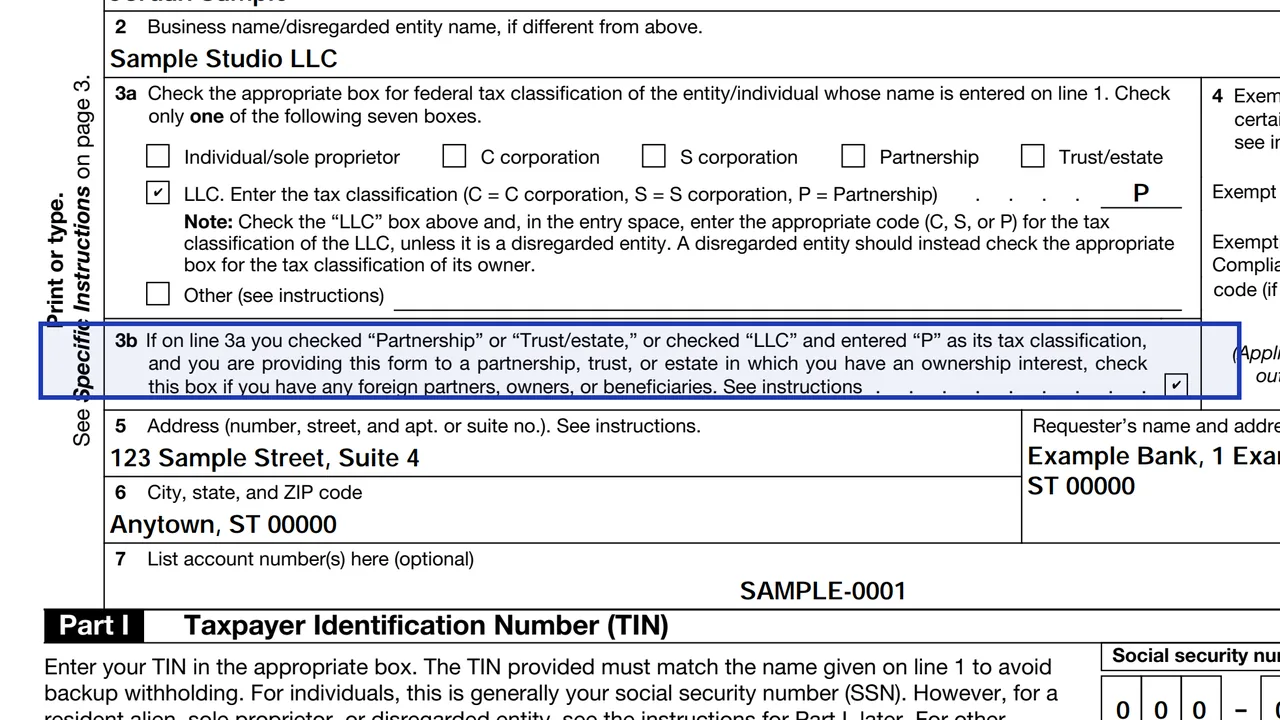
Added in the March 2024 revision. Partnerships, trusts and estates with foreign partners, owners or beneficiaries check it when giving the form to a flow-through entity they have an interest in.
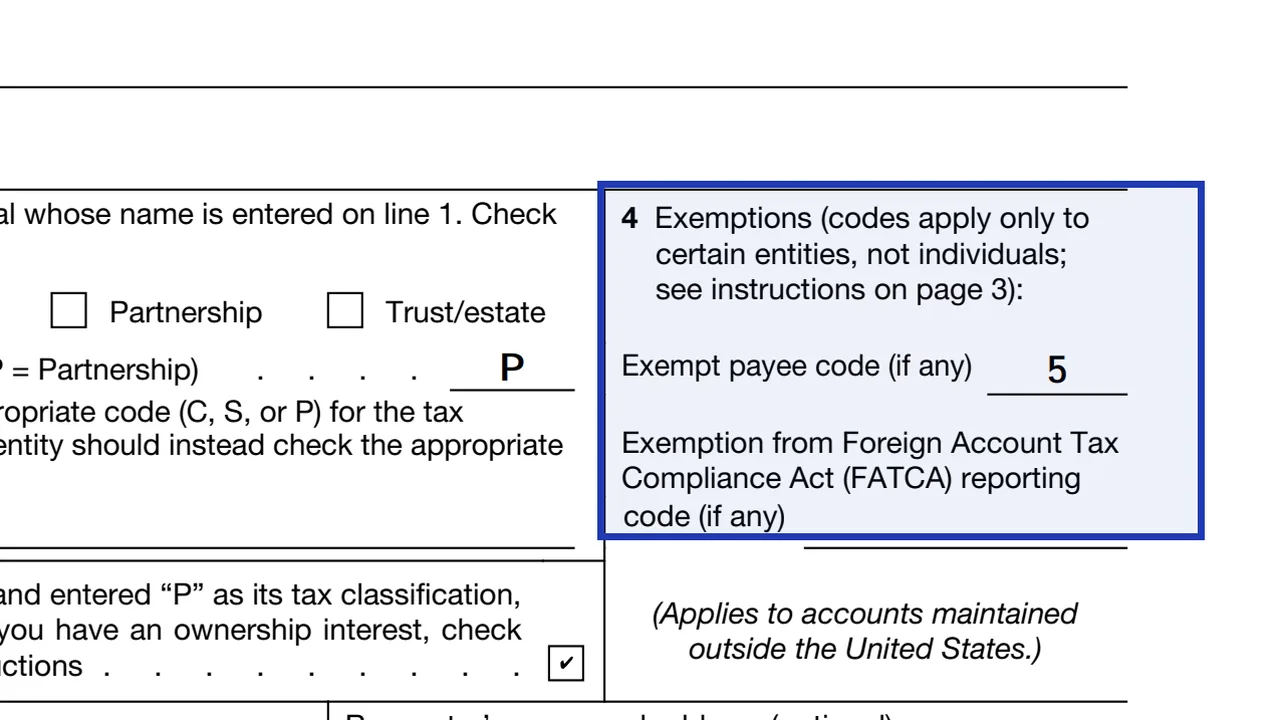
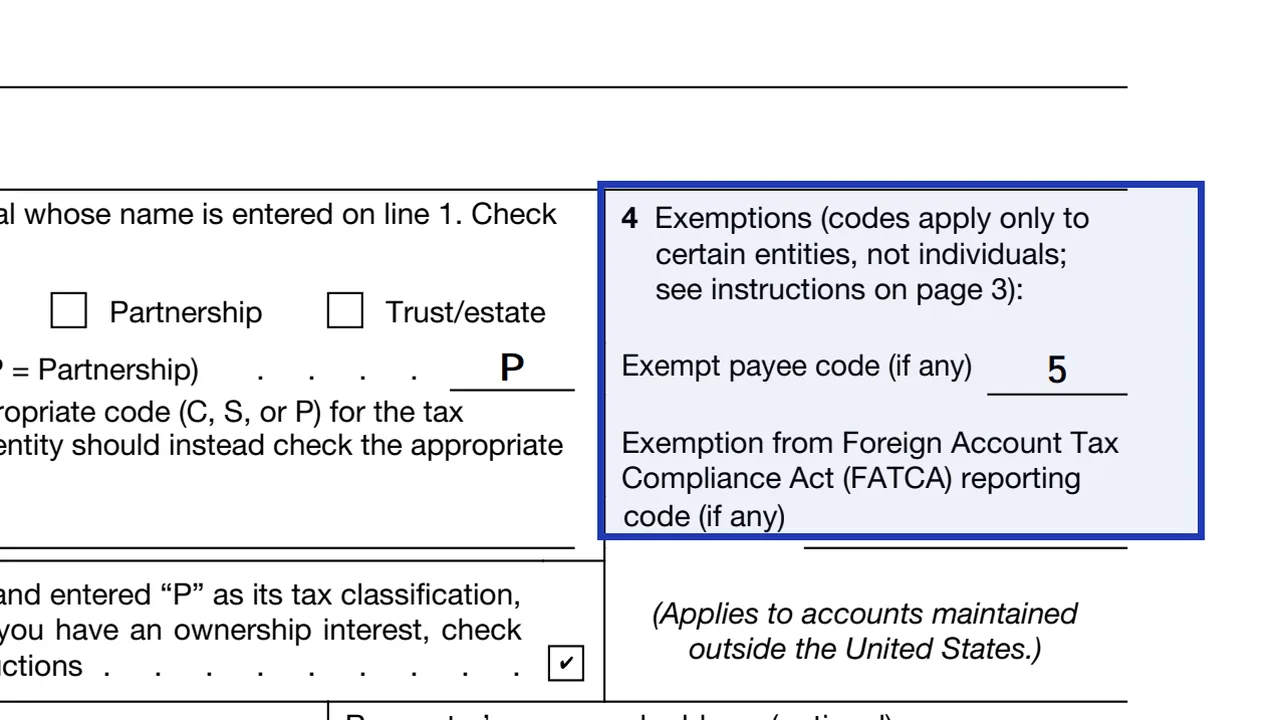
Spaces for an exempt payee code and a code for exemption from Foreign Account Tax Compliance Act (FATCA) reporting. Most individuals leave both blank.
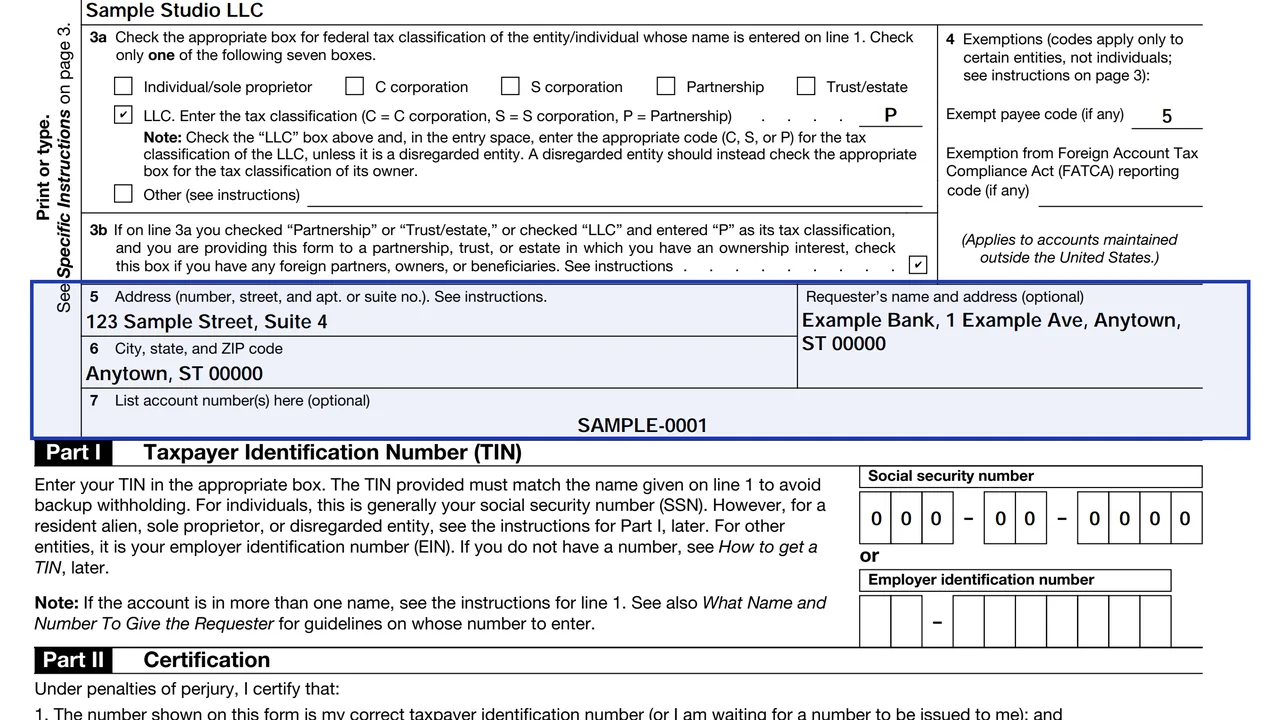
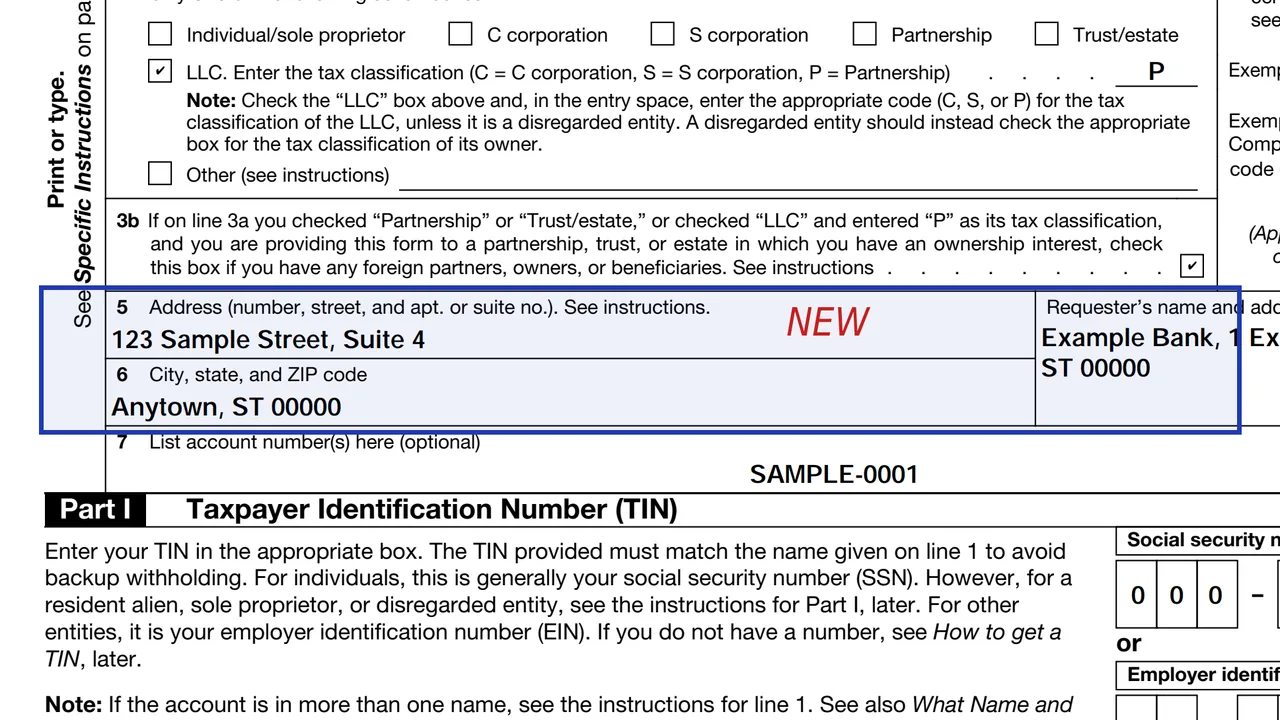
Your street address, your city, state and ZIP code, and an optional place for account numbers. The requester mails your information returns to this address.
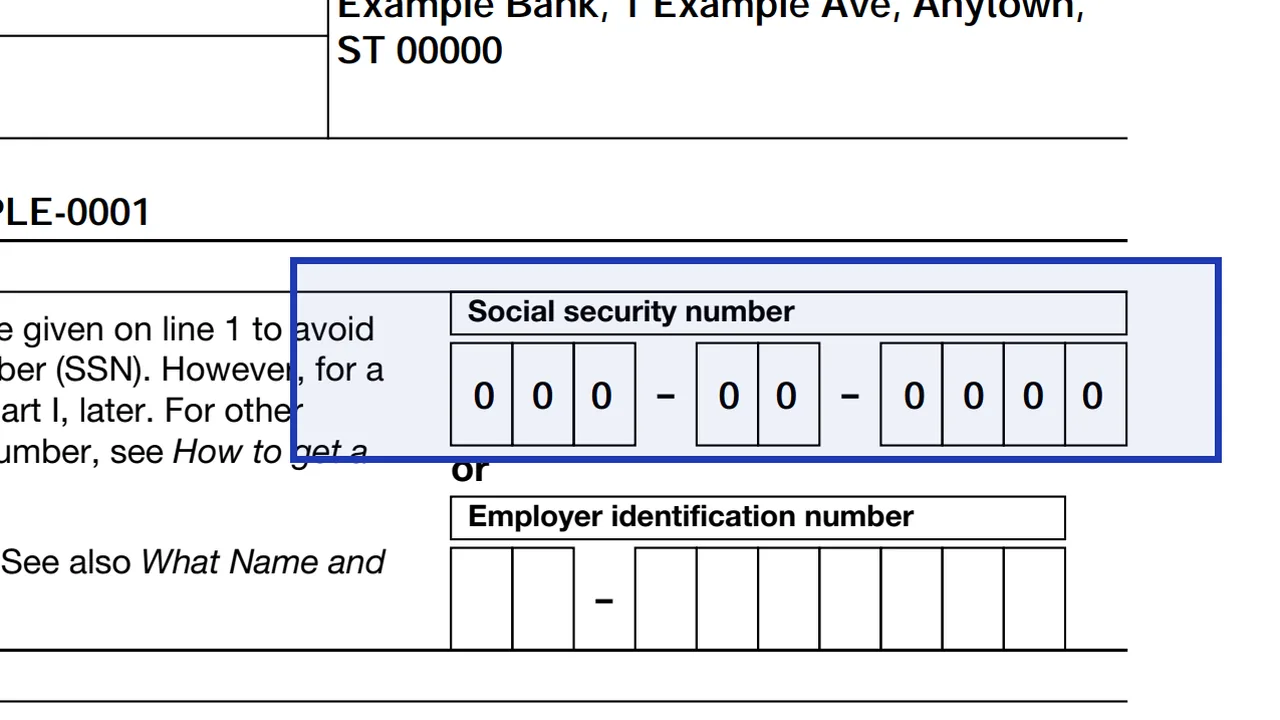
Two boxes: one for a Social Security number and one for an employer identification number. You fill in the one that applies to the name on line 1.
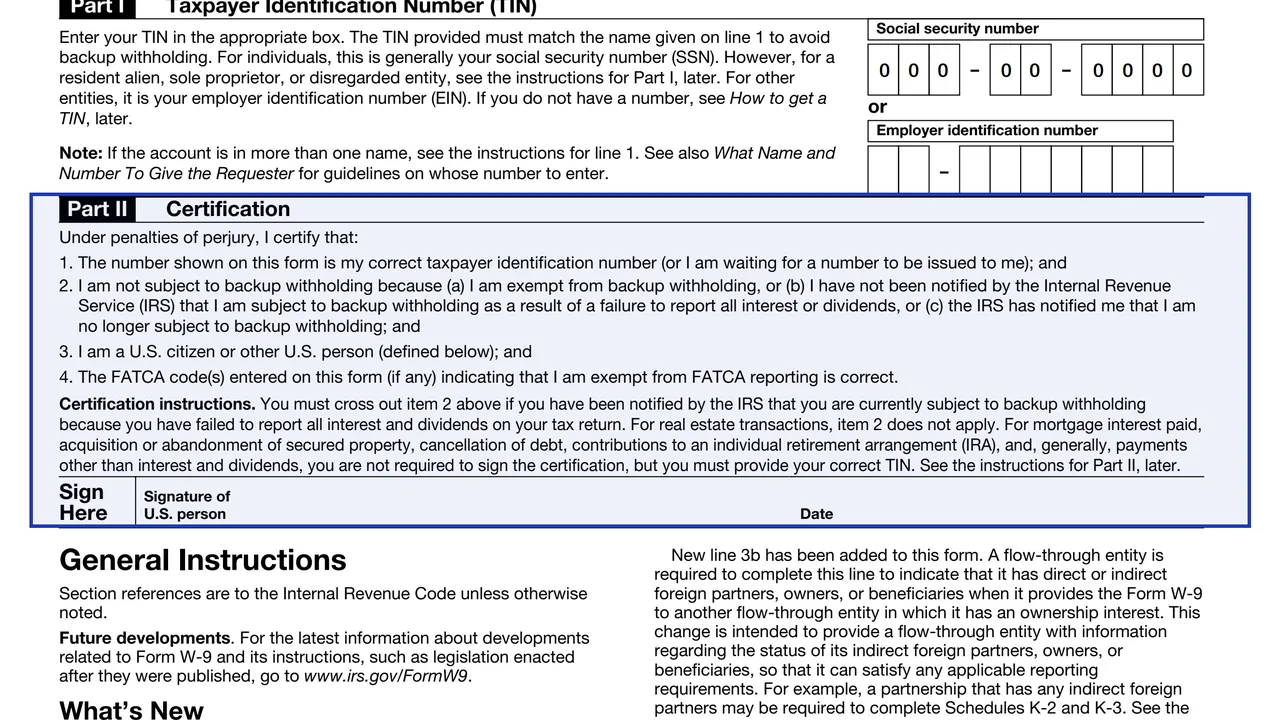
Four statements made under penalties of perjury, followed by the signature and date. They cover your TIN, backup withholding, U.S. person status and any FATCA code you entered.
Enter the name on your tax return and do not leave it blank. A sole proprietor enters their own name as it appears on Form 1040. A single-member LLC that is disregarded enters its owner's name here, never the LLC's name.
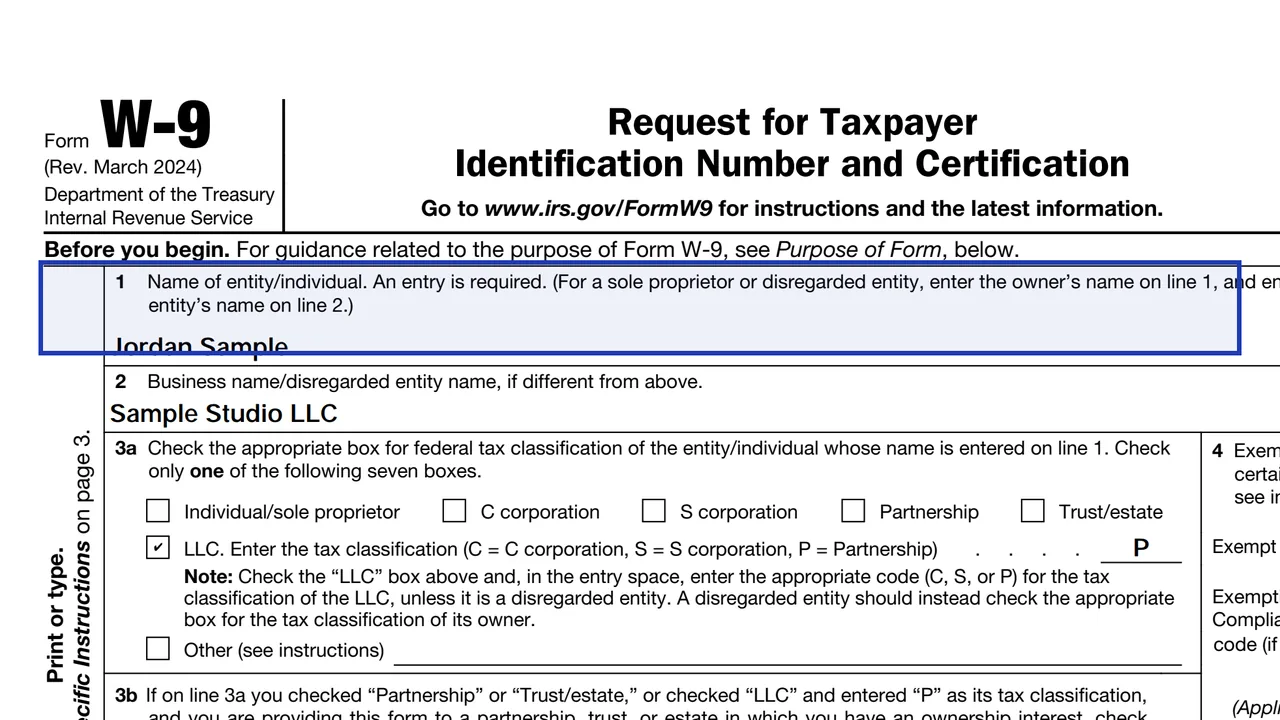
Enter your business name, trade name, DBA or the disregarded entity's name if it differs from line 1. Skip it if you have none.
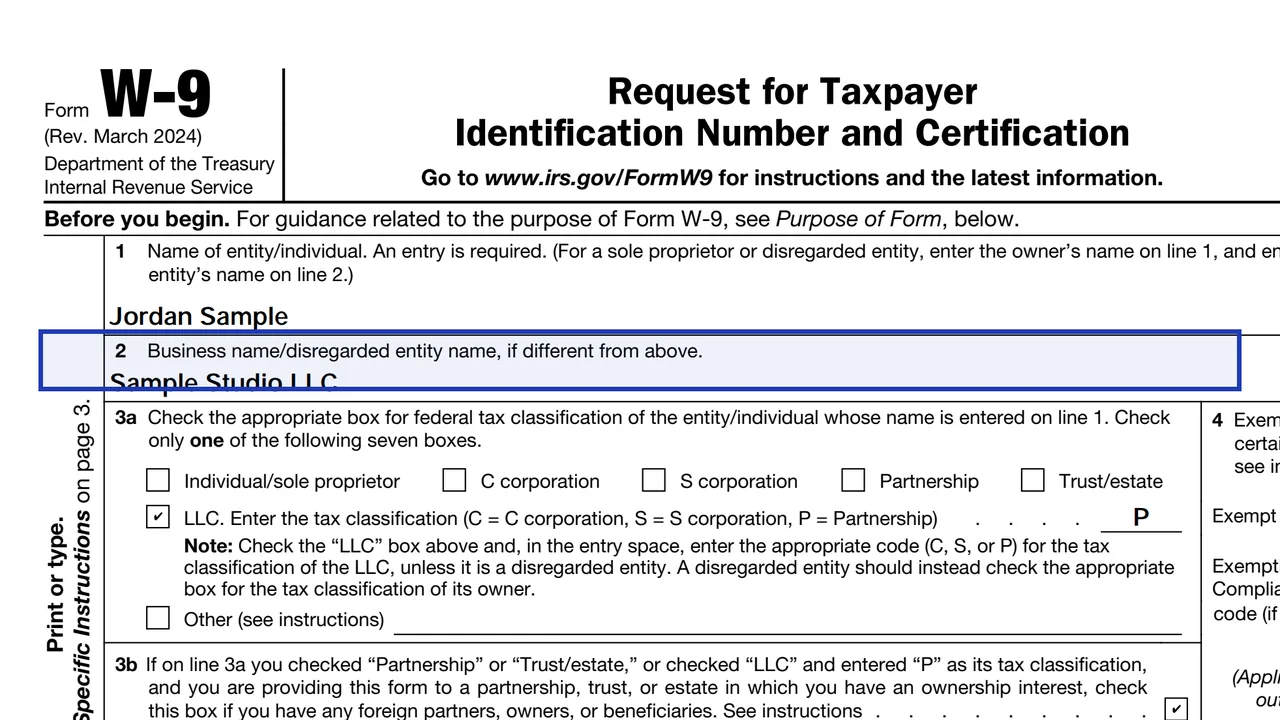
Check one box for the federal tax classification of the person named on line 1. An LLC taxed as a partnership or corporation checks the LLC box and enters P, C or S. A disregarded LLC checks the box for its owner's classification.
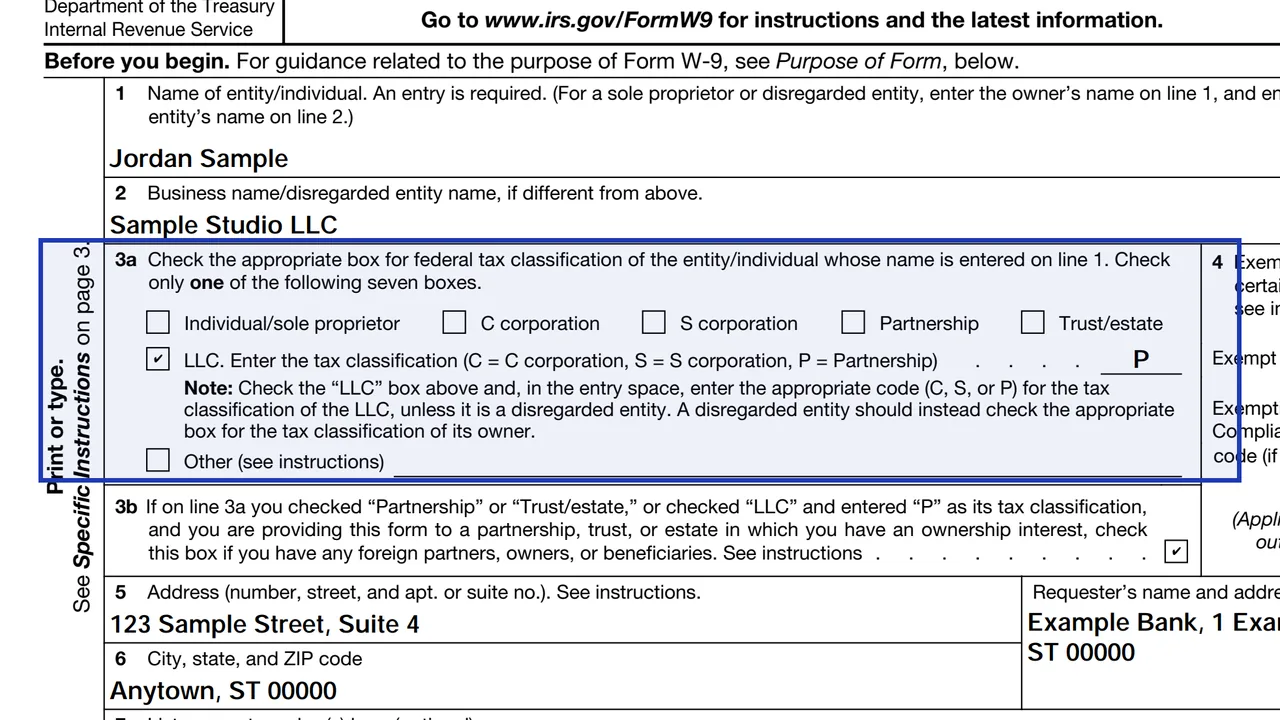
Check it only if you are a partnership, trust or estate (or an LLC taxed as a partnership) with foreign partners, owners or beneficiaries, and you are giving this form to an entity in which you have an ownership interest. Otherwise leave it empty.
Individuals and sole proprietors are generally not exempt from backup withholding, so leave it blank. A corporation may enter exempt payee code 5. The form says to ask the requester whether codes should be filled in.
Enter your street address, then city, state and ZIP code. If the address differs from the one the requester has on file, write NEW at the top.
Enter your SSN or EIN so it matches the name on line 1. A resident alien without an SSN enters an ITIN in the SSN boxes. A sole proprietor with an EIN may enter either number. A single-member LLC that is disregarded enters its owner's number. An LLC taxed as a corporation or partnership enters its own EIN.
Sign and date. Cross out item 2 of the certification only if the IRS has told you that you are currently subject to backup withholding for failing to report all interest and dividends. For payments other than interest and dividends, you give a correct TIN but generally do not need to sign.
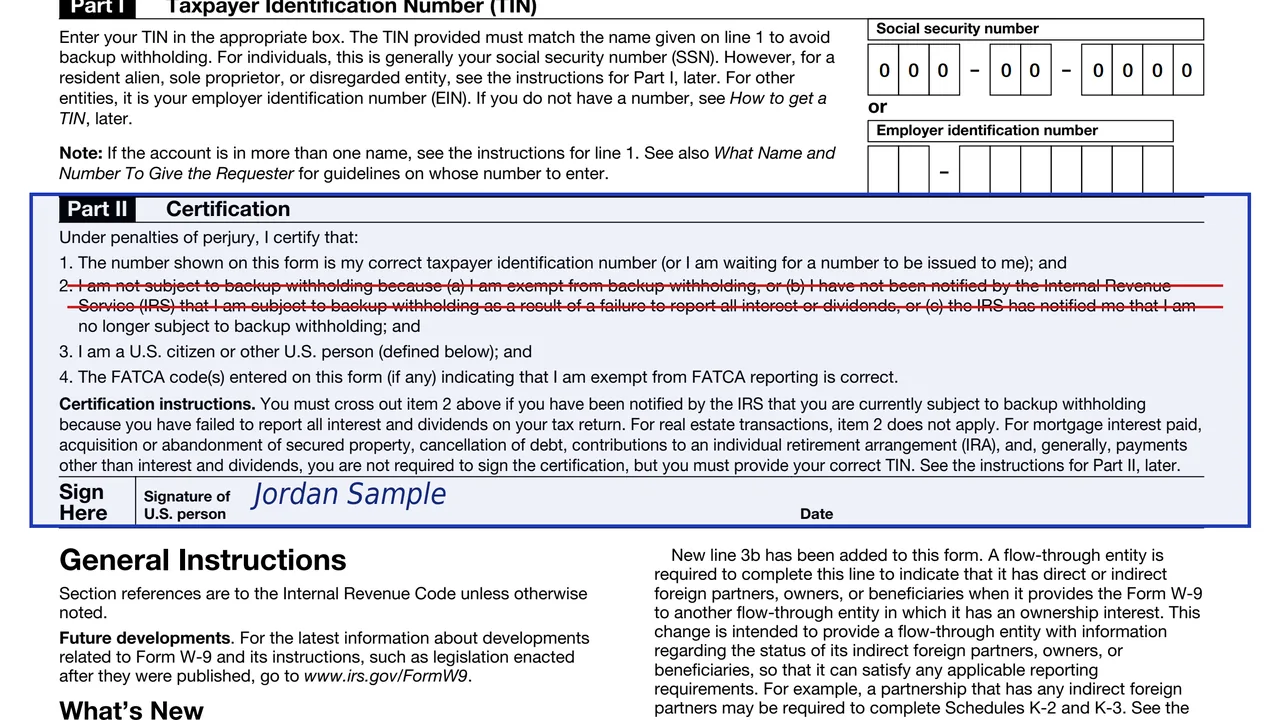
You get the real form, filled in a browser tab, with nothing standing between you and the finished PDF.
Give the completed form to the requester who asked for it. Do not send it to the IRS. The requester keeps it and uses it to prepare their information returns.
The form has no IRS filing deadline. Return it to the requester promptly, because payments can be subject to backup withholding until a correct TIN is on file.
The form says the rate is 24% of reportable payments. It applies if you do not give a TIN, the IRS tells the requester your TIN is incorrect, or you fail to make required certifications.
The form lists a $50 penalty for each failure to furnish your correct TIN, unless due to reasonable cause. A false statement with no reasonable basis that results in no backup withholding carries a $500 penalty.
Give the requester a new W-9 if your name or TIN changes, or if you stop being an exempt payee, for example when a C corporation elects S corporation status.
Entering an LLC's name on line 1 when it is disregarded, checking more than one box on line 3a, entering a number in Part I that does not match the name on line 1, and leaving the signature blank.
1099-NEC
140 fields, 6 pages
1099-INT
127 fields, 7 pages
1099-DIV
140 fields, 6 pages
1099-K
207 fields, 6 pages
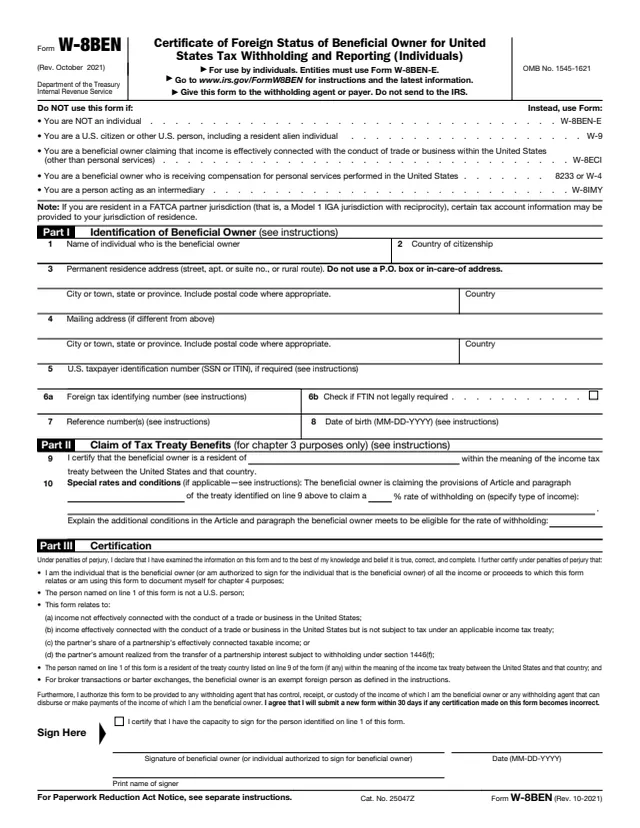
W-8
23 fields, 1 page
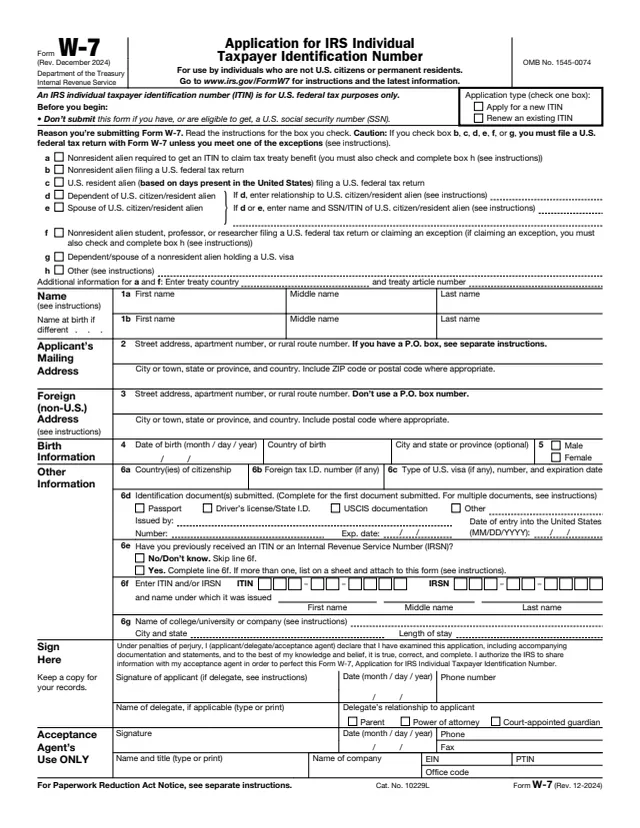
W-7
69 fields, 1 page
You fill out the form when a requester who must file an information return asks you for it. The form itself says to use it only if you are a U.S. person, which includes resident aliens.
No tool matches that search.
No. The form states that you give it to the requester and do not send it to the IRS. The requester uses it for their own information returns.
The form must contain your TIN, so give it only to a requester you know needs it. The requester instructions say misuse of TINs can bring civil and criminal penalties for the requester.
The form says a sole proprietor with an EIN may enter either the SSN or the EIN in Part I. The number must match the name on line 1.
You sign Part II for interest and dividend accounts and for certain other payments. For many payments other than interest and dividends, the form says you only need to provide your correct TIN.
It is a withholding of 24% from certain payments, such as interest, dividends, rents, royalties and nonemployee pay, when the payee has not given a correct TIN or required certifications.
Do not use Form W-9. A foreign person gives the requester the appropriate Form W-8, such as Form W-8BEN for individuals, or Form 8233 in some cases.