1099-K

Payment Card and Third Party Network Transactions

Agency
IRS
Revision
Rev. December 2026
Fillable fields
207
Pages
6
Official source
IRS form page
Checked
October 14, 2026
Fill 1099-K online
Page 1 of form 1099-K

Form 1099-K: Payment Card and Third Party Network Transactions

Form 1099-K reports the gross amount of payments a seller received through payment cards or third party payment networks during the year. If you sell goods or services and customers pay by card, or through an online marketplace or payment app, the company that settles those payments may send you this form and file a copy with the IRS.

The filer is called a payment settlement entity (PSE). It is either a merchant acquiring entity, such as a bank that pays participating payees for card transactions, or a third party settlement organization (TPSO), such as a payment app or online marketplace. The seller does not fill out the form.

Box 1a shows the gross amount, which is not adjusted for fees, refunds or returns. If you receive one, you still report your income on your own return. The IRS publishes pages called Understanding your Form 1099-K and What to do with Form 1099-K for recipients.

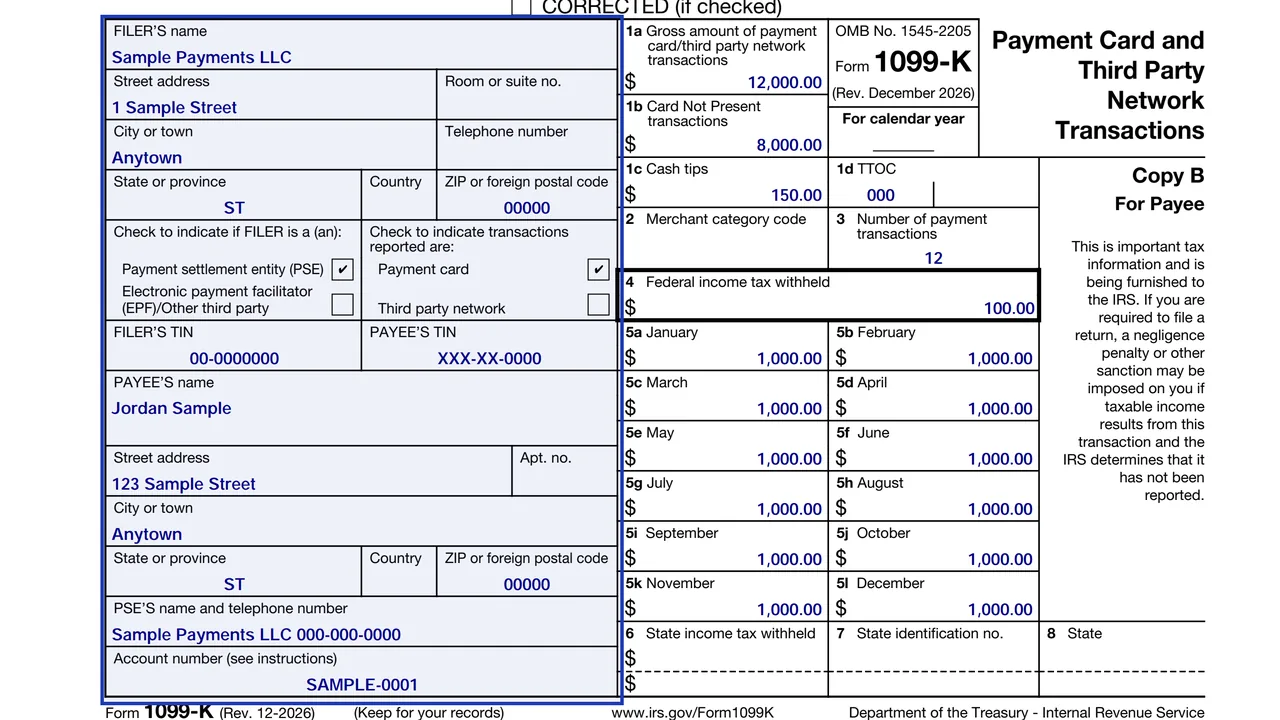
Page 1 of Form 1099-K (Rev. December 2026) with its title area and filer and payee blocks

What's on Form 1099-K

Filer and payee blocks

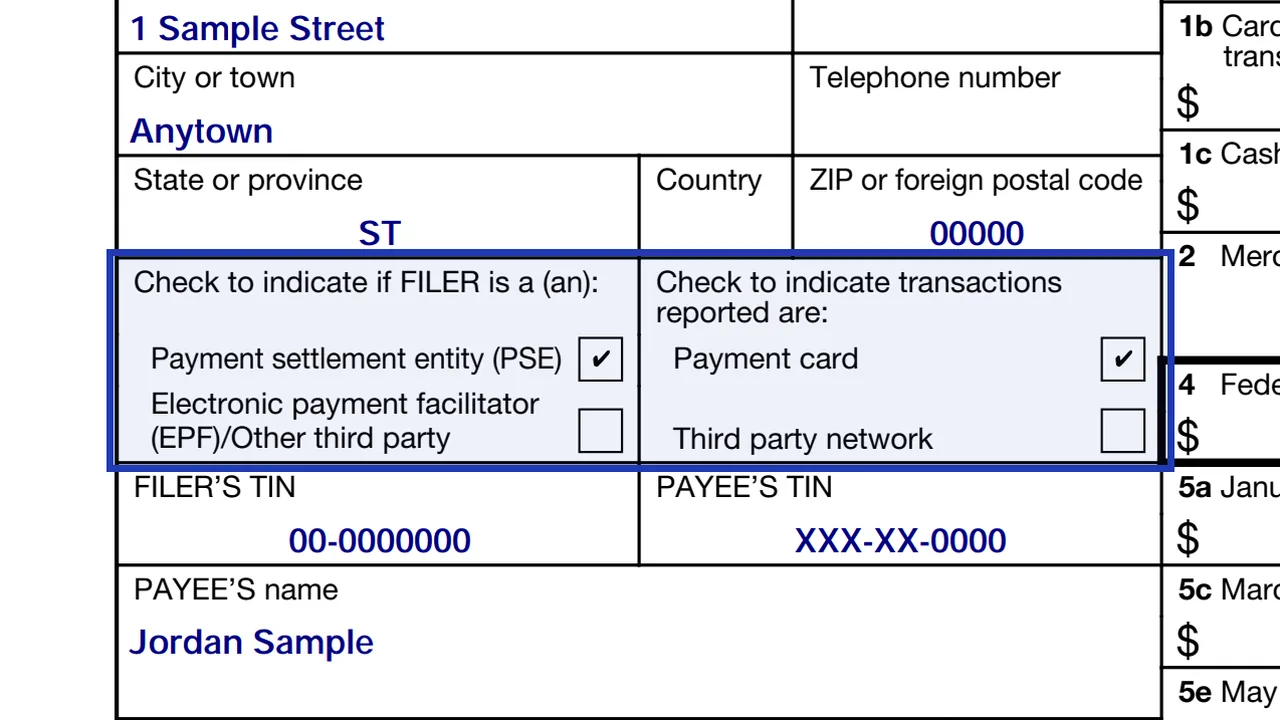
Names, addresses and TINs, plus checkboxes for whether the filer is a PSE or an electronic payment facilitator, and whether the form reports payment card or third party network transactions. Separate forms are needed for each type.
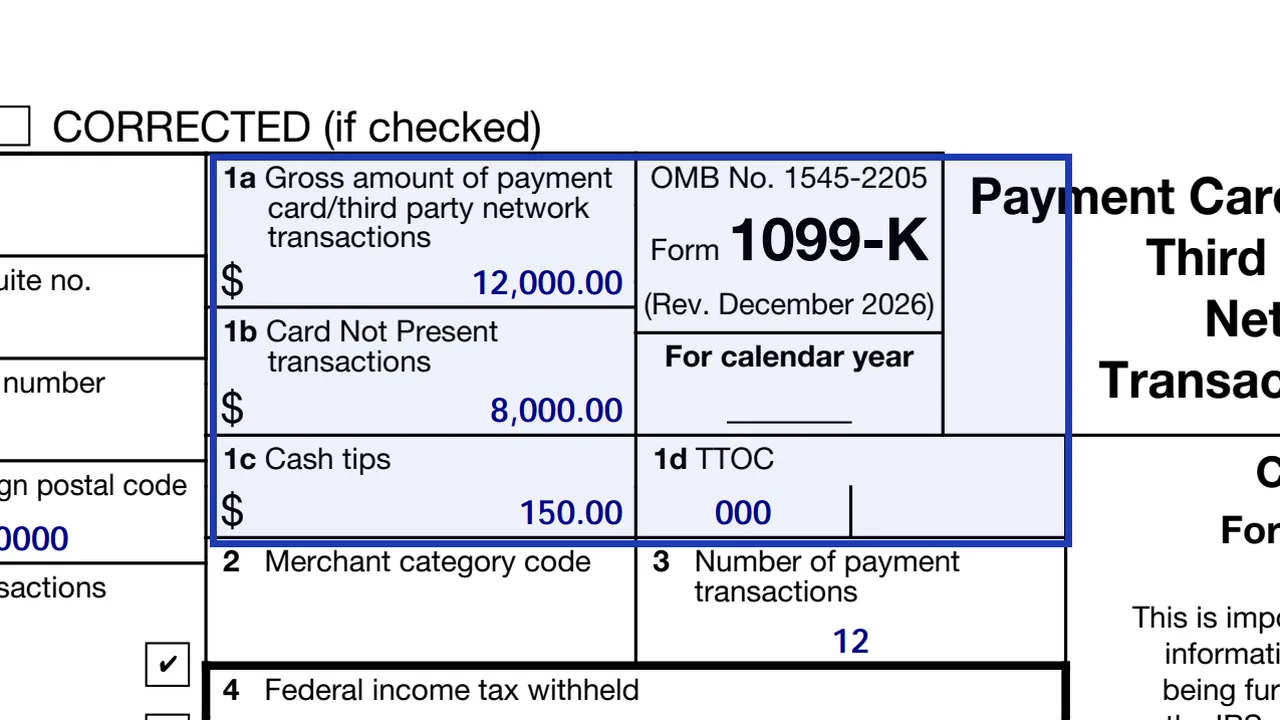
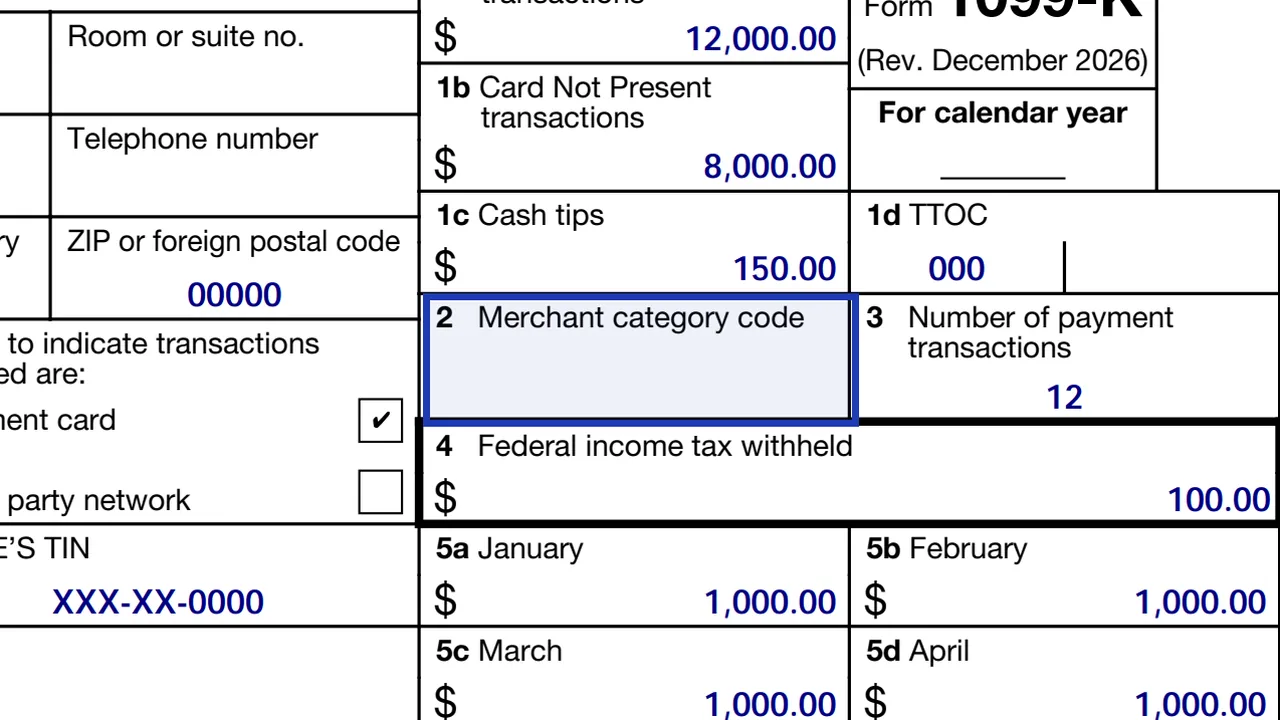
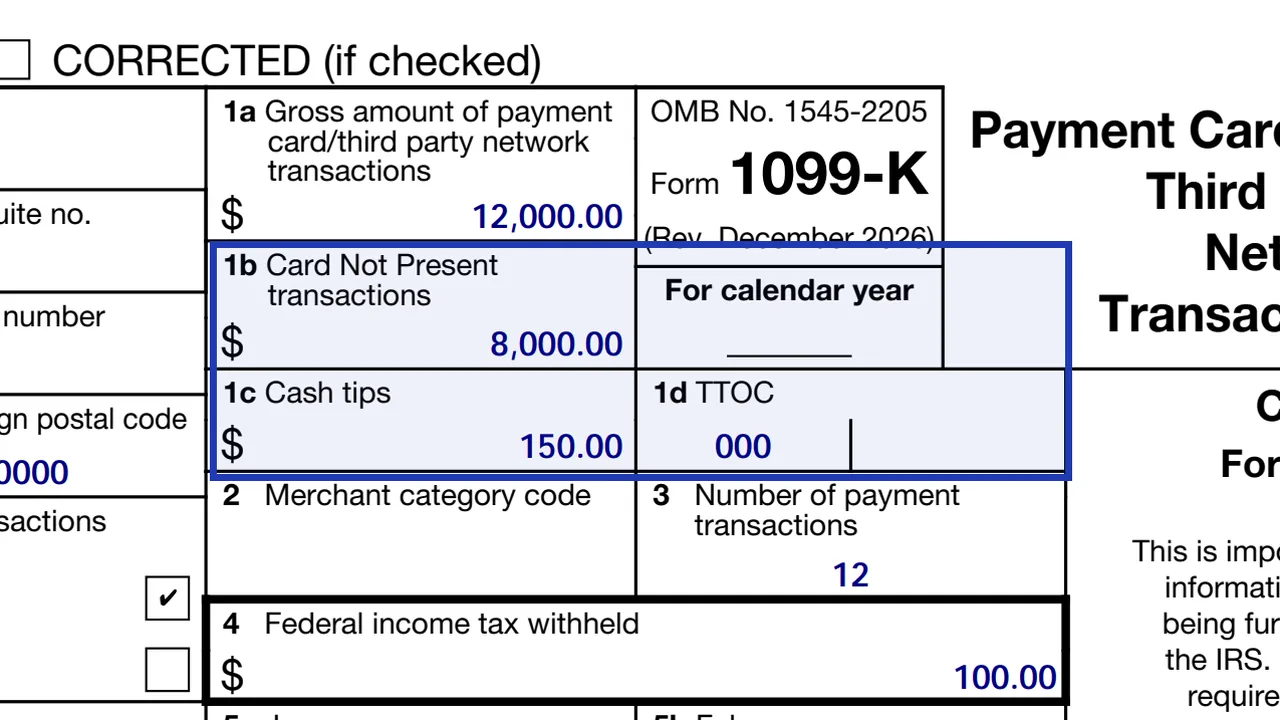
Boxes 1a to 1d

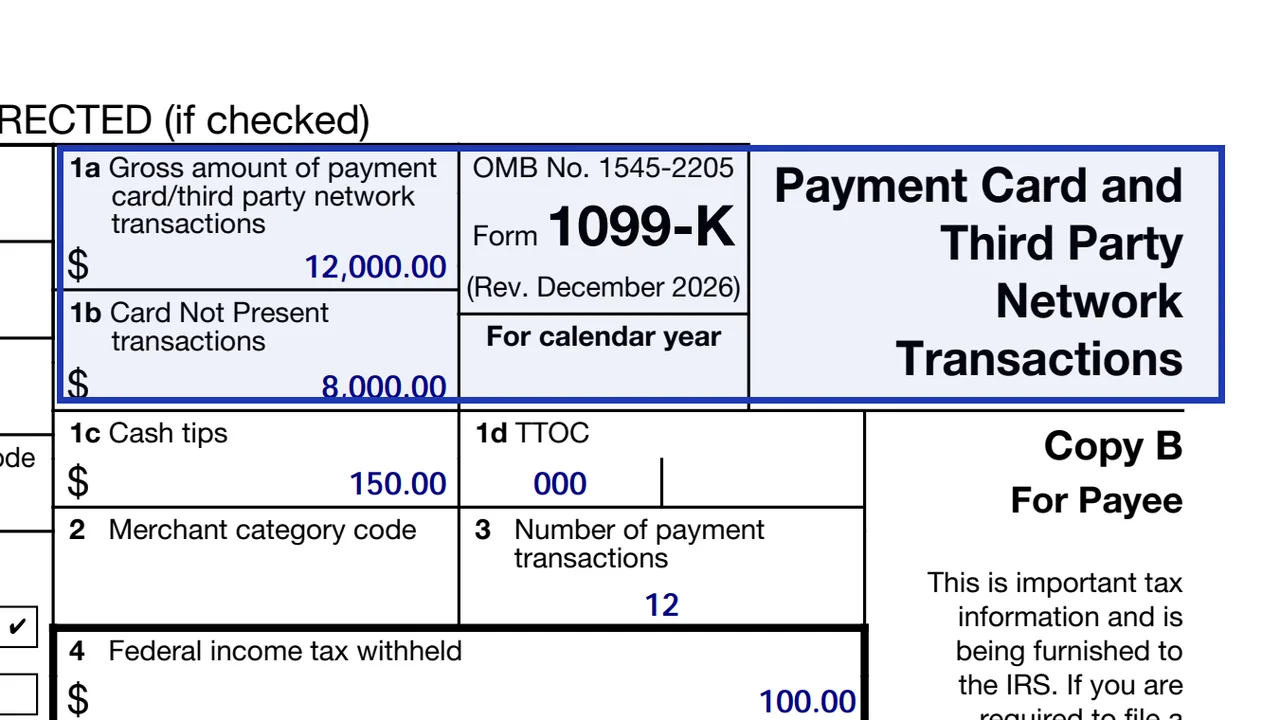
1a gross amount of reportable transactions, 1b card-not-present transactions such as online or phone sales, 1c cash tips included in 1a, 1d Treasury Tipped Occupation Codes.

Box 2

Four-digit merchant category code. Leave blank if the filer is a TPSO or does not use an industry classification system.

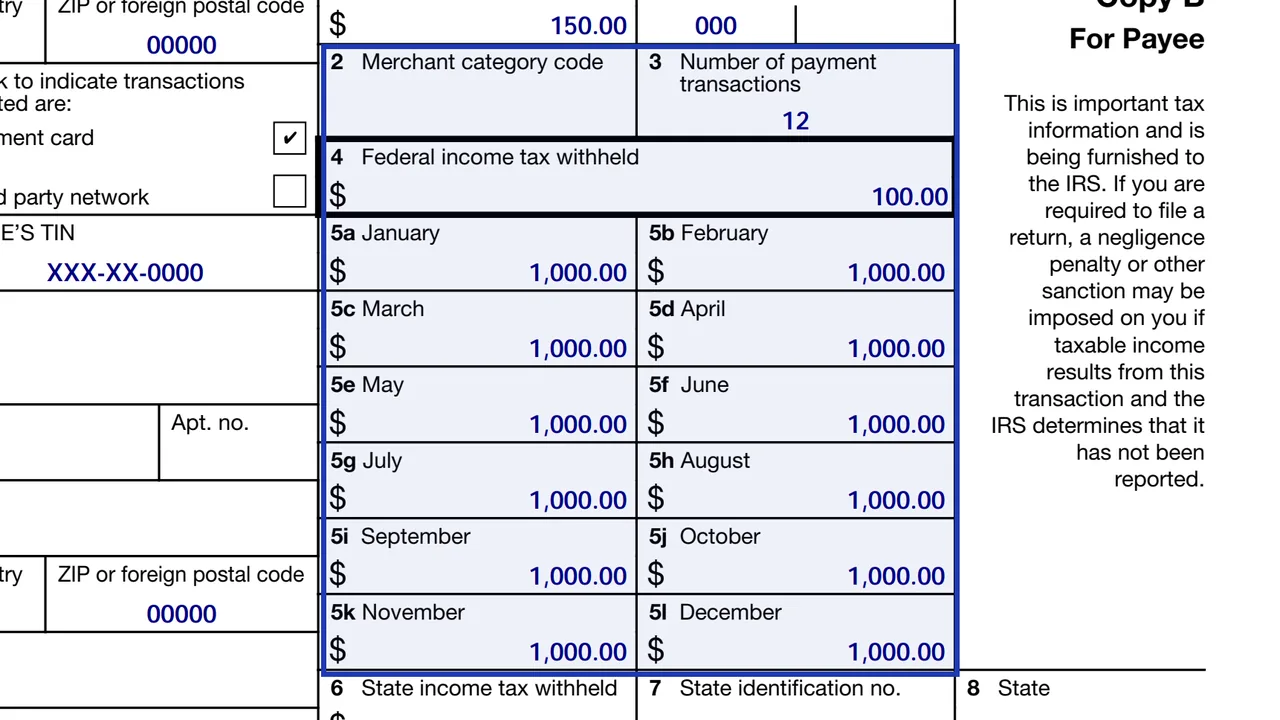
Box 3

Number of payment transactions, excluding refunds.

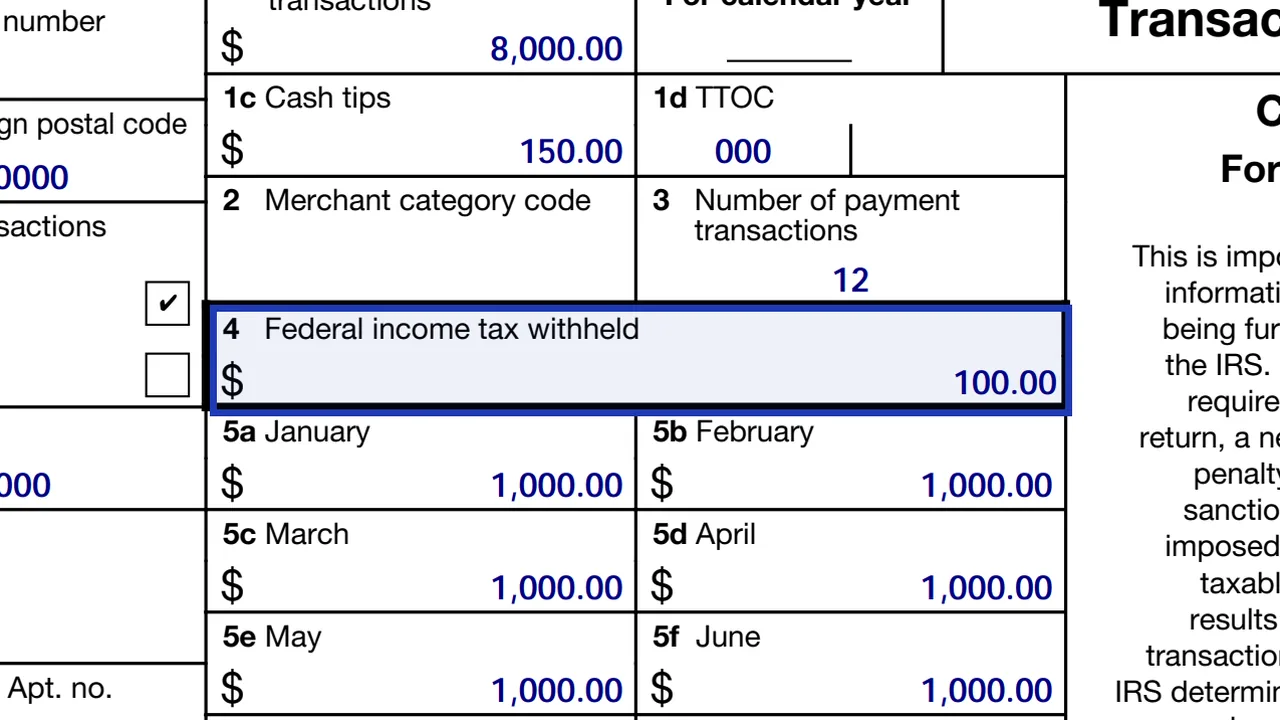
Box 4

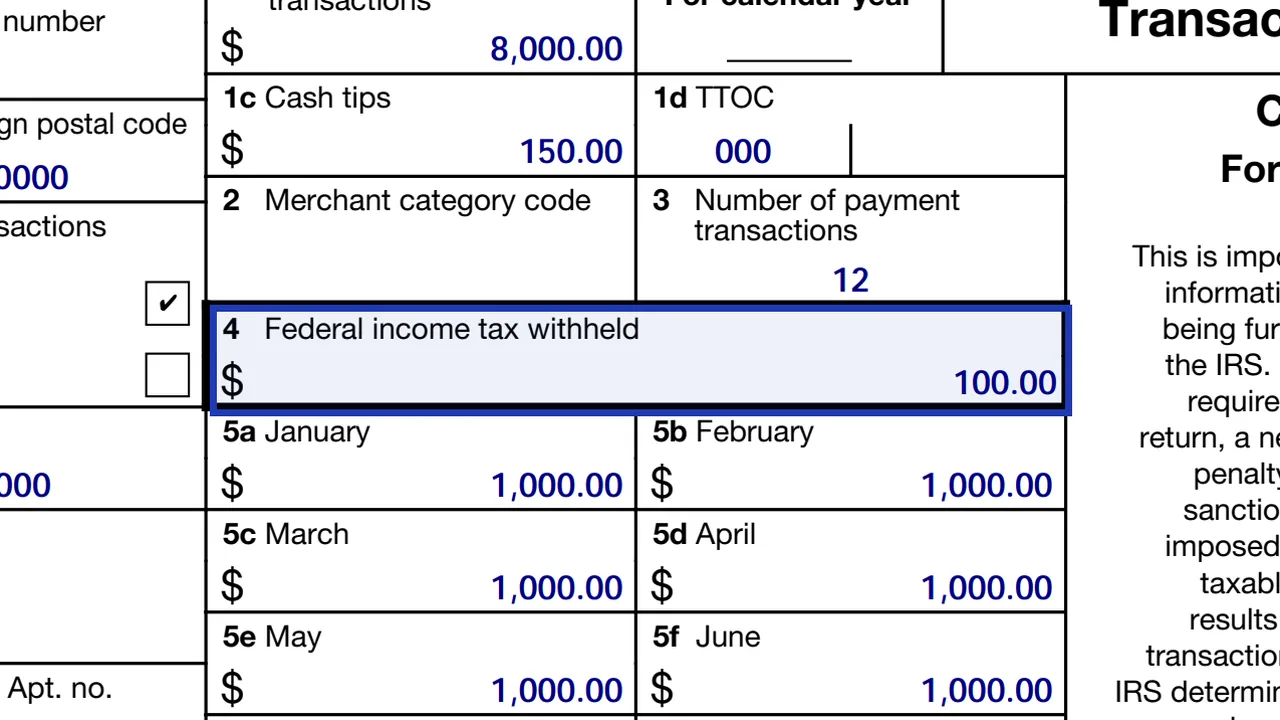
Federal income tax withheld, which is backup withholding.

Boxes 5a to 5l

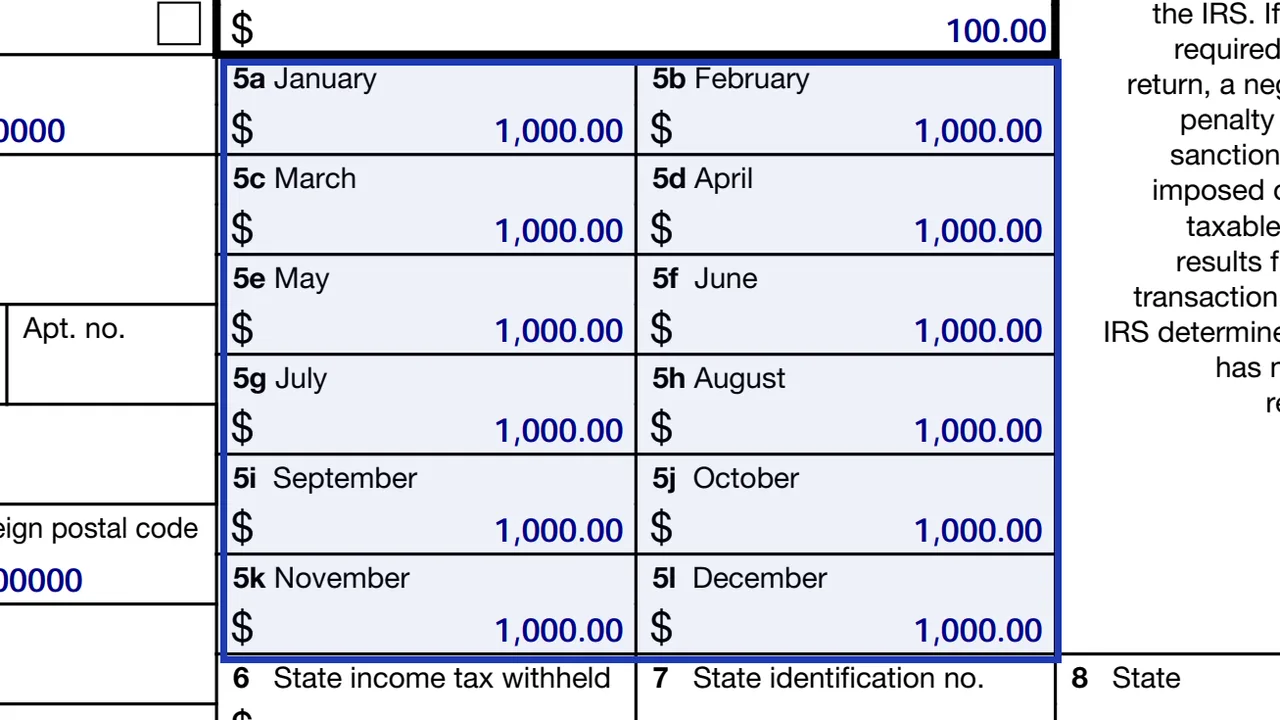
The gross reportable amount for each month of the year.

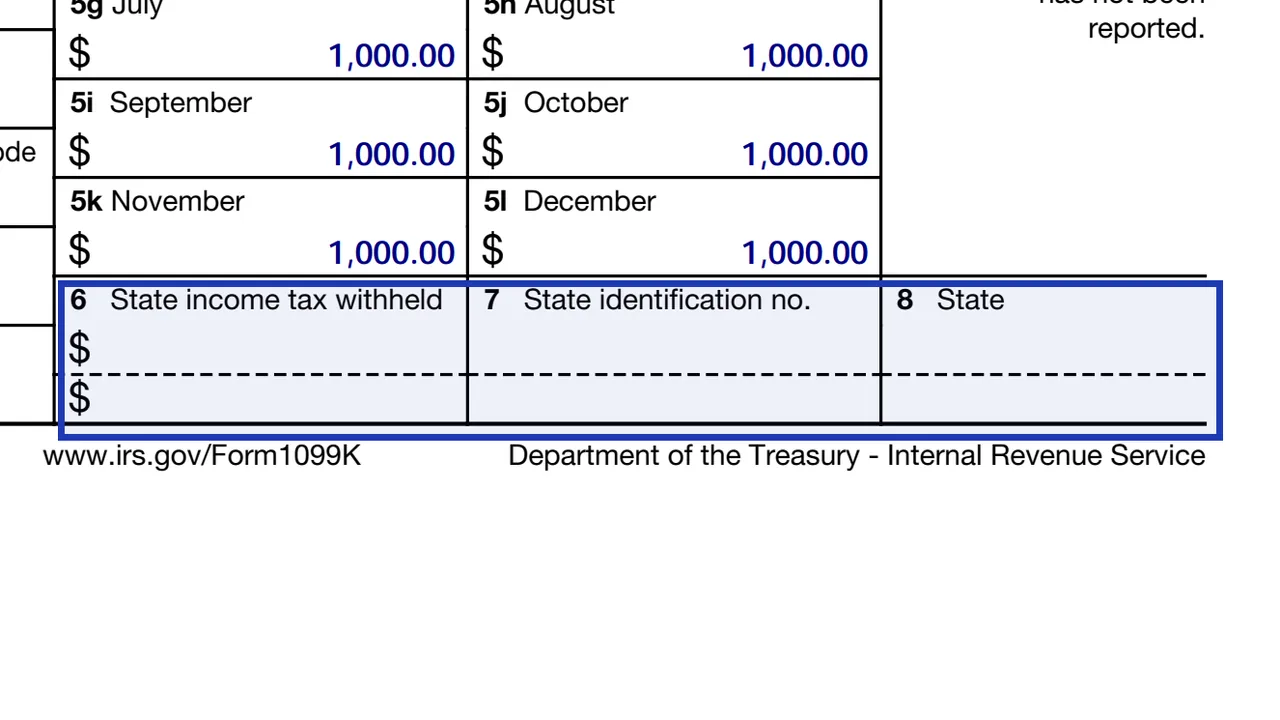
Boxes 6 to 8

Optional state information for up to two states: state, filer's state ID number and state income tax withheld.

How to fill out Form 1099-K

  1. 1

    Filer type

    Check the box showing whether you are a PSE or an electronic payment facilitator, and which type of transactions this form reports. Use a separate form for each type.

    The filer type and transaction type checkboxes of Form 1099-K
  2. 2

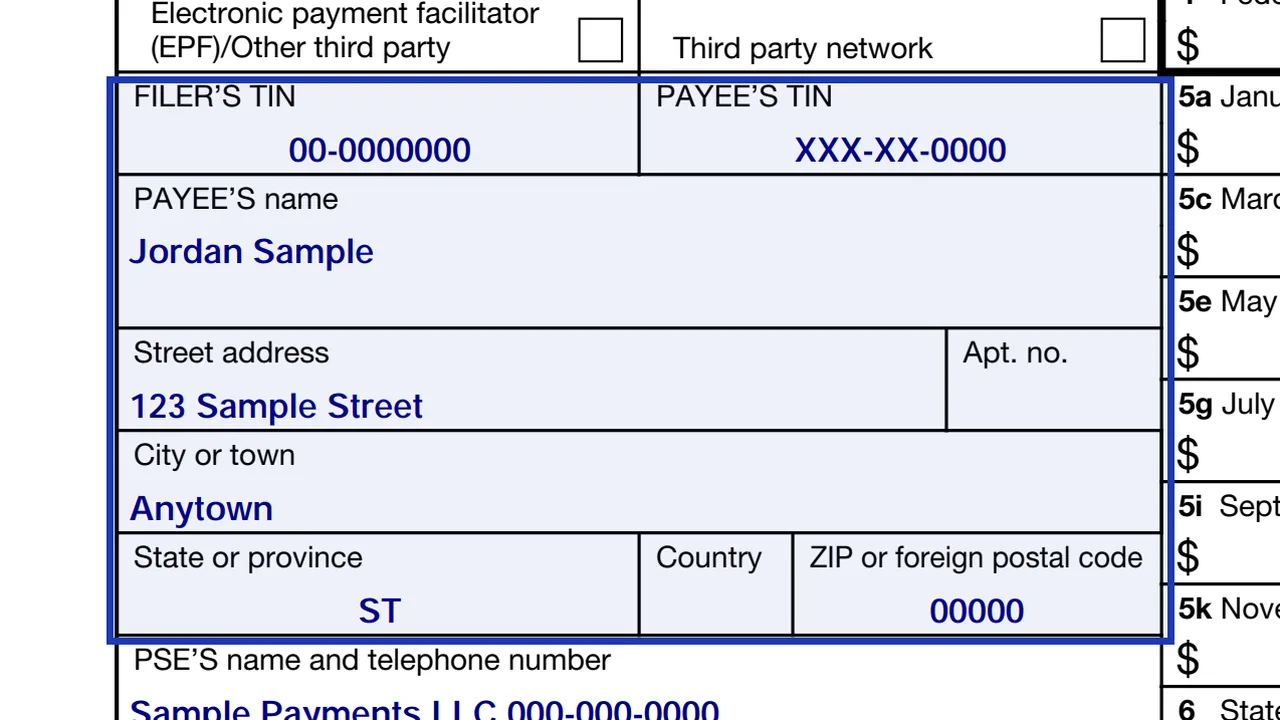
    Payee information

    Enter the payee's name, address and TIN. You may truncate the payee's TIN on the payee statement but not on the IRS copy.

    The payee name, address and TIN area of Form 1099-K with sample values
  3. 3

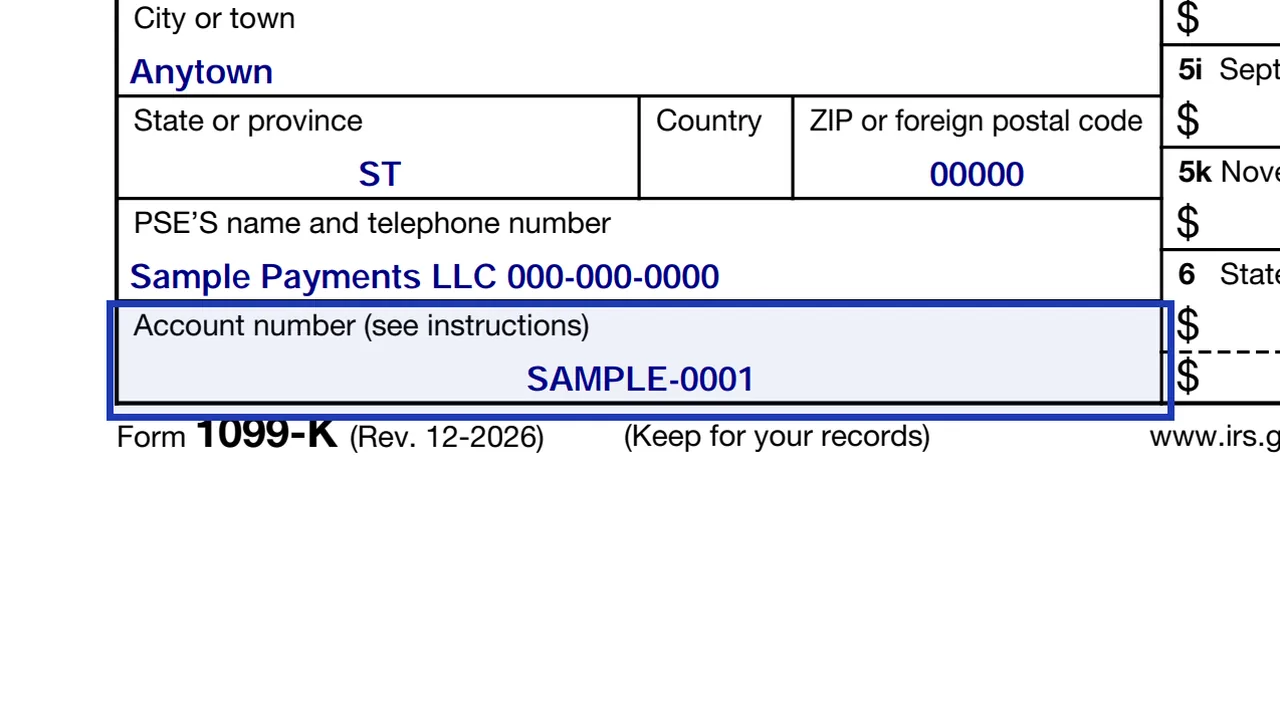
    Account number

    Required when a payee has multiple accounts and more than one Form 1099-K. The IRS encourages using one number across all the forms.

    The account number field of Form 1099-K for a payee with several accounts
  4. 4

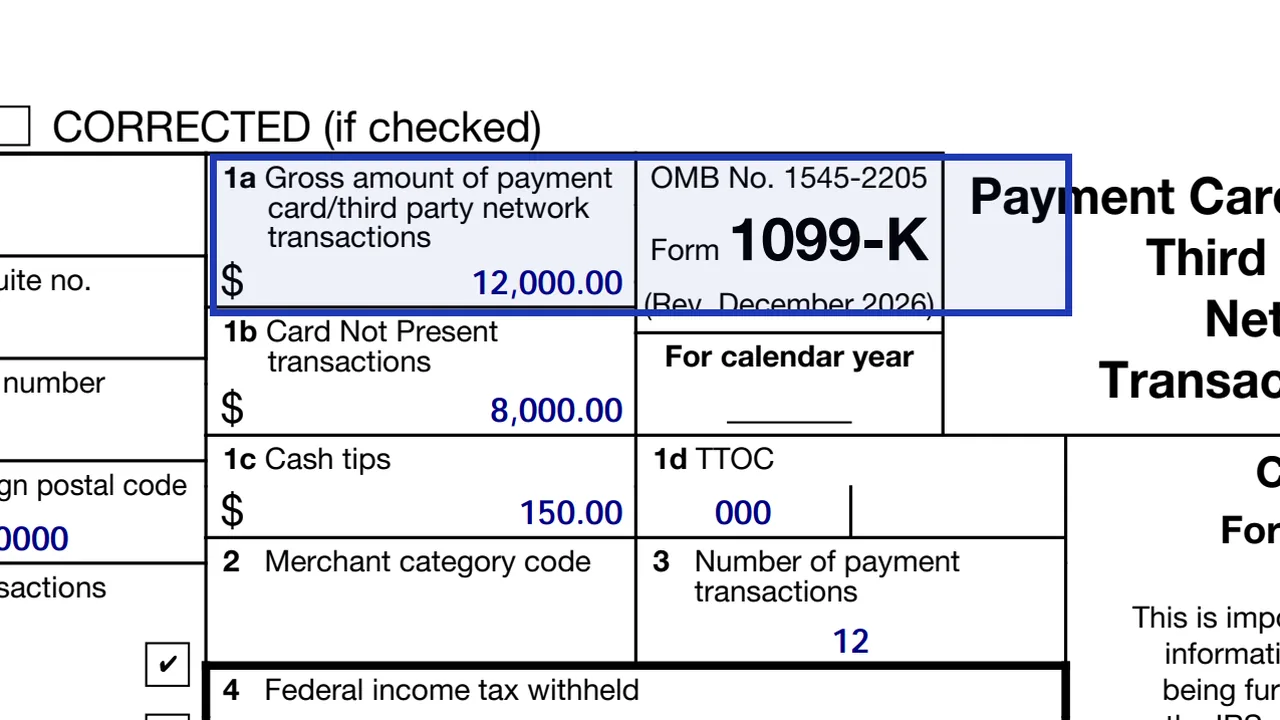
    Box 1a

    Enter the gross amount of all reportable transactions, with no adjustment for credits, fees, refunds, shipping or other amounts.

    Box 1a of Form 1099-K with a sample gross amount and no fee or refund adjustments
  5. 5

    Boxes 1b to 1d

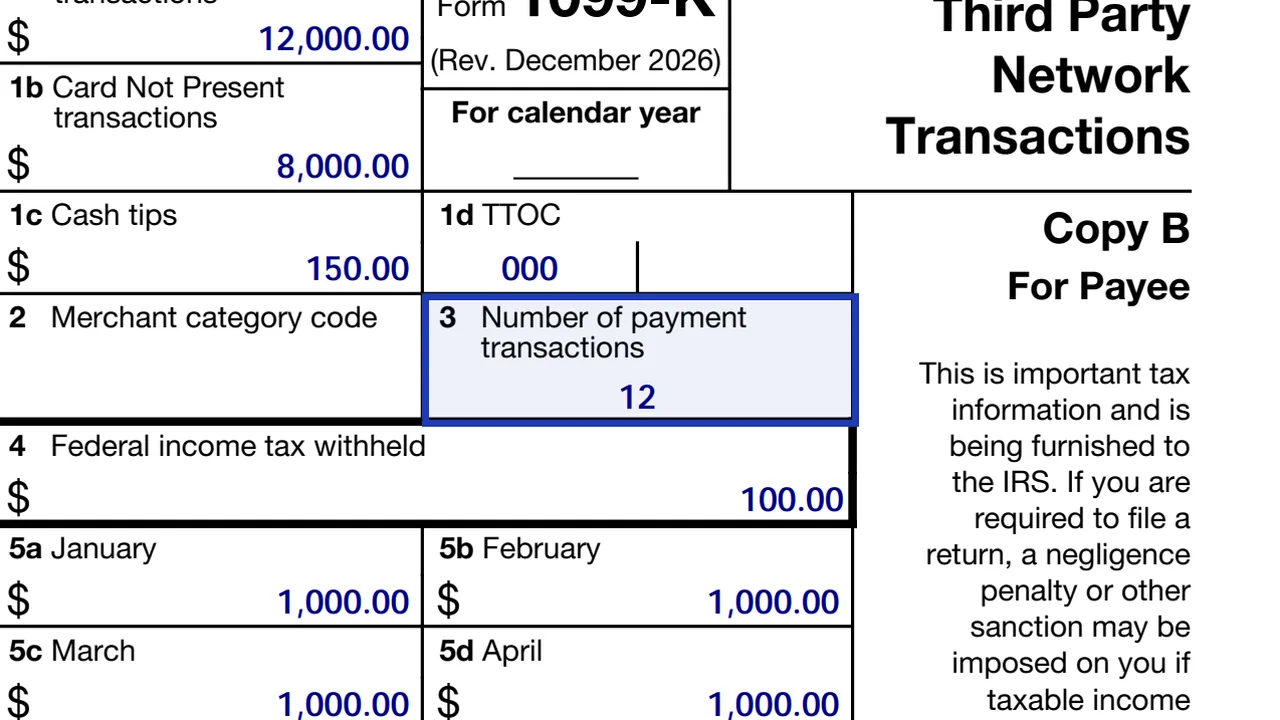
    Enter card-not-present transactions in 1b, cash tips in 1c, and up to two Treasury Tipped Occupation Codes in 1d. Use 000 if any tips came from a nonqualifying occupation.

    Boxes 1b to 1d of Form 1099-K with sample card-not-present and tip amounts and code 000 in 1d
  6. 6

    Box 3 and boxes 5a to 5l

    Count the transactions without refunds, then enter each month's gross amount.

    Box 3 and boxes 5a to 5l of Form 1099-K with sample transaction counts and monthly amounts
  7. 7

    Box 4

    Enter backup withholding, which applies to box 1a amounts when the payee did not give a TIN in the required manner.

    Box 4 of Form 1099-K with a sample backup withholding amount

Why fill Form 1099-K on indox

You get the real form, filled in a browser tab, with nothing standing between you and the finished PDF.

  • Fill the form right in your browser, no software to install
  • Free to fill and free to download, with no account
  • The official blank straight from the IRS, not a copy someone retyped
  • Works on a phone, tablet or computer

Deadlines, where to send it and common mistakes

Deadlines

The General Instructions for Certain Information Returns list the due dates each year. For 2025 returns, paper filing with the IRS was due March 2, 2026 and electronic filing March 31, 2026.

E-file and paper

Filers with 10 or more information returns in total must file electronically. Paper filers send Copy A with Form 1096.

Payee statements

You must furnish a statement to each payee. It may be furnished electronically. Payees use Copy 2 for their state income tax returns where applicable.

Penalties

The instructions refer to Publication 1099 part O and mention penalties under sections 6721 and 6722 for filers.

Common mistakes

Combining card and third party network transactions on one form, using the wrong box for card-not-present sales, and adjusting box 1a for fees or refunds.

Who needs to file Form 1099-K?

  • Merchant acquiring entities

    A bank or similar organization that has an agreement to pay participating payees for payment card transactions.

  • Third party settlement organizations

    For third party network transactions, a TPSO reports only if the gross amount for the calendar year exceeds $20,000 and the number of transactions exceeds 200, according to the instructions.

  • Third parties making payments for a PSE

    If a PSE contracts with an electronic payment facilitator or other third party to make settlement payments, that party files instead.

  • Not TPSOs

    Healthcare networks, in-house accounts payable departments and automated clearing houses do not qualify as TPSOs.

A payment settlement entity files a form for each payee it settles transactions for.

Official sources and the blank

Do it all with indox

View all 123 tools

Questions about Form 1099-K

Who fills out Form 1099-K?

A payment settlement entity, such as a card processor, payment app or online marketplace. You receive a copy as the seller.

What is the threshold for a third party network?

The instructions say a TPSO reports third party network transactions when the gross amount for the year exceeds $20,000 and the number of transactions exceeds 200.

Does box 1a include fees and refunds?

Box 1a is the gross amount with no adjustment for credits, fees, refunds, shipping or other amounts.

Is a 1099-K different from a 1099-NEC?

Yes. Payments by credit card or a third party network are reported on Form 1099-K, and the payer does not report them on Form 1099-NEC.

Where can I read about what to do with one?

The IRS has pages titled Understanding your Form 1099-K and What to do with Form 1099-K for recipients, linked from its Form 1099-K page.