2026 Estimated Tax Worksheet
Lines 1 to 17 for adjusted total income, deductions, exemption, taxable income, tax, credits, other taxes, the required annual payment, withholding and the installment amount. It is kept for the records.
1041-ES
Estimated Income Tax for Estates and Trusts
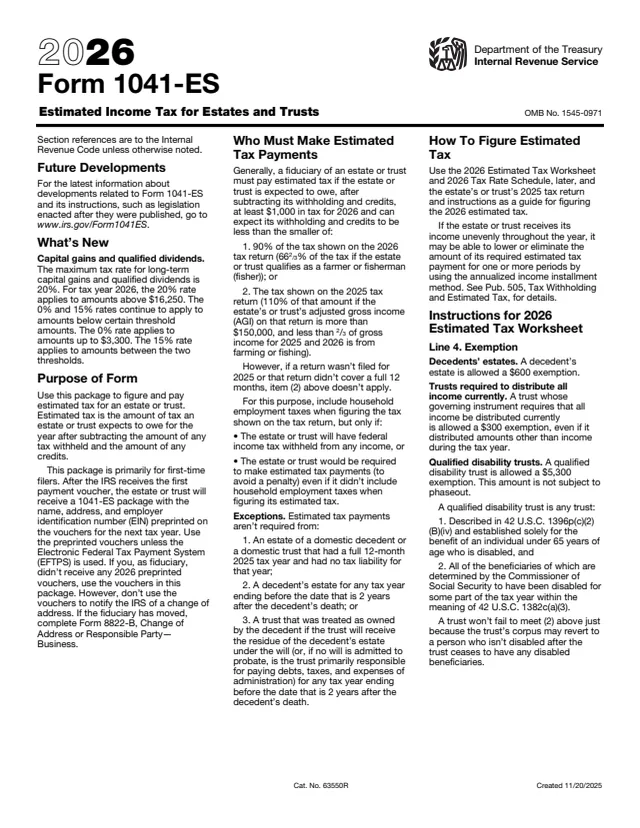
Form 1041-ES is the IRS package used to figure and pay estimated tax for an estate or trust. The form says estimated tax is the amount of tax an estate or trust expects to owe for the year after subtracting the amount of any tax withheld and the amount of any credits. The package holds the 2026 Estimated Tax Worksheet, the 2026 Tax Rate Schedule, a capital gains tax worksheet, a record of payments and four payment vouchers.
It is completed by the fiduciary of the estate or trust, not by a beneficiary. The form says the package is primarily for first-time filers: after the IRS receives the first payment voucher, the estate or trust receives a package with its name, address and employer identification number (EIN) preprinted on the vouchers for the next tax year. A voucher is sent only with a payment, and the IRS recommends paying electronically whenever possible.
This page hosts the 2026 edition. You can fill it out free in your browser on this page and download the result without an account.
Lines 1 to 17 for adjusted total income, deductions, exemption, taxable income, tax, credits, other taxes, the required annual payment, withholding and the installment amount. It is kept for the records.
Four brackets for estates and trusts: 10% up to $3,300, then 24%, 35% and 37% on amounts over $16,000.
The 2026 Tax Computation Worksheet Using Maximum Capital Gains Rates, used when a net capital gain or qualified dividends are expected and line 6 is more than zero.
A table for each payment's date, check or money order number, amount, 2025 overpayment credit applied and total.
Each voucher has the EIN, the name of the estate or trust, the fiduciary's name, title and address, and the amount paid. The printed calendar year due dates run from April 15, 2026, to Jan. 15, 2027.
The form lists $600 for a decedent's estate, $300 for a trust required to distribute all income currently, $5,300 for a qualified disability trust, none for a qualified funeral trust and $100 for all other trusts.
Figure the tax on line 6 with the 2026 Tax Rate Schedule, or with the capital gains worksheet when it applies. The form says Electing Alaska Native Settlement Trusts multiply line 6 by 10% unless they expect qualified dividends or a net capital gain.
For credits, the form points to the instructions for lines 2a to 2d of Schedule G, Form 1041. Other taxes include the Net Investment Income Tax of 3.8%, certain credit recapture taxes and the tax on accumulation distributions of trusts.
Line 14c is the smaller of line 14a or 14b. Subtract the expected withholding on line 15. The form notes that if line 13 minus line 15 is less than $1,000, estimated tax payments aren't required.
If the first payment is due April 15, 2026, enter 1/4 of line 16, minus any 2025 overpayment applied, here and on the voucher. The form says cents may be rounded to the nearest whole dollar.
Enter the estate's or trust's name and EIN and the fiduciary's name, title and address, and only the amount being sent. Make the check payable to United States Treasury and write the EIN and 2026 Form 1041-ES on it.
You get the real form, filled in a browser tab, with nothing standing between you and the finished PDF.
Internal Revenue Service, P.O. Box 932400, Louisville, KY 40293-2400. The form says not to send the voucher to the service center where Form 1041 is filed, and that only the U.S. Postal Service can deliver to this address.
For trusts and calendar year estates: April 15, 2026, June 15, 2026, Sept. 15, 2026, and Jan. 15, 2027. A date on a Saturday, Sunday or legal holiday moves to the next business day.
The form says the January 15, 2027, payment isn't needed if the 2026 Form 1041 is filed by January 31, 2027, and the entire balance due is paid with the return.
Installments fall on the 15th day of the 4th, 6th and 9th months of the 2026 tax year and the 1st month of the following tax year.
The IRS recommends paying electronically whenever possible. For EFTPS, the form gives www.EFTPS.gov and 800-555-4477, and says a deposit is on time if submitted by 8 p.m. Eastern time the day before the due date.
The form says a penalty may apply if the estate or trust didn't pay enough estimated tax or didn't pay on time, even if it has an overpayment on its return. Pub. 505 explains when it may be waived.
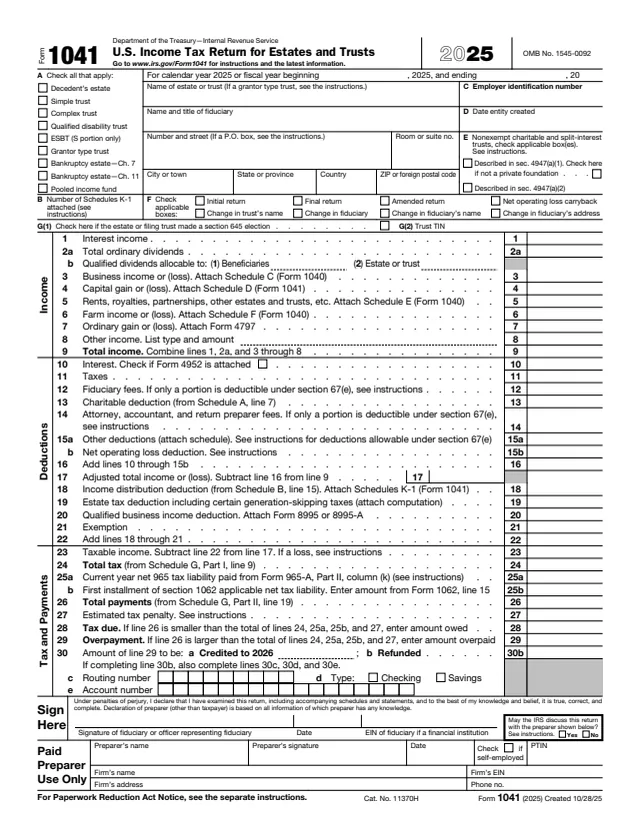
1041
173 fields, 3 pages
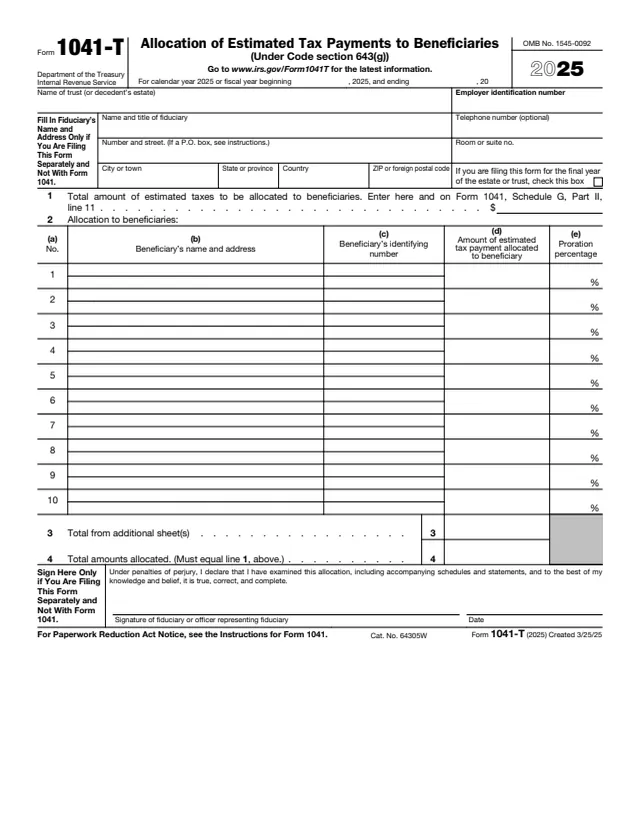
1041-T
57 fields, 2 pages
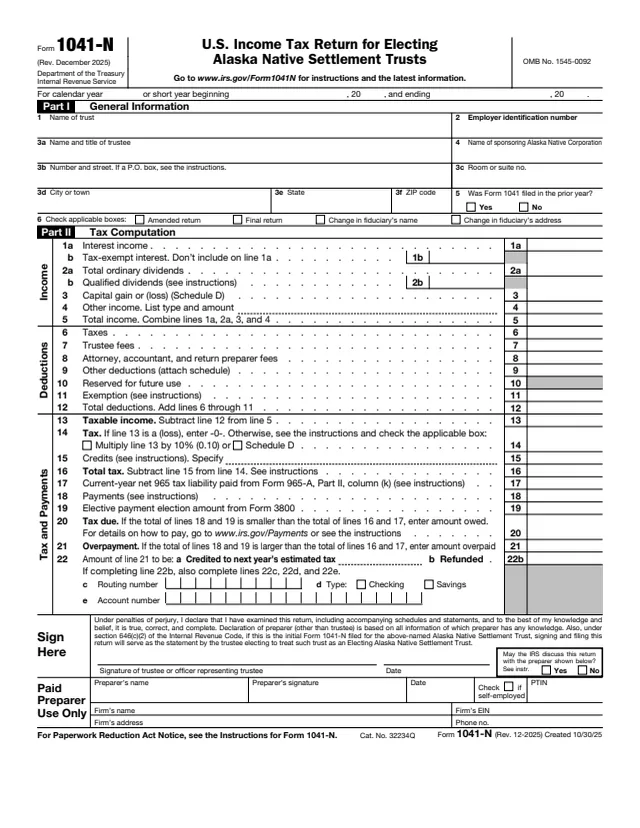
1041-N
226 fields, 4 pages
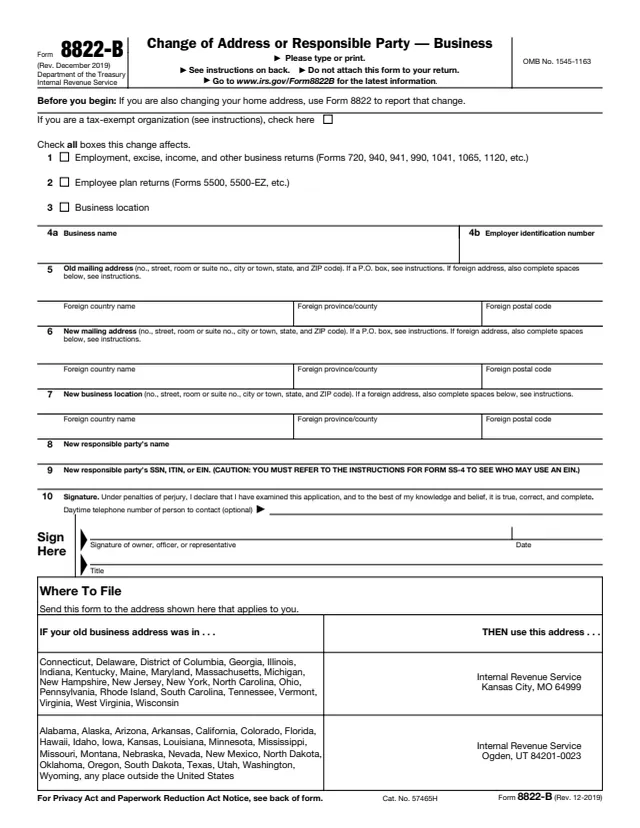
8822-B
22 fields, 2 pages
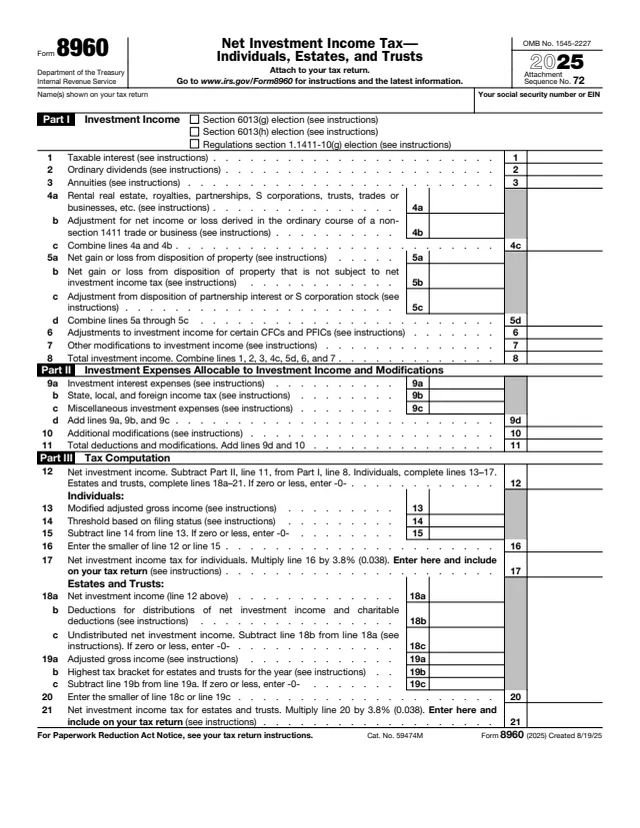
8960
38 fields, 1 page
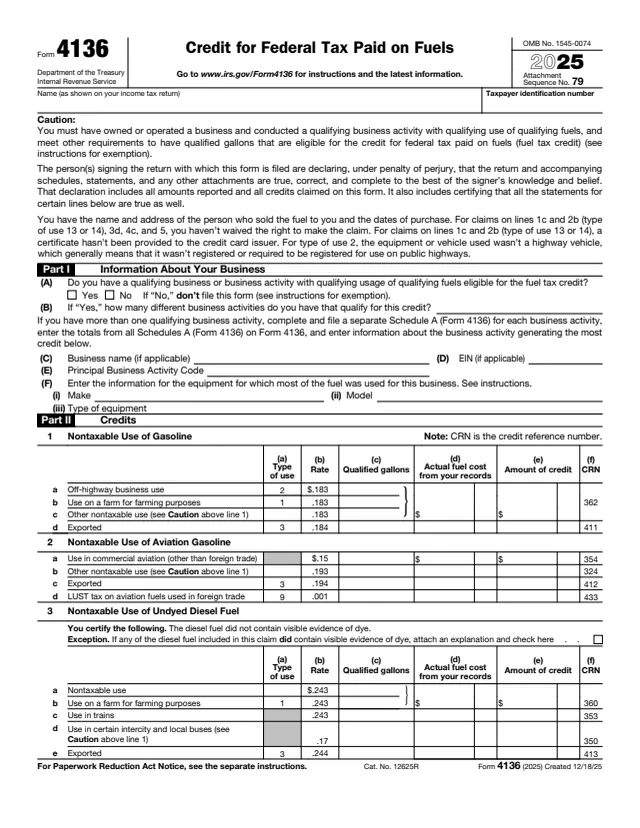
4136
485 fields, 4 pages
The fiduciary completes the worksheet and vouchers for the estate or trust and sends payments to the IRS.
No tool matches that search.
The fiduciary of the estate or trust. The vouchers carry the estate's or trust's name and EIN and the fiduciary's name, title and address.
For trusts and calendar year estates, the form lists April 15, 2026, June 15, 2026, Sept. 15, 2026, and Jan. 15, 2027. A trust may also pay all of it by April 15, 2026.
To Internal Revenue Service, P.O. Box 932400, Louisville, KY 40293-2400, and not to the service center where Form 1041 is filed.
The form says estimated tax generally applies when the estate or trust expects to owe at least $1,000 in tax for 2026 after subtracting withholding and credits.
No. The form says not to use the vouchers to notify the IRS of a change of address. A fiduciary who has moved completes Form 8822-B.
The form says the fiduciary may elect to treat part of the payments as made by a beneficiary, on the 2026 Form 1041-T, filed on or before the 65th day after the close of the tax year.
The form says the IRS can't accept a single check of $100 million or more. Larger amounts by check are spread over two or more checks. The limit does not apply to electronic payments.