Part I: Decedent and Executor
The decedent's name, SSN, domicile and dates of birth and death, the executor's name, TIN, address and phone, the probate court, and checkboxes for the will, death certificate, extension and supplemental return.
706
United States Estate (and Generation-Skipping Transfer) Tax Return
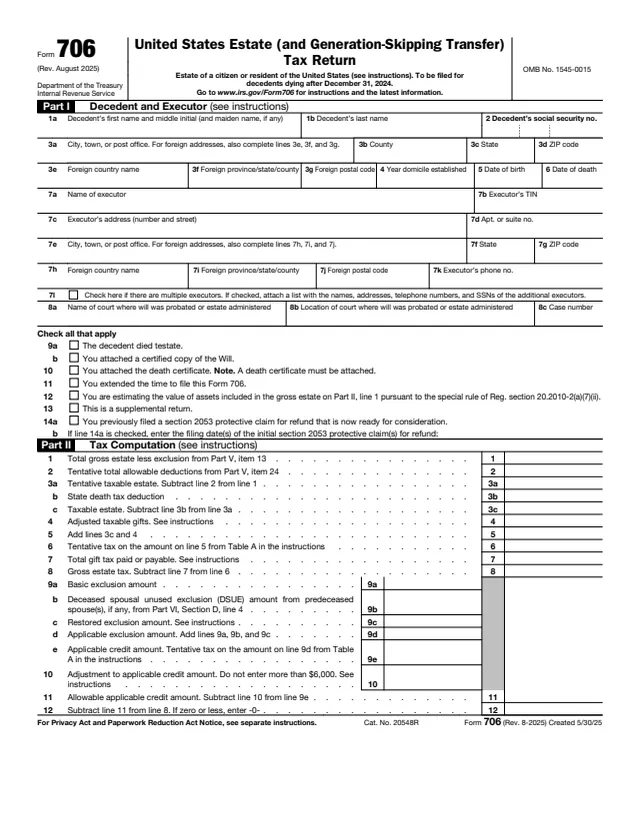
Form 706 is the United States Estate (and Generation-Skipping Transfer) Tax Return. The instructions say the executor of a decedent's estate uses it to figure the estate tax imposed by chapter 11 of the Internal Revenue Code, and the generation-skipping transfer (GST) tax imposed by chapter 13 on direct skips.
The form is for the estate of a citizen or resident of the United States, and this revision says it is to be filed for decedents dying after December 31, 2024. For decedents who died in 2026, the instructions say a return is filed when the gross estate, plus adjusted taxable gifts and specific exemption, is more than $15,000,000, or when the executor elects to transfer the deceased spousal unused exclusion (DSUE) amount to the surviving spouse.
The return has six parts on five pages. Its schedules, from Schedule A (Form 706) to Schedule W (Form 706), are separate forms attached as needed. You can fill it out free in your browser on this page and download the result without an account.
The decedent's name, SSN, domicile and dates of birth and death, the executor's name, TIN, address and phone, the probate court, and checkboxes for the will, death certificate, extension and supplemental return.
Lines 1 to 23 run from the gross estate and deductions to the taxable estate, tentative tax, applicable credit, other credits, GST taxes and tax due or overpayment, followed by the executor's signature and the paid preparer area.
Yes or No questions on alternate valuation, special-use valuation, section 6166 installment payments and section 6163 postponement for a reversionary or remainder interest.
Death certificate details, marital history, the surviving spouse, beneficiaries receiving $5,000 or more, and questions on gift tax returns, insurance, joint property, business interests, trusts, powers of appointment, foreign accounts and annuities.
Items 1 to 13 total the gross estate from Schedules A to I and U, and items 14 to 24 total the deductions from Schedules J, K, L, M and O.
Section A to opt out of portability, Section B on qualified domestic trusts, Section C to figure the DSUE amount portable to the surviving spouse, and Section D for DSUE received from predeceased spouses.
The instructions say to file Schedules A through I, as appropriate, to support Part V, items 1 through 9, to number the items on each schedule starting with 1, and to enter each schedule's total on Part V.
Enter the SSN assigned to the decedent, the domicile at death (not a hospital or hospice address), and the executor's details. Check line 10 to show the death certificate is attached, and line 7l for multiple executors.
Check Yes or No for each election and question. The form says some Yes answers call for an attached schedule, such as Schedule E, G, H, I, PC or T (Form 706).
Use the alternate value column only if alternate valuation was elected on Part III, line 1. Enter item 13 on Part II, line 1, and item 24 on Part II, line 2.
Figure the tentative tax with Table A, the unified rate schedule in the instructions. The instructions list a basic exclusion amount of $15,000,000 for decedents dying in 2026, which goes on line 9a.
Complete Part VI, Section C to elect portability, or check Section A to opt out. The executor signs under penalties of perjury; the instructions say one co-executor's signature is sufficient.
You get the real form, filled in a browser tab, with nothing standing between you and the finished PDF.
The instructions give Department of the Treasury, Internal Revenue Service, Kansas City, MO 64999, and for a private delivery service 333 W. Pershing Road, Kansas City, MO 64108. The About page points to Filing estate and gift tax returns for the latest address.
The instructions say Form 706 is filed, and the estate and GST taxes are due, within 9 months after the date of the decedent's death. Form 4768 applies for an automatic 6-month extension of time to file.
The instructions say the death certificate is attached, plus a certified copy of the will if the decedent died testate. Other documents can include Form 712, Form 709 and Form 706-CE.
To change a filed return, check line 13, add a statement of what changed and attach a copy of the original. The instructions give Internal Revenue Service Center, Attn: E&G, Stop 824G, 7940 Kentucky Drive, Florence, KY 41042-2915.
The instructions describe late filing and late payment penalties under section 6651, and a 20% penalty under section 6662 for certain underpayments that rises to 40% for a gross valuation understatement.
Form 8971 reports estate tax values to the IRS and beneficiaries. A closing letter is requested through Pay.gov; the About page says the estate tax closing letter fee increased to $76 after October 26, 2026.
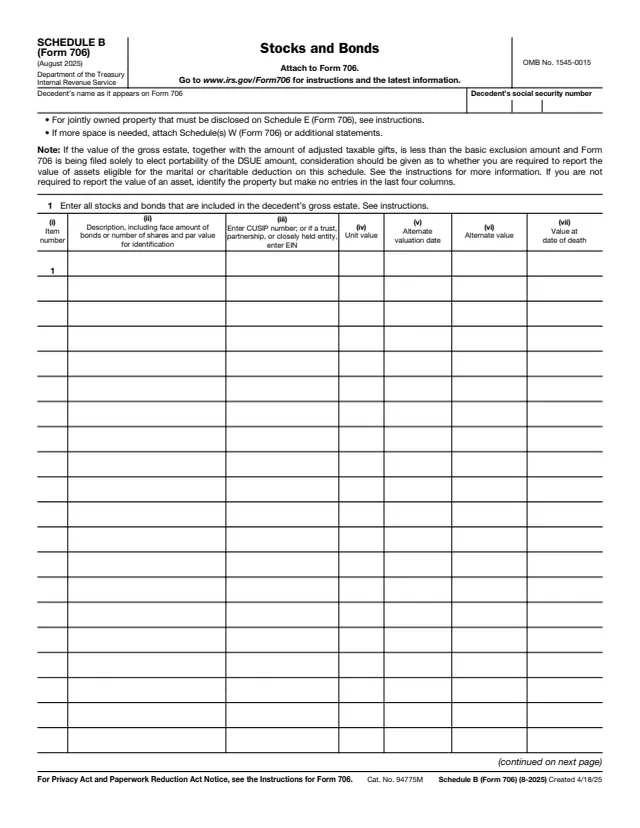
706 Sch. B
323 fields, 2 pages
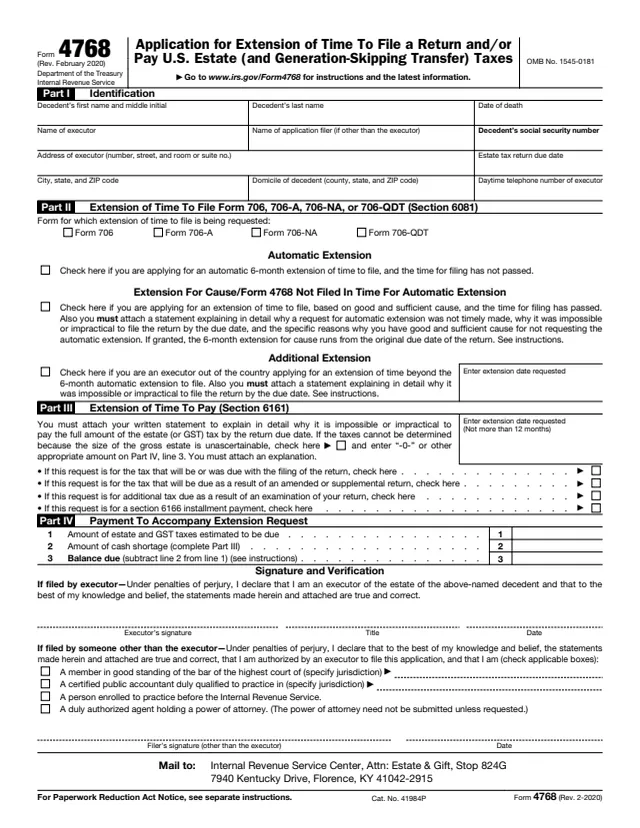
4768
35 fields, 1 page
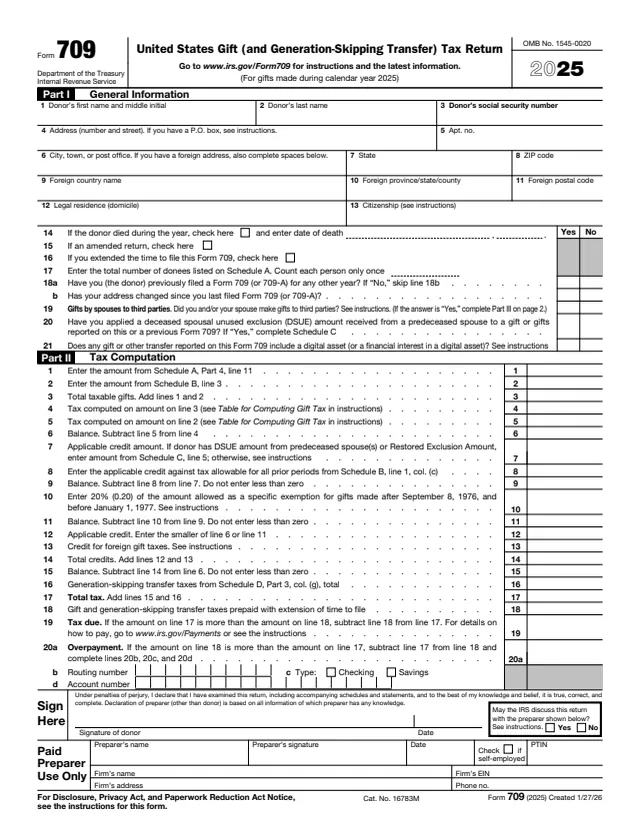
709
1,851 fields, 10 pages
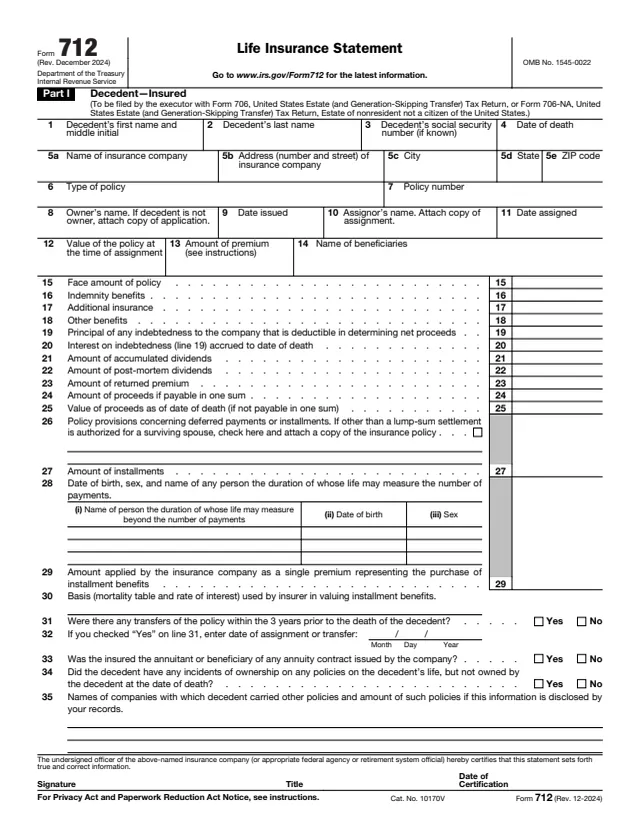
712
91 fields, 3 pages
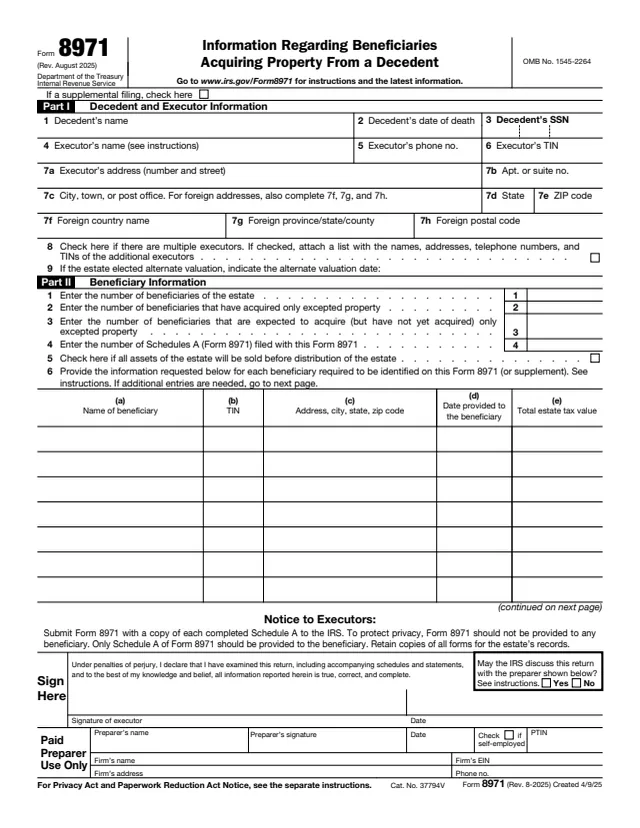
8971
196 fields, 2 pages
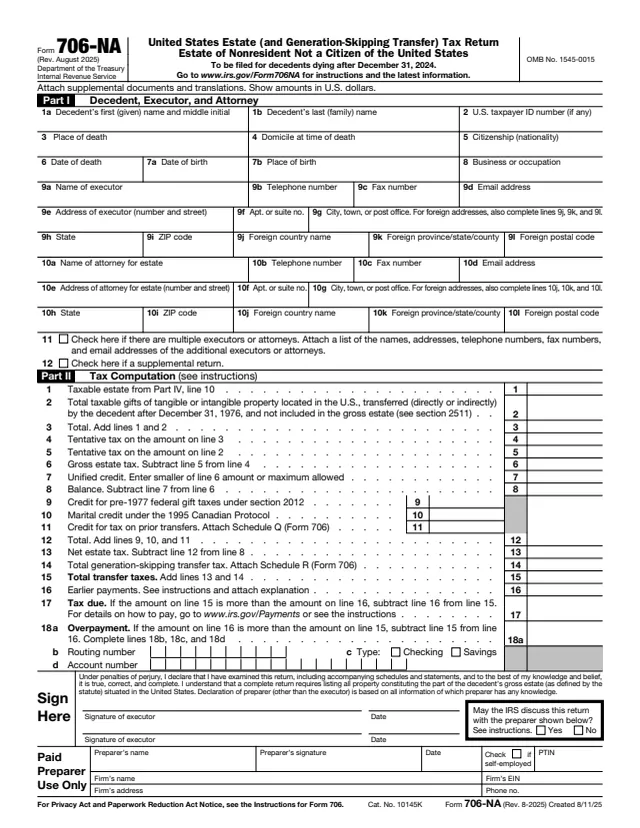
706-NA
259 fields, 3 pages
The executor of the decedent's estate files Form 706. The instructions say the term executor includes the executor, personal representative or administrator of the estate.
No tool matches that search.
The executor signs under penalties of perjury. The instructions say that with more than one executor, it is sufficient for one co-executor to sign, though all listed executors are responsible for the return.
The instructions say within 9 months after the date of the decedent's death. Form 4768 applies for an automatic 6-month extension of time to file.
The instructions list two cases for decedents who died in 2026: a gross estate, plus adjusted taxable gifts and specific exemption, of more than $15,000,000, or an executor electing to transfer the DSUE amount to the surviving spouse.
The form says a decedent with a surviving spouse elects portability of the DSUE amount by completing and timely filing the return. Part VI, Section A is checked to opt out.
They are separate forms. The instructions say all schedules were separated from Form 706 and are completed and attached as necessary.
Form 706-NA, for decedents who were neither U.S. citizens nor U.S. residents at the time of death, the instructions say.
The instructions say the executor uses Form 2848 to authorize a representative, or Form 8821 to let someone inspect or receive confidential tax information.