Supplemental filing box
A box at the top to check when this Form 8971 supplements one filed earlier.
8971
Information Regarding Beneficiaries Acquiring Property From a Decedent
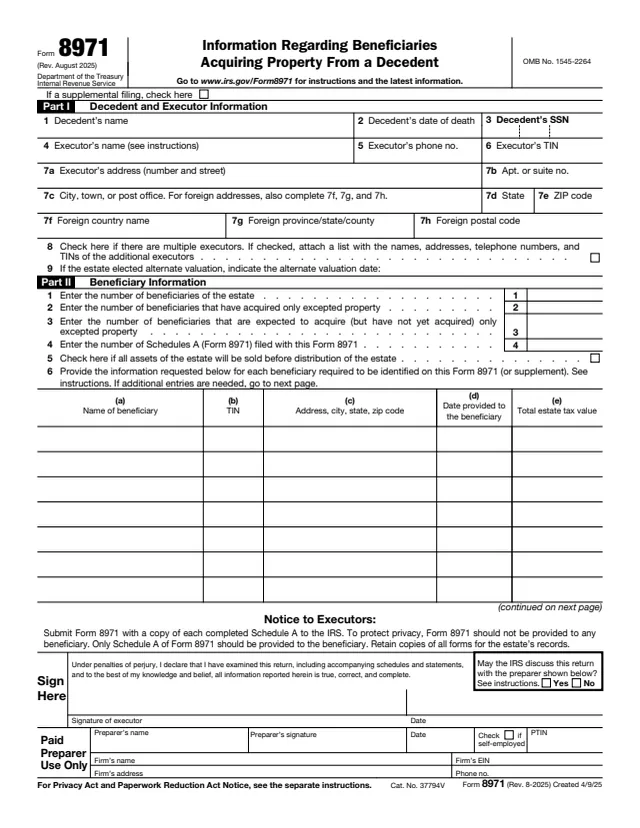
Form 8971, Information Regarding Beneficiaries Acquiring Property From a Decedent, is filed by the executor of an estate. The IRS About page says executors file it "to report the final estate tax value of property distributed or to be distributed from the estate, if the estate tax return is filed after July 2015."
The instructions say Form 8971 and copies of Schedules A give the IRS information about beneficiaries who acquired property from a decedent, while each Schedule A gives a beneficiary basis information. That basis information is tied to the consistent basis requirement of section 1014(f).
The form itself stays between the executor and the IRS. Its notice to executors says Form 8971 "should not be provided to any beneficiary"; only Schedule A goes to the beneficiary. You can fill out the form free in your browser on this page and download the result without an account.
A box at the top to check when this Form 8971 supplements one filed earlier.
The decedent's name, date of death and Social Security number.
The executor's name, phone number, TIN and address (with foreign address fields), a box for multiple executors, and the alternate valuation date if the estate elected it.
The number of beneficiaries, those acquiring only excepted property, the number of Schedules A filed, and a box if all estate assets will be sold before distribution.
For each beneficiary: name, TIN, address, the date Schedule A was provided and the total estate tax value. Page 2 continues the table and totals it on lines 7 to 9.
The executor's signature under penalties of perjury, a yes or no box allowing the IRS to discuss the return with the preparer, and the Paid Preparer Use Only area.
Check it only if this form supplements a previously filed Form 8971. The instructions say a supplement reports only the information that has changed.
Enter the decedent's details, then the name, phone, TIN and address of one executor. If there are others, check line 8 and attach a statement with each one's name, address, phone and TIN. Line 9 is the alternate valuation date under section 2032, if elected.
Enter the total number of beneficiaries, those who acquired or will acquire only excepted property, and the number of Schedules A attached, then check line 5 if all assets will be sold first.
Enter each beneficiary's name, TIN, address, the date Schedule A was furnished and the total estate tax value. The instructions say to enter "requested" if a TIN was asked for in writing but not received, and to attach the request.
Attach a copy of each required and optional Schedule A. Line 9 totals the values and matches the total from all attached Schedules A.
The instructions say it is enough for one executor to sign, though all executors are responsible for the information and liable for applicable penalties.
You get the real form, filled in a browser tab, with nothing standing between you and the finished PDF.
No later than the earlier of 30 days after Form 706 or 706-NA is required to be filed (including extensions) or 30 days after it is filed. Each required Schedule A goes to its beneficiary by the same date.
Internal Revenue Service, Mail Stop 824G, 7940 Kentucky Drive, Florence, KY 41042. The instructions say it is filed separately from any other tax return of the estate.
In person, by email, by U.S. mail or by a designated private delivery service to the beneficiary's last known address.
A supplement is filed when a beneficiary acquires property not yet reported or when reported information changes. The instructions give January 31 of the following year, or 30 days after the change becomes known, depending on the case.
Penalties may apply for failing to file a correct Form 8971 or furnish a correct Schedule A, even with no estate tax due. The instructions point to IRS.gov/Payments/Information-Return-Penalties for the amounts.
The instructions say the form is still filed on time even if all property is excepted property, such as U.S. dollars or life insurance proceeds paid in a lump sum.
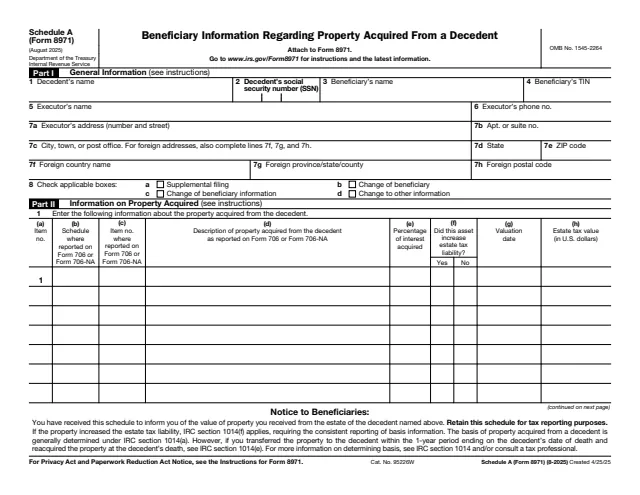
8971 Sch. A
237 fields, 2 pages
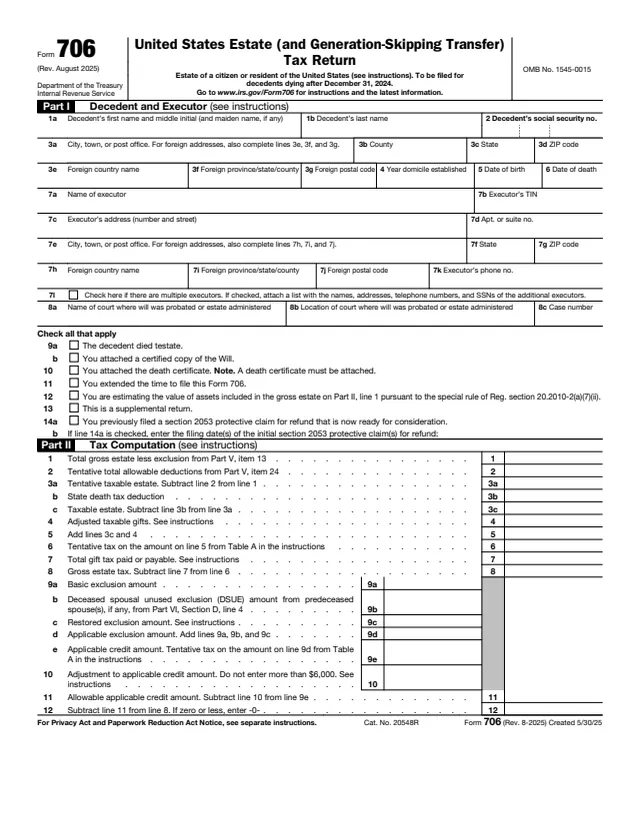
706
316 fields, 5 pages
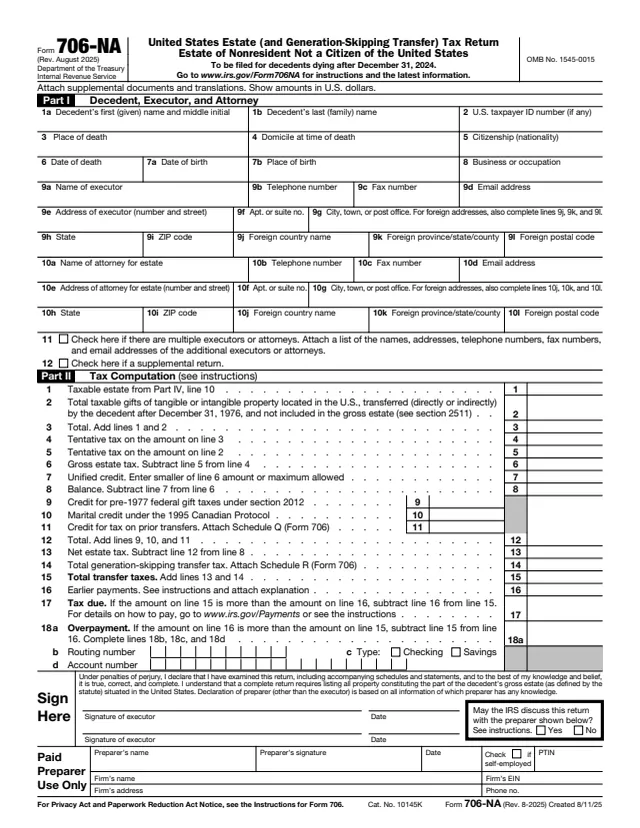
706-NA
259 fields, 3 pages
2848
92 fields, 2 pages
8822
25 fields, 2 pages
The executor completes Form 8971 and files it with the IRS. Beneficiaries do not file it; they receive only their own Schedule A.
No tool matches that search.
No. The form says it should not be provided to any beneficiary. Each beneficiary receives only the Schedule A that reports their property.
The earlier of 30 days after the Form 706 or 706-NA due date, including extensions, or 30 days after that return is filed.
No. The instructions say Form 8971 and copies of Schedules A are filed with the IRS separately from all other returns the estate files.
If the TIN was requested in writing and not received by the due date, the instructions say to enter "requested," attach a copy of the request, and file a supplement once the TIN arrives.
The instructions say one executor's signature is enough, but all executors shown are responsible for the reporting and liable for applicable penalties.
The form is still filed on time. The instructions say the executor does not report excepted property on a Schedule A.