Part I: General Information
Lines 1 to 21: the donor's name, SSN, address, domicile and citizenship, plus questions on amended returns, extensions, prior returns, gifts by spouses, DSUE amounts and digital assets.
709
United States Gift (and Generation-Skipping Transfer) Tax Return
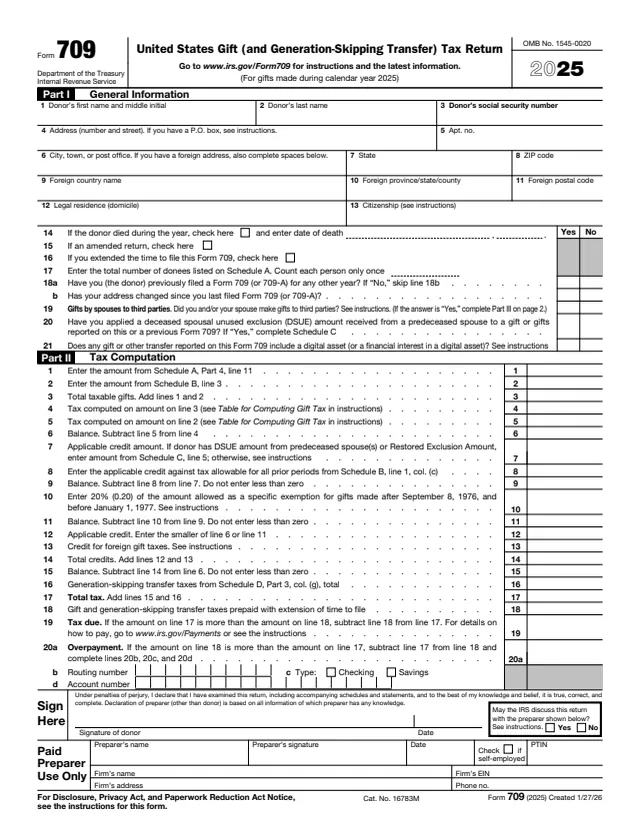
Form 709 is the United States Gift (and Generation-Skipping Transfer) Tax Return. The instructions say it is used to report transfers subject to the federal gift and certain generation-skipping transfer (GST) taxes, to figure the tax due, if any, and to allocate the lifetime GST exemption to property transferred during the transferor's lifetime.
This page covers the 2025 form, for gifts made during calendar year 2025. The instructions say gift and GST taxes are figured and filed on a calendar-year basis, with all reportable gifts for the year listed on one Form 709, and not more than one Form 709 for the same calendar year.
The donor completes and signs it, and the instructions say spouses may not file a joint gift tax return. You can fill it out free in your browser on this page and download it without an account.
Lines 1 to 21: the donor's name, SSN, address, domicile and citizenship, plus questions on amended returns, extensions, prior returns, gifts by spouses, DSUE amounts and digital assets.
Lines 1 to 20 carry taxable gifts from Schedules A and B, apply the applicable credit and any credit for foreign gift taxes, add GST taxes, and show tax due or an overpayment with direct deposit fields.
Lines 1 to 7 for gifts to third parties considered as made one-half by each spouse, with the consenting spouse's name and SSN and a question about the Notice of Consent.
Part 1 gifts subject only to gift tax, Part 2 direct skips, Part 3 indirect skips and other transfers in trust, and Part 4 taxable gift reconciliation with the marital and charitable deductions.
Schedule B lists gifts from prior periods. Schedule C figures the deceased spousal unused exclusion (DSUE) amount and Restored Exclusion Amount received from prior spouses.
Part 1 lists generation-skipping transfers, Part 2 reconciles the GST exemption under section 2631, and Part 3 computes the generation-skipping transfer tax.
The instructions start with whether a return is required, which gifts to report, and whether spouses will elect to split gifts for the year.
Complete lines 1 through 21 of Part I, then lines 1 through 7 of Part III when line 19 is answered Yes. The instructions say a consenting spouse signs a Notice of Consent that is attached to the donor's return.
Put each gift on Part 1, 2 or 3 with the donee, description, adjusted basis, date and value of the gift. The form says direct skips in Part 2 are listed in chronological order.
Complete Schedules B, C and D as they apply. The instructions say a gift listed on Part 2 or 3 of Schedule A also goes through the needed portions of Schedule D.
Reconcile taxable gifts on Schedule A, Part 4, enter line 11 on Part II, line 1, and complete the tax computation through line 20.
The donor signs and dates the return. The instructions say returns filed without entries in each field will not be processed.
The instructions give this order for completing the return.
You get the real form, filled in a browser tab, with nothing standing between you and the finished PDF.
The instructions say Form 709 is filed no earlier than January 1, but not later than April 15, of the year after the gift was made, or the next business day when April 15 falls on a Saturday, Sunday or legal holiday.
Department of the Treasury, Internal Revenue Service Center, Kansas City, MO 64999. With a private delivery service: Internal Revenue Service, 333 W. Pershing Road, Kansas City, MO 64108.
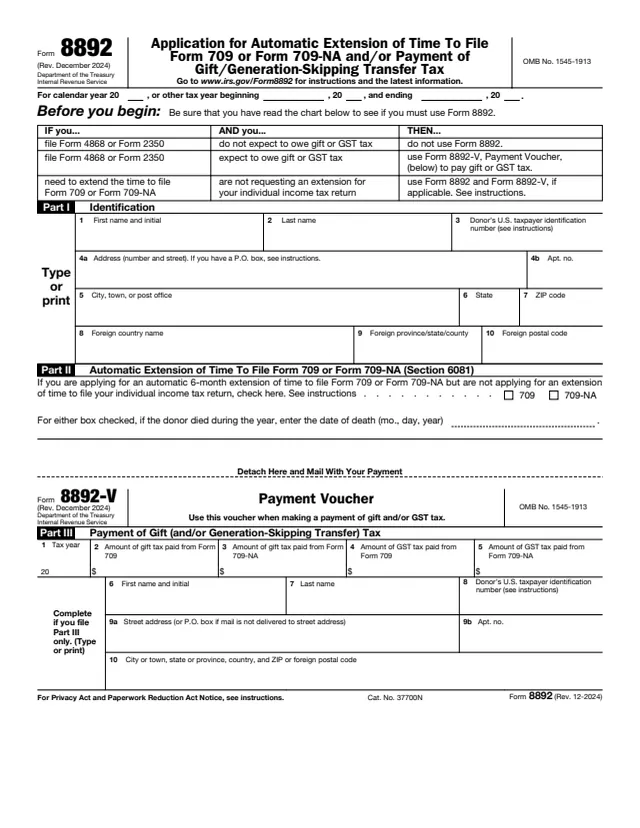
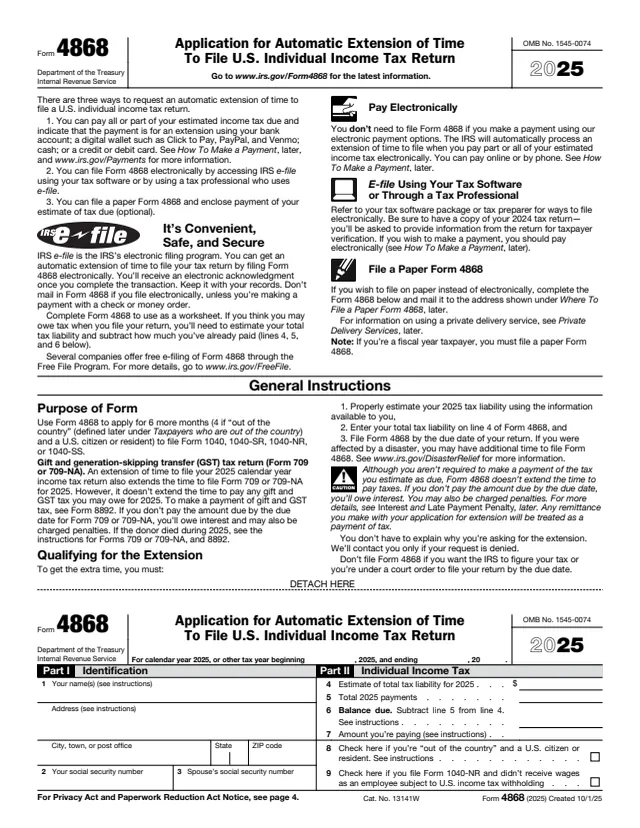
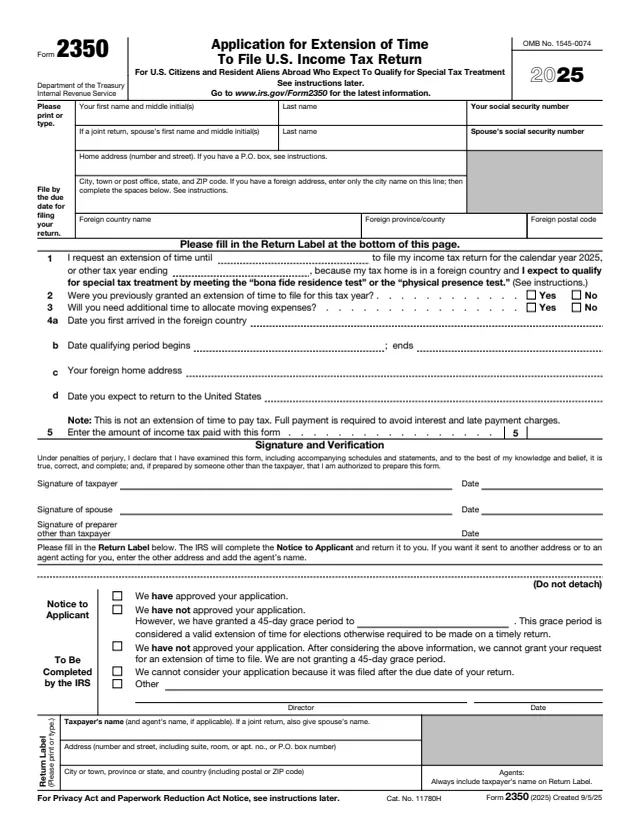
An extension for the 2025 income tax return on Form 4868 or Form 2350 also extends the gift tax return. Otherwise Form 8892 requests an automatic 6-month extension. The instructions say neither extends the time to pay.
The instructions say Modernized e-File (MeF) accepts the Form 709 family of returns, including a balance due paid by electronic funds withdrawal.
File another Form 709, check line 15 of Part I, include a statement of what changed, and attach a copy of the original. The instructions give an address in Florence, KY 41042-2915 for it.
The instructions say section 6651 imposes penalties for late filing and late payment unless there is reasonable cause, and list penalties for valuation understatements.
8892
30 fields, 1 page
4868
17 fields, 4 pages
2350
26 fields, 4 pages
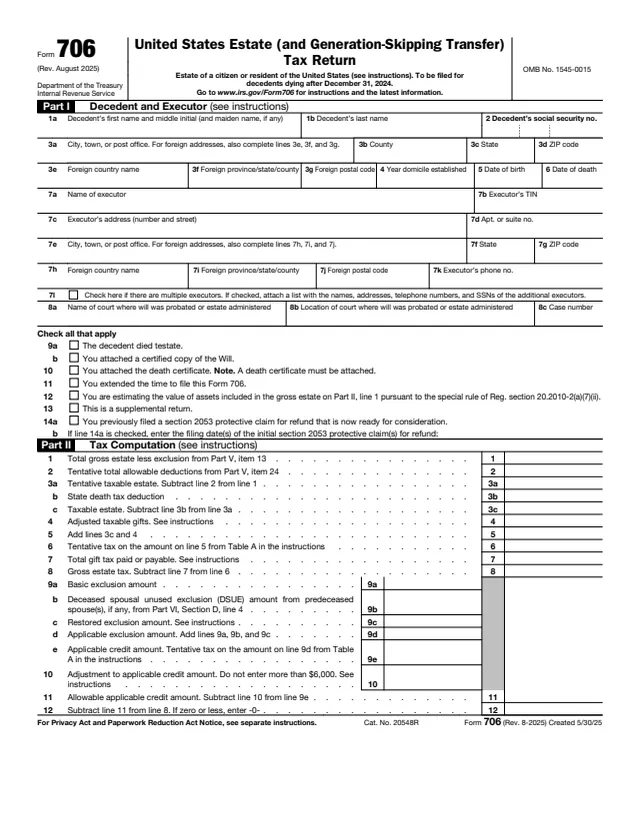
706
316 fields, 5 pages
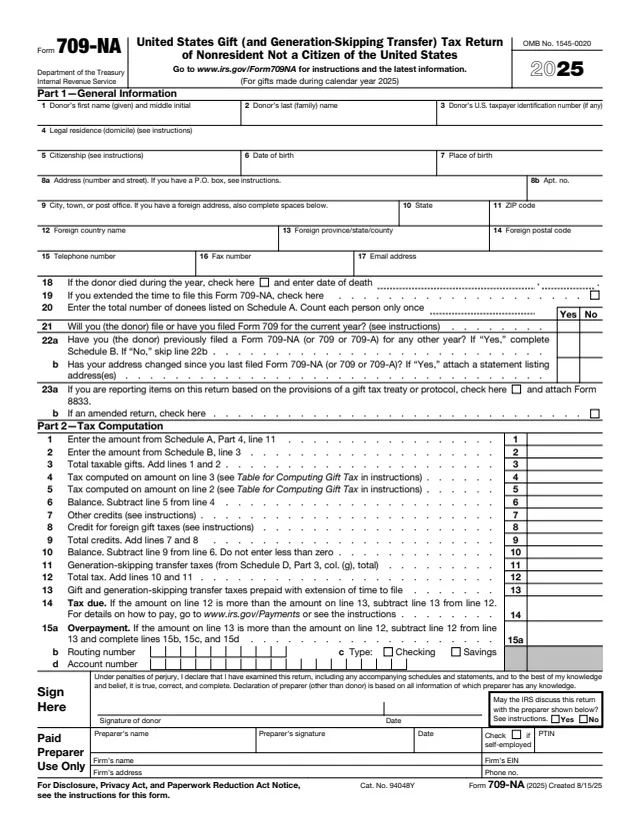
709-NA
889 fields, 8 pages
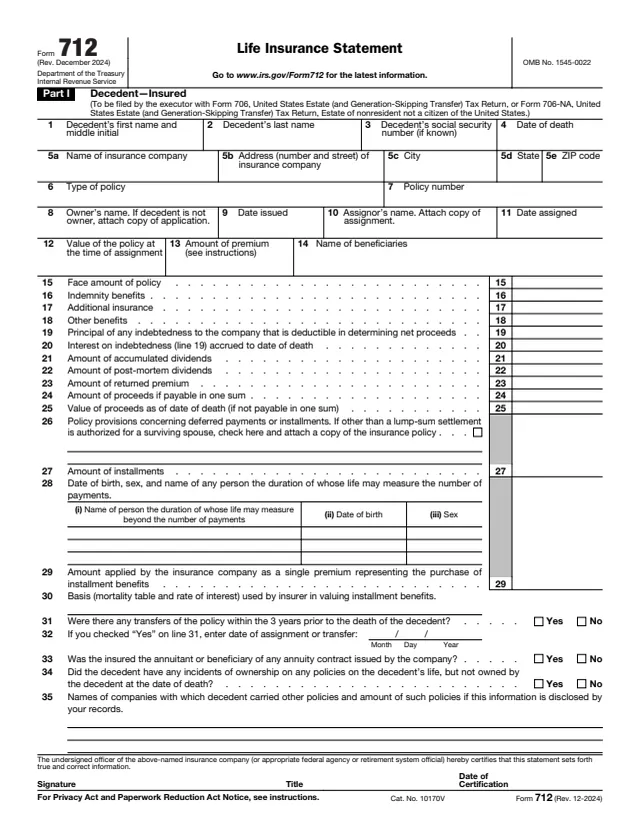
712
91 fields, 3 pages
The instructions say only individuals are required to file gift tax returns. Each spouse files their own.
No tool matches that search.
No. The instructions say spouses may not file a joint gift tax return. Part III, line 6 says that if the spouse also files a return for the year, both returns are mailed in the same envelope.
The instructions say the annual gift exclusion for 2025 is $19,000 for gifts of present interest to each donee. For gifts to a spouse who is not a U.S. citizen, it is $190,000.
The instructions list four transfers that are not gifts for Form 709: transfers to political organizations, transfers to certain exempt organizations, and payments that qualify for the educational or medical exclusion. They are not listed on Schedule A.
The instructions say no return is needed if the only gifts were deductible gifts to charities of the donor's entire interest in the property. A partial interest is still reported.
Yes. The instructions say the gift tax applies to transfers of digital assets, and Part I, line 21 asks whether any reported gift includes one.
The instructions say the executor files the 2025 Form 709 by the earlier of the estate tax return due date (with extensions) or April 15, 2026, or the extended due date for the gift tax return.
The instructions say the donor is responsible for paying it, but if the donor does not pay, the person receiving the gift may have to pay.