Decedent information
The decedent's name as it appears on Form 706 and the decedent's Social Security number, followed by notes on Schedule PC and Schedule W.
706 Sch. L
Net Losses During Administration and Expenses Incurred in Administering Property Not Subject to Claims
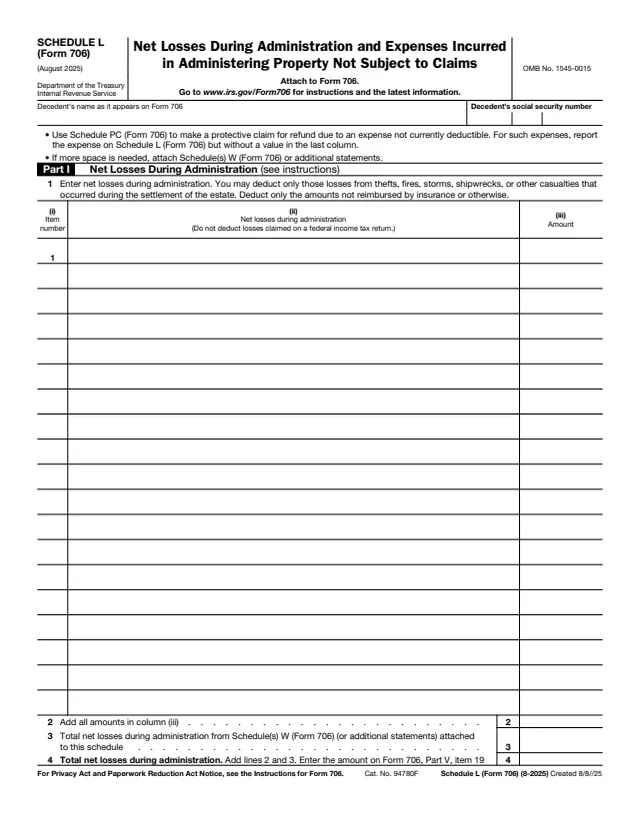
Schedule L (Form 706) reports two kinds of estate tax deductions: net losses during administration, and expenses incurred in administering property not subject to claims. The IRS About Form 706 page says it is used when deductions are claimed for net losses and property expenses during administration that are not subject to claims. It is attached to Form 706, the estate tax return the executor of a decedent's estate uses to figure the estate tax.
The Instructions for Form 706 say to complete Schedule L and file it with the return if the estate claims deductions on Form 706, Part V, item 19 or item 20. Part I totals the losses for item 19 and Part II totals the expenses for item 20.
You can fill out Schedule L (Form 706) free in your browser on this page and download it without an account.
The decedent's name as it appears on Form 706 and the decedent's Social Security number, followed by notes on Schedule PC and Schedule W.
A table with item number, a description of each net loss during administration, and the amount. The column heading says not to deduct losses claimed on a federal income tax return.
The total of column (iii), the total from attached Schedule W or statements, and their sum, which goes to Form 706, Part V, item 19.
A table for expenses incurred in administering property not subject to claims, with a note to indicate whether each is estimated, agreed upon or paid.
The total of column (iii), the total from attached Schedule W or statements, and their sum, which goes to Form 706, Part V, item 20.
The instructions say to describe in detail the loss and its cause, state any insurance or other compensation collected, and identify the property by the schedule, line and item number where it is in the gross estate.
The instructions say not to deduct losses claimed on a federal income tax return, depreciation in the value of securities or other property, or, under alternate valuation, the amount an item's value was already reduced.
The instructions say to list the names and addresses of the persons each expense was payable to, the nature of the expense, and the schedule, line and item number of the related property.
The instructions say an estimate may be deducted if it can be verified with reasonable certainty and will be paid before the section 6501 period of limitations for assessment expires.
For an expense not currently deductible, the schedule says to use Schedule PC (Form 706) and report the expense on Schedule L without a value in the last column.
Add column (iii) on lines 2 and 6, add any Schedule W totals on lines 3 and 7, then carry line 4 to Form 706, Part V, item 19 and line 8 to item 20.
You get the real form, filled in a browser tab, with nothing standing between you and the finished PDF.
The schedule says "Attach to Form 706." Line 4 is entered on Form 706, Part V, item 19 and line 8 on item 20.
The Form 706 instructions say Form 706 is filed within 9 months after the date of the decedent's death, and Form 4768 is used to apply for an automatic 6-month extension of time to file.
The Form 706 instructions give Department of the Treasury, Internal Revenue Service, Kansas City, MO 64999. The About page points to Filing estate and gift tax returns for the latest address.
The schedule says to attach Schedule(s) W (Form 706) or additional statements if more space is needed, and to enter their totals on lines 3 and 7.
The instructions say to keep all vouchers and receipts for inspection by the IRS.
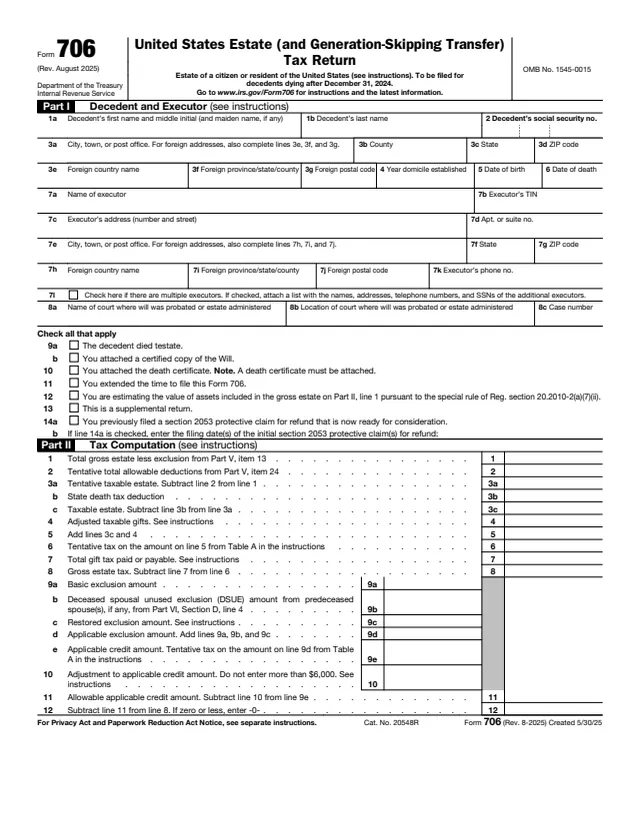
706
316 fields, 5 pages
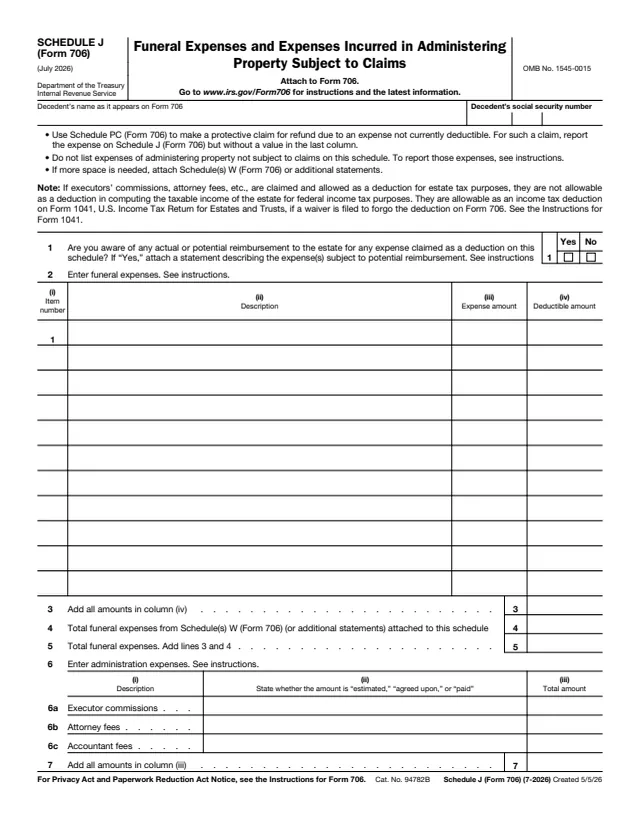
706 Sch. J
134 fields, 2 pages
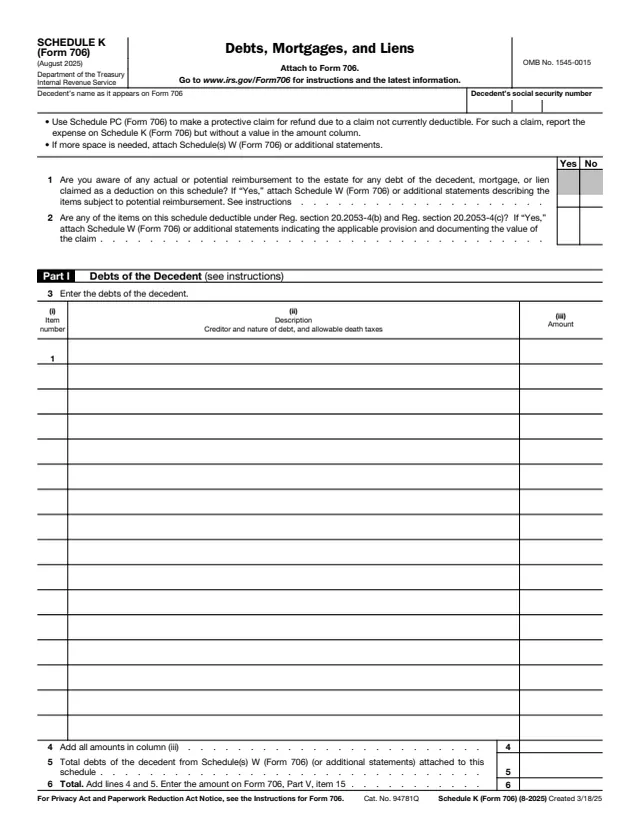
706 Sch. K
132 fields, 2 pages
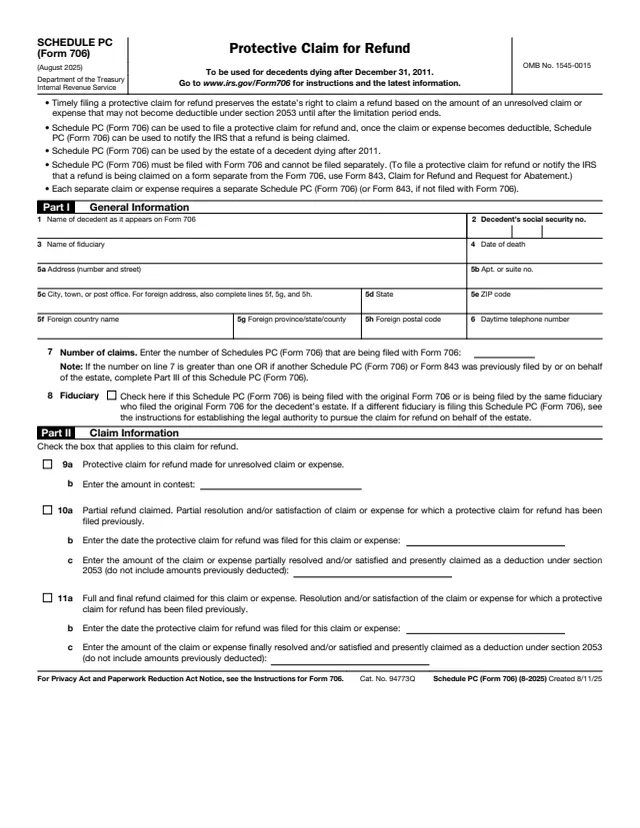
706 Sch. PC
354 fields, 3 pages
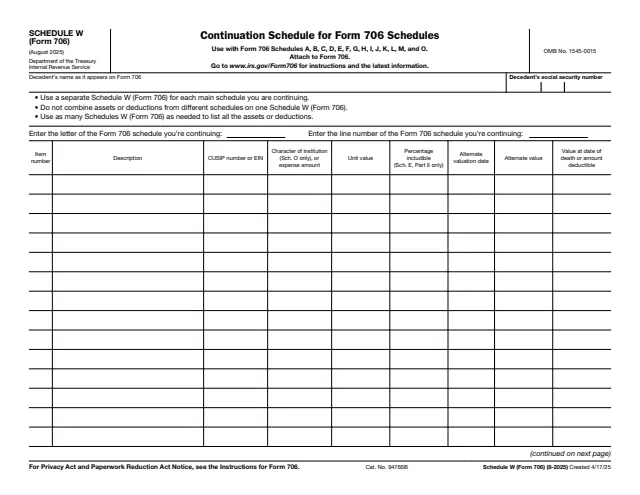
706 Sch. W
303 fields, 2 pages
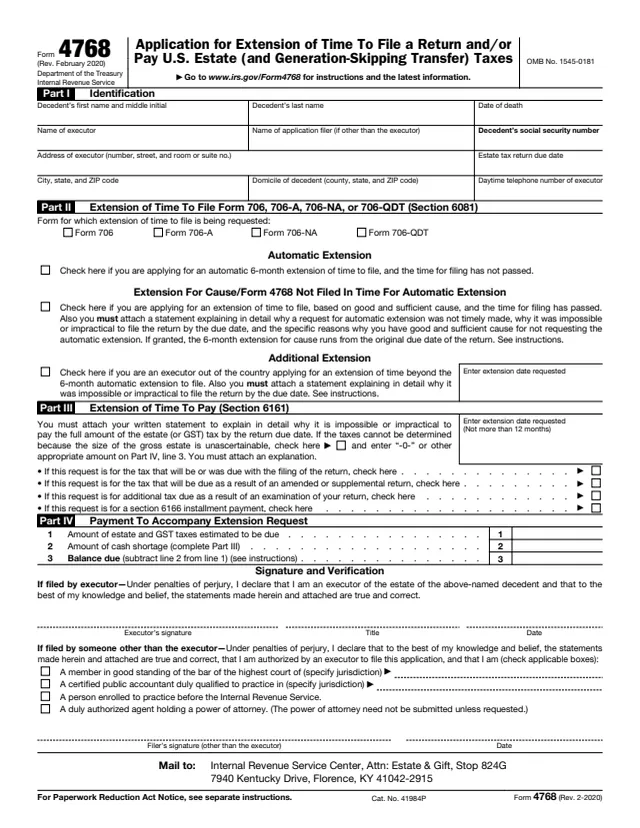
4768
35 fields, 1 page
The schedule is completed for a decedent's estate as part of Form 706 and goes to the IRS with that return. It is not an individual income tax form.
No tool matches that search.
The About Form 706 page says it is used to report deductions for net losses and property expenses during administration that are not subject to claims.
The schedule says only losses from thefts, fires, storms, shipwrecks or other casualties that occurred during the settlement of the estate, and only amounts not reimbursed by insurance or otherwise.
The instructions say they are usually expenses of administering a trust the decedent set up before death, and may include collecting other assets or clearing title to property not in the probate estate.
The schedule says to deduct these expenses only if they were paid before the section 6501 period of limitations for assessment expired.
The instructions say Schedule J (Form 706) lists expenses of administering property subject to claims, and expenses for property not subject to claims go on Schedule L.
Line 4 goes to Form 706, Part V, item 19, and line 8 goes to Form 706, Part V, item 20.