Heading items A to G
Trust and trustee names and address, EIN, type of entity, fair market value of assets at year end, gross income, return type boxes and the date the trust was created.
5227
Split-Interest Trust Information Return
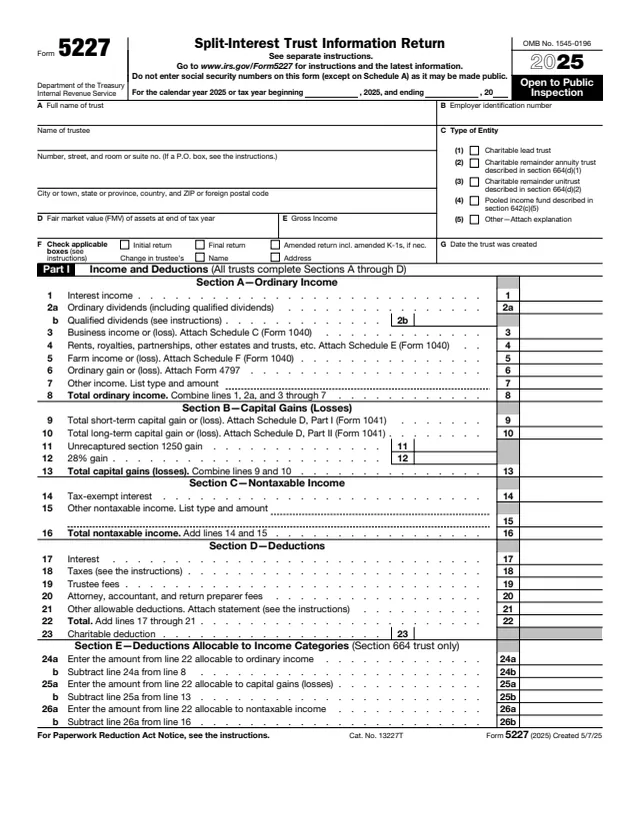
Form 5227 is the Split-Interest Trust Information Return. The instructions say it is used to report the financial activities of a split-interest trust, to provide certain information about charitable deductions and distributions of or from the trust, and to determine whether the trust is treated as a private foundation and subject to certain excise taxes under chapter 42.
It is filed by the trustee of a charitable remainder trust, a pooled income fund, a charitable lead trust or another split-interest trust. Form 5227 is open to public inspection, while its Schedule A, which covers accumulations, distributions to noncharitable recipients and donor information, is not.
The instructions say to file it for each calendar year. This page covers the 2025 form. You can fill out Form 5227 free in your browser on this page and download the result without an account.
Trust and trustee names and address, EIN, type of entity, fair market value of assets at year end, gross income, return type boxes and the date the trust was created.
Part I has ordinary income, capital gains, nontaxable income and deductions (Sections A to D), plus Section E for section 664 trusts. Part II is the schedule of distributable income for section 664 trusts.
Distributions of principal and income for charitable purposes, and a balance sheet of assets, liabilities and net assets with beginning and end of year book values and fair market value.
Part V is completed only by a section 664 CRAT and Part VI only by a section 664 CRUT.
Statements regarding activities, questions on activities for which Form 4720 may be required, and a questionnaire for charitable lead trusts, pooled income funds and charitable remainder trusts.
Schedule A covers accumulations, the SNIIC election, current distributions and assets and donor information. The return ends with the trustee's signature and the paid preparer block.
Enter the trust's name exactly as on Form SS-4, the trustee's name and address and the trust's EIN. Check the type of entity, enter the FMV of assets at year end and gross income, check any return type boxes and enter the date the trust was created.
Report income on lines 1 through 16 and attach the schedules the lines name, such as Schedule D (Form 1041) for capital gains. Enter deductions on lines 17 through 23. Section 664 trusts allocate deductions to income categories in Section E.
The instructions say parts or lines marked for one type of trust are completed only by that type, and unmarked parts by every split-interest trust. Parts VII and VIII are not completed by a trust whose charitable interests involve only cemeteries or war veterans' posts.
Answer every question in Part VII, entering "N/A" if a line does not apply. Part VIII checks whether the trust, trustee or disqualified persons may owe chapter 42 excise taxes, which the instructions say are paid on Form 4720.
Complete the Schedule A parts for the trust type. For section 664 trusts, the instructions say to give each recipient in Schedule A, Part III a Schedule K-1 (Form 1041) and attach a copy of each to Form 5227.
The trustee or an authorized representative signs and dates. A paid preparer enters a PTIN, not an SSN, because the instructions note the preparer block becomes public.
You get the real form, filled in a browser tab, with nothing standing between you and the finished PDF.
The instructions say to file the calendar year 2025 form by April 15, 2026. For a final short year, it is due by the 15th day of the 4th month after the trust's termination.
Form 8868 requests an automatic extension of time to file. The instructions say the request is filed by the due date of the return.
The instructions say filers of 10 or more returns in the aggregate in a calendar year file Form 5227 electronically. Not filing electronically when required is treated as a failure to file, even if a paper return is sent.
By U.S. Postal Service from the United States: Department of the Treasury, Internal Revenue Service Center, Ogden, UT 84201-0027. By private delivery service or from outside the United States: Internal Revenue Service Center, 1973 Rulon White Blvd., M/S 6054, Ogden, UT 84201.
The instructions list $25 for each day the failure continues, up to $13,000 per return. If the trust has gross income greater than $327,000, it is $130 per day, up to $65,000.
For the first return of a charitable remainder or charitable lead annuity trust or unitrust, the instructions say to include a copy of the trust instrument and a written declaration under penalties of perjury that it is a true and complete copy.
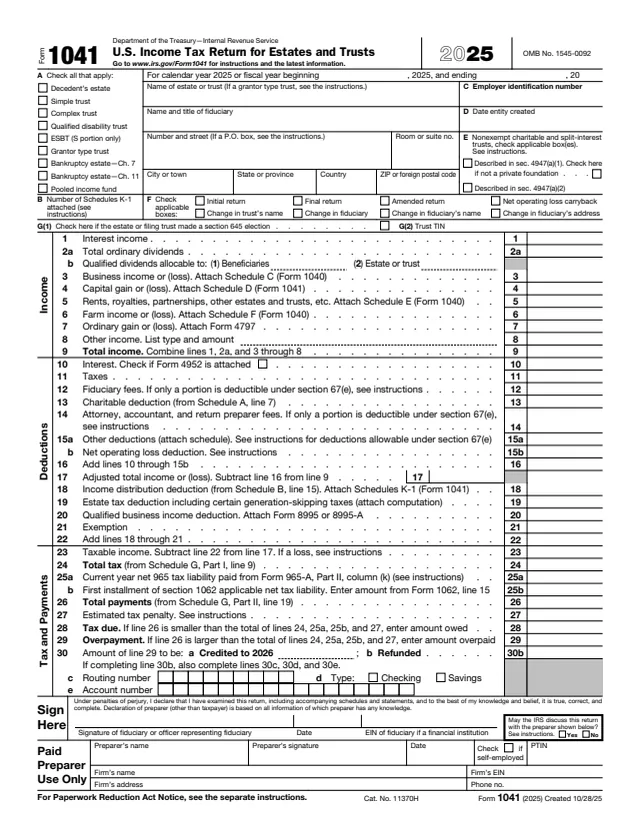
1041
173 fields, 3 pages
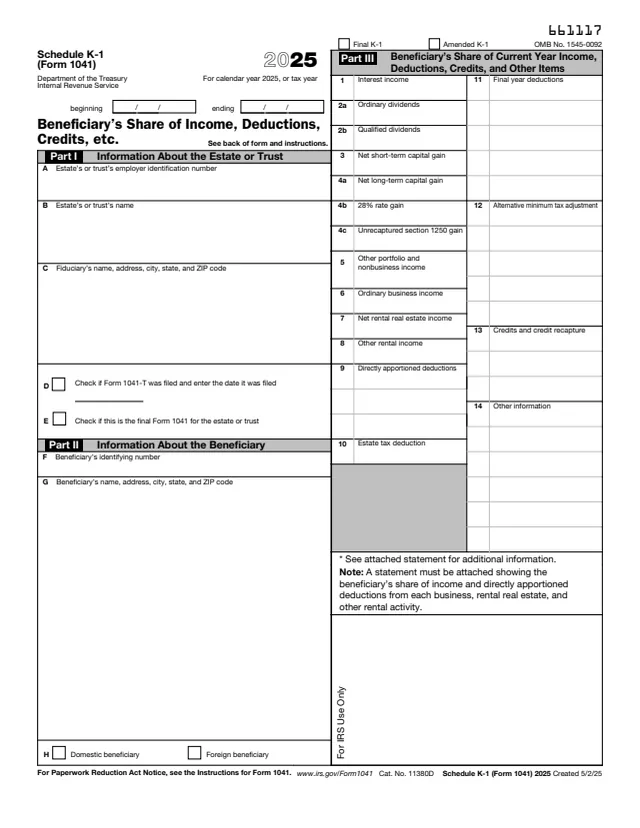
1041
74 fields, 2 pages
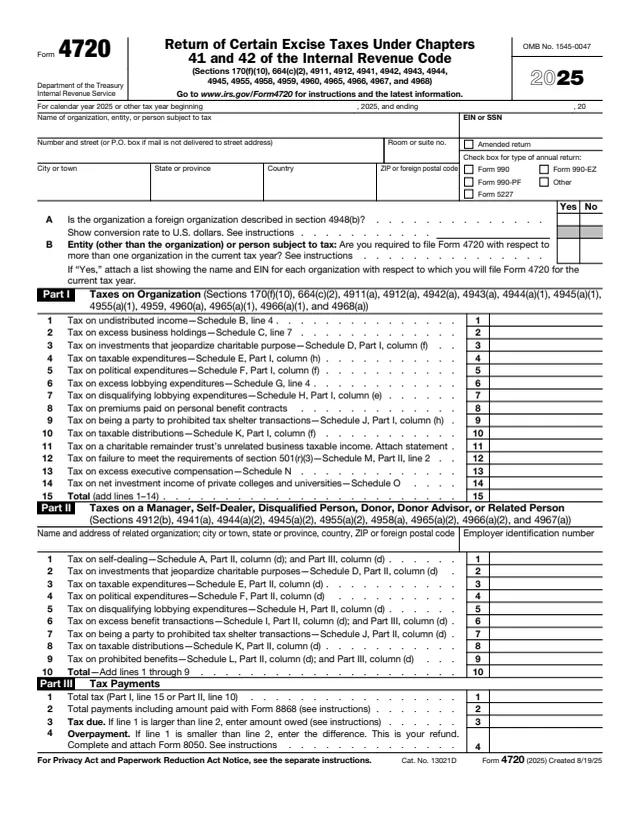
4720
666 fields, 10 pages
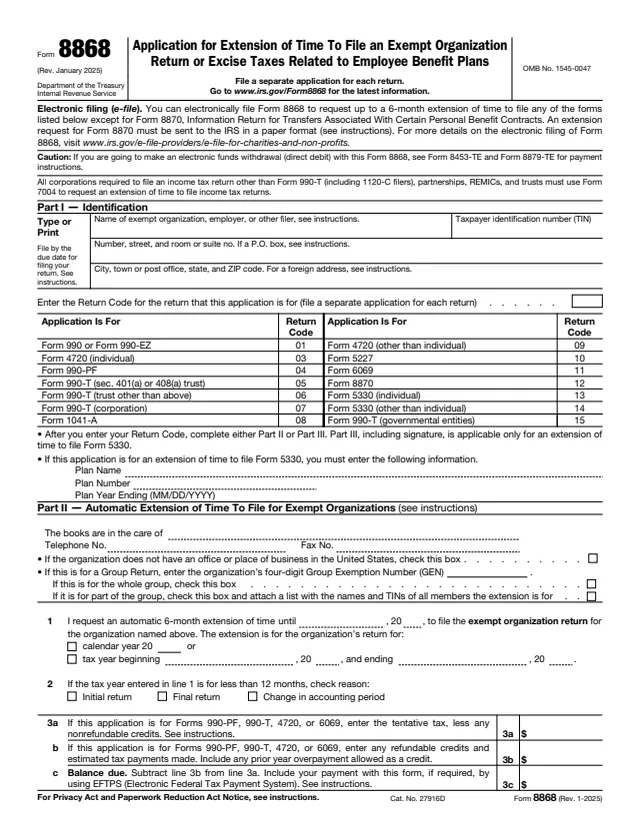
8868
47 fields, 2 pages
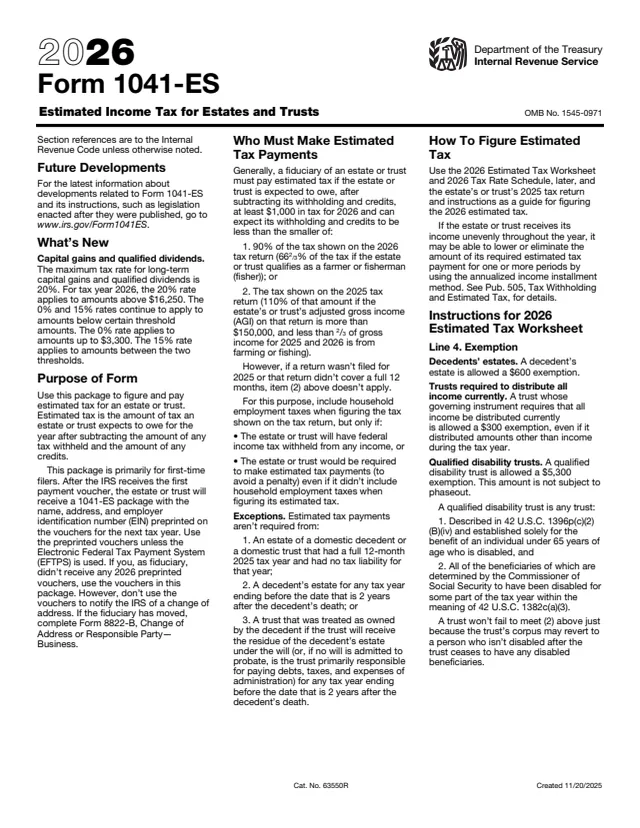
1041-ES
116 fields, 7 pages
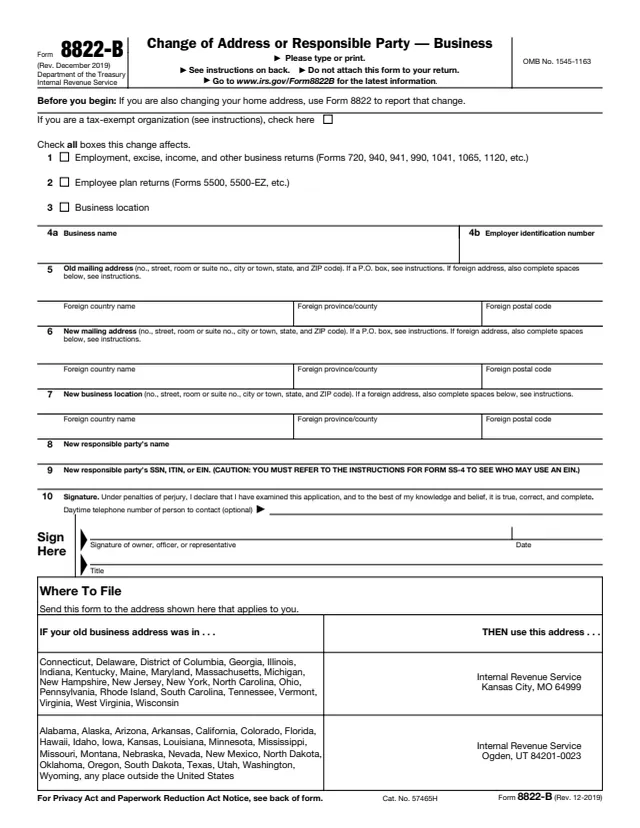
8822-B
22 fields, 2 pages
The return is filed for the trust and signed by its trustee. The instructions name these filers.
No tool matches that search.
The instructions describe it as a trust not exempt under section 501(a), with some interests devoted to other than charitable purposes and amounts transferred in trust after May 26, 1969, for which a deduction was allowed under a section listed in section 4947(a)(2).
Yes. The instructions say Form 5227 is open to public inspection, but Schedule A, Schedule K-1, the trust agreement and attachments with donor information are not. The form says not to enter social security numbers except on Schedule A.
By April 15, 2026, according to the instructions. Form 8868 requests an automatic extension, filed by the due date.
The trustee or an authorized representative. A person paid to prepare the return for a charitable remainder trust generally also signs as paid preparer.
The instructions say Form 5227 replaces Form 1041-B, and replaces Form 1041-A for split-interest trusts.
The instructions list 877-829-5500 for questions and help completing the form, available Monday through Friday.