Part I: Identification
Name of the exempt organization, employer or other filer, taxpayer identification number, address, and the Return Code.
8868
Application for Extension of Time To File an Exempt Organization Return or Excise Taxes Related to Employee Benefit Plans
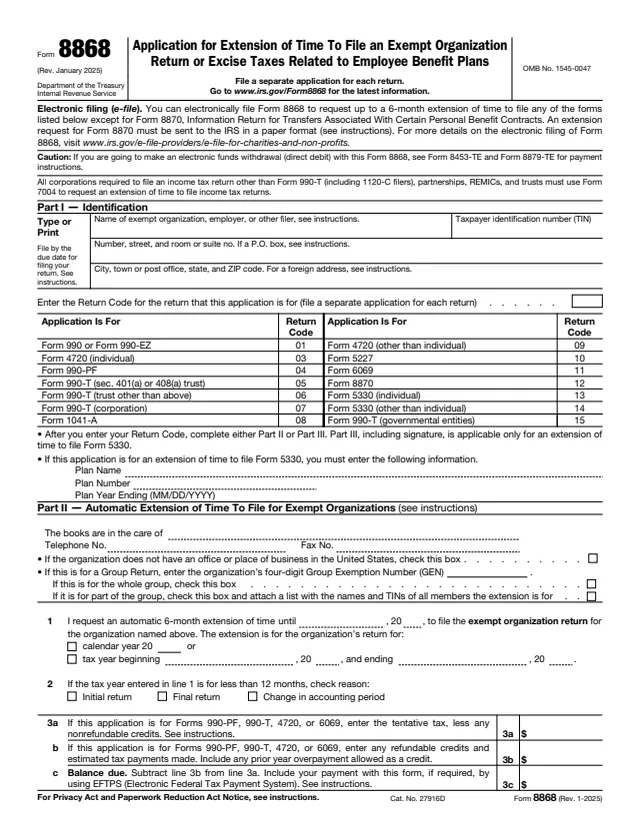
Form 8868 is the Application for Extension of Time To File an Exempt Organization Return or Excise Taxes Related to Employee Benefit Plans. The About page says it is used by an exempt organization or governmental entity (filing Form 990-T to make an elective payment election), or by the trustee of a trust required to file Form 1041-A or Form 5227, to request an automatic 6-month extension of time to file its return. A Form 5330 filer also uses it to request an extension of up to 6 months to file a return for excise taxes related to employee benefit plans.
Each application covers one return, picked by a Return Code from 01 to 15. Part II is the automatic extension for exempt organizations, and Part III is the extension for Form 5330. The instructions say extending the time to file does not extend the time to pay tax.
You can fill out Form 8868 free in your browser on this page and download it without an account.
Name of the exempt organization, employer or other filer, taxpayer identification number, address, and the Return Code.
Codes 01 to 15 for Forms 990 or 990-EZ, 4720, 990-PF, the four kinds of 990-T, 1041-A, 5227, 6069, 8870 and 5330.
Plan name, plan number and plan year ending, completed only for a Form 5330 extension.
Who keeps the books, foreign and group return boxes, the requested date and tax year on line 1, short-year reasons on line 2, and tentative tax, credits and balance due on lines 3a to 3c.
The requested date, the Code sections imposing the tax, the payment amount attached, a reversion/amendment date for sections 4980 or 4980F, and the reason for the extension.
A penalties of perjury declaration with signature and date, which applies to Part III.
Enter the filer's name, TIN and address. The instructions say to use C/O for mail received through a third party, and that a new address on Form 8868 will not update the filer's record; Form 8822 or Form 8822-B does that.
Enter only one Return Code, for the return being extended. The instructions say a separate Form 8868 is filed for each return. Then complete either Part II or Part III, but not both.
Enter the date requested, which the instructions say cannot be later than 6 months from the original due date, and the calendar or tax year. Check a reason on line 2 if the tax year is less than 12 months.
The instructions say all filers complete lines 3a, 3b and 3c, entering -0- when the amount is expected to be zero. Line 3c is the balance due.
Fill in the plan details, the requested date, the Code sections on line 1a and the payment on line 1b. On line 2, the instructions say to clearly describe the circumstances beyond the filer's control.
The instructions say a signature is required only for a Form 5330 extension. No signature is required for Part II filers.
You get the real form, filled in a browser tab, with nothing standing between you and the finished PDF.
The form says Form 8868 can be e-filed to request up to a 6-month extension for any listed form except Form 8870, whose extension request goes in paper format.
The instructions list Internal Revenue Service, Mail Stop 6054, 1973 N Rulon White Blvd., Ogden, UT 84201-0045 for applications not filed electronically.
By the due date of the return being extended. For Form 5330, the instructions say to file in sufficient time for the IRS to consider and act on it before the return's normal due date. Attaching Form 8868 to the return does not extend the due date.
The instructions say Form 8868 does not extend the time to pay tax, and interest is charged on tax not paid by the regular due date. They describe EFTPS, same-day wire, check, cash and, for Form 5330 e-filers, Electronic Funds Withdrawal.
The instructions say no blanket requests: a separate Form 8868 is filed for each return, and the extension does not cover related returns. A central organization can request an extension for a group return using its Group Exemption Number.
The instructions say the filer receives a computer-generated notice that the Form 5330 extension is approved or denied.
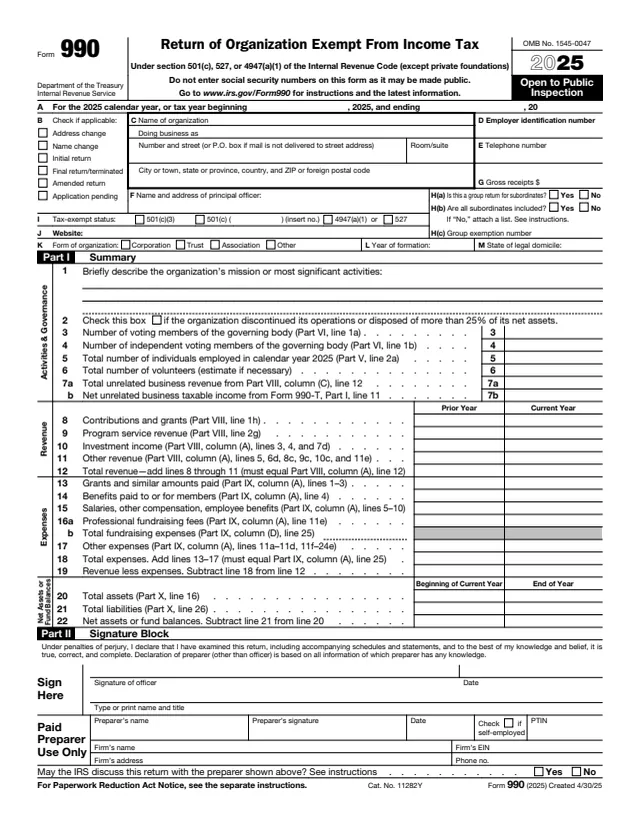
990
1,075 fields, 12 pages
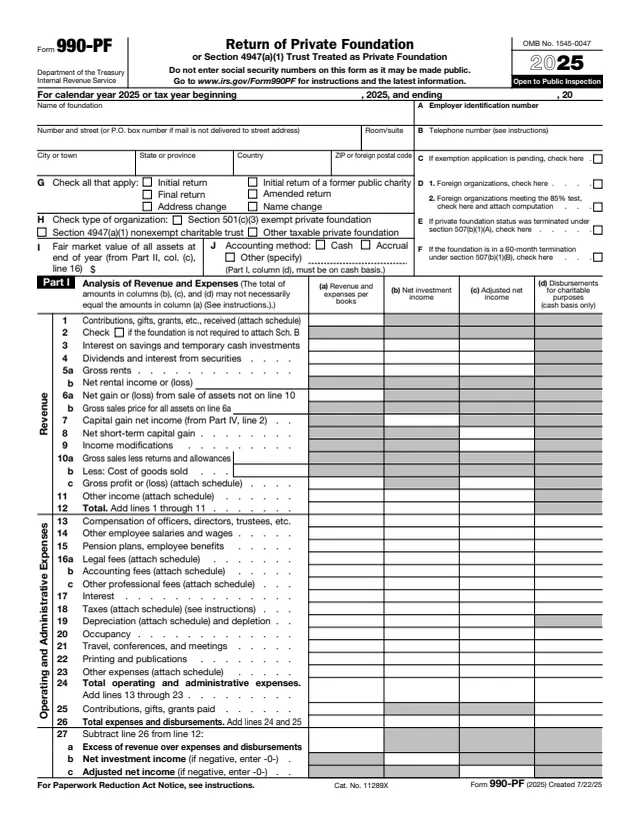
990-PF
1,147 fields, 13 pages
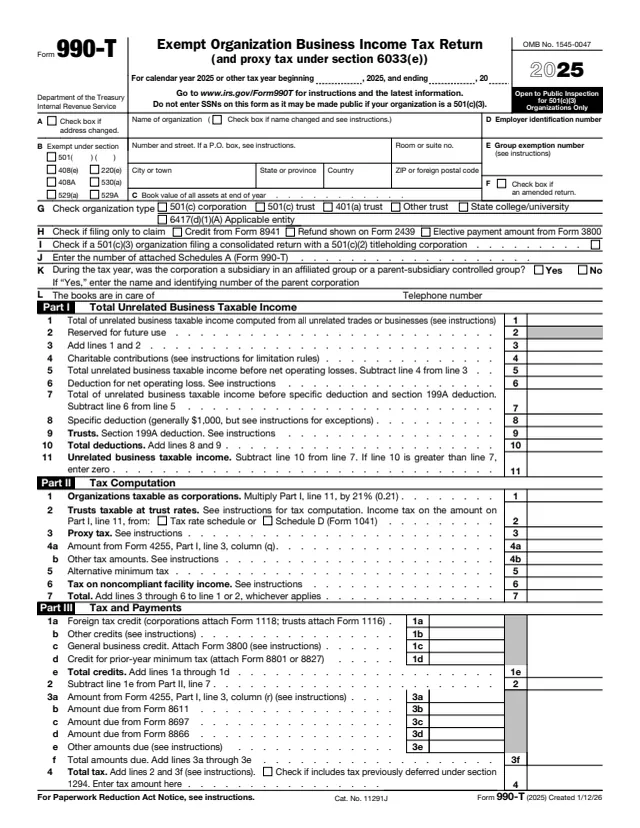
990-T
128 fields, 2 pages
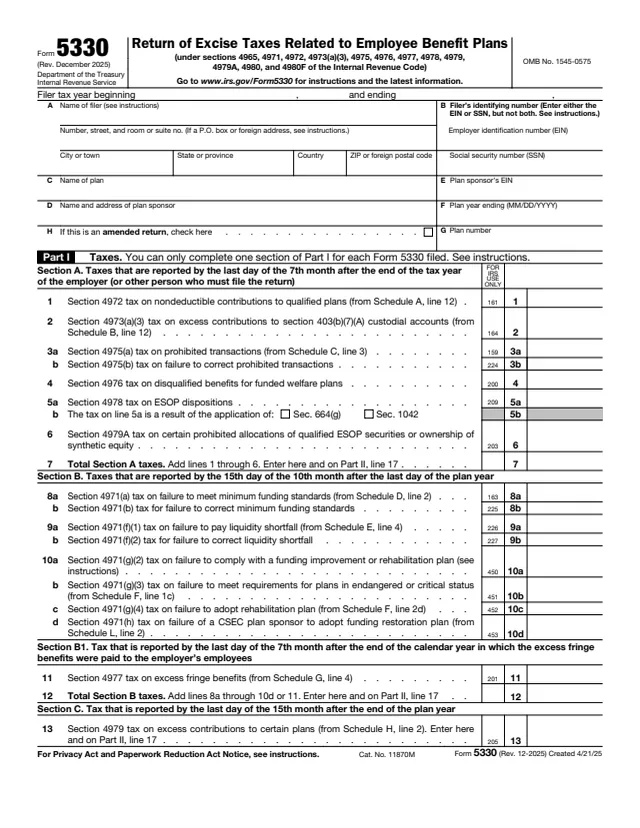
5330
304 fields, 6 pages
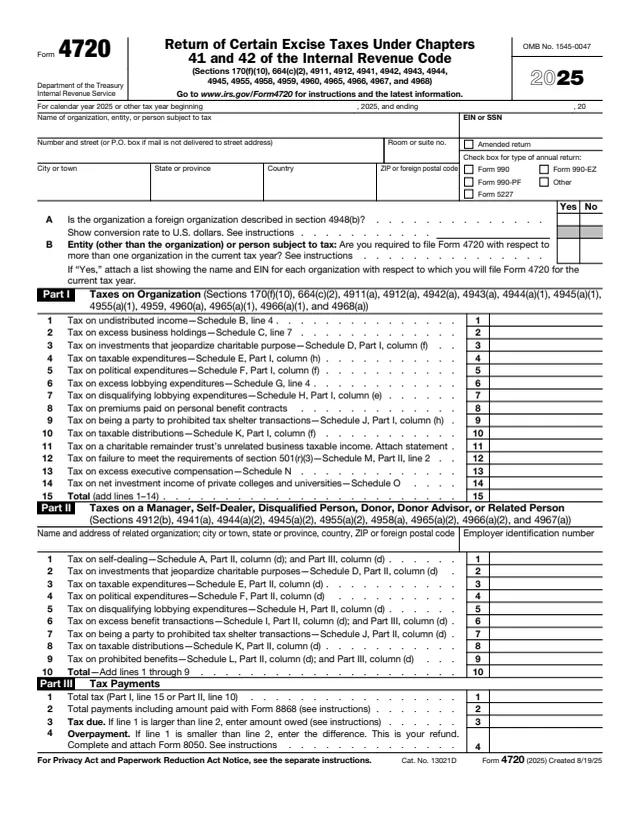
4720
666 fields, 10 pages
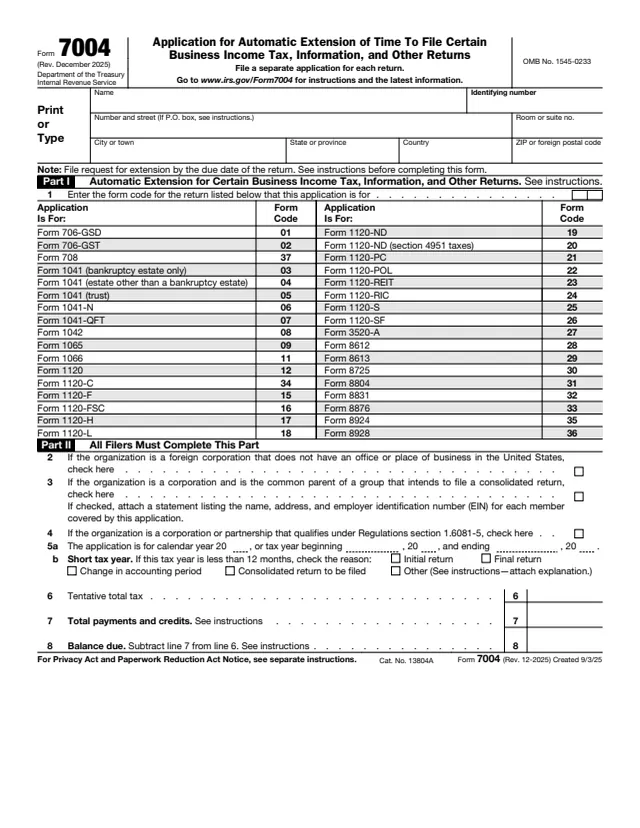
7004
26 fields, 1 page
The instructions say the filer may be an exempt organization, a nonexempt organization (for example, a disqualified person or a foundation manager trustee), an employer, a governmental entity, or an individual. The application goes to the IRS.
No tool matches that search.
The About page describes an automatic 6-month extension for exempt organization returns, and an extension of up to 6 months for Form 5330. The instructions say a single extension of 6 months is allowed for each type of return for a tax year.
No. The instructions say extending the time to file does not extend the time to pay tax, and interest is charged from the regular due date until the tax is paid.
No. The instructions say Form 8868 cannot be used to extend the due date of Form 990-N.
No. The form and instructions say to file a separate application for each return. An extension for a private foundation return, for example, does not apply to Form 4720.
Only for an extension of time to file Form 5330. The instructions say no signature is required for Part II filers.
Yes, for every listed return except Form 8870. The form says an extension request for Form 8870 is sent to the IRS in paper format.