Items A to H
The filer's name, address and EIN or SSN, the plan name, the plan sponsor's name, address and EIN, the plan year ending, the plan number and an amended return box.
5330
Return of Excise Taxes Related to Employee Benefit Plans
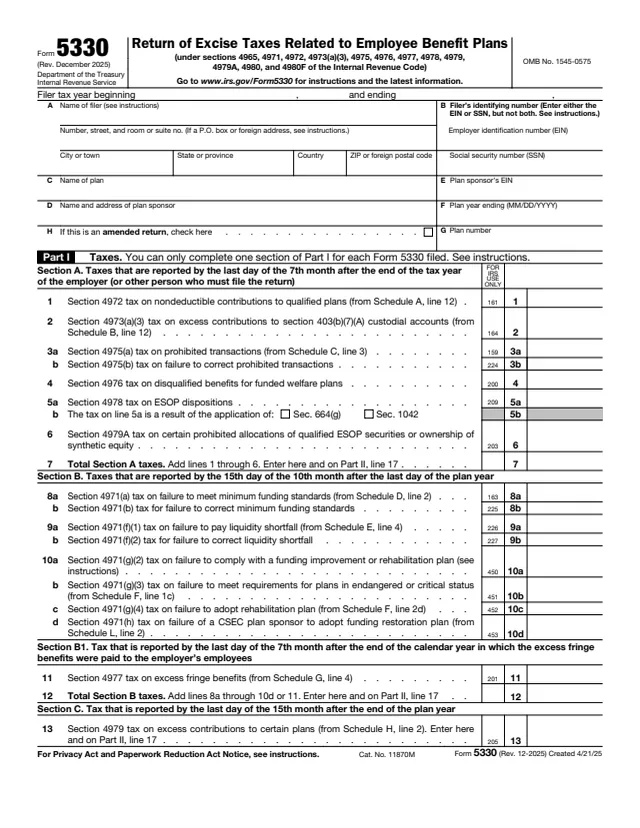
Form 5330 is the IRS return for excise taxes related to employee benefit plans. The IRS says this form is used to report and pay the excise tax related to employee benefit plans. The form covers taxes under sections 4965, 4971, 4972, 4973(a)(3), 4975, 4976, 4977, 4978, 4979, 4979A, 4980 and 4980F of the Internal Revenue Code.
The instructions list taxes such as those on prohibited transactions, minimum funding deficiencies, nondeductible contributions to qualified plans, excess contributions, ESOP dispositions, reversions of plan assets to employers and failures to give notice of a significant reduction in future accruals. Each tax has its own schedule (A to L) and its own due date, so Part I is split into sections by due date.
Most filers are employers, plan sponsors or other persons liable for the tax, and in some cases an individual. You can fill out Form 5330 free in your browser on this page and download the result without an account.
The filer's name, address and EIN or SSN, the plan name, the plan sponsor's name, address and EIN, the plan year ending, the plan number and an amended return box.
Lines 1 to 7: taxes reported by the last day of the 7th month after the end of the tax year, such as sections 4972, 4973(a)(3), 4975, 4976, 4978 and 4979A.
Lines 8a to 10d cover section 4971 funding taxes, reported by the 15th day of the 10th month after the plan year. Line 11 is the section 4977 tax on excess fringe benefits.
Line 13 for section 4979, line 14 for section 4980 reversions, line 15 for section 4980F notice failures and line 16 for section 4965 prohibited tax shelter transactions.
The tax from Part I, any tax paid with Form 5558 or earlier, the tax due or overpayment, direct deposit fields and the signature area.
One schedule per tax, such as Schedule C for prohibited transactions, Schedule D for minimum funding, Schedule I for reversions and Schedule K for prohibited tax shelter transactions.
Enter the tax year and the name and address of the person liable for the tax. Item B takes either the EIN or the SSN, but not both. The instructions say an individual uses an SSN unless a sole proprietor with an EIN.
Enter the plan name as shown on the Form 5500 series return, the plan sponsor and its EIN, the plan year ending in MM/DD/YYYY order and the three-digit plan number.
The form says only one section of Part I can be completed on each Form 5330. The instructions say to report all taxes with the same due date on one form, with separate forms for separate plans.
Figure each tax on its schedule and carry it to Part I. For example, Schedule A multiplies taxable excess contributions by 10%, and Schedule I applies a 20% or 50% rate to the employer reversion.
Enter the Part I total on line 17 and any tax already paid on line 18. Line 19 is the tax due; line 20a is an overpayment with direct deposit details on lines 20b to 20d.
The instructions ask the filer to sign and date the form and enter a daytime phone number. A paid preparer signs and completes the Paid Preparer Use Only area.
You get the real form, filled in a browser tab, with nothing standing between you and the finished PDF.
They depend on the tax. Per the instructions' table, sections 4972 and 4975 are due the last day of the 7th month after the end of the tax year, section 4971 the 15th day of the 10th month after the plan year ends.
The instructions say to use Form 8868, which can give up to 6 months if filed by the normal due date. Form 5558 is no longer used for this, and Form 8868 does not extend the time to pay.
The instructions say e-filing is required for tax years ending on or after December 31, 2023, if the filer files at least 10 returns of any type during the calendar year the Form 5330 is due.
Department of the Treasury, Internal Revenue Service Center, Ogden, UT 84201.
Make the check or money order payable to "United States Treasury" and write the name, identifying number, plan number and "Form 5330, Section ____" on it, per the instructions.
The instructions list 5% of the unpaid tax per month late for filing, up to 25%, and ½ of 1% per month for late payment, up to 25%, unless due to reasonable cause.
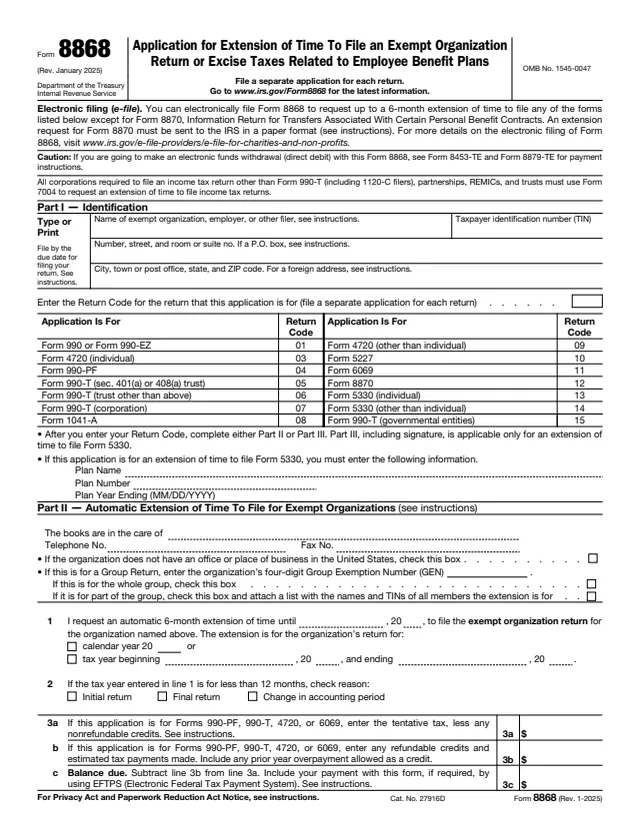
8868
47 fields, 2 pages
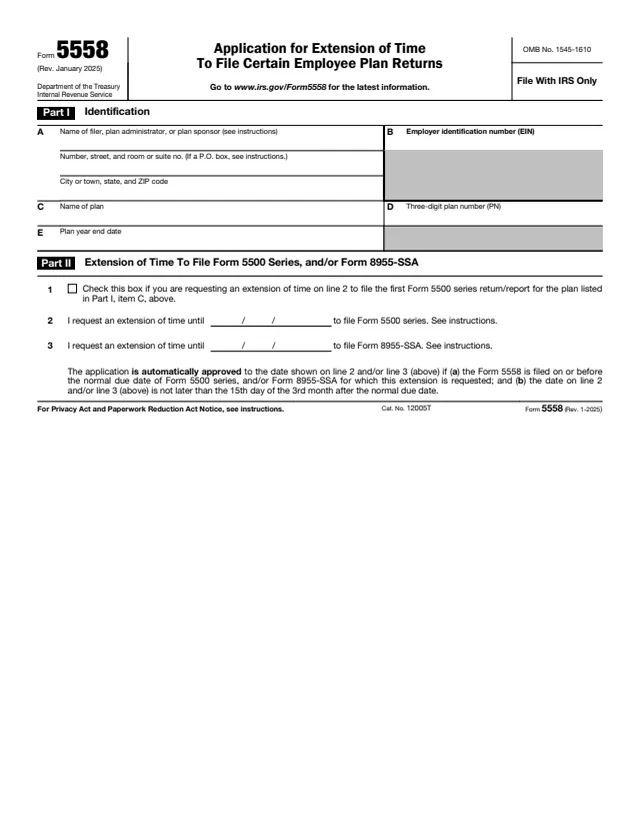
5558
13 fields, 3 pages
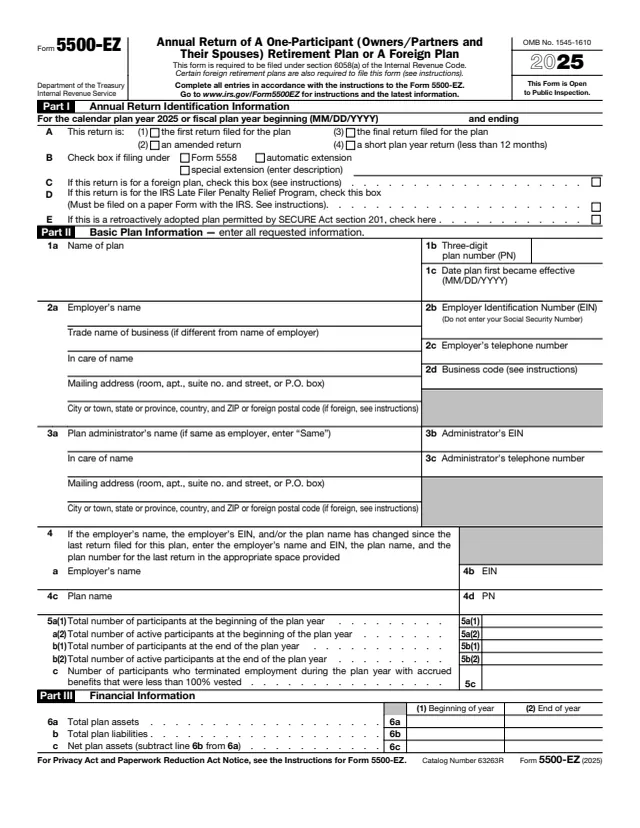
5500-EZ
78 fields, 2 pages
5329
75 fields, 3 pages
The return is filed by the person liable for the tax. The instructions list who files it, and most entries on that list are employers.
No tool matches that search.
The person liable for the tax. The instructions list mainly employers, plus disqualified persons in prohibited transactions, plan sponsors, entity managers, ESOP employers or cooperatives and, in some cases, individuals.
The instructions say to file one Form 5330 for all excise taxes with the same filing due date, but separate forms for taxes from separate plans. The form allows only one section of Part I per return.
With Form 8868, filed by the normal due date. The instructions say Form 5558 is no longer used to extend Form 5330, and the extension does not extend the time to pay.
No. The instructions say a financial institution that is a disqualified person files only one Form 5330 under its EIN, pays the tax and attaches a list of all impacted IRAs or plans.
File an amended Form 5330, check the box in item H and report the corrected taxes. The instructions say a refund or credit claim states the reasons in detail with supporting evidence.
The instructions give Department of the Treasury, Internal Revenue Service Center, Ogden, UT 84201, for filers not required to e-file.