Use of the form and the standards
Page 1 explains the certification and lists six standards, VSC #1 to VSC #6, from following all Quality Site Requirements to treating all taxpayers in a professional, courteous and respectful manner.
13615
Volunteer Standards of Conduct Agreement – VITA/TCE Programs
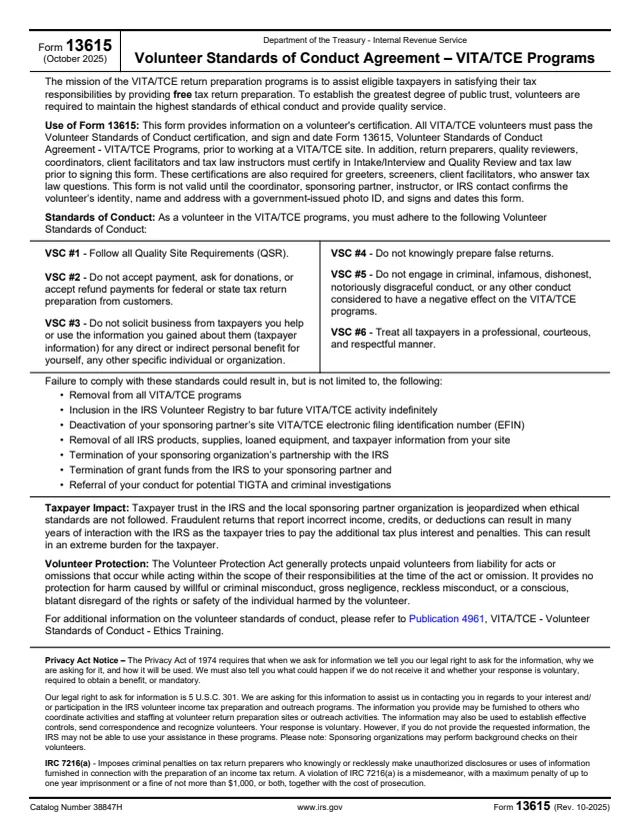
Form 13615 is the Volunteer Standards of Conduct Agreement for the VITA/TCE programs, which the form says exist to assist eligible taxpayers in satisfying their tax responsibilities by providing free tax return preparation. It is completed by the volunteers and approved by a site official. Taxpayers who get help at a site do not fill it out.
The form says all VITA/TCE volunteers pass the Volunteer Standards of Conduct certification, and sign and date Form 13615, before working at a VITA/TCE site. It is not valid until the coordinator, sponsoring partner, instructor or IRS contact confirms the volunteer's identity, name and address with a government-issued photo ID, and signs and dates the form.
Page 1 lists six standards of conduct and what can happen when they are not followed. Page 2 holds the volunteer's details and signature, certification levels, the approving official's signature, a parent or guardian consent and a section for continuing education credits. The PDF can be filled out free in the browser on this page and downloaded without an account.
Page 1 explains the certification and lists six standards, VSC #1 to VSC #6, from following all Quality Site Requirements to treating all taxpayers in a professional, courteous and respectful manner.
A list of possible results of not complying, such as removal from all VITA/TCE programs, plus notes on taxpayer impact, the Volunteer Protection Act and IRC 7216(a).
Full name, volunteer positions, home address, email, daytime phone, sponsoring partner or site name, years volunteered and an electronic or typed signature with date, plus an IRS Employee box.
Boxes for each certification passed, from Volunteer Standards of Conduct (required for all) to Basic, Advanced, Military, International, Puerto Rico, Foreign Students and SPEC OPI, plus professional designation and license details.
Signature blocks for the coordinator, sponsoring partner, instructor or IRS contact, and for a parent or guardian.
PTIN account name, PTIN, CTEC ID, site address and SIDN, professional status, certification level and total hours volunteered, with the approving official's signature.
The form says volunteers pass the Volunteer Standards of Conduct certification first, and some roles also certify in Intake/Interview and Quality Review and tax law, before signing.
Enter full name, volunteer positions, home address, email, daytime telephone, sponsoring partner or site name and the number of years volunteered, including this year.
The form says to add the letter P for all passing test scores. A volunteer with a professional designation (Attorney, CPA, CTEC or Enrolled Agent) adds the jurisdiction and number.
By signing, the volunteer declares completing the certification and agreeing to the standards, and certifies being a U.S. citizen, a legal resident, or otherwise residing in the U.S. legally.
The approving official checks the certification levels and a government-issued photo ID, then signs and dates. A parent or guardian signs for a child who volunteers.
The coordinator or partner completes this section. The form says CE credits will not be issued without a PTIN for Enrolled Agents, non-credentialed preparers and CTEC registered preparers.
You get the real form, filled in a browser tab, with nothing standing between you and the finished PDF.
The form says it is signed and dated before the volunteer works at a VITA/TCE site, and it is not valid until the approving official confirms the volunteer's ID and signs.
For CE credits, the coordinator, sponsoring partner or instructor signs and sends the completed form to the SPEC territory office or relationship manager for further processing.
The form says a minimum of 10 volunteer hours is required to issue CE credits. Advanced qualifies for 14 CE credits, and Advanced and One or More Specialty Courses qualifies for 18.
Listed results include removal from all VITA/TCE programs, inclusion in the IRS Volunteer Registry, deactivation of the site EFIN, termination of grant funds and referral for TIGTA and criminal investigations.
The form says a violation of IRC 7216(a) is a misdemeanor, with a maximum penalty of up to one year imprisonment or a fine of not more than $1,000, or both, together with the cost of prosecution.
The form refers to Publication 4961 for the standards of conduct, and to Publications 5362 and 5683 for CE credit requirements.
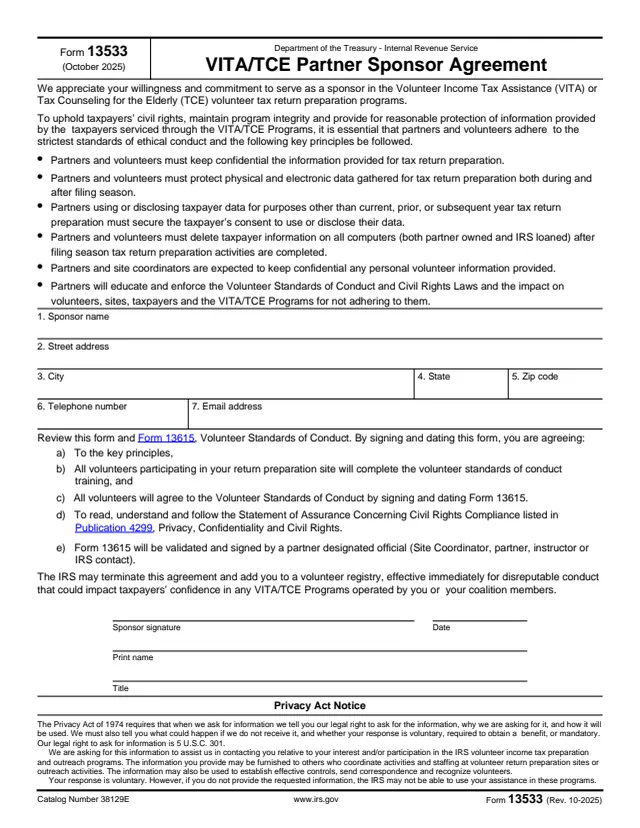
13533
13 fields, 1 page
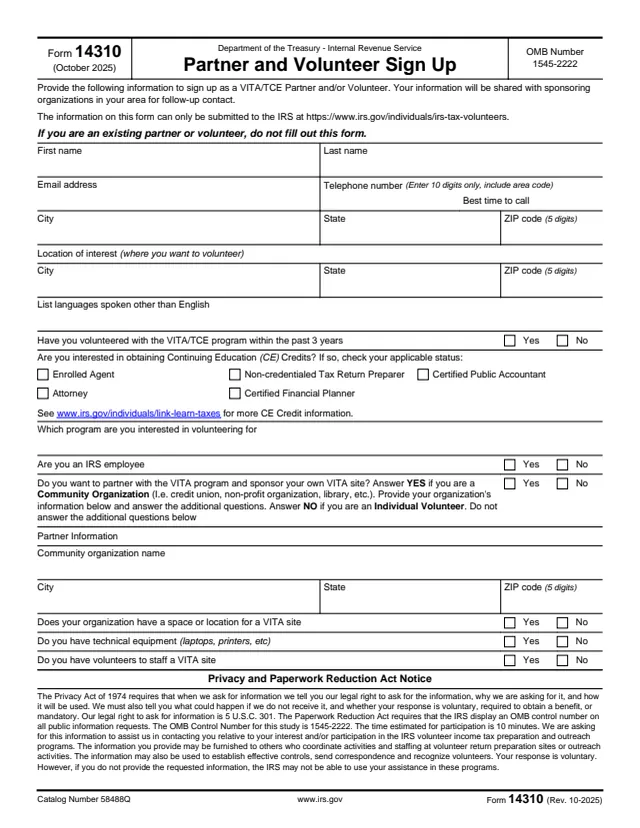
14310
36 fields, 1 page
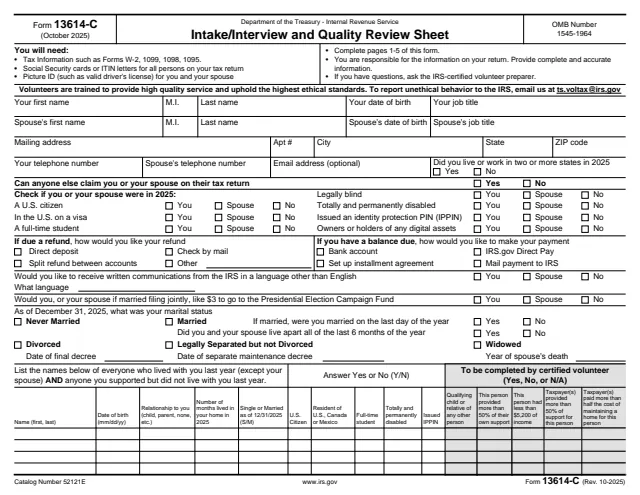
13614-C
297 fields, 6 pages
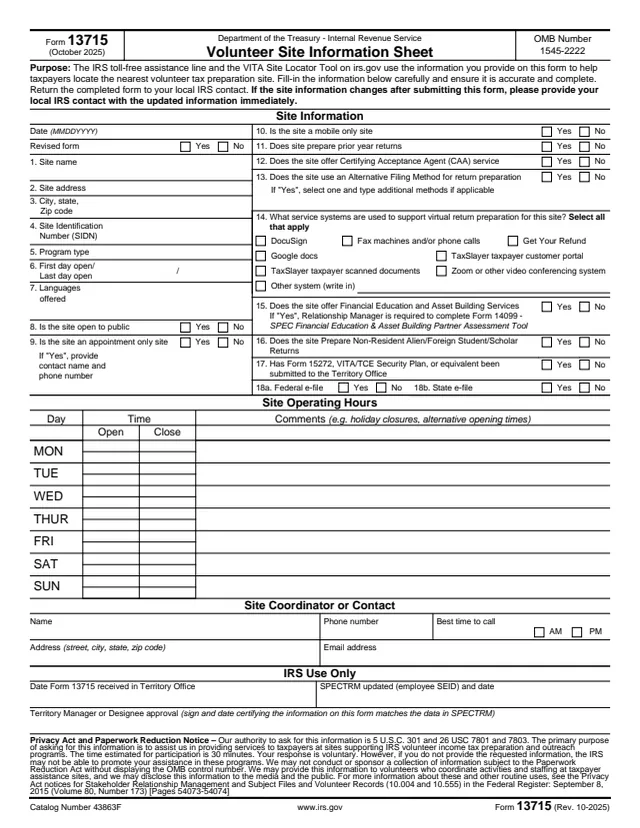
13715
89 fields, 1 page
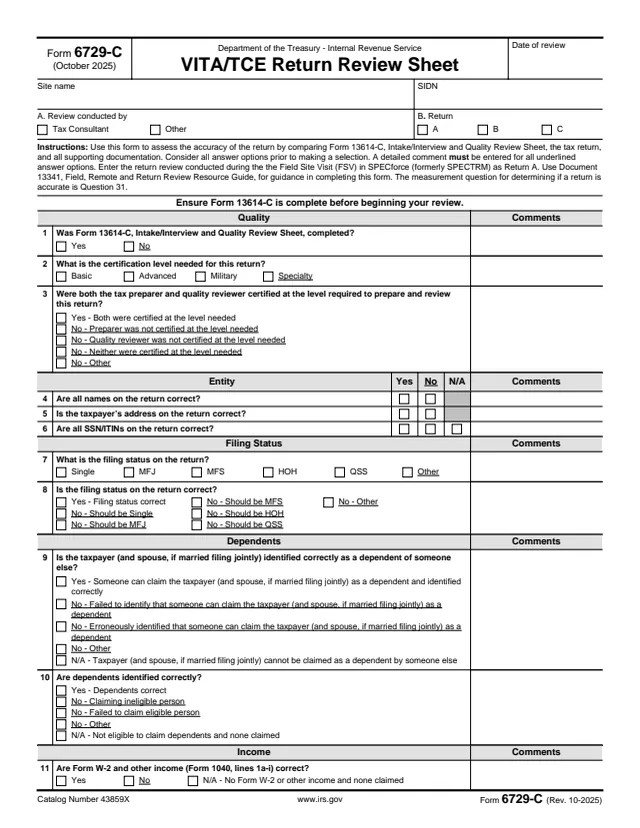
6729-C
196 fields, 3 pages
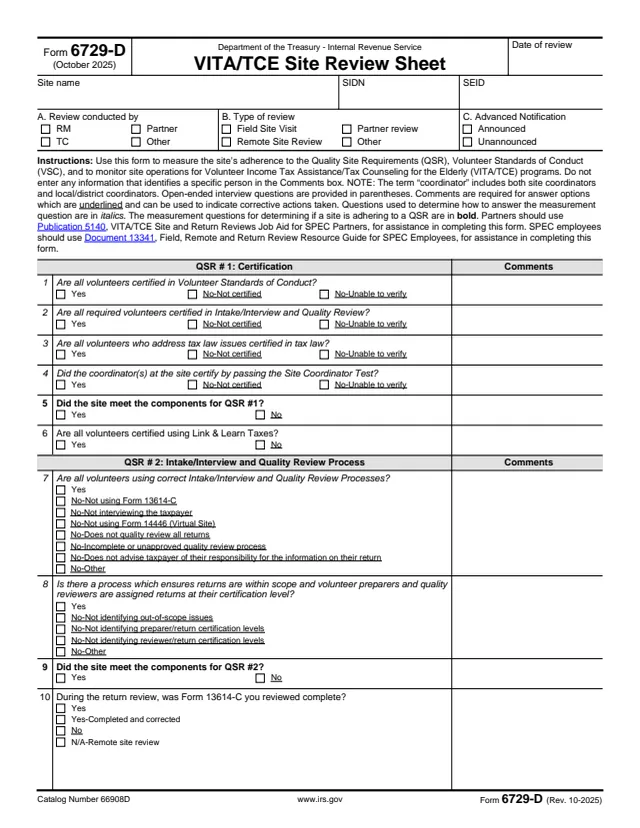
6729-D
145 fields, 3 pages
The form is signed by VITA/TCE volunteers and approved by a site official. It has no lines for the taxpayers the programs serve.
No tool matches that search.
No. The form is signed by VITA/TCE volunteers, an approving official and, for a child volunteer, a parent or guardian. It has no lines for the taxpayers a site helps.
The form says the coordinator, sponsoring partner, instructor or IRS contact confirms the volunteer's identity, name and address with a government-issued photo ID, and signs and dates the form.
Follow all Quality Site Requirements; do not accept payment, ask for donations or accept refund payments; do not solicit business or use taxpayer information for personal benefit; do not knowingly prepare false returns; do not engage in conduct with a negative effect on the programs; and treat all taxpayers professionally.
VSC #2 says do not accept payment, ask for donations, or accept refund payments for federal or state tax return preparation from customers.
The coordinator or partner completes the CE section for an unpaid certified volunteer, signs it and sends the form to the SPEC territory office or relationship manager. The form says at least 10 volunteer hours are required.
The form says it generally protects unpaid volunteers from liability for acts within the scope of their responsibilities, but not for harm caused by willful or criminal misconduct, gross negligence or reckless misconduct.