Line 1: EIN
The estate's or trust's employer identification number, as shown on its return.
1041-V
Payment Voucher for Estates and Trusts
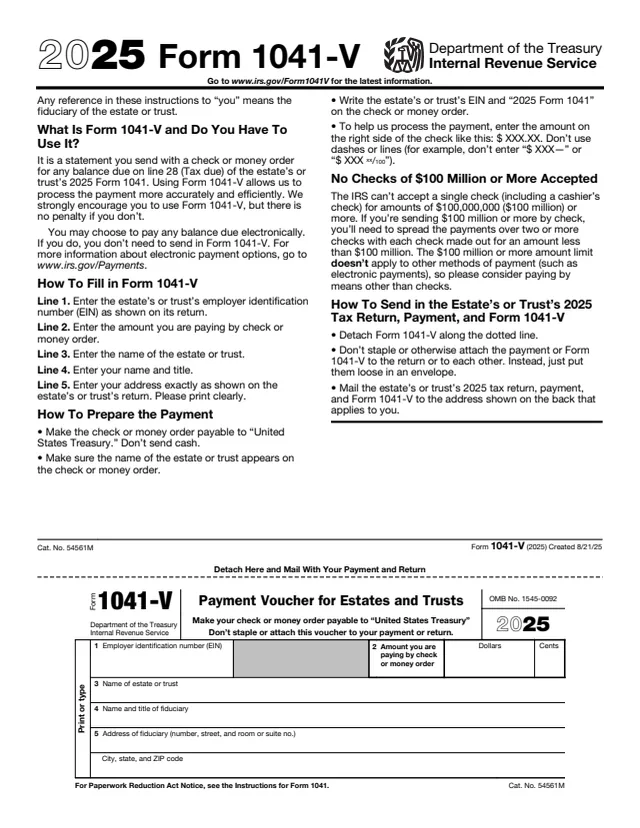
Form 1041-V is a payment voucher for estates and trusts. The form says it is a statement sent with a check or money order for any balance due on line 28 (Tax due) of the estate's or trust's 2025 Form 1041, and that any reference to "you" in its instructions means the fiduciary of the estate or trust.
The form says using it allows the IRS to process the payment more accurately and efficiently. The IRS strongly encourages its use, but the form says there is no penalty if it is not used. When the balance due is paid electronically, the form says Form 1041-V is not needed.
The voucher has five lines: the estate's or trust's EIN, the amount paid, the name of the estate or trust, the fiduciary's name and title, and the fiduciary's address. You can fill out the PDF free in your browser on this page and download it without an account.
The estate's or trust's employer identification number, as shown on its return.
The amount being paid by check or money order, in dollars and cents.
The name of the estate or trust making the payment.
The fiduciary's name and title, and the fiduciary's address with number, street, room or suite, city, state and ZIP code.
A chart that lists the mailing address by where the estate or trust is located, with a separate address for a foreign country or a U.S. territory.
Enter the estate's or trust's EIN as shown on its return, the amount being paid by check or money order, and the name of the estate or trust.
Enter the fiduciary's name and title, then the address exactly as shown on the estate's or trust's return. The form asks to print clearly.
Make the check or money order payable to "United States Treasury" and make sure the name of the estate or trust is on it. The form says not to send cash.
Write the estate's or trust's EIN and "2025 Form 1041" on the check or money order. Enter the amount on the right side like $ XXX.XX, without dashes or lines.
Detach the voucher along the dotted line. Don't staple or attach the payment or the voucher to the return or to each other; put them loose in an envelope with the 2025 return.
You get the real form, filled in a browser tab, with nothing standing between you and the finished PDF.
For an estate or trust located in Connecticut, Delaware, the District of Columbia, Georgia, Illinois or another state in the first group on page 2, the form lists Department of the Treasury, Internal Revenue Service, Kansas City, MO 64999-0148.
For Alabama, Alaska, Arizona, Arkansas, California or another state in the second group, the form lists Department of the Treasury, Internal Revenue Service, Ogden, UT 84201-0148.
The form lists Internal Revenue Service, P.O. Box 409101, Ogden, UT 84409.
The estate's or trust's 2025 tax return, the payment and Form 1041-V, mailed together to the address that applies.
The form says the IRS strongly encourages using Form 1041-V, but there is no penalty if it is not used.
The $100 million limit applies only to checks. The form says it doesn't apply to other methods of payment, such as electronic payments.
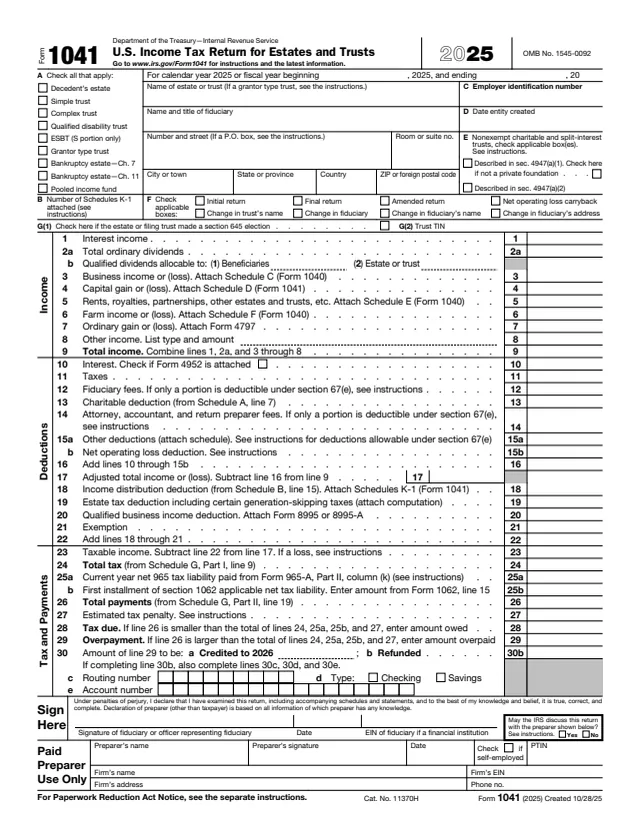
1041
173 fields, 3 pages
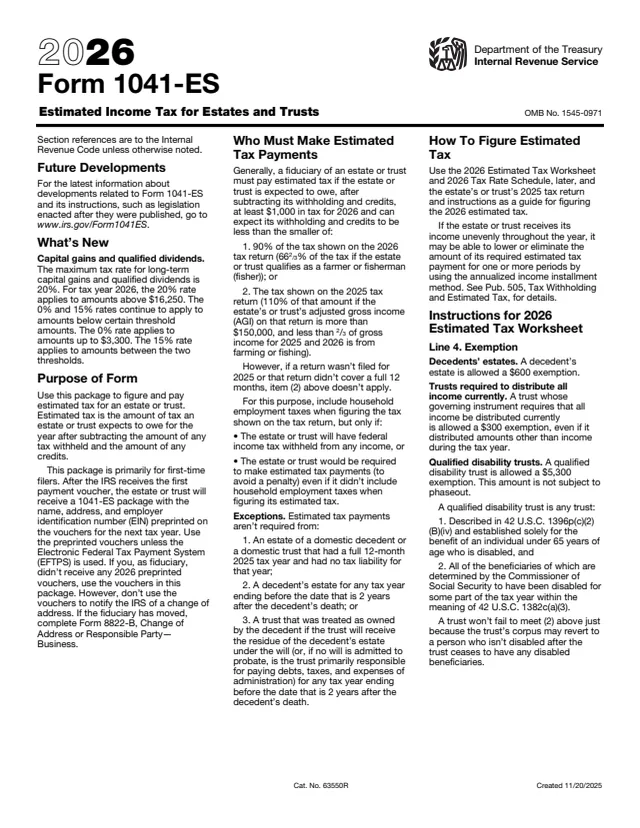
1041-ES
116 fields, 7 pages
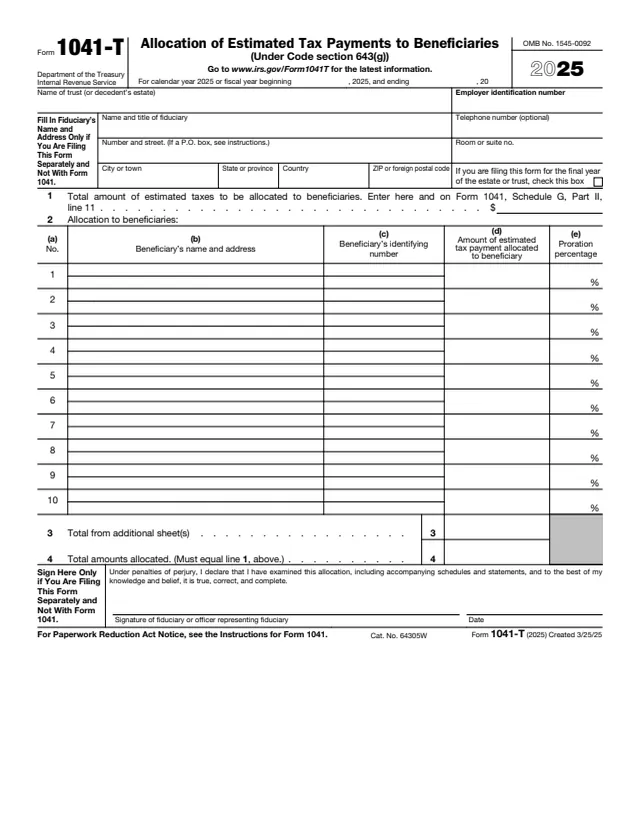
1041-T
57 fields, 2 pages
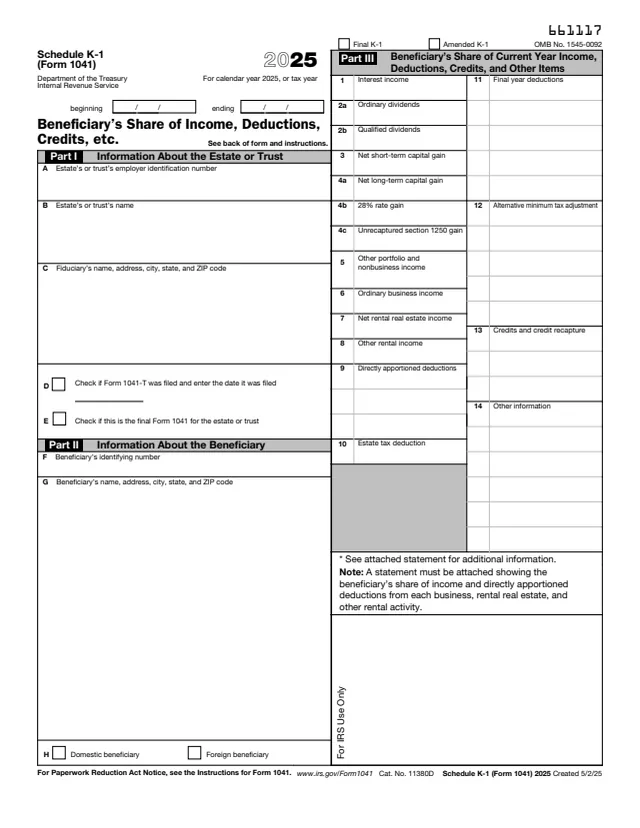
1041
74 fields, 2 pages
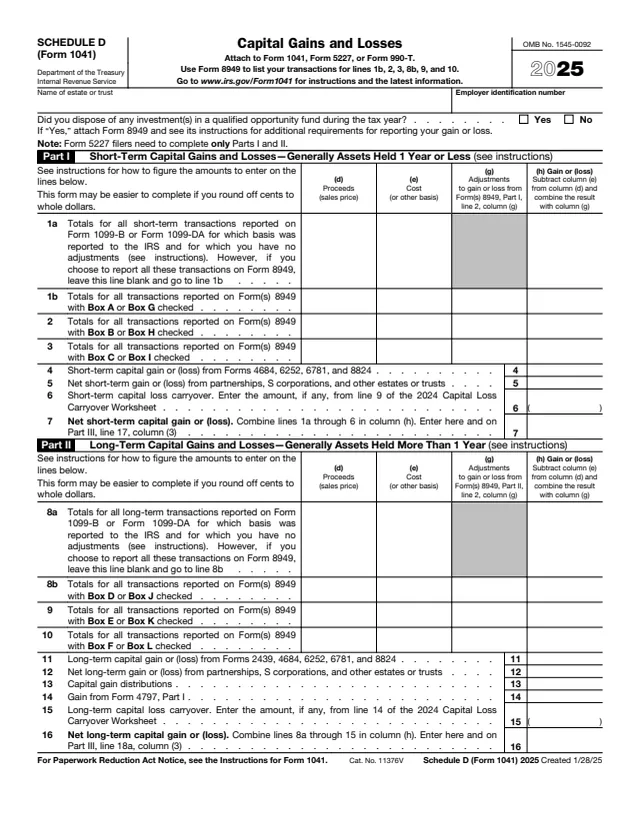
1041
87 fields, 2 pages
The fiduciary of an estate or trust fills it out when paying a Form 1041 balance due by check or money order.
No tool matches that search.
The form says the IRS strongly encourages using it, but there is no penalty if it is not used.
The fiduciary of the estate or trust. The form says any reference to "you" in its instructions means the fiduciary, and line 4 holds the fiduciary's name and title.
No. The form says not to staple or otherwise attach the payment or Form 1041-V to the return or to each other, and to put them loose in an envelope.
Yes. The form says any balance due may be paid electronically, and then Form 1041-V is not sent. It points to www.irs.gov/Payments.
The form says to make the check or money order payable to "United States Treasury" and to write the estate's or trust's EIN and "2025 Form 1041" on it.