Lines 1 to 6: receipts and costs
Domestic production gross receipts (DPGR), allocable cost of goods sold, other allocable deductions and losses, and line 4 for the small business simplified overall method.
8903
Domestic Production Activities Deduction
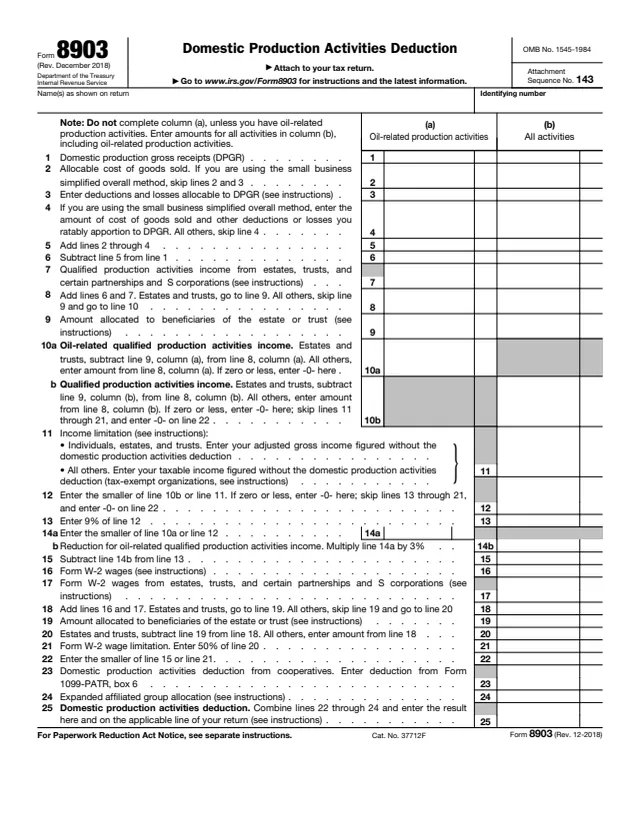
Form 8903 is used to figure the domestic production activities deduction (DPAD) under former section 199. The instructions say the DPAD is generally 9% of the smaller of qualified production activities income (QPAI) or adjusted gross income (taxable income for taxpayers other than individuals, estates and trusts), figured without the DPAD. It generally can't be more than 50% of the Form W-2 wages paid to employees that are properly allocable to domestic production gross receipts.
The instructions also say the DPAD under former section 199 has been repealed for tax years beginning after 2017. The form is still used for earlier tax years and items arising from them, and specified agricultural or horticultural cooperatives may use it to calculate the section 199A(g) deduction. The form says to attach it to the tax return.
You can fill out Form 8903 free in your browser on this page and download the result without an account.
Domestic production gross receipts (DPGR), allocable cost of goods sold, other allocable deductions and losses, and line 4 for the small business simplified overall method.
QPAI from estates, trusts and certain partnerships and S corporations, the amount estates and trusts allocate to beneficiaries, and oil-related QPAI and total QPAI.
The income limitation, 9% of the smaller of line 10b or line 11, and a reduction of 3% for oil-related qualified production activities income.
Form W-2 wages, wages from estates, trusts and certain partnerships and S corporations, amounts allocated to beneficiaries, and the Form W-2 wage limitation at 50% of line 20.
The smaller of line 15 or line 21, the DPAD from cooperatives from Form 1099-PATR, box 6, the expanded affiliated group allocation, and the final deduction on line 25.
The form has two amount columns: column (a) for oil-related production activities and column (b) for all activities, including oil-related ones.
Enter the name or names as shown on the return and the identifying number.
Enter DPGR on line 1. Enter allocable cost of goods sold and other deductions on lines 2 and 3, or, if using the small business simplified overall method, skip them and use line 4. Line 6 subtracts line 5 from line 1.
Partners, S corporation shareholders and beneficiaries enter QPAI reported on Schedule K-1 on line 7. Estates and trusts enter QPAI allocated to beneficiaries on line 9. If line 10b is zero or less, the form says to enter -0- on line 22.
Individuals, estates and trusts enter adjusted gross income figured without the DPAD; all others enter taxable income figured without it. Line 13 is 9% of line 12. Lines 14a and 14b apply only to oil-related QPAI.
Enter Form W-2 wages properly allocable to DPGR on line 16 and wages reported on Schedule K-1 on line 17. Estates and trusts use line 19. Line 21 is 50% of line 20.
Enter the smaller of line 15 or 21, any cooperative deduction from Form 1099-PATR, box 6, and any expanded affiliated group allocation. Line 25 combines lines 22 through 24 and goes on the applicable line of the return.
The instructions say to complete lines 1 through 10, column (a), only for oil-related production activities. All others leave lines 1 through 9, column (a), empty and enter zero on line 10a.
You get the real form, filled in a browser tab, with nothing standing between you and the finished PDF.
The form says to attach it to your tax return. It has no separate mailing address.
The instructions say to continue to use the December 2018 version of Form 8903 for tax years beginning after 2017 until a new revision is issued.
The instructions say that for Form 1040 returns filed after tax year 2017, the line 25 amount goes on Schedule 1 (Form 1040), line 36. For Form 1120 returns, it goes on line 26, Other deductions.
The reporting member completes lines 10a through 16 and 18 through 22 for the group and attaches a schedule showing each member's name, EIN and share of the DPAD. Other computing members skip lines 1 through 22 and use line 24.
For tax years beginning before January 1, 2018, the instructions say to report the total DPAD on line 25, leave lines 1 through 24 blank, and attach separate patronage and nonpatronage calculations.
1099-PATR
46 fields, 4 pages
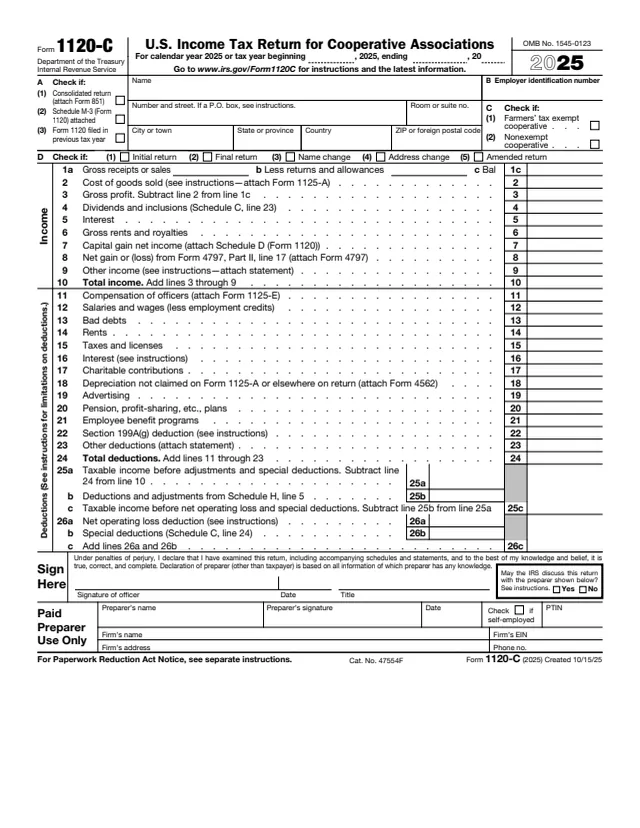
1120-C
449 fields, 5 pages
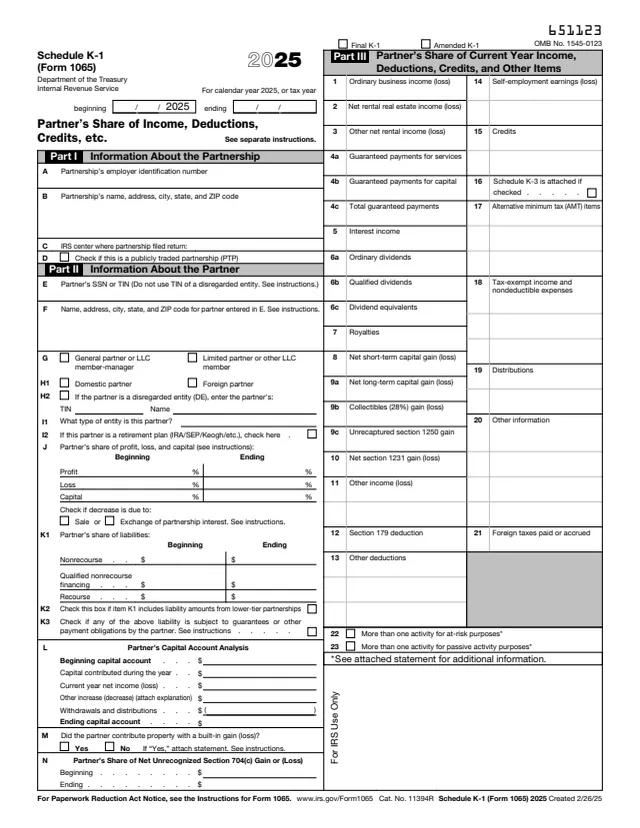
1065
111 fields, 1 page
1120-S
114 fields, 1 page
1041
74 fields, 2 pages
4626
813 fields, 8 pages
The instructions say individuals, corporations, cooperatives, estates and trusts use Form 8903 to figure their allowable DPAD from certain trade or business activities.
No tool matches that search.
The instructions say the DPAD under former section 199 has been repealed for tax years beginning after 2017. The form is still used for earlier tax years and by specified cooperatives for the section 199A(g) deduction.
The instructions say it is generally 9% of the smaller of QPAI or adjusted gross income (taxable income for most other taxpayers), figured without the DPAD, and generally no more than 50% of allocable Form W-2 wages.
Column (a) is only for oil-related production activities. The form says to enter amounts for all activities, including oil-related ones, in column (b).
No. The instructions say married individuals filing a joint return figure the deduction on one Form 8903 using the applicable items of both spouses.
The instructions say that without Form W-2 wages paid or allocated on a Schedule K-1, a DPAD can't be claimed, unless a cooperative's DPAD was allocated to you or you are a member of an expanded affiliated group.
On line 23. The form says to enter the deduction from Form 1099-PATR, box 6.