Header and items A to C
Name, identifying number and address, the statement number when filing several, the return's form number and year, whether it is an amended return, and the initial year filer and protective disclosure boxes.
8886
Reportable Transaction Disclosure Statement
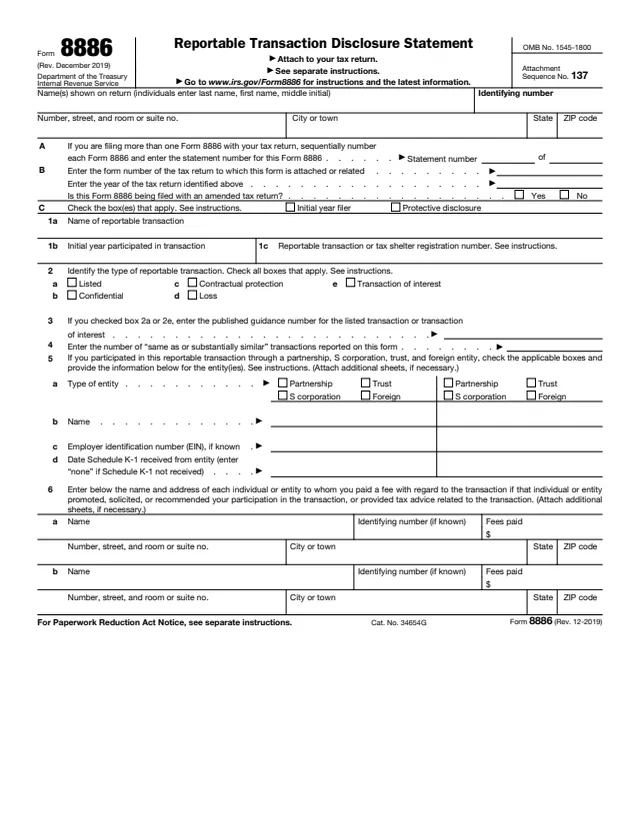
Form 8886, Reportable Transaction Disclosure Statement, is used to disclose information for each reportable transaction in which a taxpayer participated. The instructions describe five categories of reportable transactions: listed transactions, confidential transactions, transactions with contractual protection, loss transactions and transactions of interest.
This is the December 2019 revision, used with the instructions revised October 2022. The form is attached to the tax return or information return for each tax year of participation. The first year a transaction is disclosed, the instructions say an exact copy also goes to the IRS Office of Tax Shelter Analysis (OTSA). The instructions add that reporting a transaction on this form does not mean its tax benefits will be disallowed.
You can fill out Form 8886 free in your browser on this page and download the result without an account.
Name, identifying number and address, the statement number when filing several, the return's form number and year, whether it is an amended return, and the initial year filer and protective disclosure boxes.
Its name, the first year of participation, any reportable transaction number, the category boxes, the published guidance number for listed transactions and transactions of interest, and the count of similar transactions.
The partnership, S corporation, trust or foreign entity you participated through, with its name, EIN and the date its Schedule K-1 was received.
Name, address, identifying number and fees paid for each person who promoted, solicited or recommended your participation, or gave tax advice on the transaction.
Type of tax benefit, its total dollar amount, the number of years, your total investment or basis, and a written description of the transaction and its expected tax treatment.
Each tax-exempt, foreign or related individual or entity involved, with name, identifying number, address and a description of its involvement.
If more than one Form 8886 goes with the return, number each one (for example, statement number 1 of 3). Enter the form number and year of the return, or the fiscal year end as MM/DD/YYYY.
Check initial year filer the first year the transaction is disclosed; that is the year an exact copy also goes to OTSA. Protective disclosure is optional, and the instructions say it still has to be complete.
Name the transaction or describe it briefly, enter the first year (YYYY) and any 9-digit or 11-digit number from a material advisor, and check every category that applies. Line 3 takes the published guidance for listed transactions and transactions of interest.
List each pass-through or foreign entity you participated through, then each person paid a fee who promoted, solicited or recommended the transaction or gave tax advice, with the approximate fees paid.
Check each type of tax benefit and enter the totals on 7b to 7d. On 7e, describe each step of the transaction, the parties, the business reasons and any tax result protection. List tax-exempt, foreign and related parties on line 8.
The instructions say a form stating that information will be provided upon request is not a complete disclosure. Extra details go on attached sheets in line order, with your name and identifying number on each.
You get the real form, filled in a browser tab, with nothing standing between you and the finished PDF.
The instructions say to attach Form 8886 to the income tax return or information return, including amended returns, for each tax year of participation. For a carryback, it goes with Form 1045, Form 1139 or the amended return.
For an initial year filing, an exact copy goes to OTSA by mail or by fax to 844-253-2553, a number the instructions say is only for these copies. The IRS About page notes a 2026 update to the OTSA mailing address.
The instructions say the copy sent to OTSA has to show word for word the same information as the e-filed return, on the official Form 8886 or an exact copy of it.
A partner, shareholder or beneficiary who gets a timely Schedule K-1 less than 10 calendar days before the return due date has 60 days after that due date to file with OTSA, the instructions say.
The instructions describe section 6707A penalties for not disclosing. For a listed transaction, the maximum annual penalty is $100,000 for an individual and $200,000 in any other case.
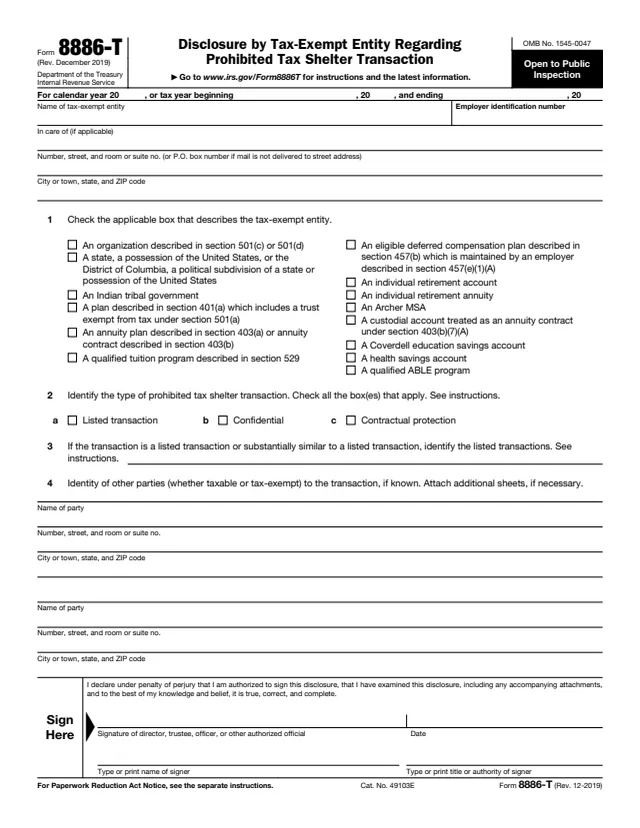
8886-T
37 fields, 1 page
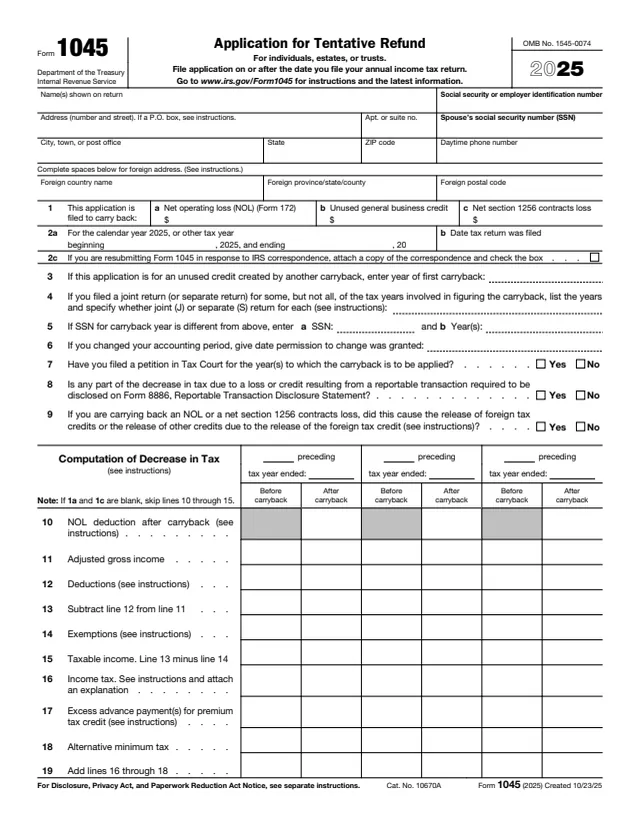
1045
193 fields, 2 pages
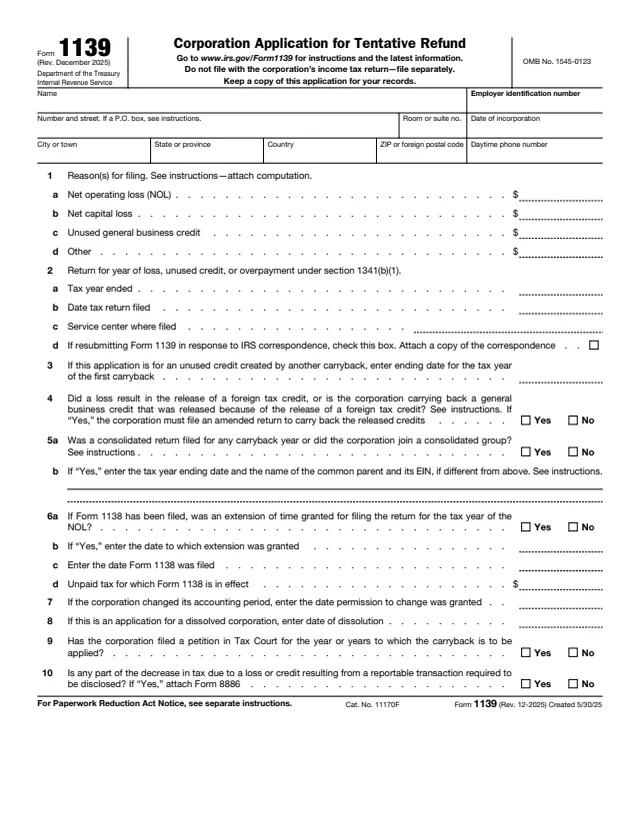
1139
162 fields, 2 pages
1040
185 fields, 2 pages
1065
440 fields, 6 pages
1120-F
527 fields, 9 pages
The instructions say any taxpayer, including an individual, trust, estate, partnership, S corporation or other corporation, that participates in a reportable transaction and is required to file a federal tax return or information return files Form 8886.
No tool matches that search.
The instructions describe five categories: listed transactions, confidential transactions, transactions with contractual protection, loss transactions and transactions of interest.
Generally yes. The instructions say more than one transaction can go on one form only if the transactions are the same or substantially similar.
No. The instructions say that a transaction having to be reported on this form does not mean the tax benefits from it will be disallowed.
For individuals, the instructions use a section 165 loss of at least $2 million in any single tax year or $4 million in any combination of tax years. Corporations other than S corporations use $10 million and $20 million.
By mail or by fax to 844-253-2553. The About page for Form 8886 notes a 2026 update to the mailing address in the instructions, so check IRS.gov/Form8886 before mailing.
No. The instructions say statements such as "Information provided upon request" make the disclosure incomplete and subject the filer to penalty under sections 6707A and 6662A.