Header
The calendar year 2025 or fiscal year dates, the name of the estate or trust, its employer identification number, and the name and title of the fiduciary.
8453-FE
U.S. Estate or Trust Declaration for an IRS e-file Return
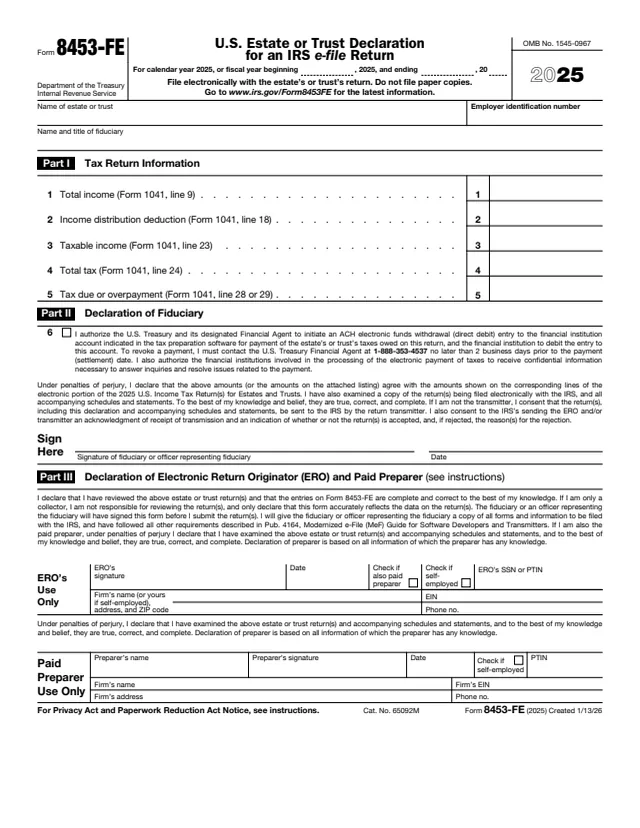
Form 8453-FE, U.S. Estate or Trust Declaration for an IRS e-file Return, goes with an electronically filed Form 1041, U.S. Income Tax Return for Estates and Trusts. The instructions say it is used to authenticate the electronic Form 1041, authorize the electronic filer to transmit via a third-party transmitter, and authorize an electronic funds withdrawal for payment of federal taxes owed.
The form is completed for the estate or trust, not for an individual return. The fiduciary, or an officer representing the fiduciary, signs the declaration in Part II. The electronic return originator (ERO), and a paid preparer who is not the ERO, sign Part III. The form says to file it electronically with the estate's or trust's return and not to file paper copies.
This page has the 2025 edition, which carries its instructions on page 2. You can fill out the PDF free in your browser on this page and download it without an account.
The calendar year 2025 or fiscal year dates, the name of the estate or trust, its employer identification number, and the name and title of the fiduciary.
Lines 1 to 5 repeat amounts from Form 1041: total income, income distribution deduction, taxable income, total tax, and tax due or overpayment.
A box authorizing the U.S. Treasury and its designated Financial Agent to initiate an ACH electronic funds withdrawal for the estate's or trust's taxes owed.
A declaration under penalties of perjury that the amounts agree with the electronic return, with consent to transmission, and the fiduciary's signature and date.
The ERO's declaration, signature and date, boxes for also paid preparer and self-employed, the ERO's SSN or PTIN, and firm name, EIN, address and phone number.
The preparer's name, signature, date, PTIN, self-employed box, and firm name, EIN, address and phone number.
Enter the fiscal year dates if the estate or trust does not use the calendar year, then its name, EIN and the fiduciary's name and title.
Copy the amounts from the Form 1041 lines printed on each row: lines 9, 18, 23 and 24, and line 28 or 29 for tax due or overpayment.
The instructions say to check the box only when paying the tax due by ACH electronic funds withdrawal (direct debit), and otherwise to leave it blank. Payment can also be made using EFTPS.
The fiduciary or an officer representing the fiduciary signs and dates the declaration. The ERO's declaration says the fiduciary will have signed before the return is submitted.
The ERO signs and checks the boxes that apply. The instructions say anyone paid to prepare the return enters a PTIN, and only an ERO who is not the paid preparer may enter an SSN instead.
You get the real form, filled in a browser tab, with nothing standing between you and the finished PDF.
The form says to file it electronically with the estate's or trust's return and not to file paper copies.
The instructions say an estate or trust files its income tax return by the 15th day of the 4th month following the close of its tax year, and that this date also applies to returns filed electronically.
The tax due on line 5 can be paid using EFTPS. The instructions give www.EFTPS.gov and 800-555-4477, plus 711 for Telecommunications Relay Services, and point to Pub. 966.
Line 6 says to contact the U.S. Treasury Financial Agent at 1-888-353-4537 no later than 2 business days prior to the payment (settlement) date.
In Part III, the ERO declares they will give the fiduciary or officer representing the fiduciary a copy of all forms and information to be filed with the IRS.
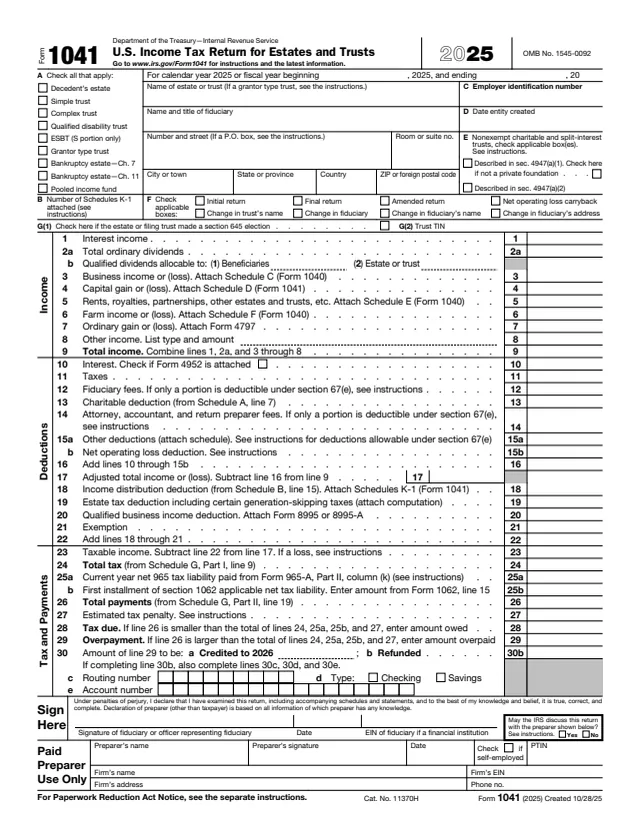
1041
173 fields, 3 pages
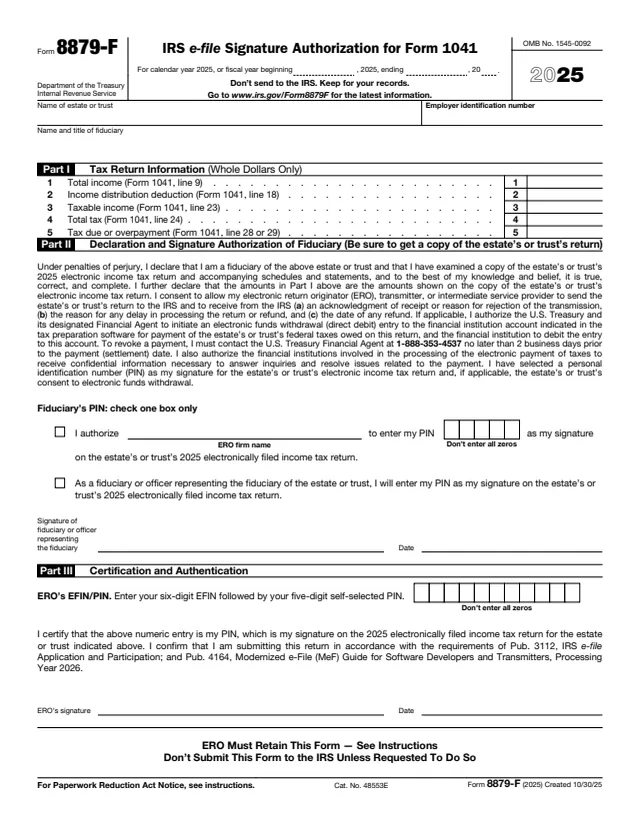
8879-F
16 fields, 2 pages
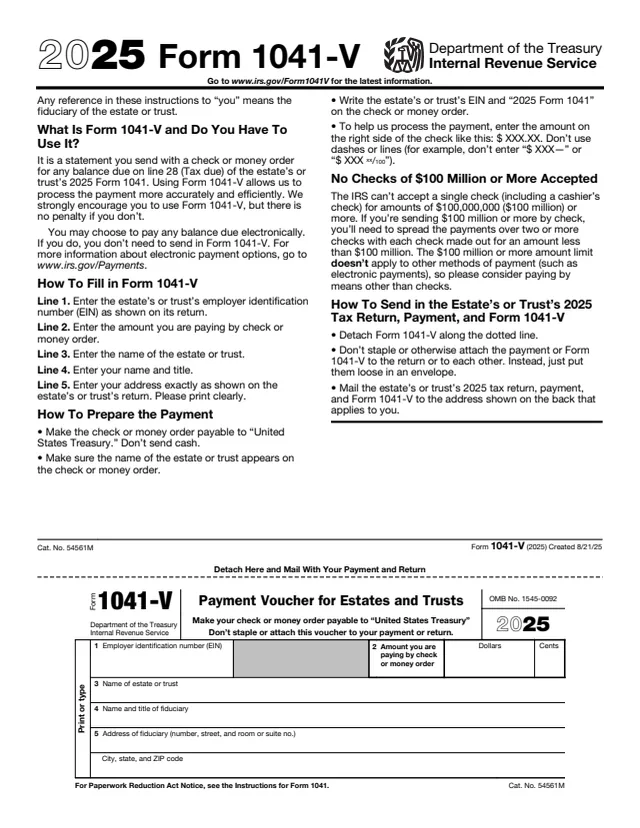
1041-V
7 fields, 2 pages
W-12
85 fields, 3 pages
8453
23 fields, 2 pages
The form is signed for an estate or trust and goes to the IRS with its e-filed Form 1041.
No tool matches that search.
The instructions list three uses: authenticating the electronic Form 1041, authorizing the electronic filer to transmit via a third-party transmitter, and authorizing an electronic funds withdrawal for federal taxes owed.
The fiduciary or an officer representing the fiduciary signs Part II. The ERO signs Part III, and a paid preparer who is not the ERO signs in Paid Preparer Use Only.
No. The form says to file it electronically with the estate's or trust's return and not to file paper copies.
The instructions say by the 15th day of the 4th month following the close of the estate's or trust's tax year, including for returns filed electronically.
The instructions say by EFTPS or by ACH electronic funds withdrawal (direct debit). The line 6 box is checked only for a direct debit.
The instructions say only an ERO who is not the paid preparer of the return has the option to enter a PTIN or an SSN. Paid preparers enter a PTIN.