Header: name and activity
Name shown on the return, identifying number and a description of the activity. The instructions say to add the name and identifying number of the partnership or S corporation, if applicable.
6198
At-Risk Limitations
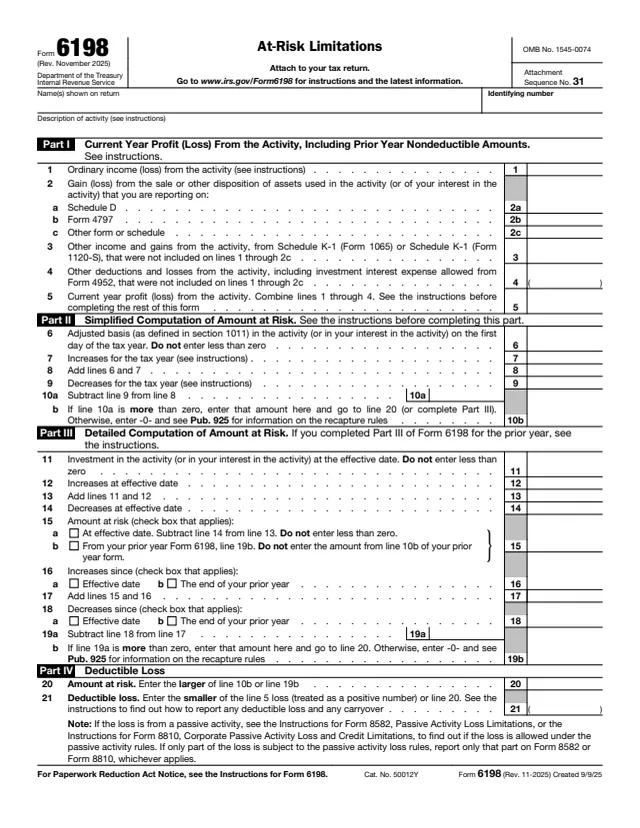
Form 6198 applies the at-risk rules of section 465 to a business or income-producing activity. The instructions say it is used to figure three things: the profit or loss from an at-risk activity for the current year (Part I), the amount at risk for the current year (Part II or Part III), and the deductible loss for the current year (Part IV). The at-risk rules limit the loss that can be deducted to the amount at risk.
The form says "Attach to your tax return." The instructions name individuals, including filers of Schedules C, E and F, estates, trusts and certain closely held C corporations as the filers. Partners and S corporation shareholders report activities passed through to them on Schedule K-1. The instructions say to file one form for activities grouped under the aggregation rules and a separate form for each activity under the separation rules.
You can fill out Form 6198 free in your browser on this page and download the result without an account.
Name shown on the return, identifying number and a description of the activity. The instructions say to add the name and identifying number of the partnership or S corporation, if applicable.
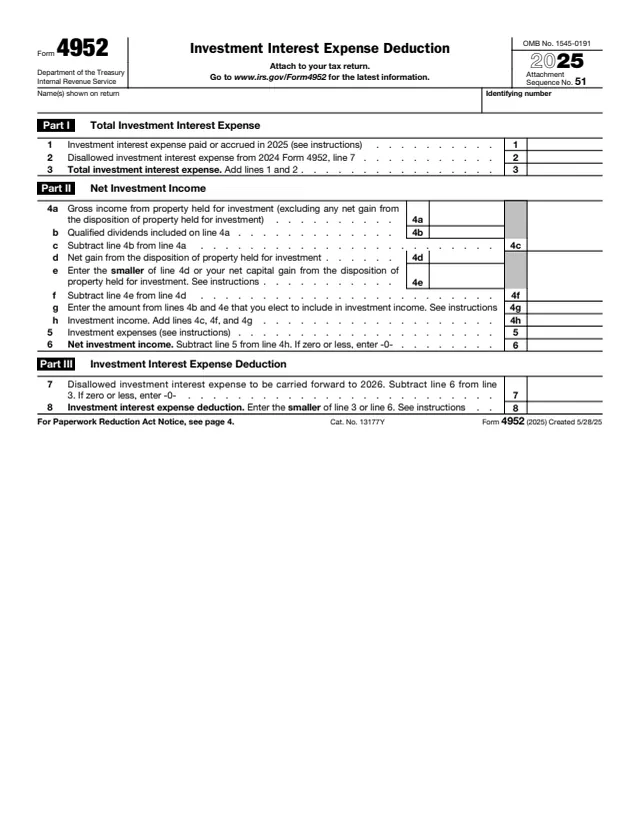
Lines 1 to 5: ordinary income or loss, gains and losses reported on Schedule D, Form 4797 or another form, other income and gains and other deductions and losses from Schedule K-1, and the combined total on line 5.
Lines 6 to 10b: adjusted basis on the first day of the tax year, increases, decreases and the amount at risk. The instructions say it can be used only if the adjusted basis in the activity or interest is known.
Lines 11 to 19b: investment at the effective date, increases and decreases, and the amount at risk. The instructions call it a longer method that may allow a larger amount at risk.
Line 20 is the larger of line 10b or line 19b. Line 21 is the smaller of the line 5 loss, treated as a positive number, or line 20. A note points to Form 8582 or Form 8810 for passive activities.
Enter the name and identifying number from the return and describe the activity. The instructions say to enter only amounts that relate to the activity on this form.
Enter income, gains, deductions and losses without regard to the at-risk limits. The instructions say to include prior year amounts that could not be deducted because of the at-risk rules. Combine lines 1 through 4 on line 5.
The instructions say the rest of the form may not need to be completed. Report the items on the forms and schedules normally used, attach Form 6198 and keep a copy. They also point to Pub. 925 on recapture income.
Part II starts from the adjusted basis on the first day of the tax year, not less than zero, then adds increases and subtracts decreases. If Part III was completed for the prior year, the instructions say to skip lines 11 to 14 and enter the prior year line 19b on line 15.
Enter the larger of line 10b or line 19b on line 20, then the smaller of the line 5 loss or line 20 on line 21. One example in the instructions: a $1,600 loss with $1,200 at risk gives ($1,200) on line 21.
When line 21 is made up of more than one loss item, the instructions say a portion of each item is allowed, using each item's share of the line 5 loss. The rest is carried over to next year.
You get the real form, filled in a browser tab, with nothing standing between you and the finished PDF.
The form says "Attach to your tax return." It goes in with the return that reports the activity.
The form prints no separate due date. It is filed with the tax return it is attached to.
The instructions say to file one form for activities grouped under the aggregation rules and a separate form for each activity under the separation rules.
If line 10b or line 19b is zero, the instructions say the recapture rules in Pub. 925 may apply.
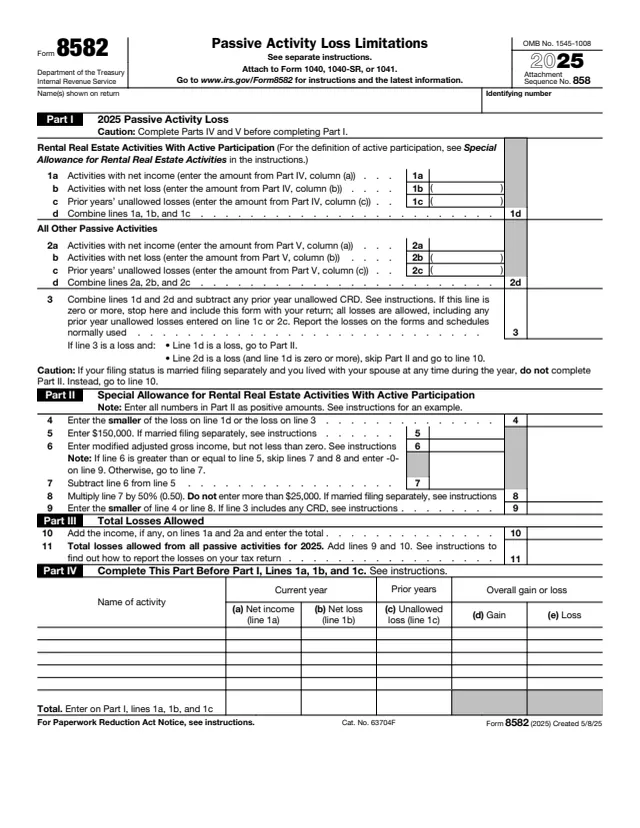
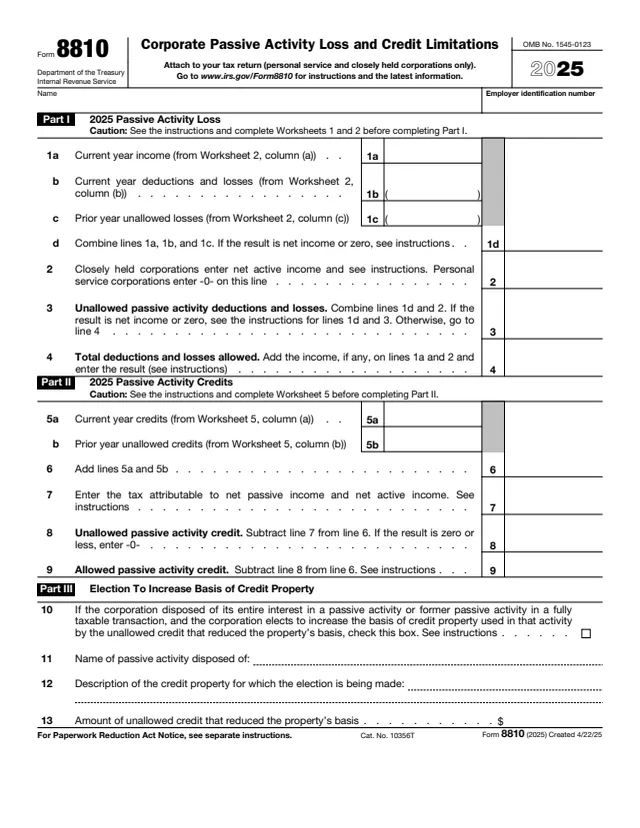
The note on line 21 points to the Instructions for Form 8582 or Form 8810 to find out if a passive activity loss is allowed under the passive activity rules.
Entering the prior year line 10b on line 15, which the form says not to do, entering less than zero on line 6 or line 11, and leaving out prior year losses disallowed by the at-risk rules.
8582
205 fields, 3 pages
8810
20 fields, 1 page
4952
17 fields, 4 pages
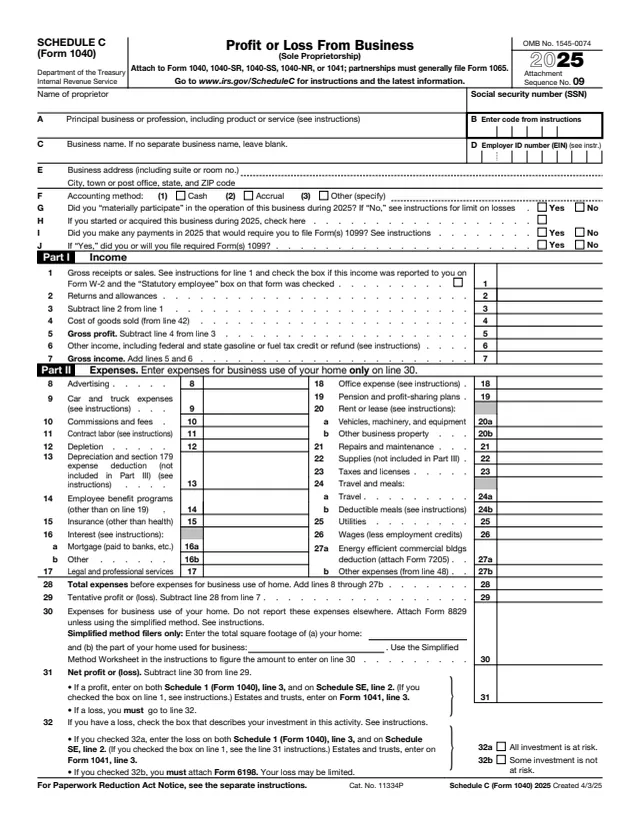
1040
105 fields, 2 pages
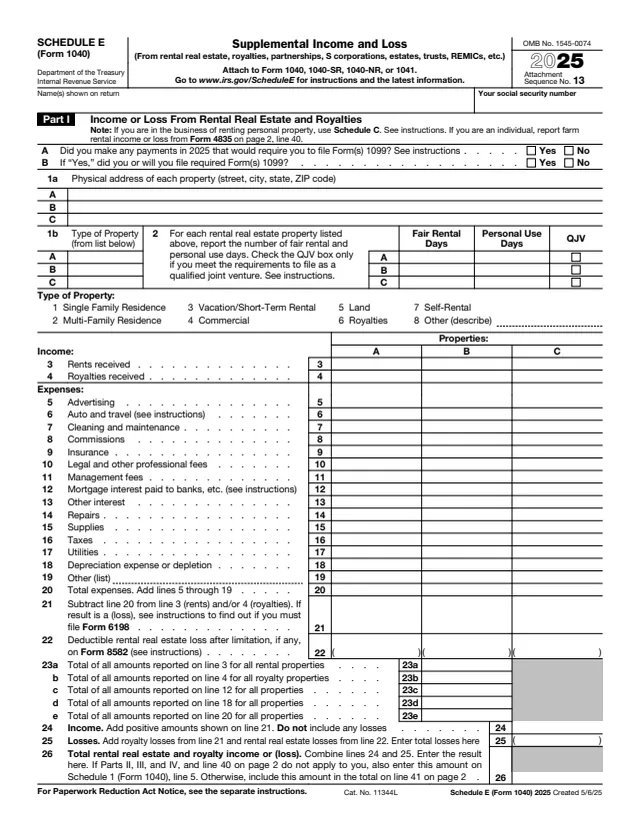
1040
185 fields, 2 pages
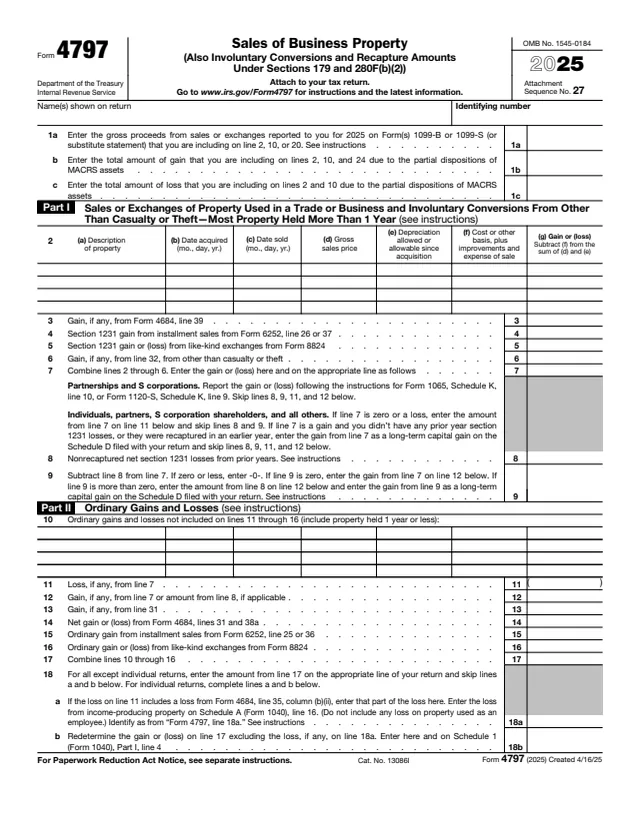
4797
182 fields, 2 pages
The instructions say the form is filed when, during the tax year, the filer, a partnership the filer was a partner in, or an S corporation the filer was a shareholder in had amounts not at risk invested in an at-risk activity that had a loss.
No tool matches that search.
The instructions say it figures the profit or loss from an at-risk activity, the amount at risk and the deductible loss for the current year.
The instructions name individuals, including filers of Schedules C, E and F, estates, trusts and certain closely held C corporations. Partners and S corporation shareholders use it for activities on their Schedule K-1.
The instructions say the rest of the form may not need to be completed. The items are reported on the usual forms and schedules, and Form 6198 is attached with a copy kept.
Part II is a simplified method that starts from the adjusted basis. Part III is a longer method that the instructions say may allow a larger amount at risk. Part II is not needed when Part III is used.
The instructions list nonrecourse loans, with exceptions such as qualified nonrecourse financing, amounts protected by a guarantee or stop-loss agreement, and certain amounts borrowed from a person with an interest in the activity other than as a creditor.
The instructions say the disallowed portion of each loss item is carried over to next year, and prior year amounts disallowed by the at-risk rules are included in the current year figures.
The form says to attach it to your tax return.