1120-REIT

U.S. Income Tax Return for Real Estate Investment Trusts

Agency
IRS
Revision
2025
Fillable fields
346
Pages
5
Official source
IRS form page
Checked
October 21, 2026
Fill 1120-REIT online
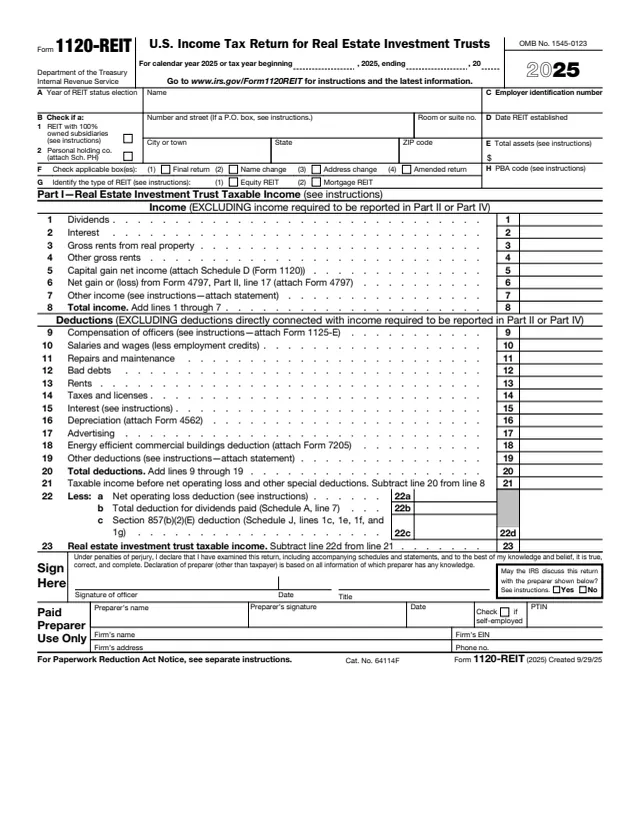
Page 1 of form 1120-REIT

Form 1120-REIT: U.S. Income Tax Return for Real Estate Investment Trusts

Form 1120-REIT, U.S. Income Tax Return for Real Estate Investment Trusts, is the annual return of a real estate investment trust (REIT). The IRS About page says corporations, trusts and associations electing to be treated as REITs file it to report their income, gains, losses, deductions, credits, certain penalties and income tax liability.

The 2025 form is for calendar year 2025 or a tax year beginning in 2025. Part I figures REIT taxable income. Parts II to IV figure the taxes on net income from foreclosure property, for failure to meet certain source-of-income requirements, and on net income from prohibited transactions. Schedules A, J, K, L, M-1 and M-2 cover the deduction for dividends paid, the tax computation, other information, balance sheets and book-to-return reconciliations.

The instructions say the election to be a REIT is made by figuring taxable income as a REIT on this form. You can fill out Form 1120-REIT free in your browser on this page and download it without an account.

What's on Form 1120-REIT

Header items A to H

Year of REIT status election, name and address, EIN, date the REIT was established, total assets, boxes for a REIT with 100% owned subsidiaries or a personal holding company, return type boxes, equity or mortgage REIT, and PBA code.
Part I: REIT taxable income

Lines 1 to 23 list income such as dividends, interest and gross rents from real property, deductions such as officer compensation, interest and depreciation, then the net operating loss deduction, the deduction for dividends paid and REIT taxable income.

Tax and payments

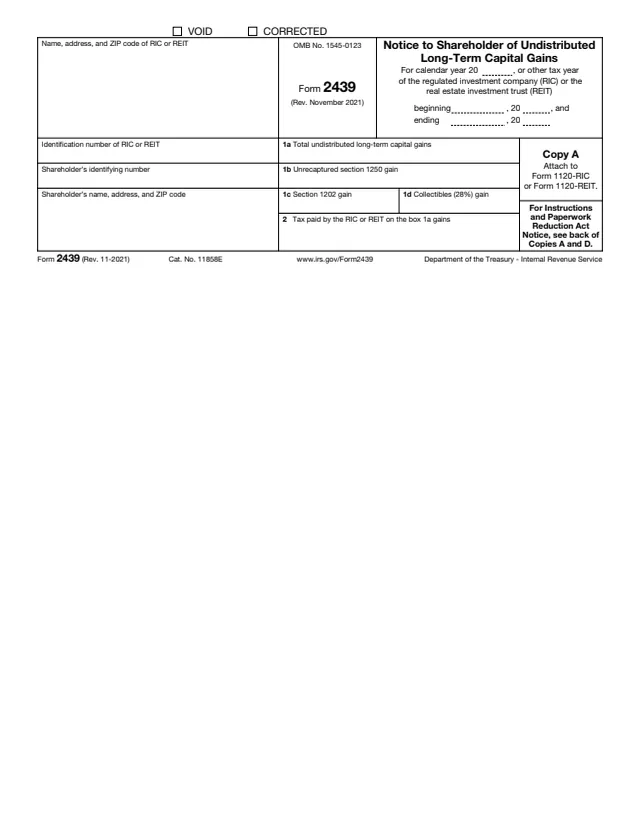
Lines 24a to 30 cover total tax, section 1062 lines, estimated tax payments, tax deposited with Form 7004, credits from Forms 2439 and 4136, the elective payment amount from Form 3800, the estimated tax penalty, and the refund or direct deposit.

Parts II, III and IV

Part II taxes net income from foreclosure property at 21% (0.21), Part III figures the section 857(b)(5) tax for failure to meet certain source-of-income requirements, and Part IV figures the tax on net income from prohibited transactions.

Schedules A, J and K

Schedule A totals the deduction for dividends paid, including consent and deficiency dividends. Schedule J computes the tax, credits and other taxes. Schedule K asks other information questions, such as the method of accounting and ownership.

Schedules L, M-1 and M-2

Schedule L holds balance sheets per books at the beginning and end of the tax year. Schedule M-1 reconciles income per books with income per return, and Schedule M-2 analyzes unappropriated retained earnings.

How to fill out Form 1120-REIT

  1. 1

    Complete the header

    Enter the tax year, the year of REIT status election, name, address, EIN, date established and total assets. Check the boxes in items B and F that apply, and mark equity or mortgage REIT in item G.

  2. 2

    Figure REIT taxable income

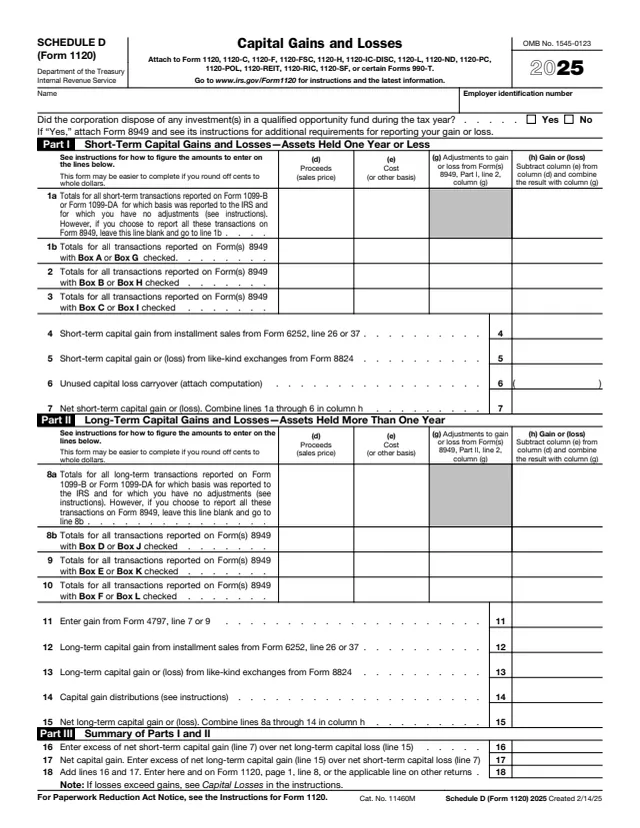
    Report income and deductions in Part I, leaving out income and deductions that belong in Part II or Part IV, as the form says. Attach Form 1125-E, Form 4562, Schedule D (Form 1120) or Form 4797 where the lines call for them.

  3. 3

    Complete Schedule A

    Total dividends paid on Schedule A, including dividends deemed paid on December 31 under section 857(b)(9) and consent dividends with Forms 972 and 973. Line 7 goes to page 1, line 22b.

  4. 4

    Figure the special taxes

    Complete Parts II, III and IV if they apply. Each part's tax goes to Schedule J, lines 1b, 1c and 1d.

  5. 5

    Compute tax and payments

    Complete Schedule J and carry line 9 to page 2, line 24a. Enter payments and credits on lines 25a to 25z, then the tax due or overpayment and any direct deposit details.

  6. 6

    Answer Schedule K, then sign

    Answer the Schedule K questions, complete Schedules L, M-1 and M-2, and have an authorized officer sign and date. A paid preparer completes the Paid Preparer Use Only section.

Why fill Form 1120-REIT on indox

You get the real form, filled in a browser tab, with nothing standing between you and the finished PDF.

  • Fill the form right in your browser, no software to install
  • Free to fill and free to download, with no account
  • The official blank straight from the IRS, not a copy someone retyped
  • Works on a phone, tablet or computer

When and where to file

Due date

The instructions say a REIT generally files by the 15th day of the 4th month after the end of its tax year. A REIT with a fiscal tax year ending June 30 files by the 15th day of the 3rd month after the end of its tax year.

Extension

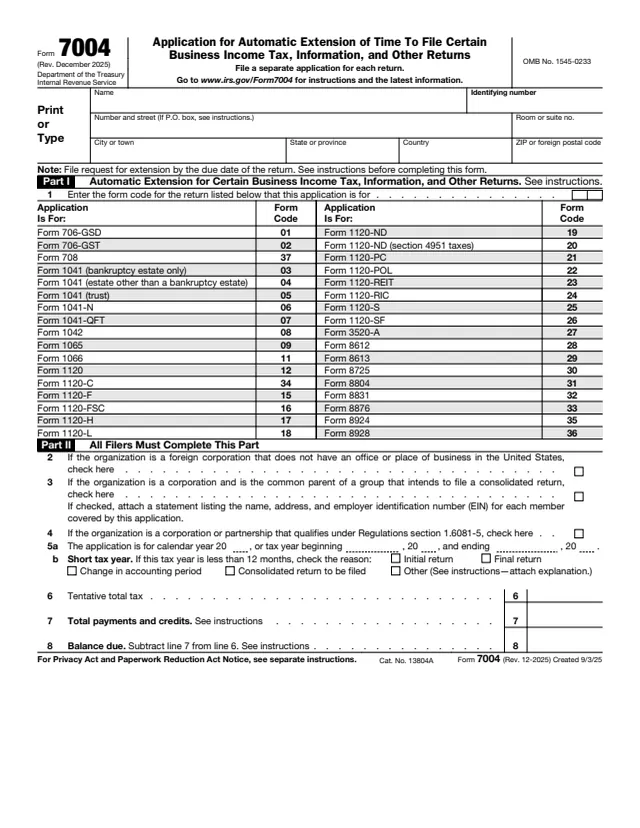
The instructions say to file Form 7004 to request an extension of time to file, generally by the regular due date of the return.

Electronic filing

The instructions say that beginning in mid-February 2026, REITs will be able to file Form 1120-REIT electronically. The About page lists "No penalty for not electronically filing Forms 1120-REIT, 1120-RIC, 1120-L, and 1120-PC for 2025."

Where to file on paper

The address depends on where the principal business, office or agency is located and on total assets. For example, the instructions list Ogden, UT 84201-0012 for any amount in states such as California and Texas, and Kansas City, MO 64999-0012 for states such as New York and Ohio when total assets are less than $10 million and Schedule M-3 is not filed.

Late filing

The instructions say the penalty can be 5% of the unpaid tax for each month or part of a month the return is late, up to 25%. For a return required to be filed in 2026 that is over 60 days late, the minimum is the smaller of the tax due or $525.

Who fills out Form 1120-REIT?

  • Corporations, trusts and associations electing REIT status

    The instructions say a corporation, trust or association that meets certain conditions files Form 1120-REIT if it elects to be treated as a REIT for the tax year, or made that election for a prior year and it was not terminated or revoked.

  • Equity and mortgage REITs

    Item G asks for the type of REIT. The instructions say to check the Mortgage box if the primary source of gross receipts is mortgage interest and fees, and the Equity box otherwise. Equity REITs also enter a PBA code in item H.

  • REITs certifying as qualified opportunity funds

    The instructions say a REIT that intends to self-certify as a qualified opportunity fund files Form 1120-REIT and attaches Form 8996, even if it had no income or expenses to report.

  • Officers who sign

    The instructions list the president, vice president, treasurer, assistant treasurer, chief accounting officer or any other corporate officer authorized to sign. A receiver, trustee or assignee filing for the REIT signs instead.

  • Paid preparers

    Anyone paid to prepare the return generally signs it and completes the Paid Preparer Use Only section with a PTIN. If an employee of the REIT completes the form, that section stays blank.

The REIT itself files this return, signed by an authorized officer. The instructions describe who files it, who signs it and when a paid preparer completes its own section.

Official sources and the blank

Do it all with indox

View all 123 tools

Questions about Form 1120-REIT

How does an organization elect to be a REIT?

The instructions say the election is made by figuring taxable income as a REIT on Form 1120-REIT.

When is Form 1120-REIT due?

The instructions say generally by the 15th day of the 4th month after the end of the tax year, or the 15th day of the 3rd month for a fiscal year ending June 30.

Can Form 1120-REIT be filed electronically?

The 2025 instructions say that beginning in mid-February 2026, REITs will be able to file it electronically. They also say REITs that file 10 or more returns of any type during the calendar year are required to e-file, and can request a waiver.

What is the difference between an equity REIT and a mortgage REIT on the form?

The instructions say to check Mortgage if the primary source of gross receipts is mortgage interest and fees, and Equity otherwise. Only equity REITs enter a PBA code in item H.

Who signs Form 1120-REIT?

The president, vice president, treasurer, assistant treasurer, chief accounting officer or another authorized corporate officer. A receiver, trustee or assignee signs when filing on the REIT's behalf.

How does a REIT elect a taxable REIT subsidiary?

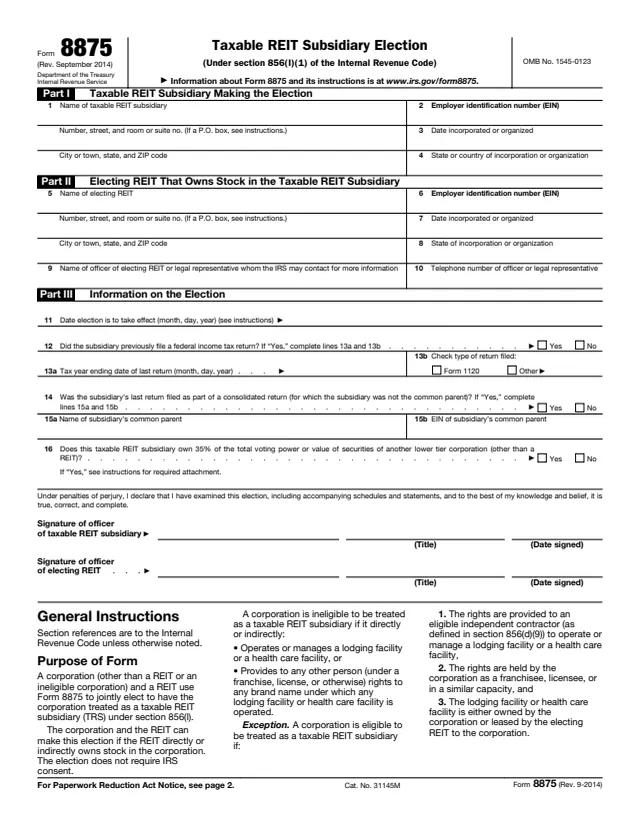
The instructions say the corporation and the REIT jointly file Form 8875, Taxable REIT Subsidiary Election.