Caption and opening instruction
Debtor 1, Debtor 2 (spouse, if filing), the district, the case number if known and an amended filing box, then the instruction to file the supplement together with Form 122A-1.
B 122A-1Supp
Statement of Exemption from Presumption of Abuse Under §707(b)(2)
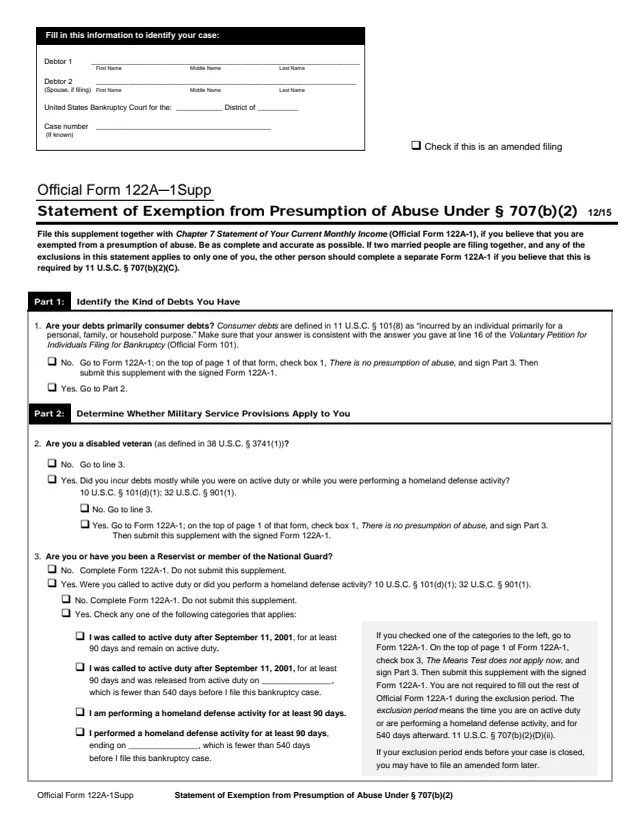
Form B 122A-1Supp, Statement of Exemption from Presumption of Abuse Under §707(b)(2), is the Official Bankruptcy Form a Chapter 7 individual debtor files together with the Chapter 7 Statement of Your Current Monthly Income (Official Form 122A-1) when they believe they are exempted from a presumption of abuse. The U.S. Courts list it under Means Test Forms. The current version is dated 12/15, and the U.S. Courts page lists it as effective on December 1, 2015. The page also says Official Bankruptcy Forms are approved by the Judicial Conference and must be used under Bankruptcy Rule 9009.
The one-page supplement asks whether debts are primarily consumer debts, then about disabled veteran status and service as a Reservist or member of the National Guard. Each answer points to a box on Form 122A-1 or to the next line. The instructions say a presumption of abuse does not mean you are actually trying to abuse the bankruptcy system. The form is derived from Official Form 22A-1Supp.
This page explains the form in plain words and is not legal advice. You can fill it out free in your browser on this page and download the result without an account.
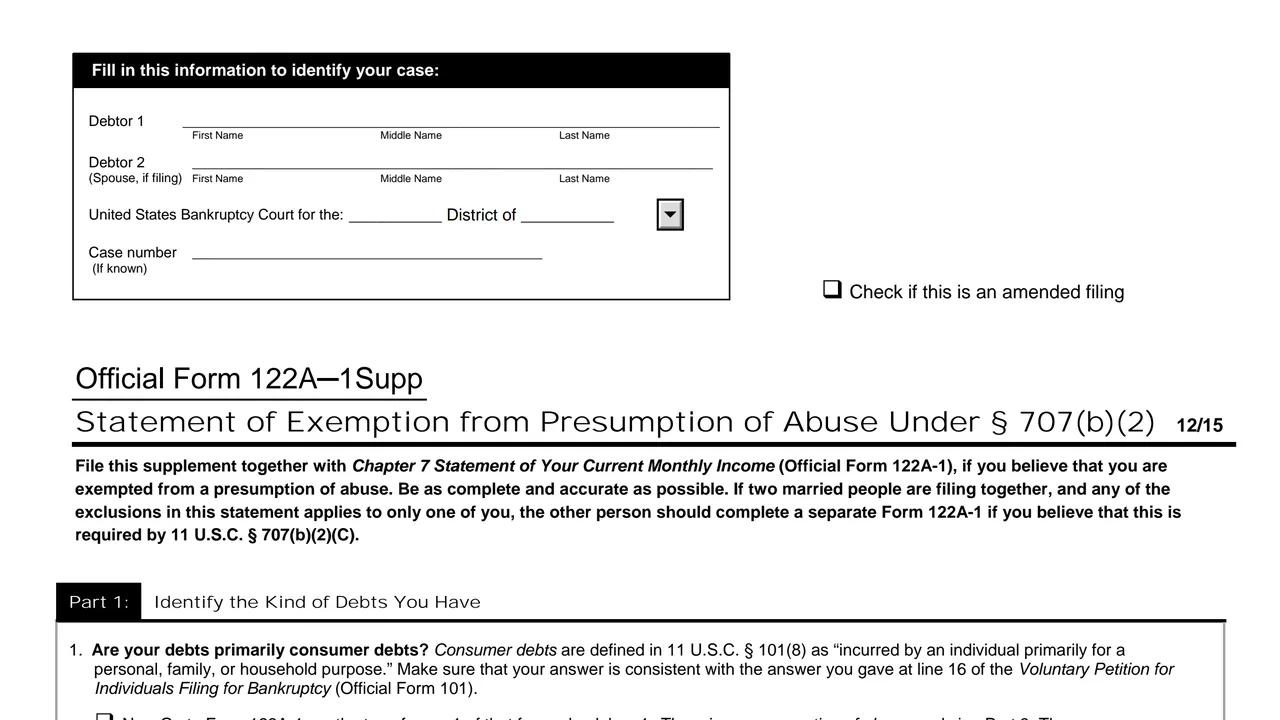
Debtor 1, Debtor 2 (spouse, if filing), the district, the case number if known and an amended filing box, then the instruction to file the supplement together with Form 122A-1.
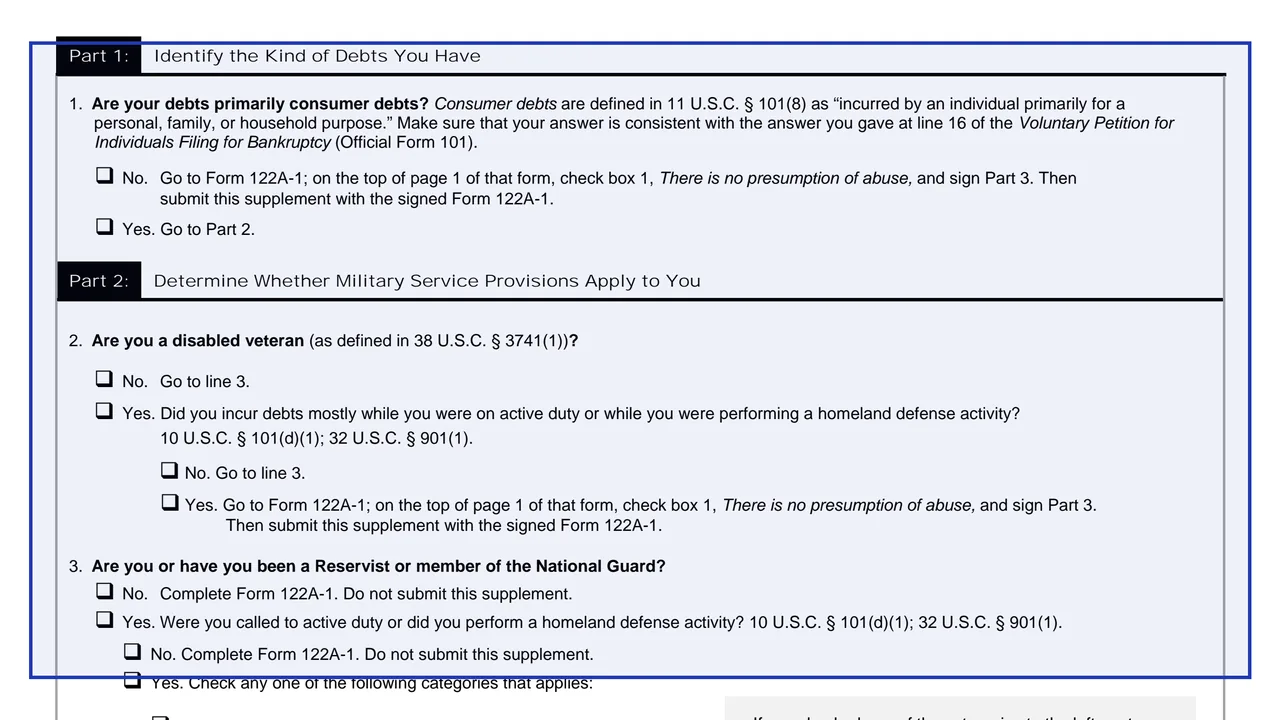
Line 1 asks whether debts are primarily consumer debts and says the answer should be consistent with line 16 of the Voluntary Petition (Official Form 101).
Whether you are a disabled veteran and, if so, whether debts were incurred mostly while on active duty or performing a homeland defense activity, citing 10 U.S.C. § 101(d)(1) and 32 U.S.C. § 901(1).
Four categories: called to active duty after September 11, 2001, for at least 90 days and still on duty, or released fewer than 540 days before filing; or performing a homeland defense activity for at least 90 days, or having performed one for at least 90 days that ended fewer than 540 days before filing.
The form defines the exclusion period as the time on active duty or performing a homeland defense activity, and 540 days afterward, citing 11 U.S.C. § 707(b)(2)(D)(ii).
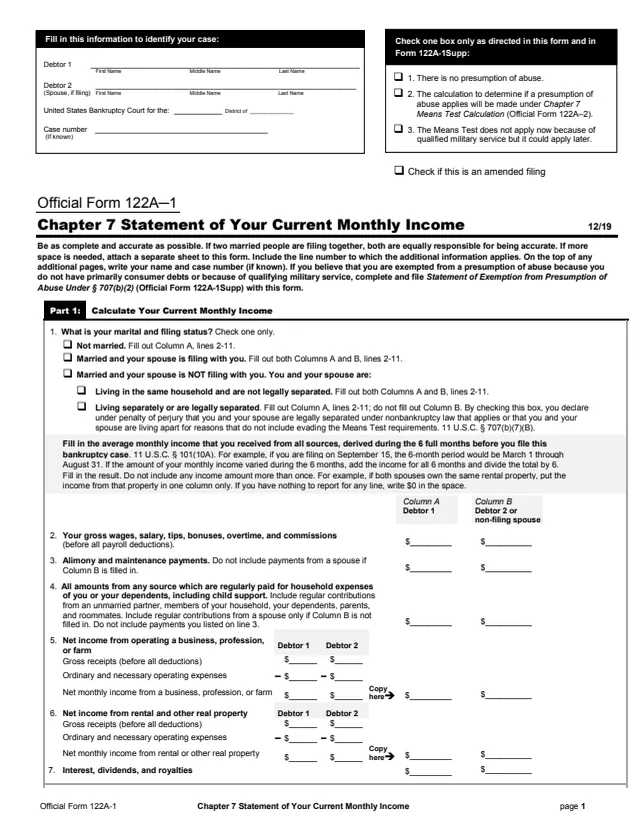
The supplement is filed together with Chapter 7 Statement of Your Current Monthly Income (Official Form 122A-1), and its answers point to boxes on that form.
If the answer is No, the form says to check box 1, There is no presumption of abuse, on page 1 of Form 122A-1, sign Part 3 of that form and submit this supplement with it. If Yes, go to Part 2.
For a disabled veteran whose debts were incurred mostly on active duty or during a homeland defense activity, the form points to box 1 on Form 122A-1. Otherwise it says to go to line 3.
If one of the four categories is checked, the form says to check box 3, The Means Test does not apply now, on Form 122A-1 and sign Part 3. If not, it says to complete Form 122A-1 and not submit this supplement.
Two categories ask for the date of release from active duty or the date a homeland defense activity ended.
The supplement has no signature line of its own. The instructions say to verify it by completing Part 3 of Form 122A-1, then the two are submitted together.
You get the real form, filled in a browser tab, with nothing standing between you and the finished PDF.
With the United States Bankruptcy Court for the district named at the top, together with Form 122A-1. The instructions list it among the Chapter 7 forms filed if necessary.
The supplement has no signature line. The instructions say the supplement is verified by completing Part 3 of Form 122A-1, and that with an exemption no other part of Form 122A-1 is required except the verification.
The form says that if the exclusion period ends before the case is closed, you may have to file an amended form later.
The form does not print a fee.
B 122A-1
58 fields, 3 pages
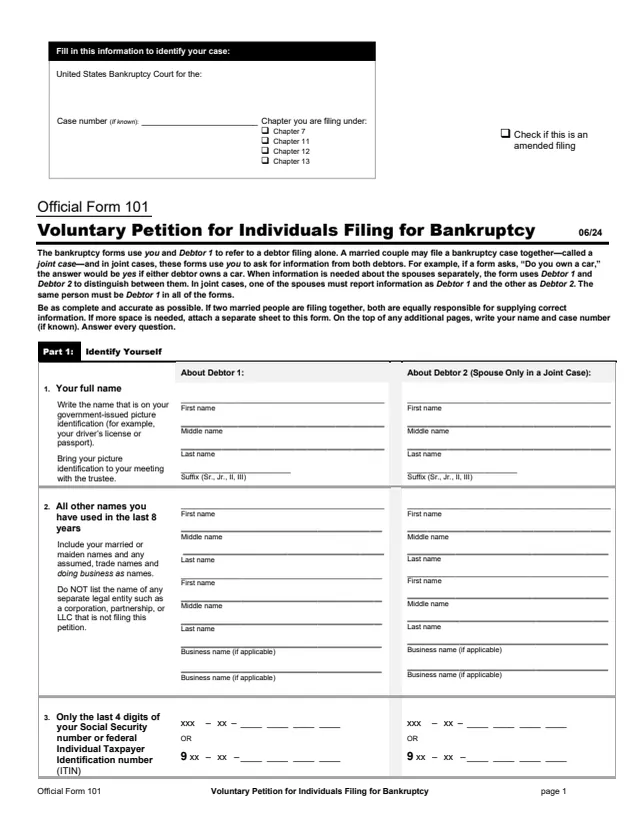
B 101
159 fields, 9 pages
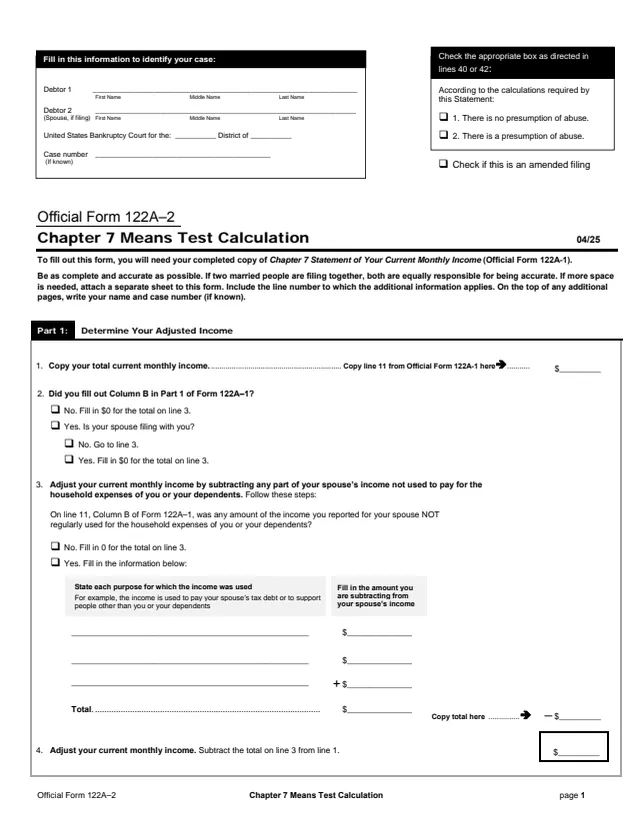
B 122A-2
146 fields, 9 pages
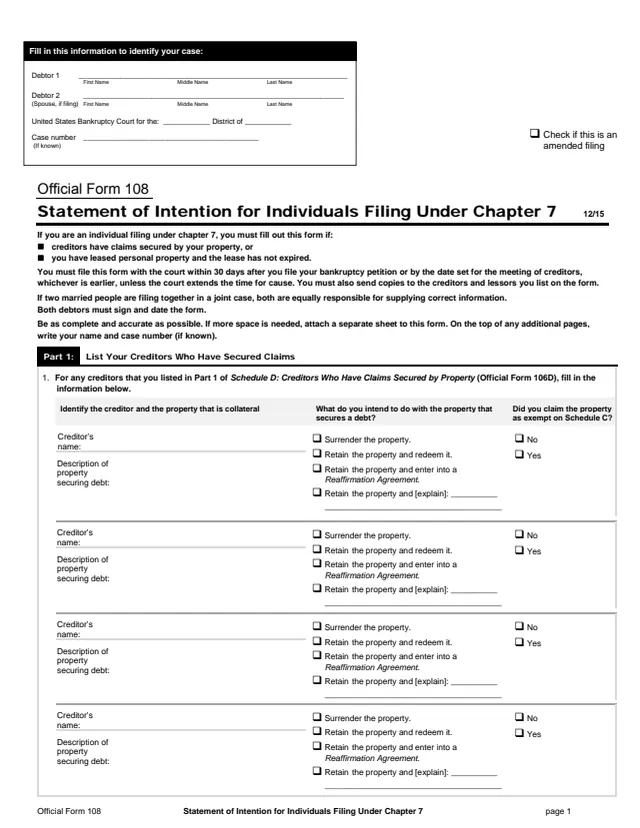
B 108
58 fields, 2 pages
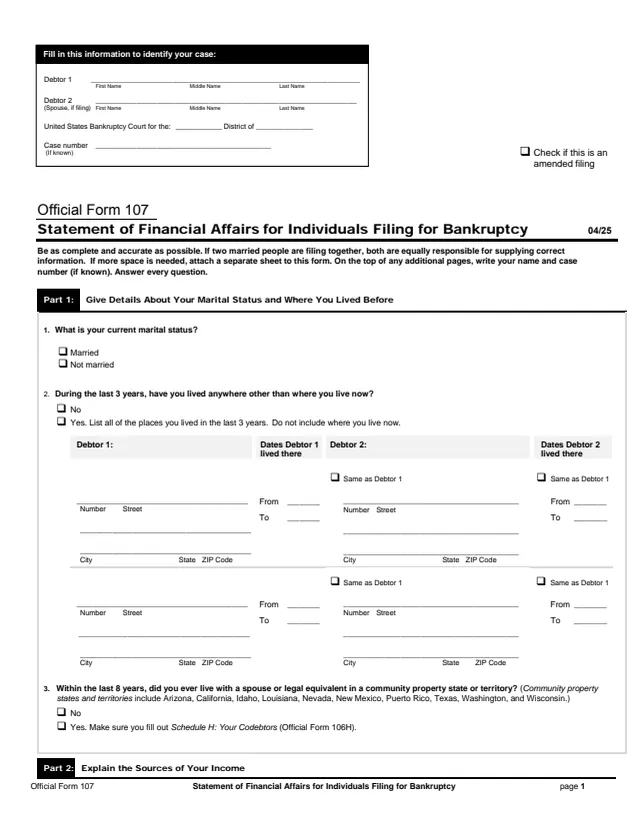
B 107
535 fields, 12 pages
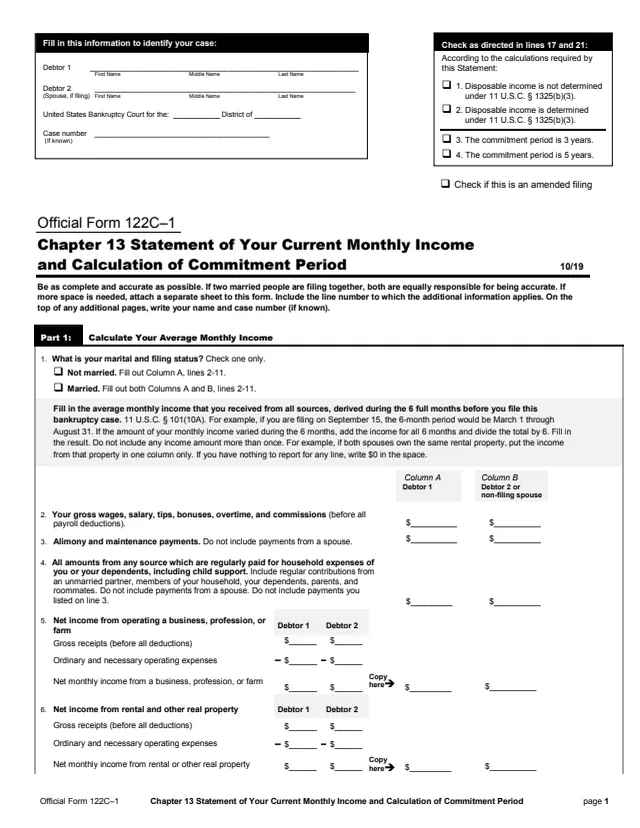
B 122C-1
71 fields, 4 pages
The form says to file it together with Form 122A-1 if you believe that you are exempted from a presumption of abuse. The instructions say not to fill out the Chapter 7 means test forms in a case under chapter 11, 12 or 13.
No tool matches that search.
The form says to file it together with Form 122A-1 if you believe you are exempted from a presumption of abuse. The instructions say the exemptions cover debts that are not primarily consumer debts and certain military or homeland defense services.
The instructions say a presumption of abuse does not mean you are actually trying to abuse the bankruptcy system, but that you are presumed to have enough income that you should not be granted relief under chapter 7, and that it may be overcome by showing special circumstances.
No. The form points to Part 3 of Form 122A-1, and the instructions say the supplement is verified by completing Part 3 of Form 122A-1.
The form says it is the time you are on active duty or are performing a homeland defense activity, and for 540 days afterward, citing 11 U.S.C. § 707(b)(2)(D)(ii).
The form says to complete Form 122A-1 and not to submit this supplement.
The form says that if your exclusion period ends before your case is closed, you may have to file an amended form later.
The form says that if any of the exclusions applies to only one spouse, the other should complete a separate Form 122A-1 if you believe this is required by 11 U.S.C. § 707(b)(2)(C).