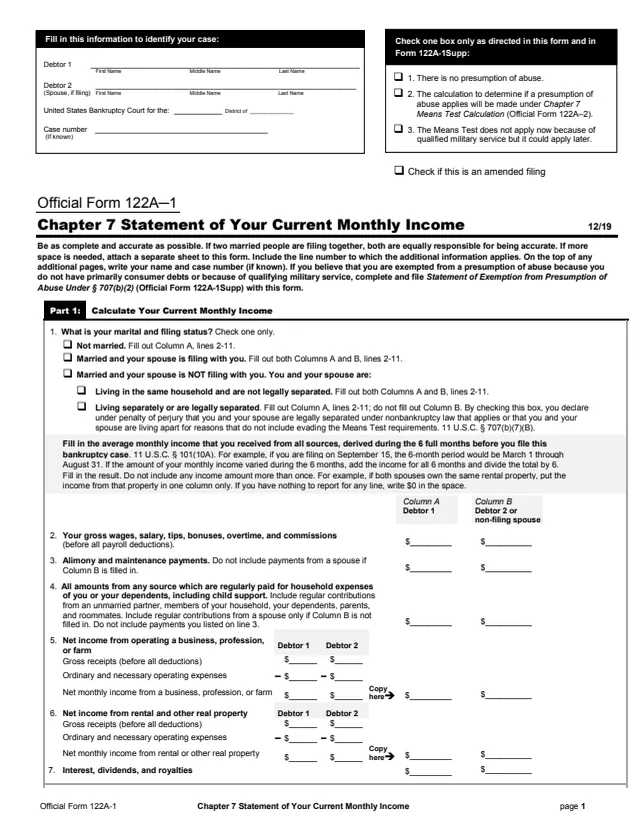
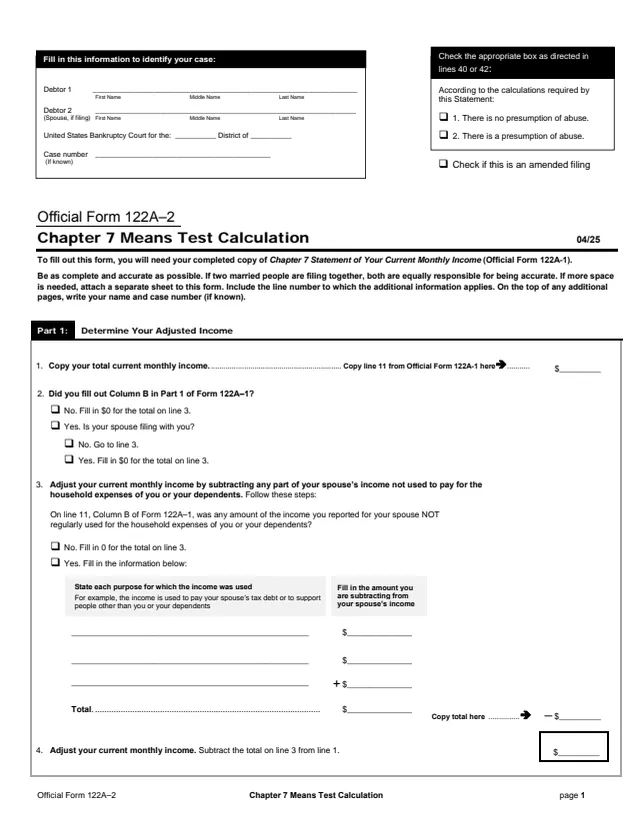
Result boxes on page 1
Boxes 1 and 2 say whether disposable income is determined under 11 U.S.C. § 1325(b)(3). Boxes 3 and 4 say whether the commitment period is 3 years or 5 years.
B 122C-1
Chapter 13 Statement of Your Current Monthly Income and Calculation of Commitment Period
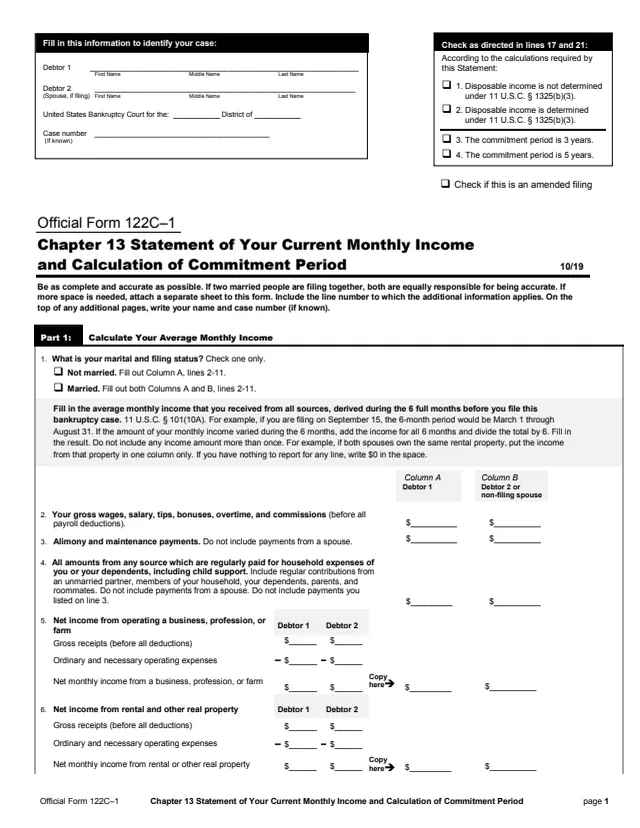
Form B 122C-1, Chapter 13 Statement of Your Current Monthly Income and Calculation of Commitment Period, is an Official Bankruptcy Form that the U.S. Courts list under Means Test Forms. It reports the average monthly income received from all sources during the 6 full months before filing, compares that income for a year with the median family income for the state and household size, and works out whether the commitment period is 3 years or 5 years. The current version is dated 10/19, and the U.S. Courts page lists it as effective on October 1, 2019. The page says it is derived from Official Form 22C-1.
The page also says the form was amended from April 3, 2020, to March 27, 2022, for temporary CARES Act changes to the Bankruptcy Code. Those changes lapsed on March 27, 2022, and the form reverted to the pre-CARES Act version.
This page explains the form in plain words and is not legal advice. You can fill it out free in your browser on this page and download the result without an account.
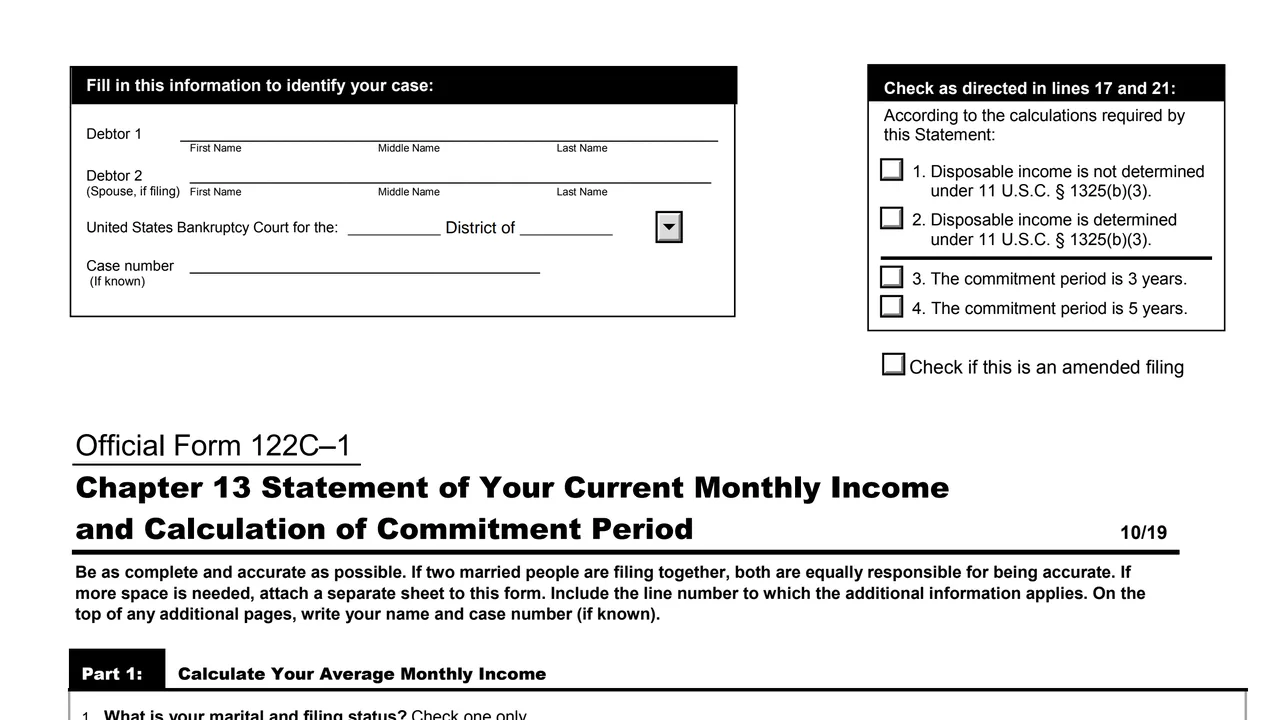
Boxes 1 and 2 say whether disposable income is determined under 11 U.S.C. § 1325(b)(3). Boxes 3 and 4 say whether the commitment period is 3 years or 5 years.
Gross wages, salary, tips, bonuses, overtime and commissions; alimony and maintenance; amounts regularly paid for household expenses, including child support; and net income from a business, profession or farm and from rental or other real property.
Interest, dividends and royalties, unemployment compensation, pension or retirement income and income from all other sources, each with listed exclusions. Line 11 adds lines 2 to 10 for each column and then both columns together.
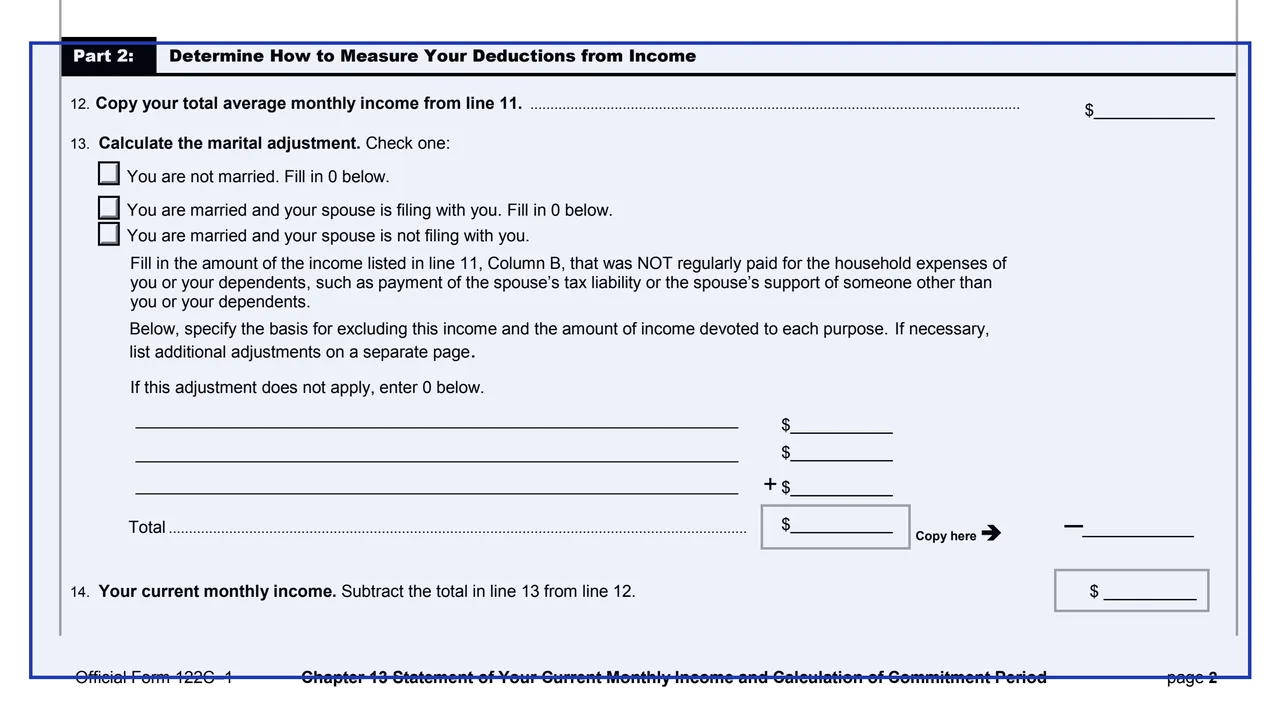
The marital adjustment, current monthly income on line 14, that amount times 12, the median family income for your state and household size, and a comparison that decides box 1 or box 2.
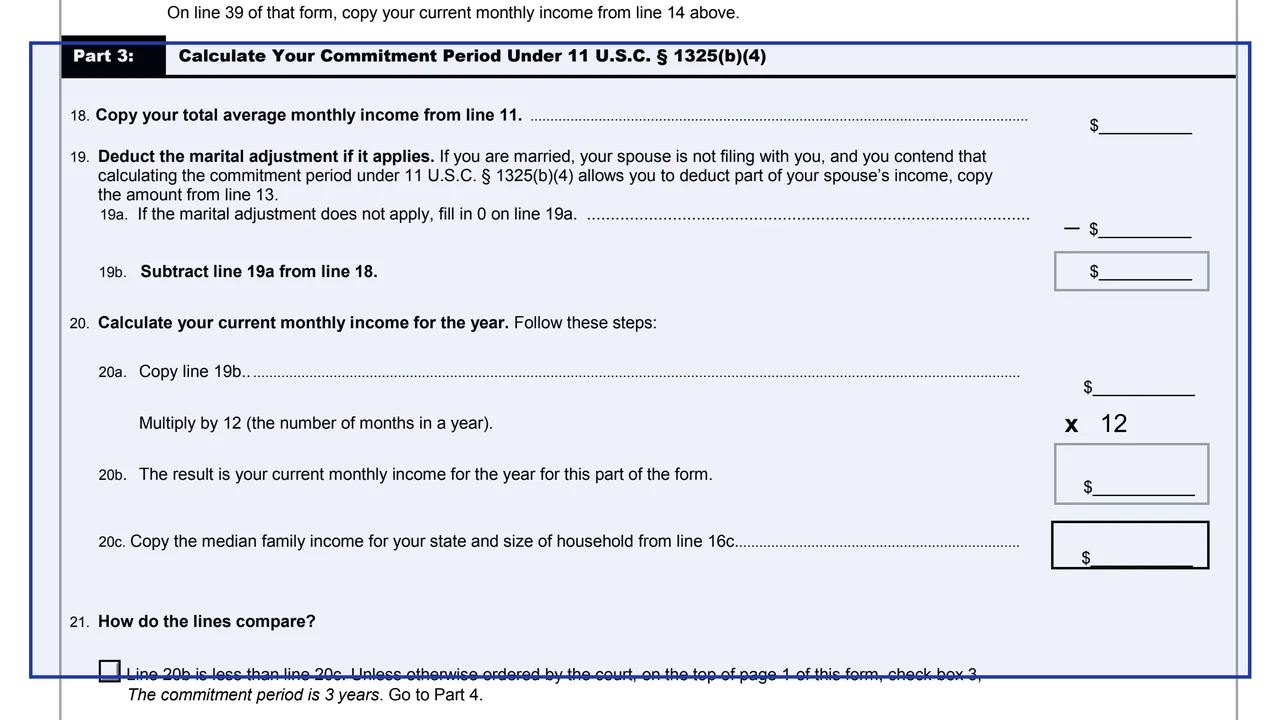
The calculation is repeated under 11 U.S.C. § 1325(b)(4), with the marital adjustment only where the filer contends it applies, and line 21 decides box 3 or box 4 unless otherwise ordered by the court.
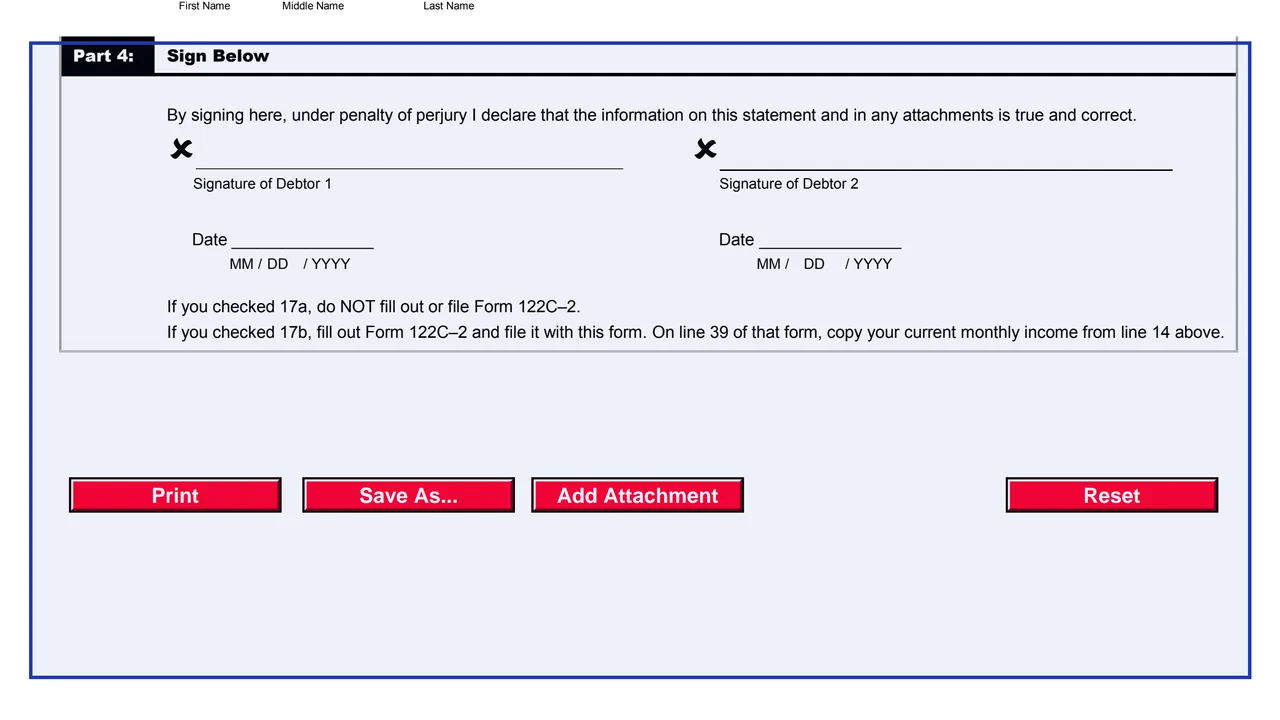
Each debtor signs under penalty of perjury that the statement and any attachments are true and correct, with a reminder about when Form 122C-2 is filed.
The form uses the 6 full months before the case is filed. Its example: filing on September 15 means March 1 through August 31.
If income varied, add all 6 months and divide by 6. Write $0 on any line with nothing to report, and count no amount more than once. For example, rent from property both spouses own goes in one column only.
On line 13, a married filer whose spouse is not filing lists each purpose and amount of the spouse's income not regularly paid for household expenses. If the adjustment does not apply, the form says to enter 0.
Line 16 asks for your state, the number of people in your household and the median family income. The form says the list is online at the link in the separate instructions and may also be at the bankruptcy clerk's office.
Line 17a, where line 15b is less than or equal to line 16c, points to box 1. Line 17b points to box 2. Line 21 points to box 3 when line 20b is less than line 20c, and to box 4 when it is more than or equal.
Each debtor signs Part 4. The form says not to fill out or file Form 122C-2 after checking 17a, and after checking 17b, to file it with this form and copy line 14 to line 39 of that form.
You get the real form, filled in a browser tab, with nothing standing between you and the finished PDF.
The form is filed in the case at the United States Bankruptcy Court, with the district and the case number, if known, at the top. A box marks an amended filing, and extra pages carry the line number, your name and the case number.
The form does not print median income amounts. The instructions give https://www.justice.gov/ust/means-testing for line 16c and say a public computer may be available at the bankruptcy clerk's office or at a public library.
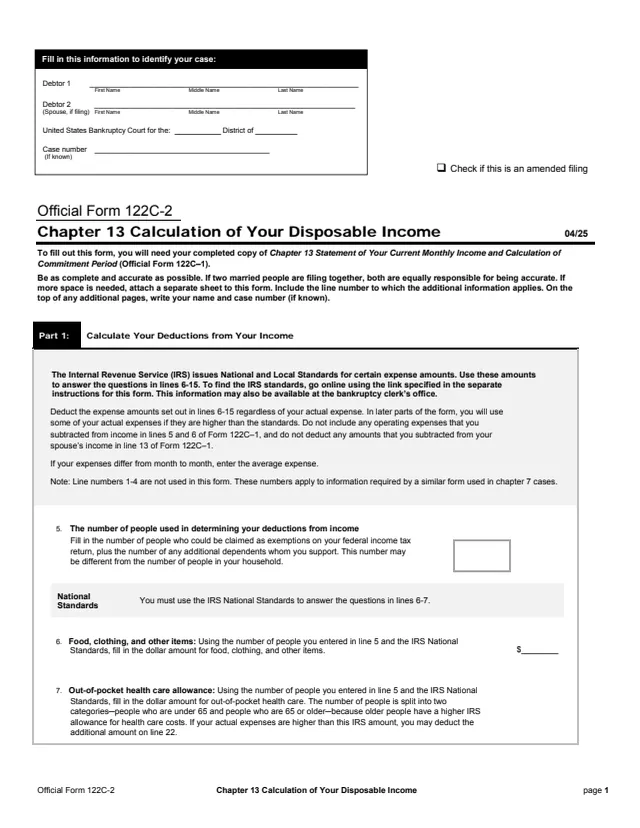
Chapter 13 Calculation of Your Disposable Income. The U.S. Courts page links it as a related form, and this form says to file it with this one after checking line 17b.
The form and its U.S. Courts page do not print a fee amount for this statement.
The U.S. Courts page says the form was amended from April 3, 2020, to March 27, 2022, for temporary CARES Act changes. Those changes lapsed on March 27, 2022, and the form reverted to the pre-CARES Act version.
The instructions say it is filed by an individual filing under chapter 13. Line 1 sets which columns each filer fills out.
No tool matches that search.
The form describes it as the average monthly income received from all sources during the 6 full months before the case is filed, citing 11 U.S.C. § 101(10A). If income varied, the 6 months are added and divided by 6.
Line 21 compares income for the year on line 20b with the median family income on line 20c. Less than the median points to box 3, 3 years. More than or equal to it points to box 4, 5 years. Both apply unless otherwise ordered by the court.
The form ties it to line 17. With 17a checked, it says not to fill out or file Form 122C-2. With 17b checked, it says to fill out Form 122C-2, file it with this form and copy line 14 to line 39 of that form.
The form does not list the amounts. It says to go online using the link in the separate instructions, and that the list may also be available at the bankruptcy clerk's office. The instructions give https://www.justice.gov/ust/means-testing.
The form says not to include benefits received under the Social Security Act on lines 9 and 10. On line 8, unemployment compensation that you contend was a Social Security Act benefit is listed separately instead of entered in the columns.
The U.S. Courts page says the CARES Act changes lapsed on March 27, 2022, and the form reverted to the pre-CARES Act version. The committee note says that is the October 2019 version, and the form now posted is dated 10/19.