B 101

Voluntary Petition for Individuals Filing for Bankruptcy

Agency
U.S. Courts
Revision
06/24
Fillable fields
159
Pages
9
Official source
U.S. Courts form page
Checked
October 20, 2026
Fill B 101 online
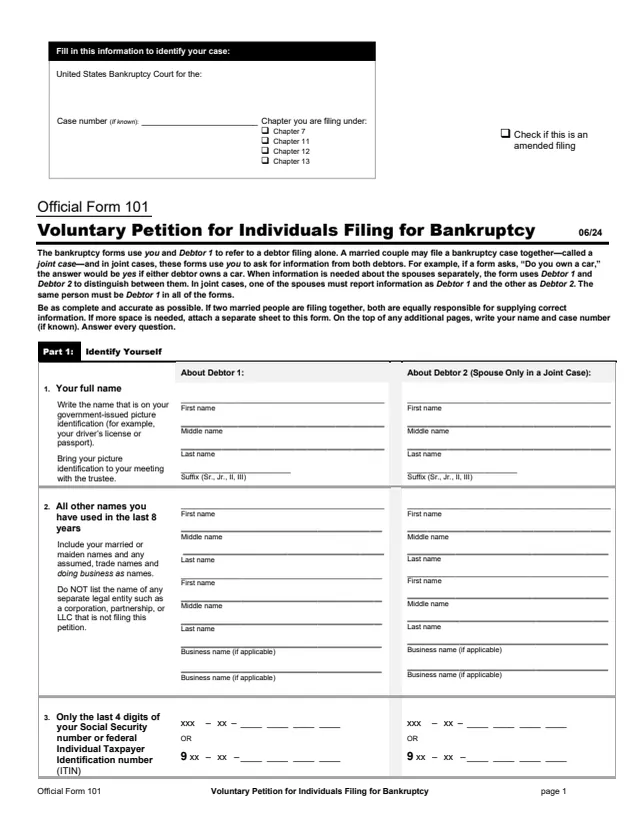
Page 1 of form B 101

Form B 101: Voluntary Petition for Individuals Filing for Bankruptcy

Form B 101, Voluntary Petition for Individuals Filing for Bankruptcy, is the Official Bankruptcy Form an individual files with the United States Bankruptcy Court to request relief under a chapter of the Bankruptcy Code. The U.S. Courts list it under Individual Debtors. The current version is dated 06/24, and the U.S. Courts page lists it as effective on June 22, 2024. The page also says Official Bankruptcy Forms are approved by the Judicial Conference and must be used under Bankruptcy Rule 9009.

The 9-page form names the chapter of the Bankruptcy Code (Chapter 7, 11, 12 or 13), identifies the debtor, and asks about the filing fee, earlier cases, businesses, hazardous property, credit counseling, debts and estimated assets. A married couple may file together in a joint case. The form is derived from Official Form 1 and incorporates former Exhibits A, C and D, and the eviction judgment statements that were part of Form 1 are now Forms 101A and 101B.

This page explains the form in plain words and is not legal advice. The form itself strongly urges people filing without an attorney to hire a qualified one. You can fill it out free in your browser on this page and download the result without an account.

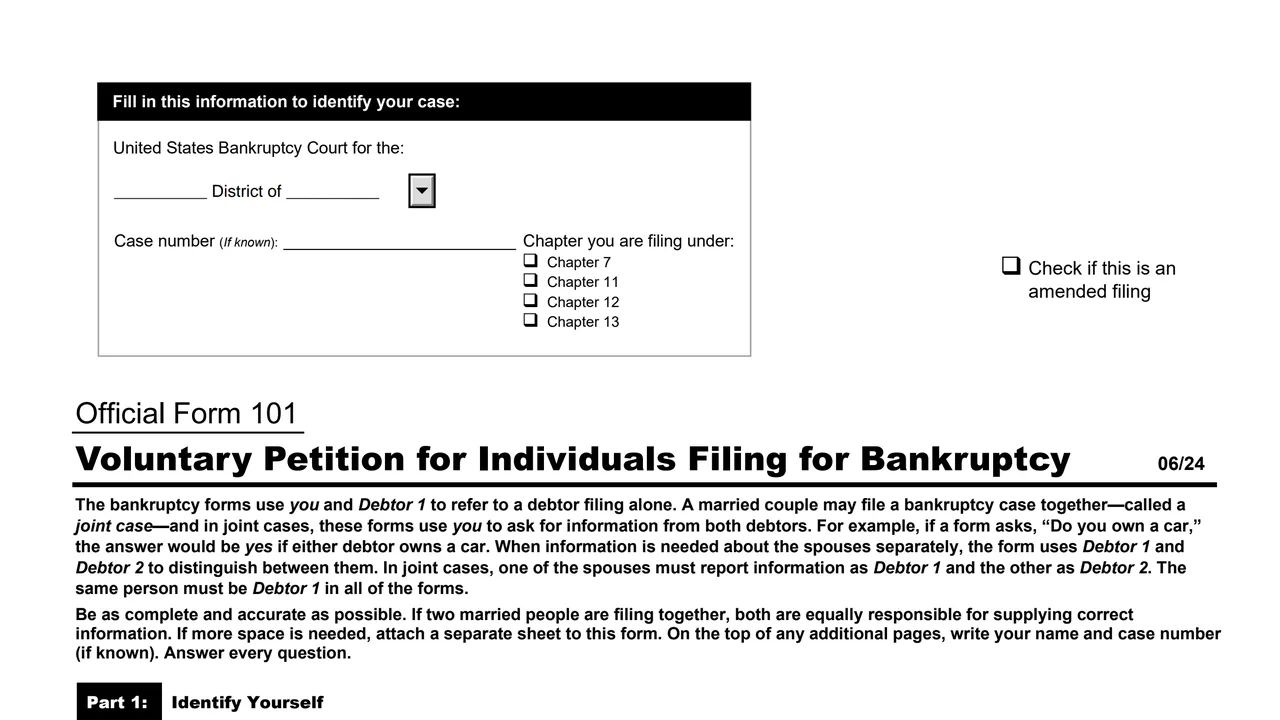
Top of page 1 of Form B 101: Voluntary Petition for Individuals Filing for Bankruptcy, as printed by COURTS

What's on Form B 101

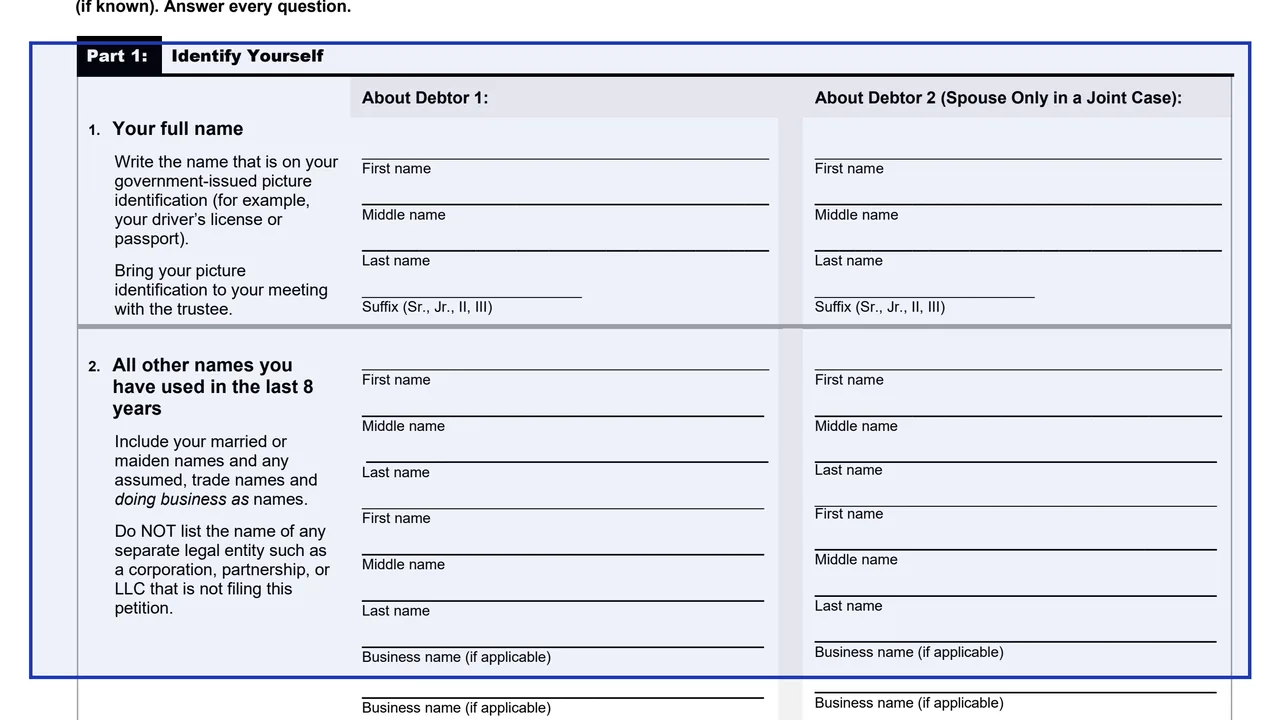
Part 1: Identify yourself

Lines 1 to 6: your full name as on a government-issued picture ID, other names used in the last 8 years, the last 4 digits of your Social Security number or ITIN, any EIN, where you live, a mailing address and why you chose this district.
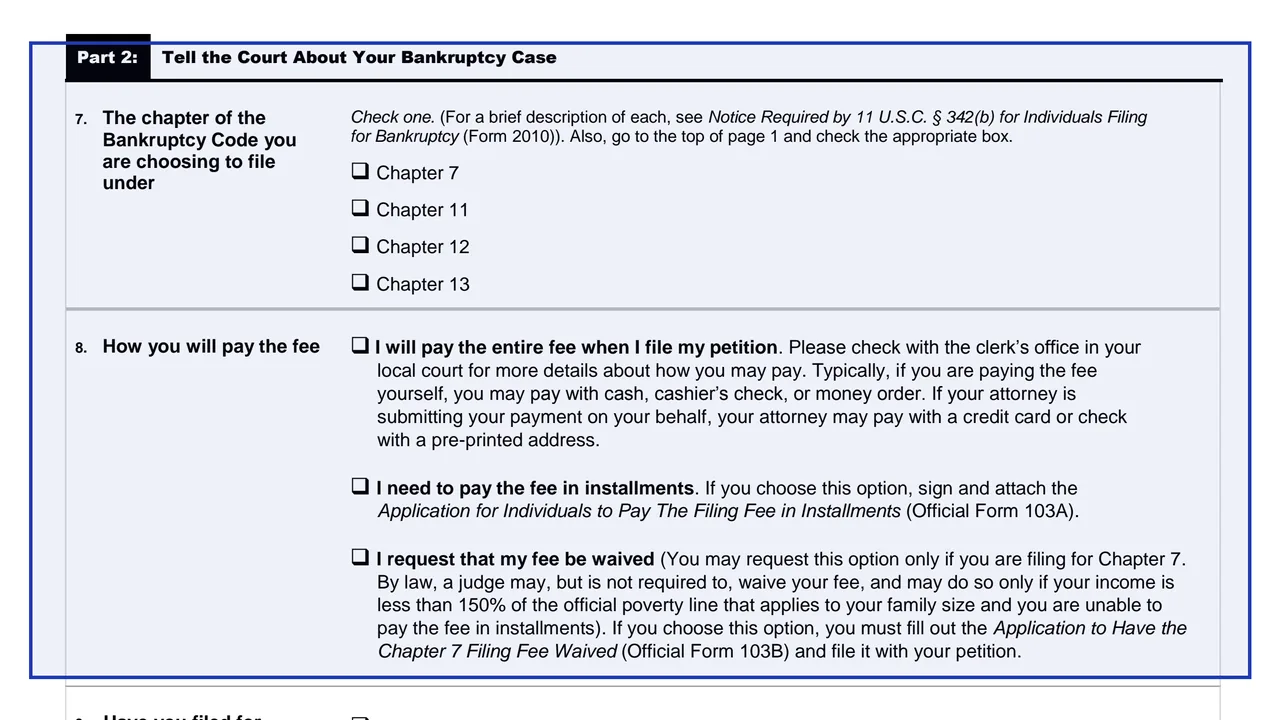
Part 2: Your bankruptcy case

Lines 7 to 11: the chapter (7, 11, 12 or 13), how you will pay the fee, bankruptcy filings in the last 8 years, cases pending by a spouse, business partner or affiliate, and whether a landlord has an eviction judgment against you.

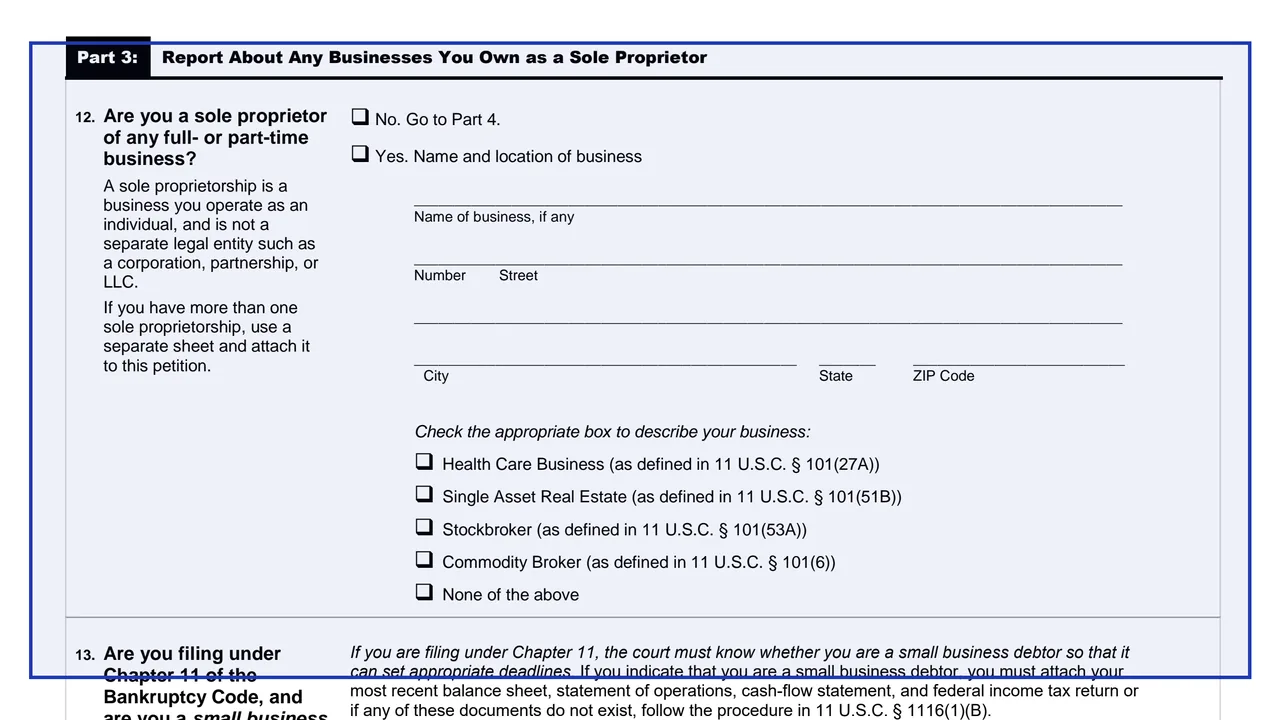
Part 3: Businesses you own

Lines 12 and 13: the name, location and type of any sole proprietorship, such as a health care business or single asset real estate, and for Chapter 11, whether you are a small business debtor and choose Subchapter V.

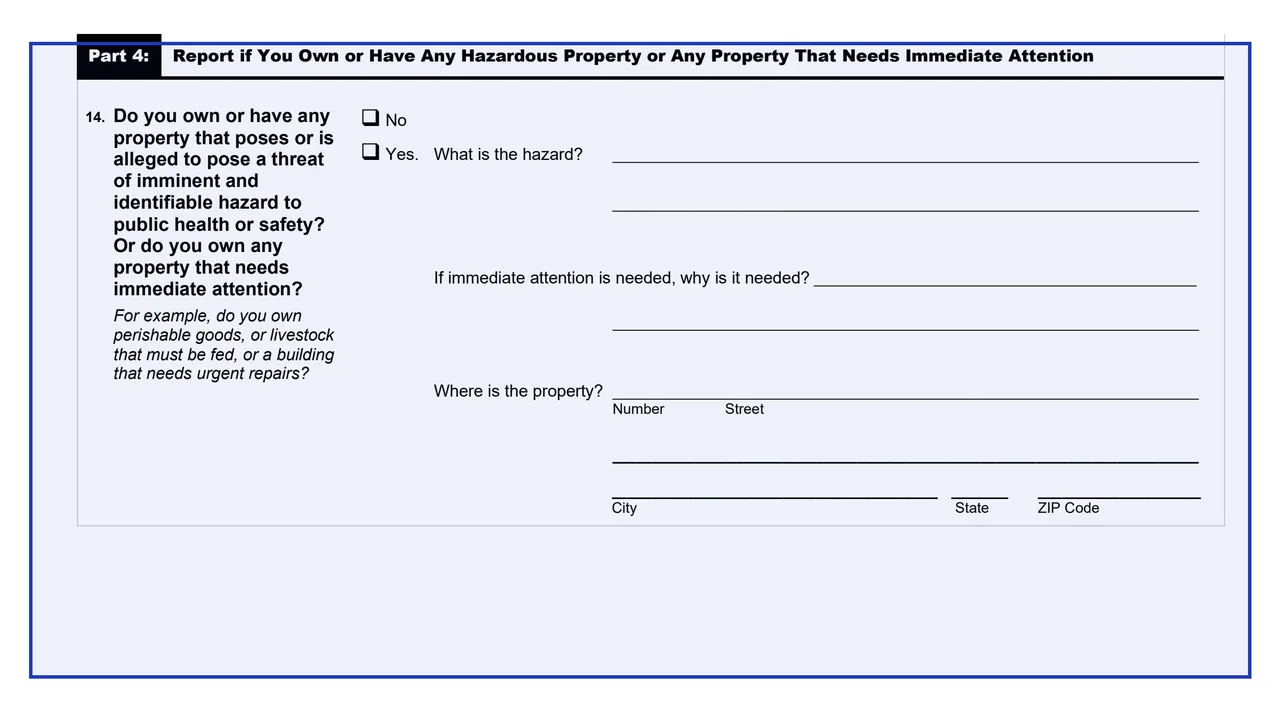
Part 4: Hazardous property

Line 14 asks about property that poses or is alleged to pose a threat to public health or safety, or that needs immediate attention, such as perishable goods, livestock or a building that needs urgent repairs.

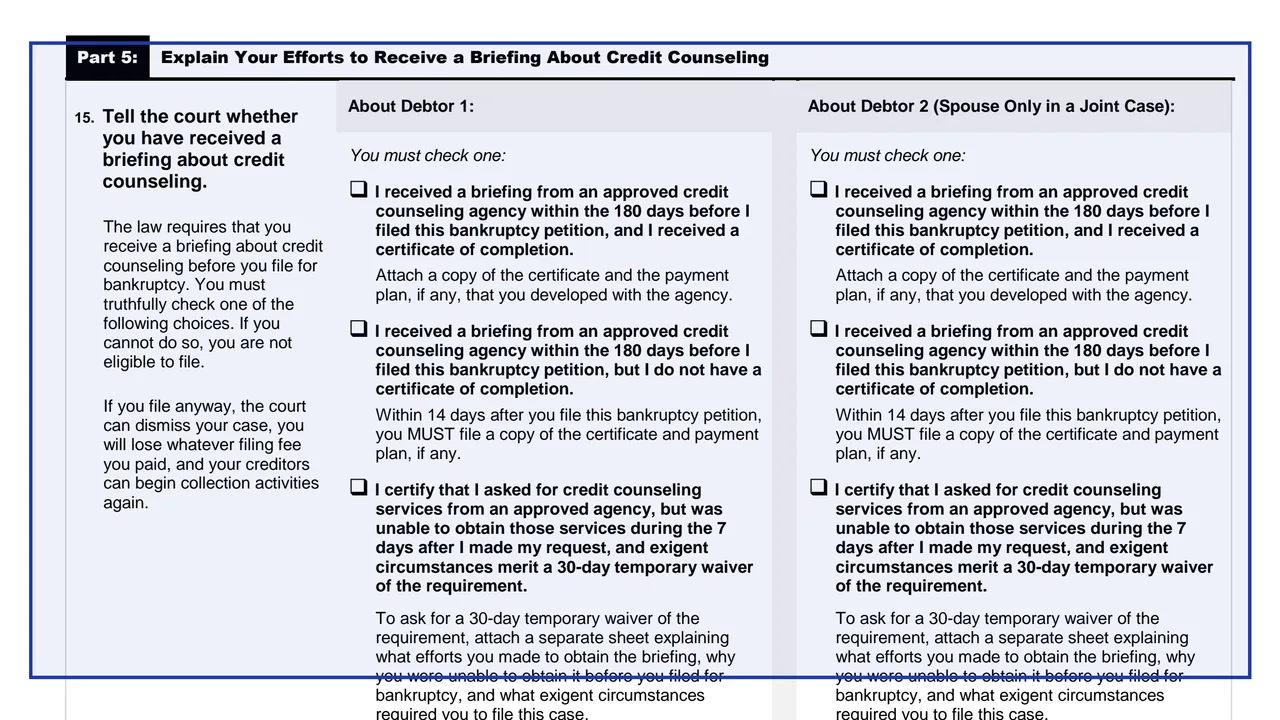
Part 5: Credit counseling

Line 15 has four choices for each debtor: a briefing with a certificate, a briefing without a certificate yet, a request for a 30-day temporary waiver, or a reason a briefing is not required (incapacity, disability or active duty in a military combat zone).

Parts 6 and 7: Estimates and signatures

Lines 16 to 20 ask whether debts are mainly consumer or business debts and estimate creditors, assets and liabilities in ranges. Part 7 is signed under penalty of perjury, then come the attorney page and the notice for filing without an attorney.

How to fill out Form B 101

  1. 1

    Name the court and the chapter

    At the top of page 1, fill in the district, the case number if known and the chapter, and check the box if this is an amended filing. Line 7 points to Form 2010 for a brief description of each chapter.

  2. 2

    Answer every question

    The form asks for answers that are as complete and accurate as possible, and for every question to be answered. If more space is needed, attach a separate sheet with your name and case number on top.

  3. 3

    Choose how the fee is paid

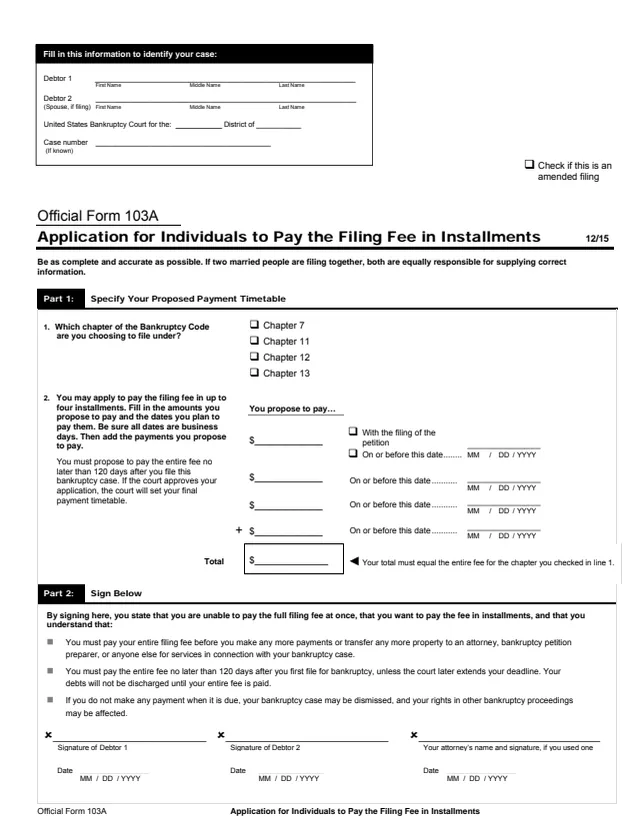
    Line 8 offers paying in full, paying in installments with Form 103A, or, in Chapter 7 only, asking for a waiver with Form 103B. The form says to check with the clerk's office in your local court about how to pay.

  4. 4

    Attach credit counseling papers

    With a briefing and a certificate, the form asks for a copy of the certificate and any payment plan. With a briefing but no certificate yet, it says to file them within 14 days after filing the petition.

  5. 5

    Add the forms that apply

    The form asks for Form 101A with the petition if a landlord has an eviction judgment against you, and for Form 119 if you paid or agreed to pay someone who is not an attorney to help fill out the forms.

  6. 6

    Sign and date it

    Each debtor signs Part 7 under penalty of perjury. An attorney signs page 8, or a debtor filing without one signs the notice on page 9. The form says to bring your picture ID to the meeting with the trustee.

Why fill Form B 101 on indox

You get the real form, filled in a browser tab, with nothing standing between you and the finished PDF.

  • Fill the form right in your browser, no software to install
  • Free to fill and free to download, with no account
  • The official blank straight from the U.S. Courts, not a copy someone retyped
  • Works on a phone, tablet or computer

Where it is filed, fees and warnings

Where it is filed

With the United States Bankruptcy Court for the district named on page 1. Line 6 asks why you chose that district, such as having lived there longer than in any other district over the last 180 days (28 U.S.C. § 1408).

Filing fee

The form does not print the fee amount. It says to check with the clerk's office in your local court, and that people paying the fee themselves typically pay with cash, cashier's check or money order. An attorney may pay with a credit card or a check with a pre-printed address.

Fee waiver

The form says a judge may, but is not required to, waive the fee in Chapter 7 only, and only if income is less than 150% of the official poverty line for the family size and the fee cannot be paid in installments.

Court notices

If your mailing address differs from where you live, line 5 has a place for it, and the form says the court sends any notices to that mailing address.

Schedules and penalties

Page 9 says all property and debts are listed in the schedules filed with the court, and a debt that is not listed may not be discharged. Part 7 says a false statement or fraud in a bankruptcy case can result in fines up to $250,000, imprisonment for up to 20 years, or both.

Who uses Form B 101?

  • A debtor filing alone

    The bankruptcy forms use you and Debtor 1 for a person filing alone. The Debtor 2 column is for a spouse in a joint case only.

  • Married couples filing together

    A married couple may file one joint case. One spouse reports as Debtor 1 and the other as Debtor 2, the same person is Debtor 1 in all of the forms, and both are equally responsible for correct information.

  • Sole proprietors

    Part 3 asks about a full- or part-time business you run as an individual, not as a separate legal entity such as a corporation, partnership or LLC. More than one goes on a separate sheet.

  • With or without an attorney

    Page 8 is signed by the debtor's attorney. Page 9 is a notice for people filing without one, and the form says the law allows an individual to represent themselves in bankruptcy court.

The form is written for individuals. It names these situations.

Official sources and the blank

Do it all with indox

View all 94 tools

Questions about Form B 101

Can a married couple file one Form B 101?

Yes. The form says a married couple may file together in a joint case. One spouse reports as Debtor 1 and the other as Debtor 2, the same person stays Debtor 1 in all of the forms, and both are equally responsible for correct information.

Does Form B 101 ask for my full Social Security number?

No. Line 3 asks only for the last 4 digits of your Social Security number or your federal Individual Taxpayer Identification Number (ITIN).

Which name goes on line 1?

The name on your government-issued picture identification, such as a driver's license or passport. The form says to bring that identification to your meeting with the trustee.

What if the filing fee cannot be paid at once?

Line 8 lists two other options: paying in installments with Form 103A, or, for Chapter 7 only, asking the court to waive the fee with Form 103B. The form says a judge may, but is not required to, waive the fee.

Is a credit counseling briefing needed before filing?

The form says the law requires a briefing about credit counseling before filing, and that a person who cannot truthfully check one of the line 15 choices is not eligible to file. The choices include a 30-day temporary waiver request and exceptions for incapacity, disability and active military duty in a combat zone.

Can I file Form B 101 without an attorney?

The form says the law allows an individual to represent themselves in bankruptcy court, but it strongly urges hiring a qualified attorney because the rules are very technical. People filing without an attorney sign the notice on page 9.

What if my landlord has an eviction judgment against me?

Line 11 says to fill out Initial Statement About an Eviction Judgment Against You (Form 101A) and file it as part of the petition. The U.S. Courts page lists Forms 101A and 101B as related forms.