Case information
Debtor 1, Debtor 2 (spouse, if filing), the United States Bankruptcy Court district, the case number if known, and a box to check if this is an amended filing.
B 106 Summary
A Summary of Your Assets and Liabilities and Certain Statistical Information (individuals)
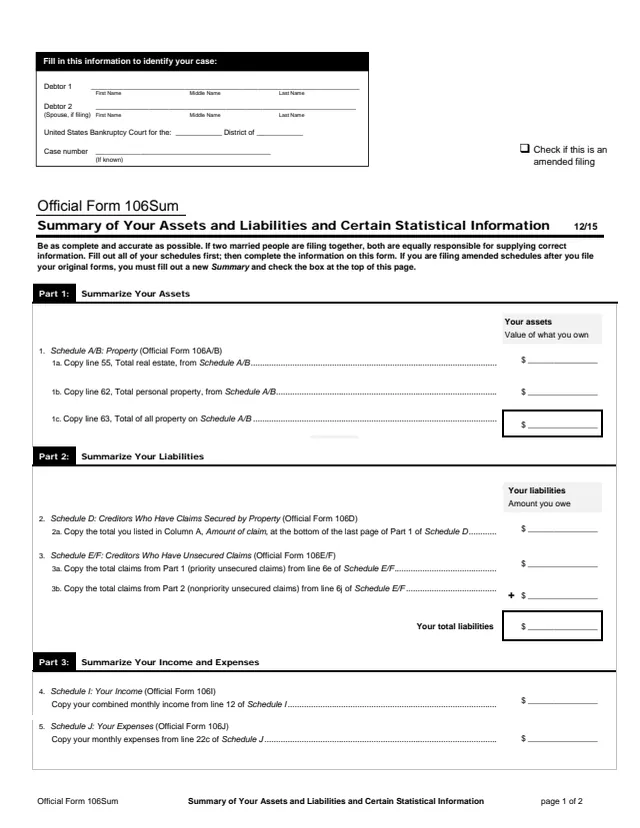
Form B 106 Summary, A Summary of Your Assets and Liabilities and Certain Statistical Information (individuals), is the Official Bankruptcy Form an individual debtor uses to bring the totals from the other bankruptcy schedules together on one form. The PDF labels it Official Form 106Sum. The U.S. Courts list it under Individual Debtors. The current version is dated 12/15, and the U.S. Courts page lists it as effective on December 1, 2015. The page also says Official Bankruptcy Forms are approved by the Judicial Conference and must be used under Bankruptcy Rule 9009, and that this form is derived from Official Form 6, Summary.
The 2-page form copies totals from Schedule A/B, Schedule D, Schedule E/F, Schedule I and Schedule J, then asks a few questions for administrative and statistical records. The form says to fill out all of the schedules first and then complete this one. The committee note says it replaces Official Form 6 in cases of individual debtors and no longer asks which schedules are attached or how many sheets of paper were used.
This page explains the form in plain words and is not legal advice. You can fill it out free in your browser on this page and download the result without an account.
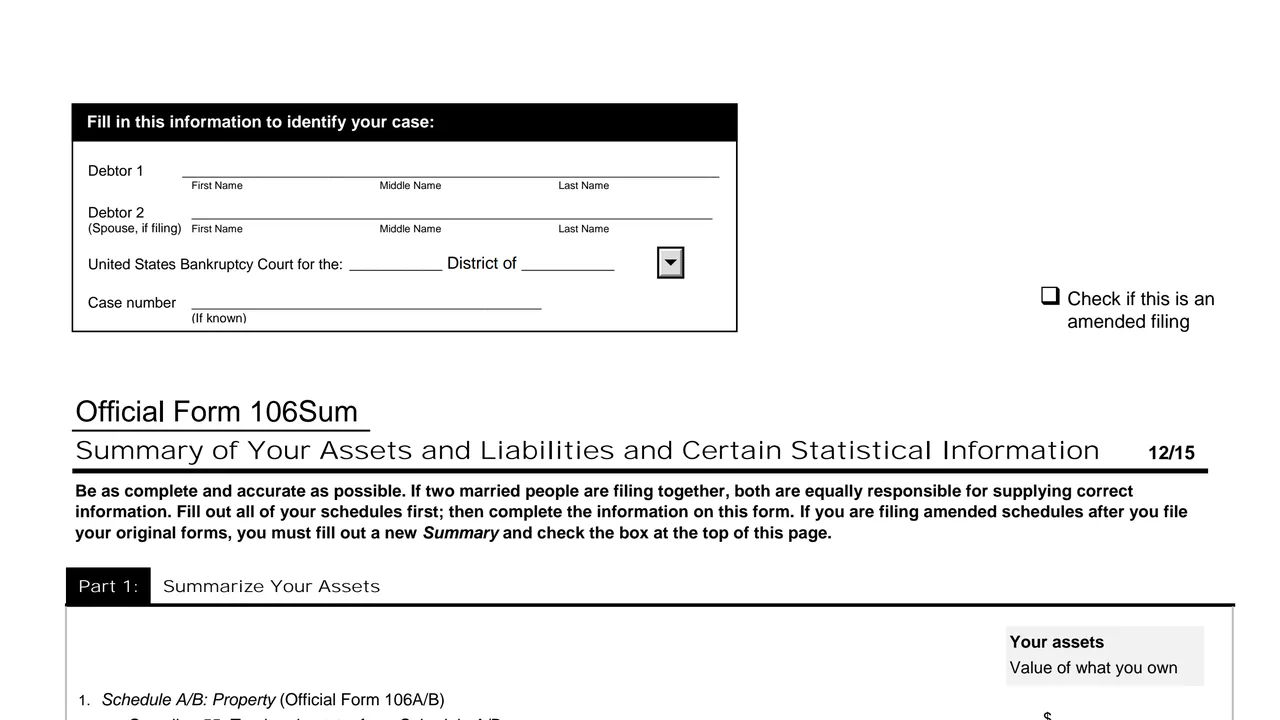
Debtor 1, Debtor 2 (spouse, if filing), the United States Bankruptcy Court district, the case number if known, and a box to check if this is an amended filing.
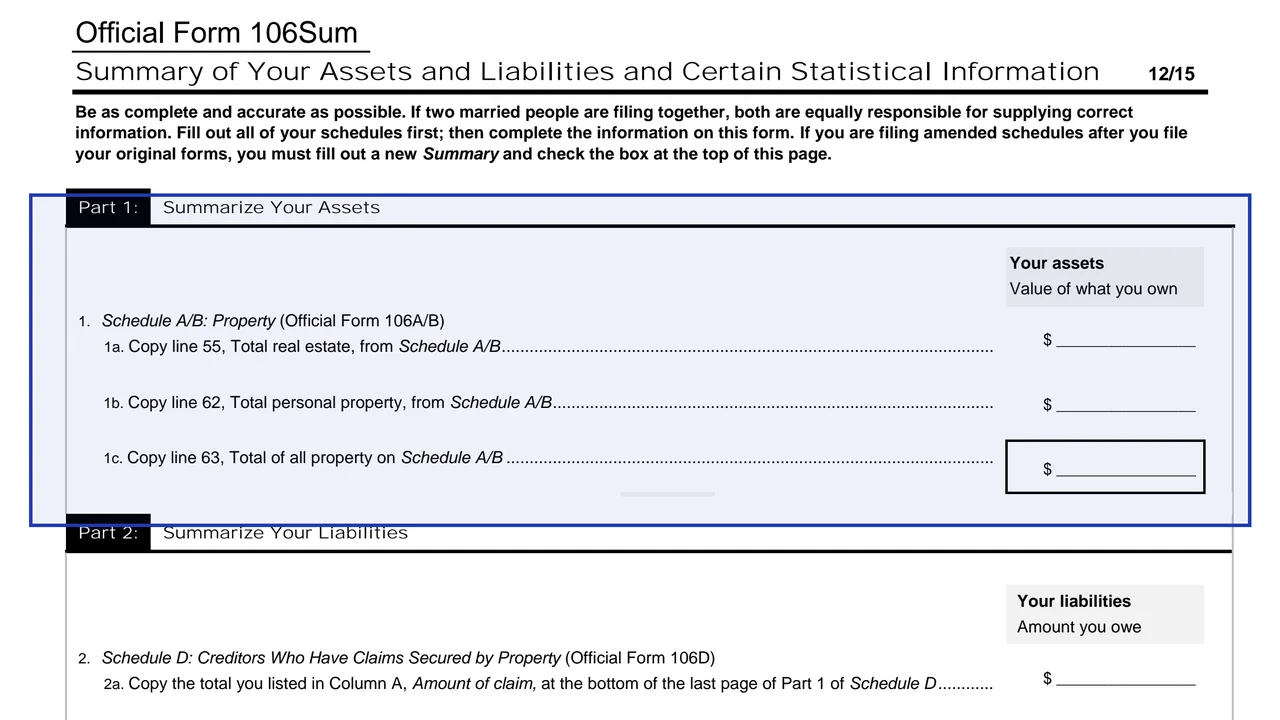
Line 1 copies three totals from Schedule A/B: line 55, total real estate (1a), line 62, total personal property (1b), and line 63, total of all property (1c).
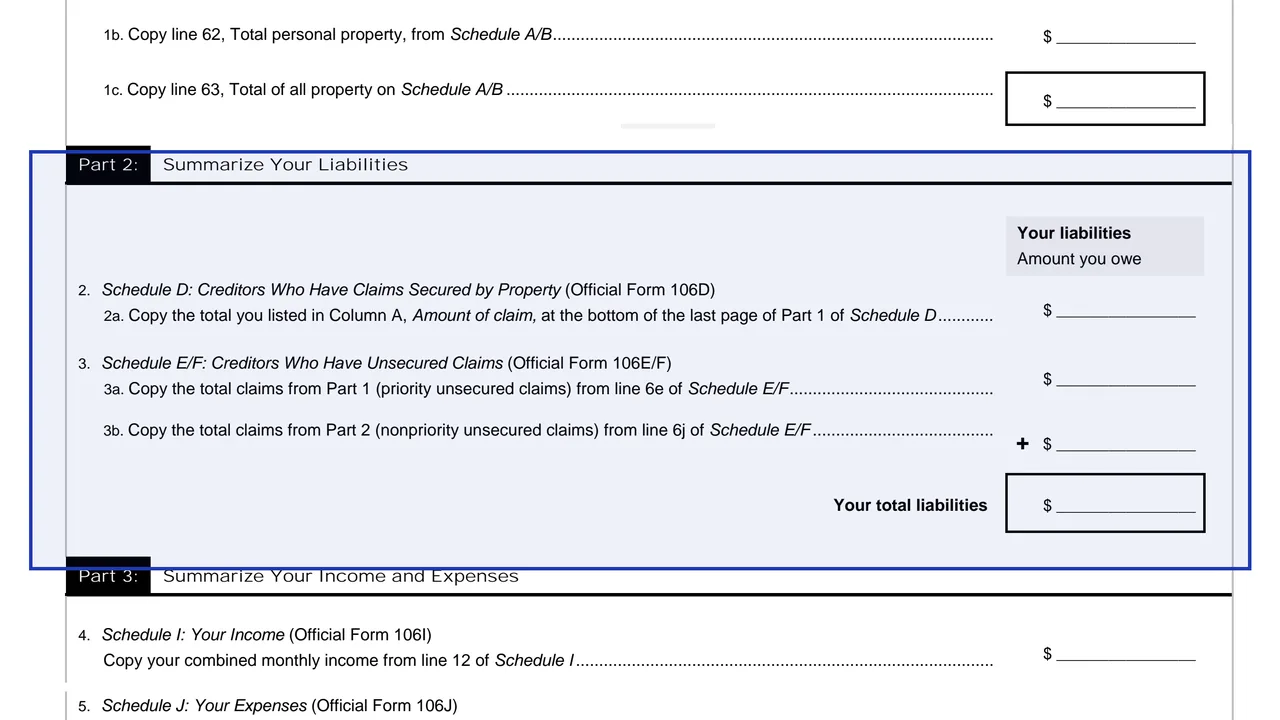
Line 2a copies the Column A total from Part 1 of Schedule D. Lines 3a and 3b copy the priority total from line 6e and the nonpriority total from line 6j of Schedule E/F, and the three add up to your total liabilities.
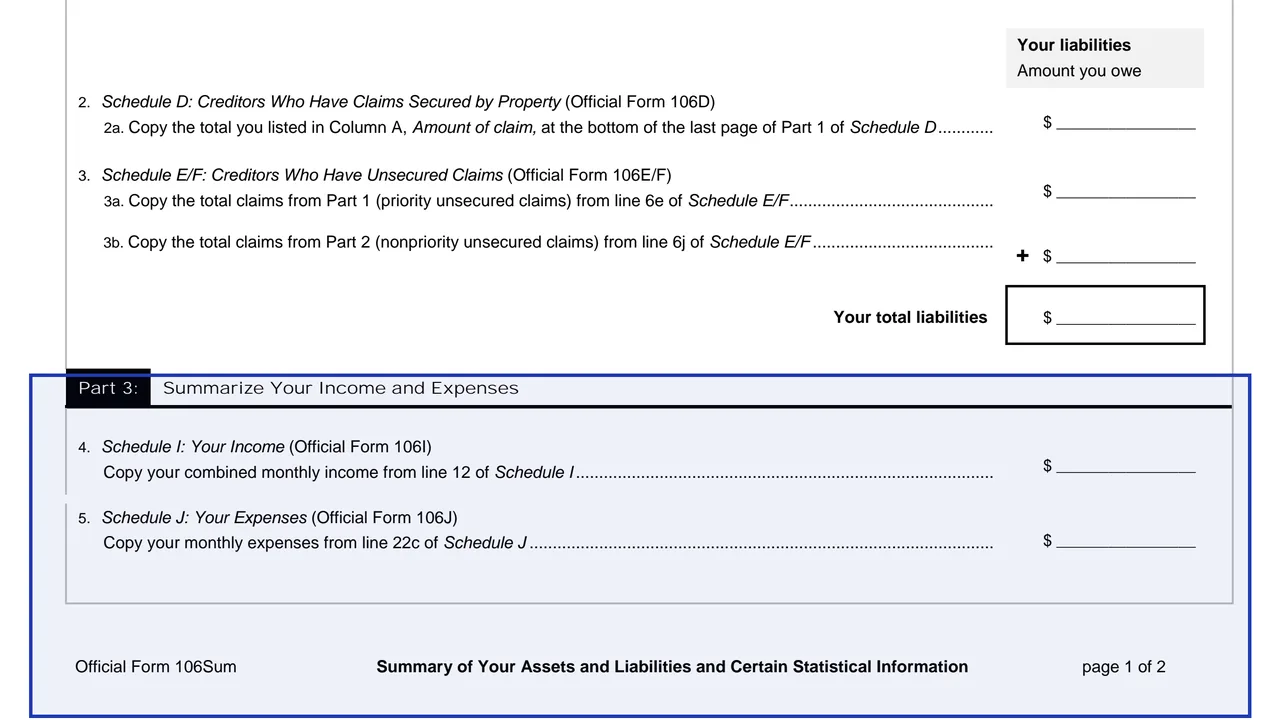
Line 4 copies combined monthly income from line 12 of Schedule I. Line 5 copies monthly expenses from line 22c of Schedule J.
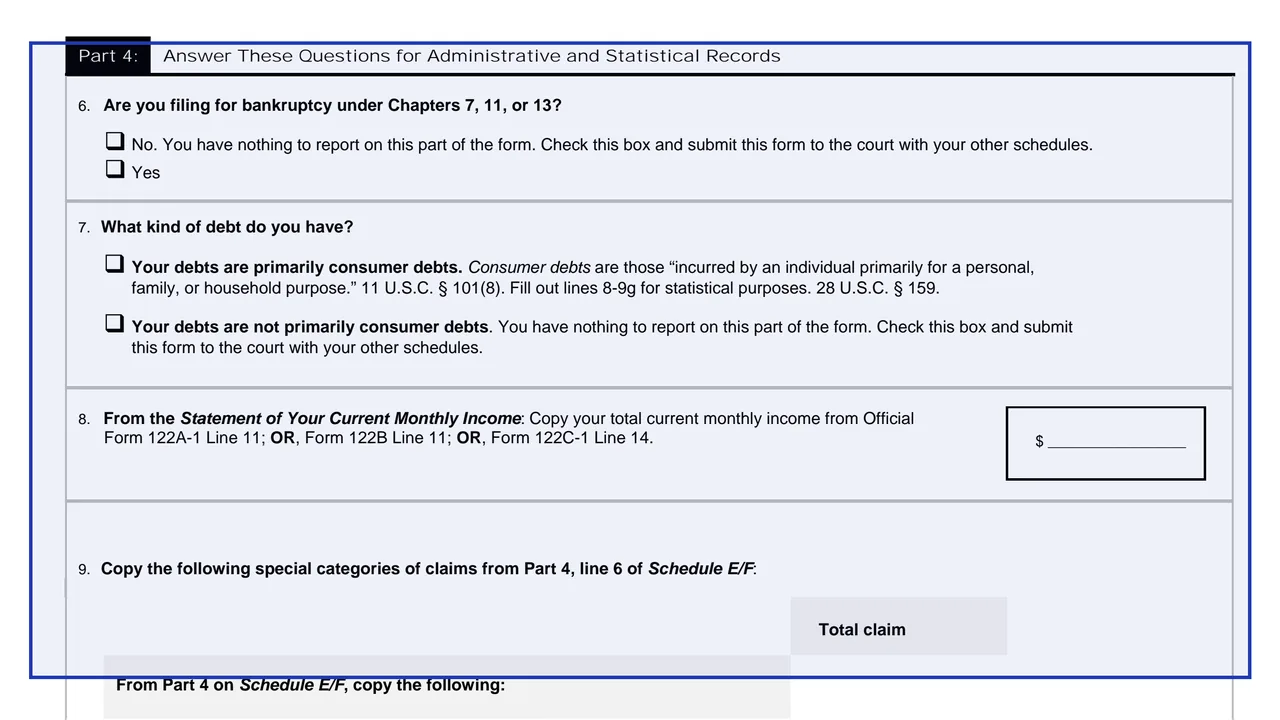
Line 6 asks whether the case is under Chapter 7, 11 or 13, and line 7 whether debts are primarily consumer debts, quoting 11 U.S.C. § 101(8). Lines 8 to 9g are filled out for statistical purposes under 28 U.S.C. § 159.
Line 8 copies total current monthly income from Form 122A-1 line 11, Form 122B line 11 or Form 122C-1 line 14. Lines 9a to 9f copy six claim categories from Part 4, line 6 of Schedule E/F, and line 9g adds them.
The form says to fill out all of your schedules first and then complete the information on this form, since every amount on it is copied from another form.
Take lines 55, 62 and 63 from Schedule A/B and enter them on lines 1a, 1b and 1c.
Copy the Column A total from the bottom of the last page of Part 1 of Schedule D, then lines 6e and 6j of Schedule E/F, and add them for your total liabilities.
Enter line 12 of Schedule I on line 4 and line 22c of Schedule J on line 5.
Where Part 4 does not apply, the form says to check the No box on line 6 or the not primarily consumer debts box on line 7 and submit the form with the other schedules. Otherwise lines 8 to 9g are filled in.
Page 2 repeats Debtor 1's name and the case number, if known, at the top. For an amended filing, check the box at the top of page 1.
You get the real form, filled in a browser tab, with nothing standing between you and the finished PDF.
With the United States Bankruptcy Court for the district named at the top of page 1. The form says to submit it to the court with your other schedules.
The instruction booklet lists the Summary among the forms filed either when the bankruptcy case is filed or within 14 days after the Voluntary Petition for Individuals Filing for Bankruptcy (Form 101), and says the case may be dismissed if they are not filed.
The form does not print a fee.
The booklet says a new Summary is filled out when an amended version of any of the summarized forms is filed after the original forms, to keep the information up to date, and the box at the top is checked.
The booklet says making a false statement, concealing property, or obtaining money or property by fraud in connection with a bankruptcy case can result in fines up to $250,000, or imprisonment for up to 20 years, or both.
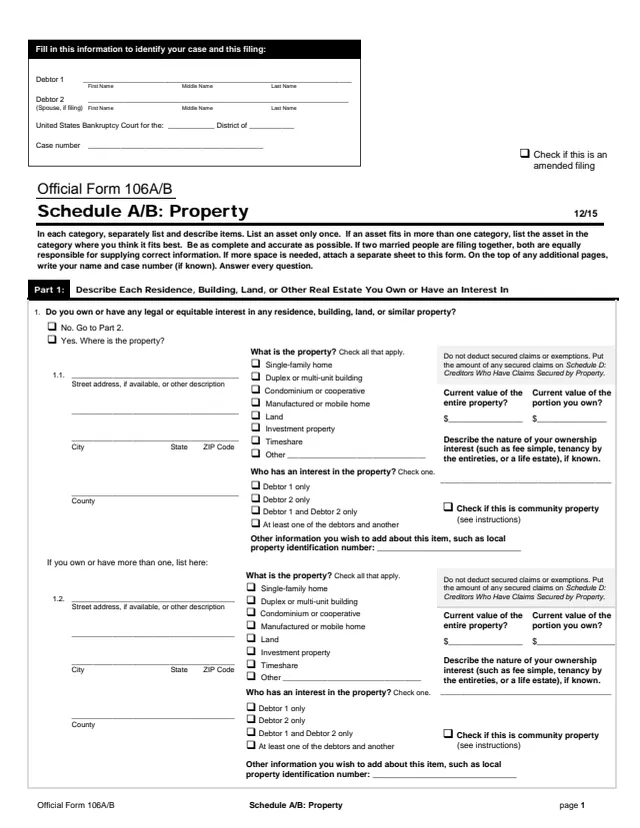
B 106A/B
368 fields, 10 pages
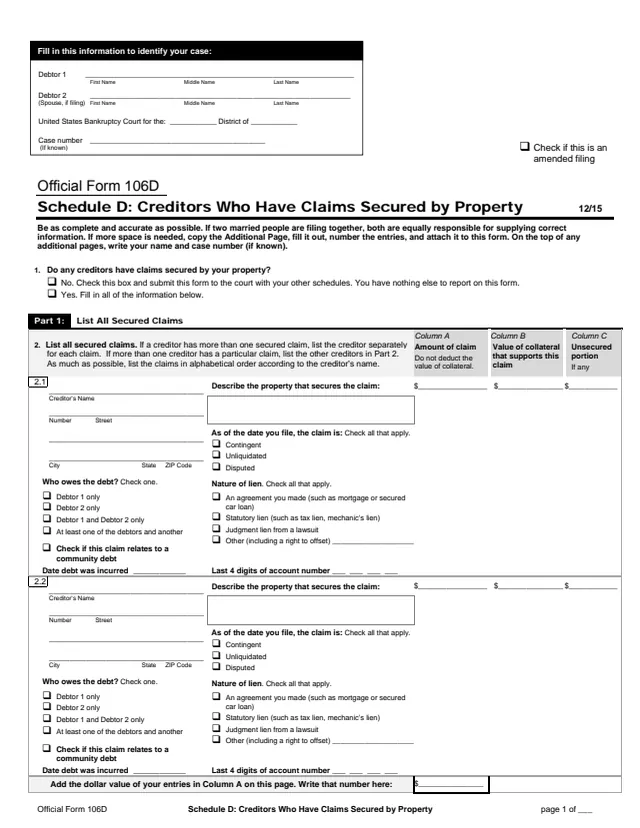
B 106D
186 fields, 3 pages
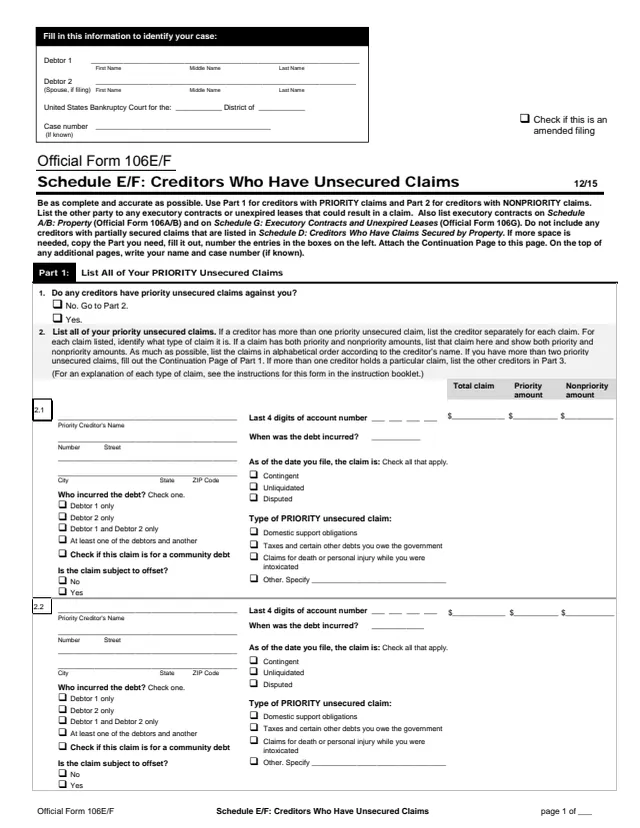
B 106E/F
323 fields, 6 pages
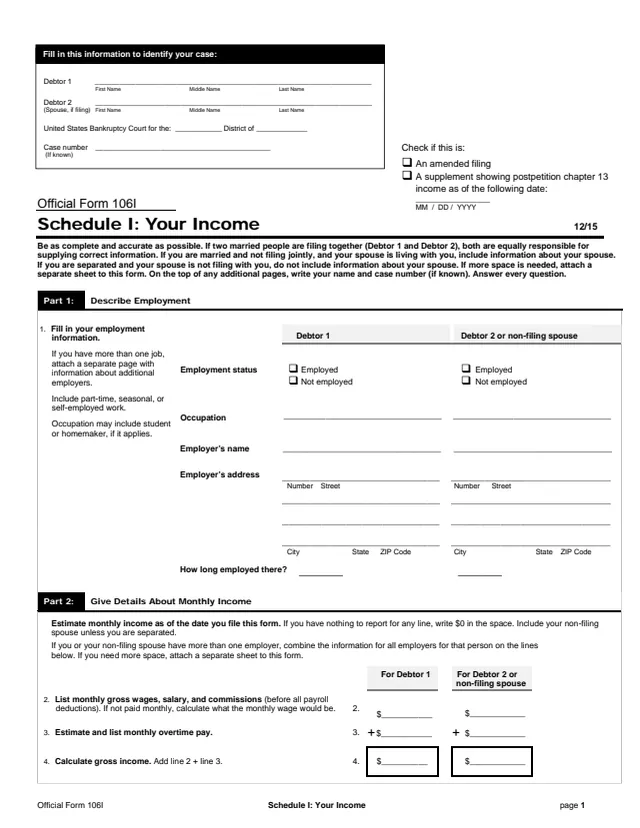
B 106I
85 fields, 2 pages
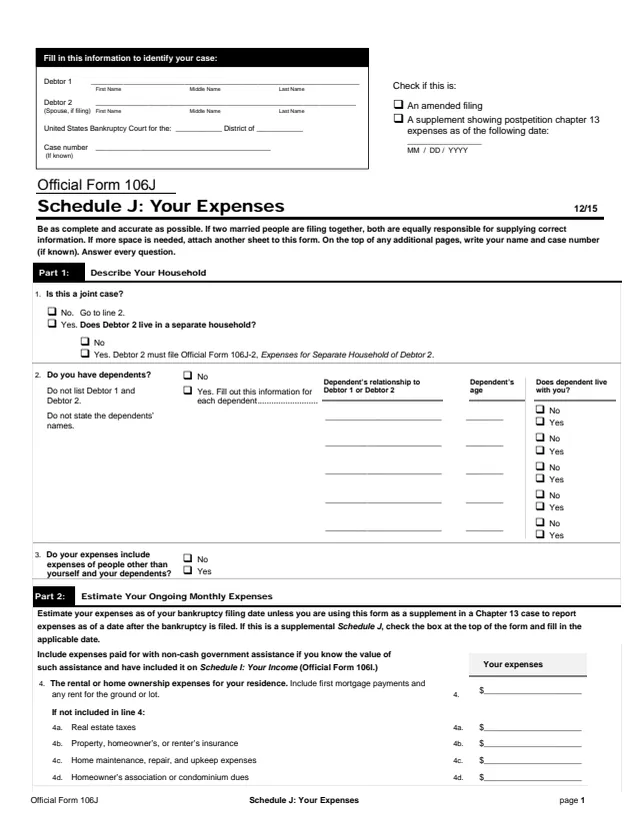
B 106J
79 fields, 3 pages
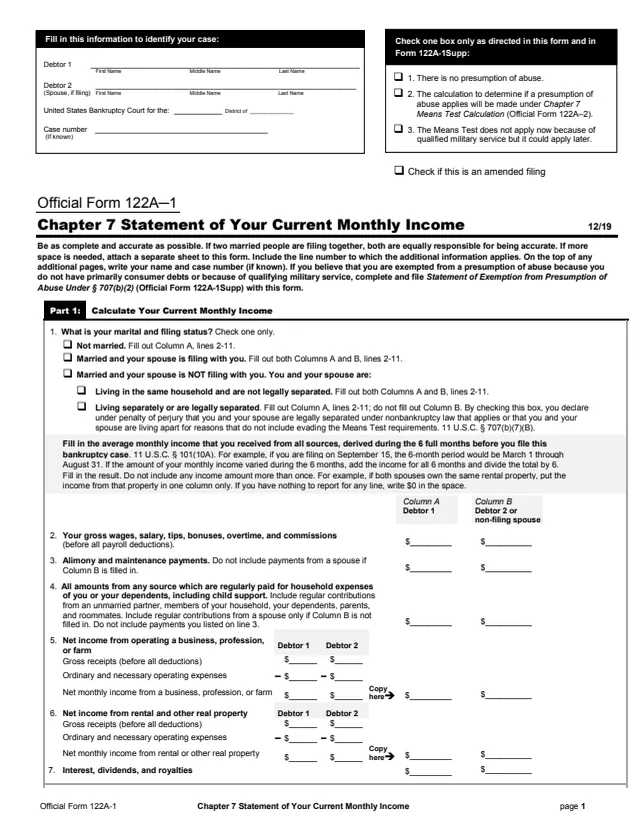
B 122A-1
58 fields, 3 pages
The form is one of the papers individuals file in a bankruptcy case. It names these situations.
No tool matches that search.
After the other schedules. The form says to fill out all of your schedules first and then complete the information on this form, because each line copies a total from another form.
Schedule A/B (Form 106A/B), Schedule D (Form 106D), Schedule E/F (Form 106E/F), Schedule I (Form 106I) and Schedule J (Form 106J), and for line 8, Form 122A-1, Form 122B or Form 122C-1.
No. The form says a case that is not under Chapter 7, 11 or 13, or whose debts are not primarily consumer debts, has nothing to report in Part 4. The box is checked and the form is submitted with the other schedules.
Line 7 quotes 11 U.S.C. § 101(8): consumer debts are those incurred by an individual primarily for a personal, family, or household purpose.
The form says that when amended schedules are filed after the original forms, a new Summary is filled out and the amended filing box at the top of page 1 is checked.
The U.S. Courts page says it is derived from Official Form 6, Summary. The committee note says it replaces Official Form 6 in cases of individual debtors and adds cross-references to the schedule lines the totals come from.