B 106A/B

Schedule A/B: Property (individuals)

Agency
U.S. Courts
Revision
12/15
Fillable fields
368
Pages
10
Official source
U.S. Courts form page
Checked
October 20, 2026
Fill B 106A/B online
Page 1 of form B 106A/B

Form B 106A/B: Schedule A/B: Property (individuals)

Form B 106A/B, Schedule A/B: Property (individuals), is the Official Bankruptcy Form on which an individual debtor lists the property they own or have a legal or equitable interest in. The U.S. Courts list it under Individual Debtors. The current version is dated 12/15, and the U.S. Courts page lists it as effective on December 1, 2015. The page also says Official Bankruptcy Forms are approved by the Judicial Conference and must be used under Bankruptcy Rule 9009, and that this form is derived from Official Forms 6A and 6B.

The 10-page form groups property into seven parts: real estate, vehicles, personal and household items, financial assets, business-related property, farm- and commercial fishing-related property, and property not listed elsewhere. Part 8 adds up the totals. Each item is reported at the current value of the portion owned, without deducting secured claims or exemptions.

This page explains the form in plain words and is not legal advice. You can fill it out free in your browser on this page and download the result without an account.

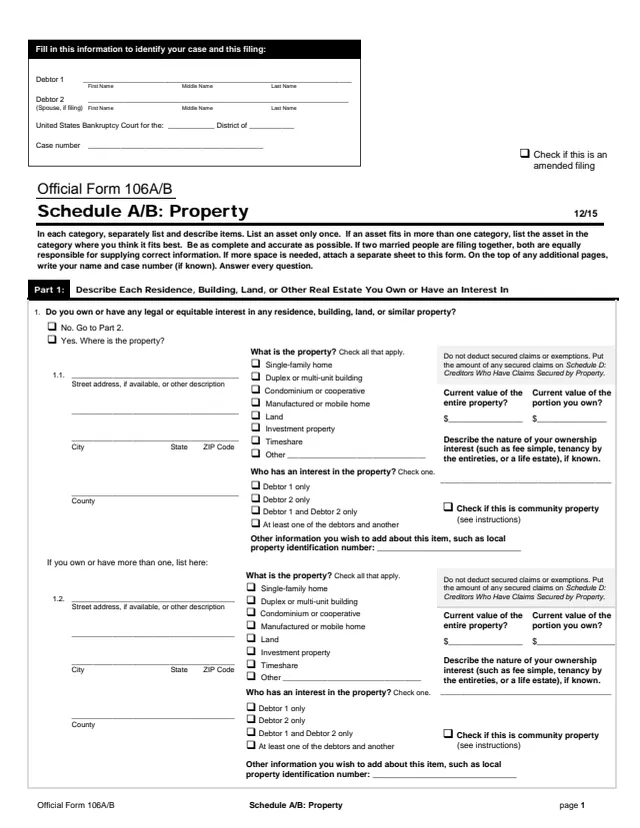
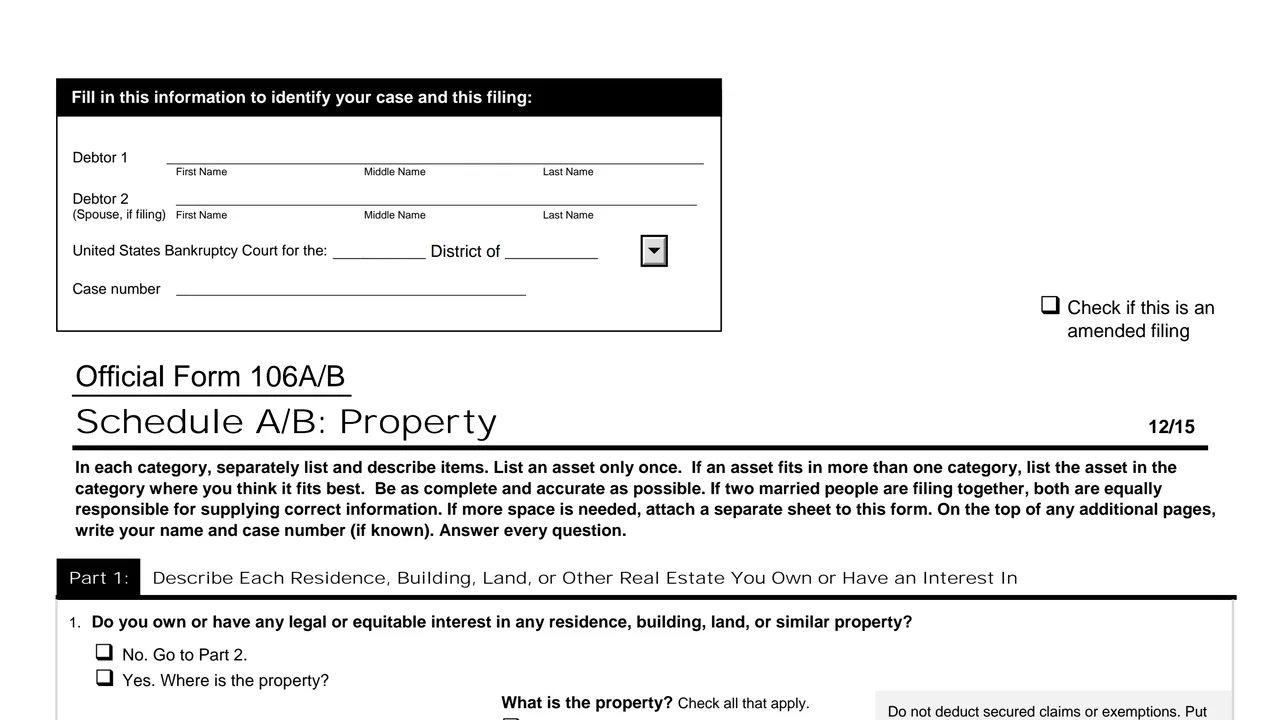
Top of page 1 of Form B 106A/B: Schedule A/B: Property (individuals), as printed by COURTS

What's on Form B 106A/B

Part 1: Real estate

Each residence, building, land or other real estate: address, type (such as single-family home, condominium or cooperative, land or timeshare), who has an interest, the current value of the entire property and of your portion, and the nature of the ownership interest. Line 2 totals it.
Part 2: Vehicles

Line 3 covers cars, vans, trucks, tractors, sport utility vehicles and motorcycles, with make, model, year and approximate mileage. Line 4 covers watercraft, aircraft, motor homes, ATVs and other recreational vehicles. Line 5 totals it.

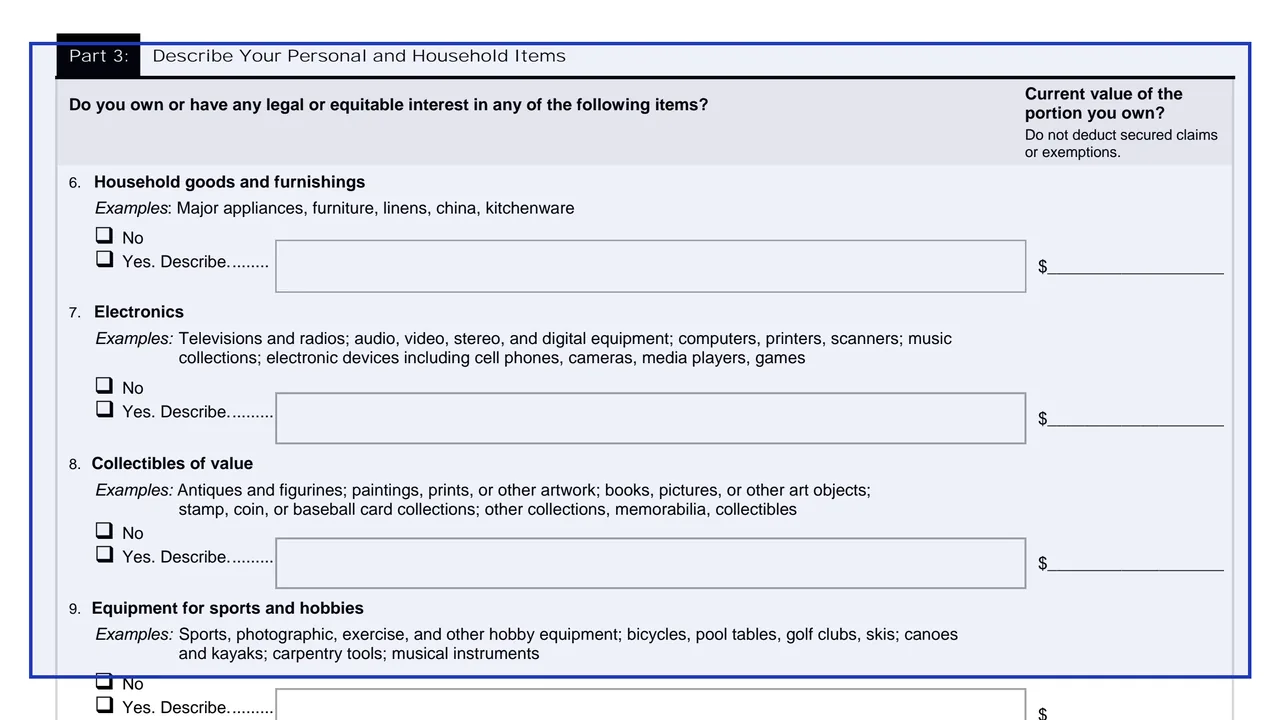
Part 3: Personal and household items

Lines 6 to 14: household goods and furnishings, electronics, collectibles of value, sports and hobby equipment, firearms, clothes, jewelry, non-farm animals and any other items, including health aids. Line 15 totals it.

Part 4: Financial assets

Lines 16 to 35: cash, deposit accounts, bonds and stocks, business interests, retirement accounts, security deposits, annuities, education and ABLE accounts, intellectual property, tax refunds, family support, insurance, inheritances and claims against others. Line 36 totals it.

Parts 5 and 6: Business and farm property

Lines 37 to 45 cover accounts receivable, office equipment, tools of trade, inventory, partnership interests and customer lists. Lines 46 to 52 cover farm animals, crops, equipment and supplies. Real estate in either goes in Part 1.

Parts 7 and 8: Other property and totals

Line 53 lists property not listed above, such as season tickets or a country club membership. Lines 55 to 63 bring each part's total together into total real estate, total personal property and the total of all property.

How to fill out Form B 106A/B

  1. 1

    Identify the case

    Fill in Debtor 1, Debtor 2 if a spouse is filing, the district and the case number if known, and check the box if this is an amended filing.

  2. 2

    Answer every question

    The form says to answer every question, list an asset only once, and put an asset that fits more than one category in the category where you think it fits best.

  3. 3

    Report the value of your portion

    The booklet describes current value as the fair market value as of the date of the filing of the petition. For shared property, it multiplies the current value of the property by the percentage owned.

  4. 4

    Leave debts for Schedule D

    The form says not to deduct secured claims or exemptions and to put the amount of any secured claims on Schedule D. The booklet says the values here are to match Schedule D and Schedule C.

  5. 5

    Group small items, itemize larger ones

    The booklet says similar items of minimal value, such as clothing, can be added together and reported as a total, and individual items worth more than $500 are described and listed separately.

  6. 6

    Add the totals in Part 8

    Copy the totals from lines 2, 5, 15, 36, 45, 52 and 54 into lines 55 to 61, then add line 55 and line 62 for line 63. Extra sheets carry your name and case number on top.

Why fill Form B 106A/B on indox

You get the real form, filled in a browser tab, with nothing standing between you and the finished PDF.

  • Fill the form right in your browser, no software to install
  • Free to fill and free to download, with no account
  • The official blank straight from the U.S. Courts, not a copy someone retyped
  • Works on a phone, tablet or computer

Where it is filed, fees and warnings

Where it is filed

With the United States Bankruptcy Court for the district named on page 1, as part of the Schedules of Assets and Liabilities (Official Form 106) that the instruction booklet lists for all individuals who file for bankruptcy.

When

The booklet says these forms are filed either when the bankruptcy case is filed or within 14 days after the Voluntary Petition for Individuals Filing for Bankruptcy (Form 101), and that the case may be dismissed if they are not filed.

Filing fee

The form does not print a fee.

Education and ABLE records

Line 24 says to separately file the records of any interests in an education IRA, a qualified ABLE program or a qualified state tuition program, citing 11 U.S.C. § 521(c).

Penalties

The booklet says the information is verified under penalty of perjury, and that a false statement, concealing property, or obtaining money or property by fraud in connection with a bankruptcy case can result in fines up to $250,000, or imprisonment for up to 20 years, or both.

Who uses Form B 106A/B?

  • Individuals filing for bankruptcy

    The instruction booklet says all individuals filing for bankruptcy list everything they own or have a legal or equitable interest in, whether or not anyone else has an interest in that property.

  • Married couples filing together

    The form says both spouses are equally responsible for supplying correct information. Each item asks who has an interest: Debtor 1 only, Debtor 2 only, Debtor 1 and Debtor 2 only, or at least one of the debtors and another.

  • Community property

    Each item has a box to check if it is community property. The booklet lists community property states and territories as Arizona, California, Idaho, Louisiana, Nevada, New Mexico, Puerto Rico, Texas, Washington, and Wisconsin.

  • Sole proprietors and farmers

    Part 5 covers business-related property and Part 6 farm- and commercial fishing-related property. The booklet says sole proprietors use the 100 series forms.

  • Not for companies

    The booklet says a bankruptcy for a nonindividual, such as a corporation, partnership, or limited liability company (LLC), uses the forms numbered in the 200 series.

The schedule is for individuals in a bankruptcy case. The form and its instructions name these situations.

Official sources and the blank

Do it all with indox

View all 94 tools

Questions about Form B 106A/B

Is property with a loan on it listed on Schedule A/B?

Yes. The booklet says property you own includes property you have purchased even if you owe money on it, such as a home with a mortgage or an automobile with a lien. The amount of any secured claim goes on Schedule D.

What value goes on Schedule A/B?

The current value of the portion owned. The booklet says current value is the fair market value as of the date of the filing of the petition, and gives the example that if you and a sister own a house equally, you report 50% of its value.

What if an item fits in more than one category?

The form says to list an asset only once, in the category where you think it fits best.

What if a value is hard to find?

The booklet says that when the value cannot be found from a reputable source, such as a pricing guide for a car, the debtor estimates it and is prepared to explain how it was determined.

Does a leased car go on this form?

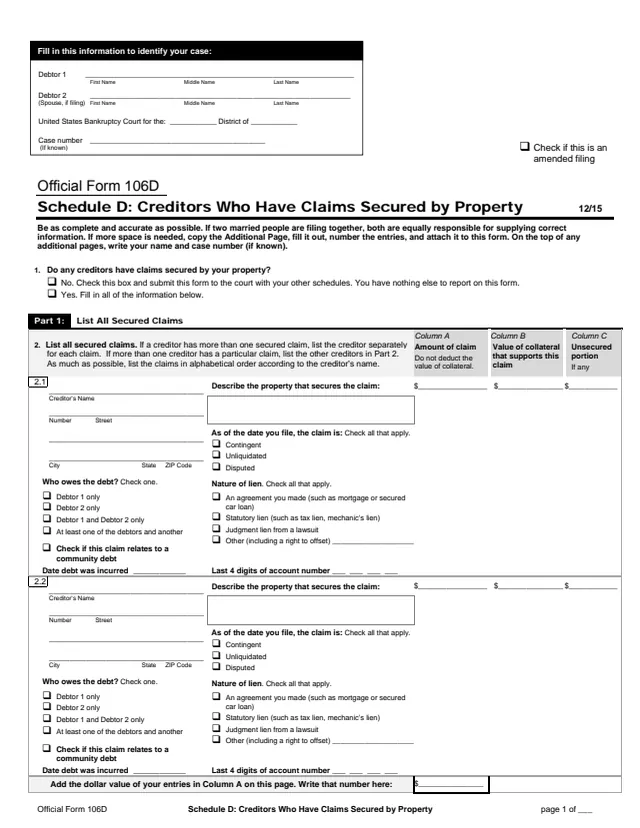
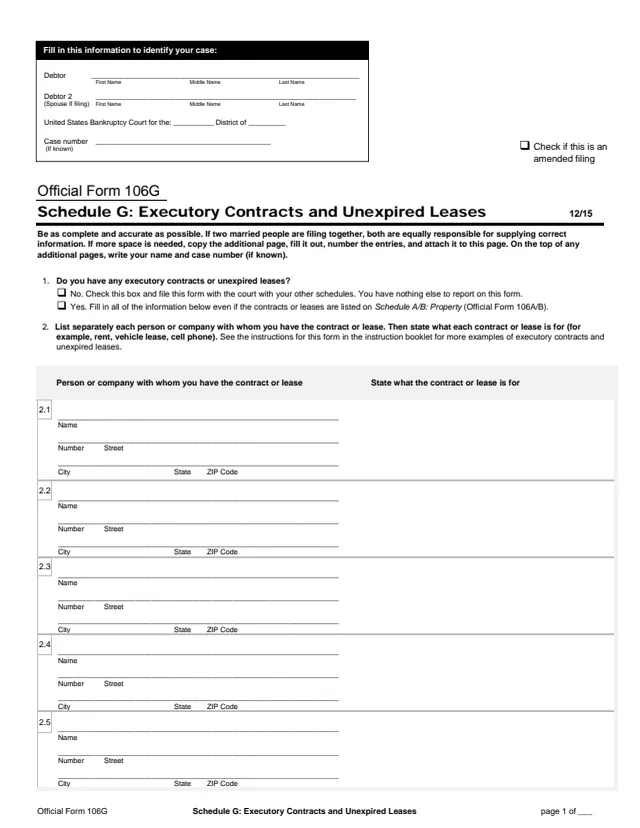
Part 2 asks about vehicles you own, lease or have a legal or equitable interest in, and says a leased vehicle is also reported on Schedule G: Executory Contracts and Unexpired Leases.

Where do the Schedule A/B totals go next?

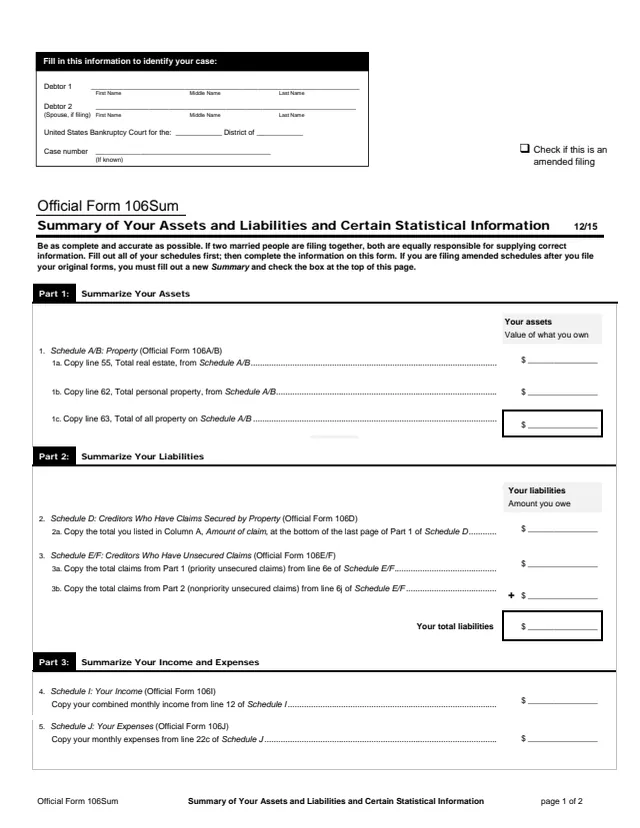
Form B 106 Summary copies line 55 (total real estate), line 62 (total personal property) and line 63 (total of all property) onto its lines 1a, 1b and 1c.