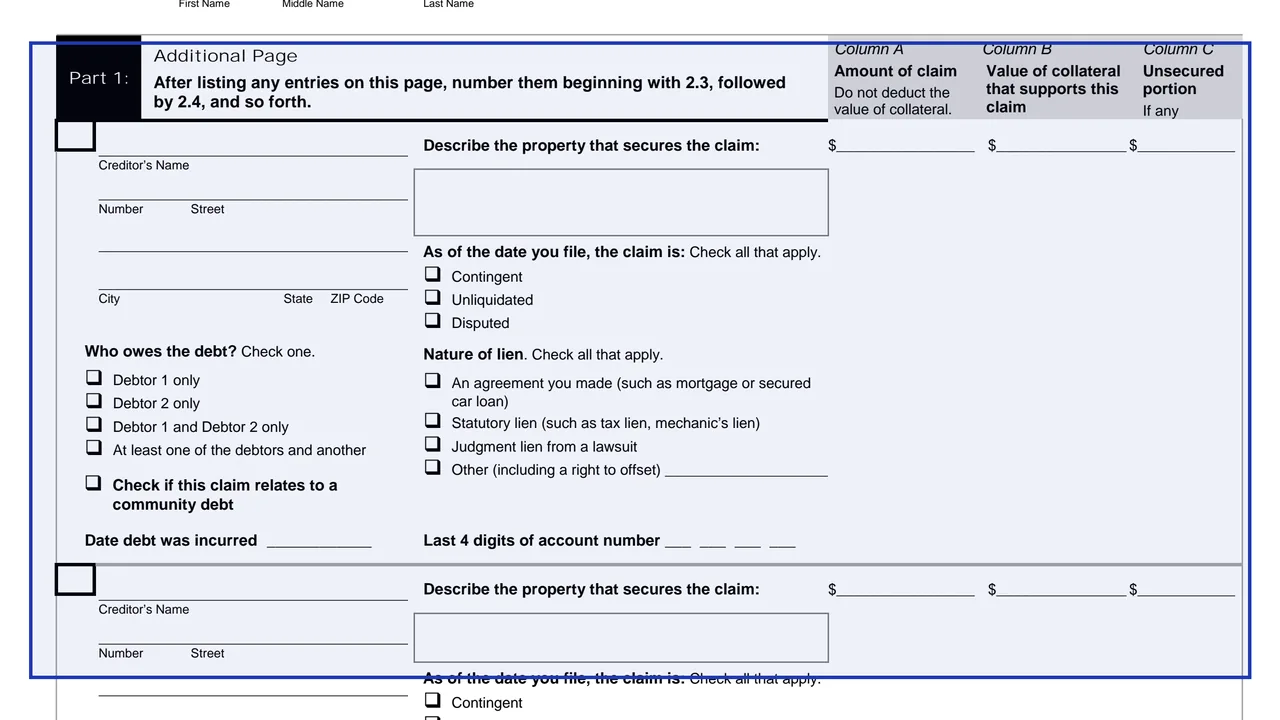
Line 1: Any secured claims?
A yes or no question, after the case caption with Debtor 1, Debtor 2 (spouse, if filing), the district, the case number if known and the amended filing box.
B 106D
Schedule D: Creditors Who Hold Claims Secured By Property (individuals)
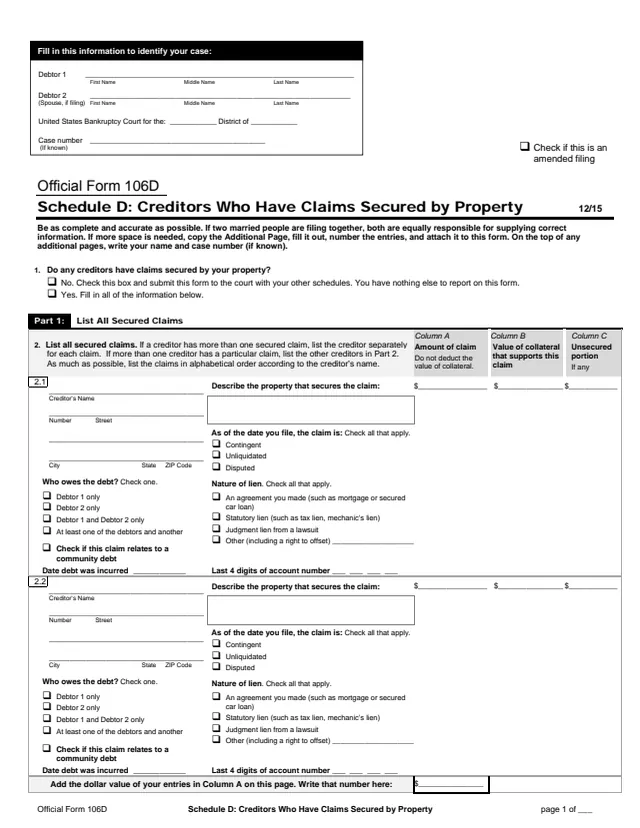
Form B 106D, Schedule D: Creditors Who Hold Claims Secured By Property (individuals), is the Official Bankruptcy Form on which an individual debtor lists the creditors whose claims are secured by the debtor's property, such as a mortgage, a car loan or a lien. The PDF titles it Schedule D: Creditors Who Have Claims Secured by Property. The U.S. Courts list it under Individual Debtors. The current version is dated 12/15, and the U.S. Courts page lists it as effective on December 1, 2015, derived from Official Form 6D. The page also says Official Bankruptcy Forms are approved by the Judicial Conference and must be used under Bankruptcy Rule 9009.
For each secured claim, the form asks for the creditor, the property that secures the claim, whether the claim is contingent, unliquidated or disputed, who owes the debt, the nature of the lien, and three amounts: the claim, the value of the collateral and any unsecured portion. Part 2 lists others to be notified about a debt already listed, such as a collection agency.
This page explains the form in plain words and is not legal advice. You can fill it out free in your browser on this page and download the result without an account.
A yes or no question, after the case caption with Debtor 1, Debtor 2 (spouse, if filing), the district, the case number if known and the amended filing box.
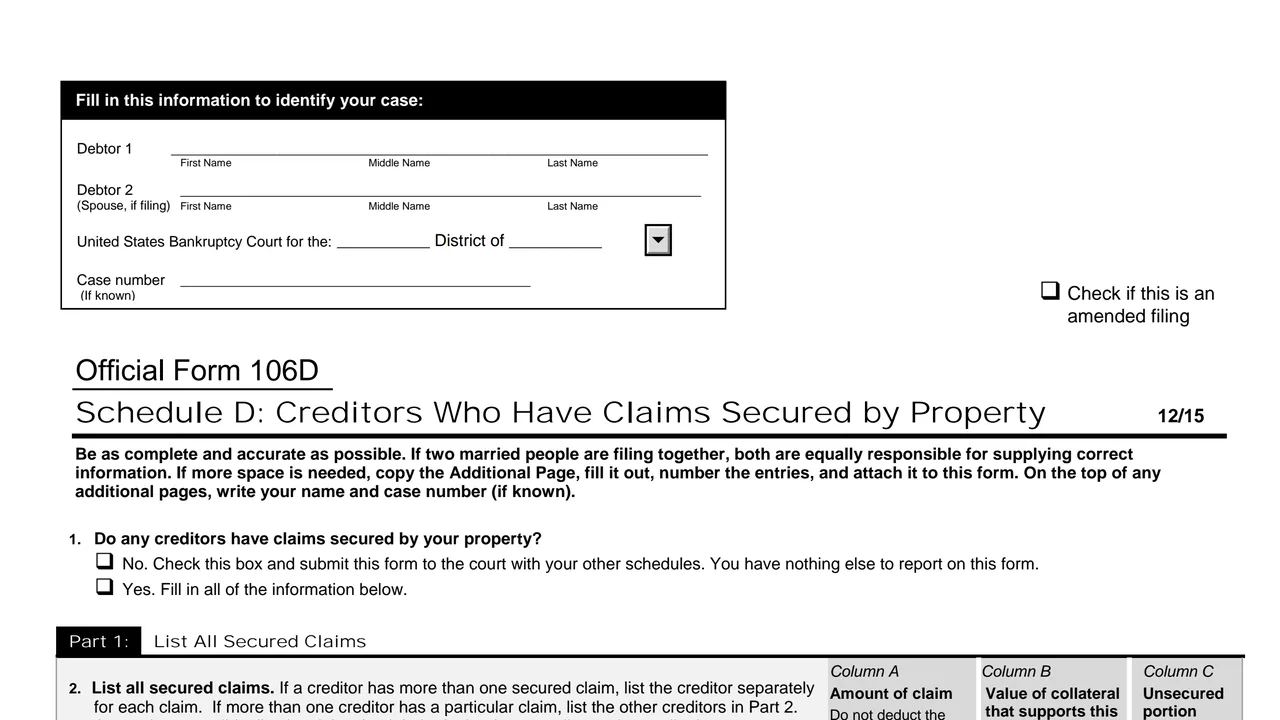
For each claim, starting at 2.1: the creditor's name and address, a description of the property that secures the claim, the date the debt was incurred and the last 4 digits of the account number.
Boxes for contingent, unliquidated or disputed, who owes the debt, a community debt box, and the nature of the lien: an agreement you made (such as mortgage or secured car loan), statutory lien (such as tax lien, mechanic's lien), judgment lien from a lawsuit, or other (including a right to offset).
Column A is the amount of the claim, without deducting the value of collateral. Column B is the value of collateral that supports the claim, and Column C is the unsecured portion, if any. Each page adds up Column A.
More entries, numbered from 2.3, followed by 2.4 and so forth. On the last page, the Column A totals from all pages are added together.
For a debt already listed in Part 1: the line in Part 1 where the creditor appears, the name and address of the other party, and the last 4 digits of the account number.
With no secured claims, the form says to check No and submit the form with the other schedules. With secured claims, check Yes and fill in all of the information.
The form says to list a creditor separately for each secured claim and, as much as possible, in alphabetical order by the creditor's name. Other creditors on the same claim go in Part 2.
The booklet's example: if the outstanding balance of a car loan is $10,000 and the car is worth $8,000, the car loan has a $2,000 unsecured portion.
The booklet says the values on Schedule A/B are to match those on Schedule D and Schedule C, and that a creditor is listed even if it appears there is no value to support the secured claim.
The booklet says a claim larger than the value of the property securing it is listed only once, on Schedule D, and is not repeated on Schedule E/F.
List a collection agency or additional creditors for a debt already in Part 1. The form says that without additional persons to be notified, Part 2 is not filled out or submitted.
You get the real form, filled in a browser tab, with nothing standing between you and the finished PDF.
With the United States Bankruptcy Court for the district named on page 1, as part of the Schedules of Assets and Liabilities (Official Form 106) that the instruction booklet lists for all individuals who file for bankruptcy.
The booklet says these forms are filed either when the bankruptcy case is filed or within 14 days after the Voluntary Petition for Individuals Filing for Bankruptcy (Form 101), and that the case may be dismissed if they are not filed.
The form does not print a fee.
The form asks only for the last 4 digits of each account number. The booklet says anyone may see filed bankruptcy forms unless the court orders otherwise under 11 U.S.C. § 107, and that certain information is protected from public disclosure under Bankruptcy Rule 9037.
The booklet says making a false statement, concealing property, or obtaining money or property by fraud in connection with a bankruptcy case can result in fines up to $250,000, or imprisonment for up to 20 years, or both.
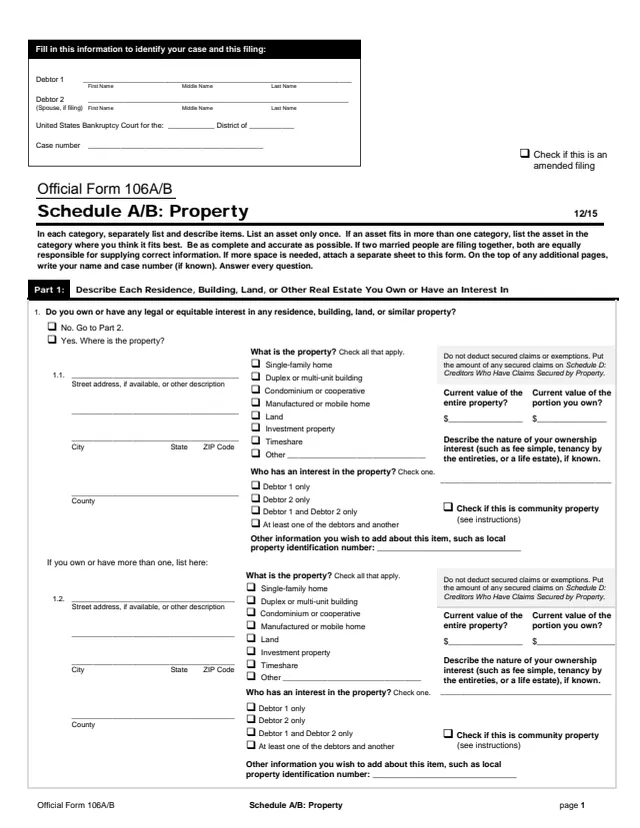
B 106A/B
368 fields, 10 pages
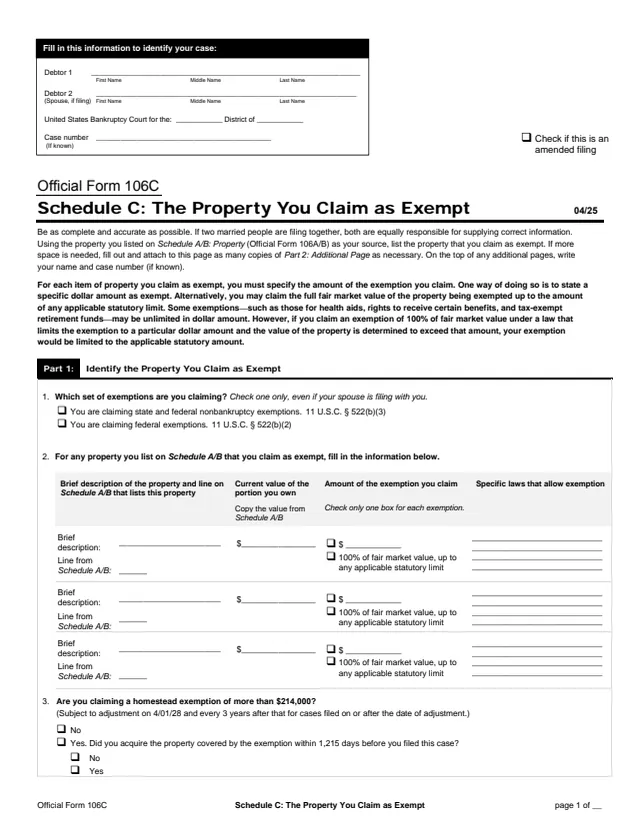
B 106C
104 fields, 2 pages
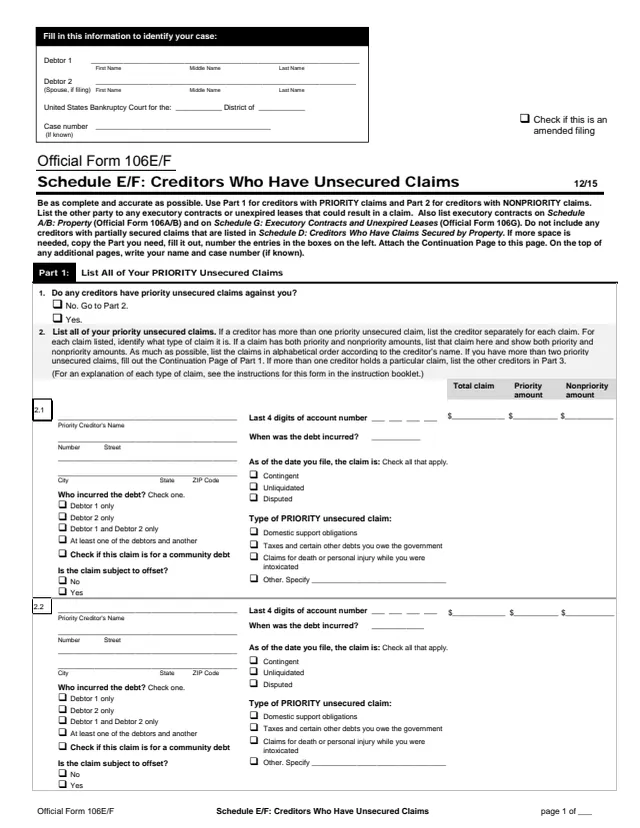
B 106E/F
323 fields, 6 pages
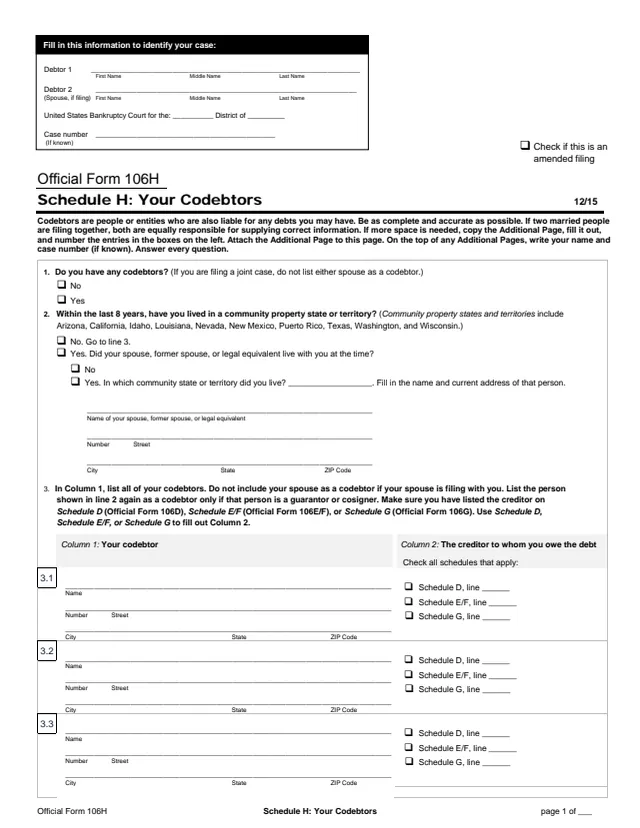
B 106H
150 fields, 2 pages
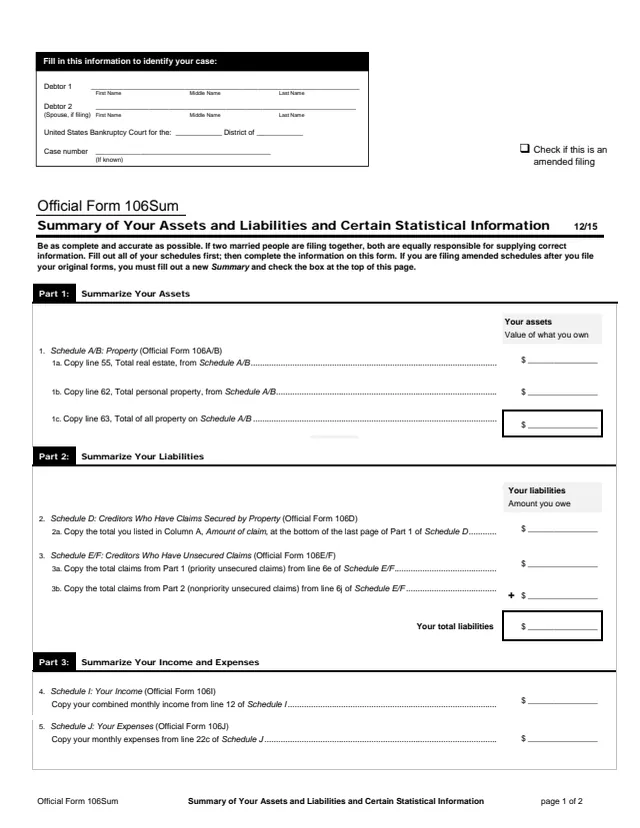
B 106 Summary
28 fields, 2 pages
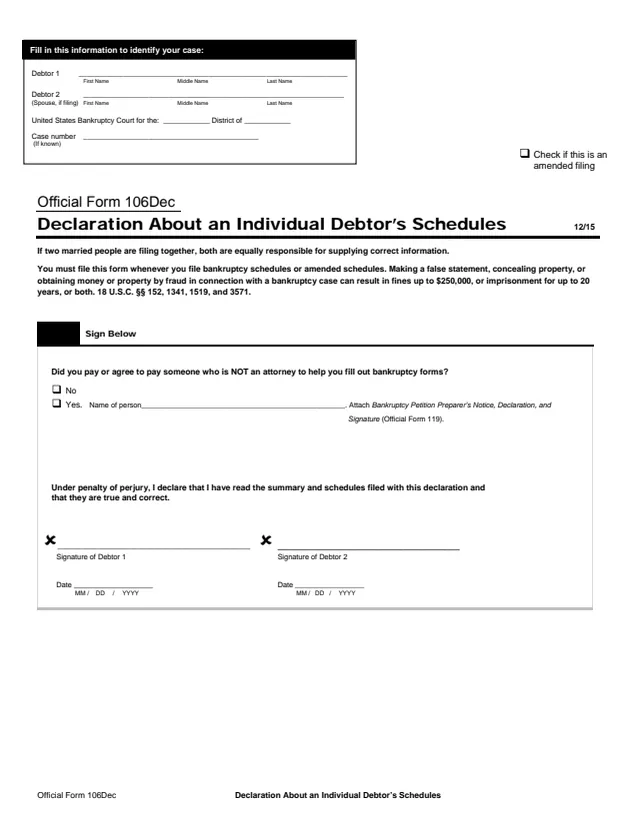
B 106 Declaration
15 fields, 1 page
The schedule is for individuals in a bankruptcy case. The form and its instructions name these situations.
No tool matches that search.
The booklet says a creditor with a secured claim may be able to get paid from specific property in which that creditor has an interest, such as a mortgage or a lien. That property is sometimes called collateral.
The booklet says the claim may be partly secured and partly unsecured. It is listed only once, on Schedule D, with the unsecured portion in Column C, and is not repeated on Schedule E/F.
The booklet says the claim entitled to be paid first is subtracted from the property value first. Its example: a home worth $300,000 with a first mortgage of $200,000 leaves $100,000 for a second mortgage of $150,000, which would have an unsecured portion of $50,000.
In Part 2. The form says to list the creditor in Part 1 and then list the collection agency in Part 2, with the Part 1 line where the creditor appears.
The booklet says a claim is contingent if it is owed only if a particular event occurs after filing, unliquidated if the amount cannot be readily determined, and disputed if you disagree about whether you owe the debt. A claim can have one, more than one, or none of these.
The form says to check No on line 1 and submit the form to the court with the other schedules, with nothing else to report on it.