B 106E/F

Schedule E/F: Creditors Who Have Unsecured Claims (individuals)

Agency
U.S. Courts
Revision
12/15
Fillable fields
323
Pages
6
Official source
U.S. Courts form page
Checked
October 20, 2026
Fill B 106E/F online
Page 1 of form B 106E/F

Form B 106E/F: Schedule E/F: Creditors Who Have Unsecured Claims (individuals)

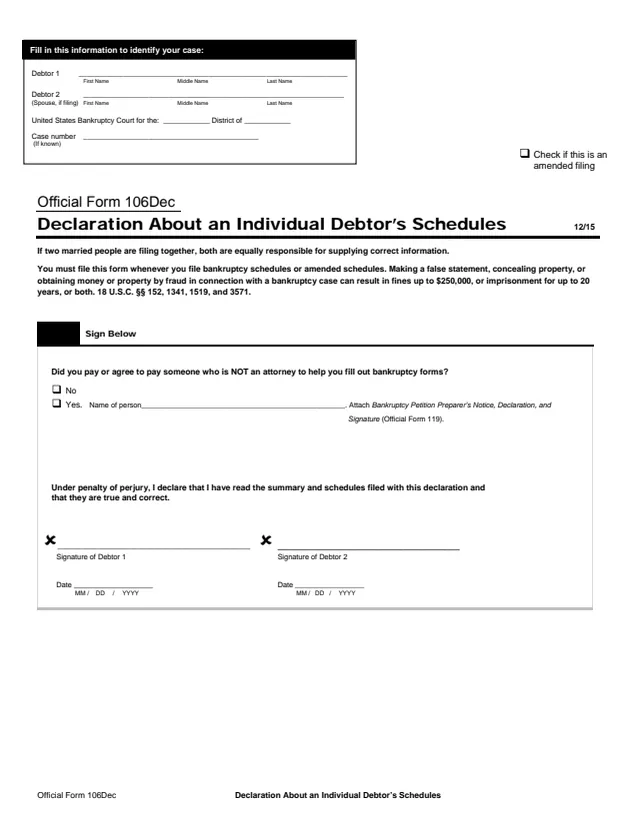
Form B 106E/F, Schedule E/F: Creditors Who Have Unsecured Claims (individuals), is the Official Bankruptcy Form on which an individual debtor lists the creditors who have unsecured claims, grouped into priority and nonpriority claims. The U.S. Courts list it under Individual Debtors. The current version is dated 12/15, and the U.S. Courts page lists it as effective on December 1, 2015, derived from Official Forms 6E and 6F. The page also says Official Bankruptcy Forms are approved by the Judicial Conference and must be used under Bankruptcy Rule 9009.

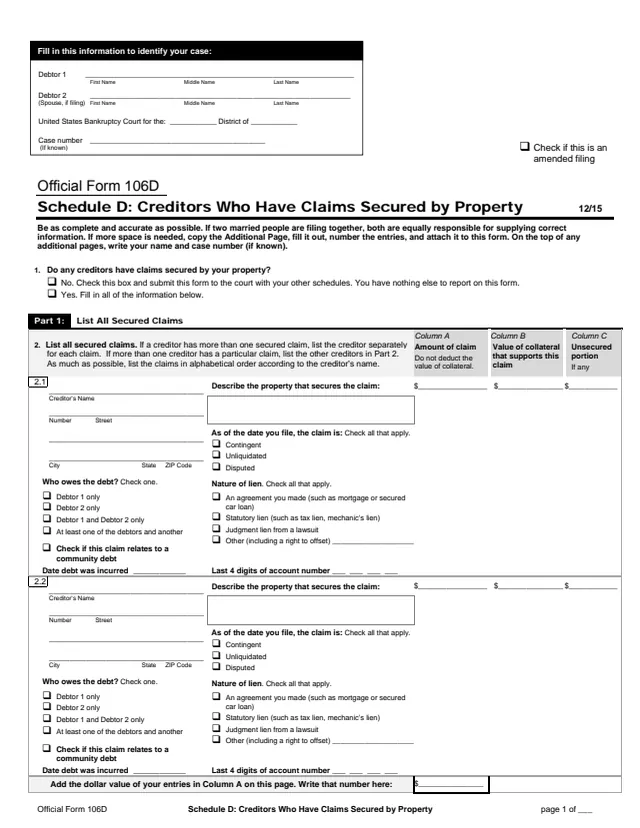
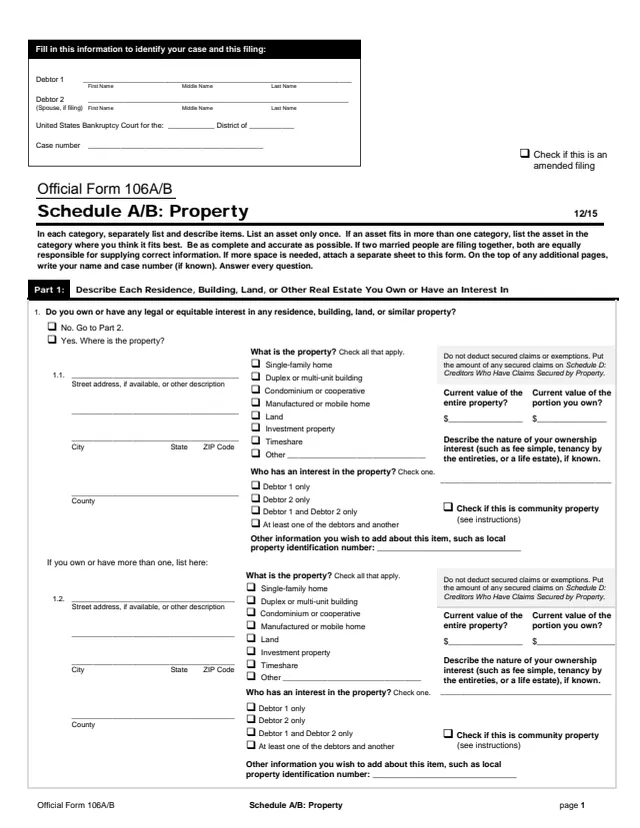
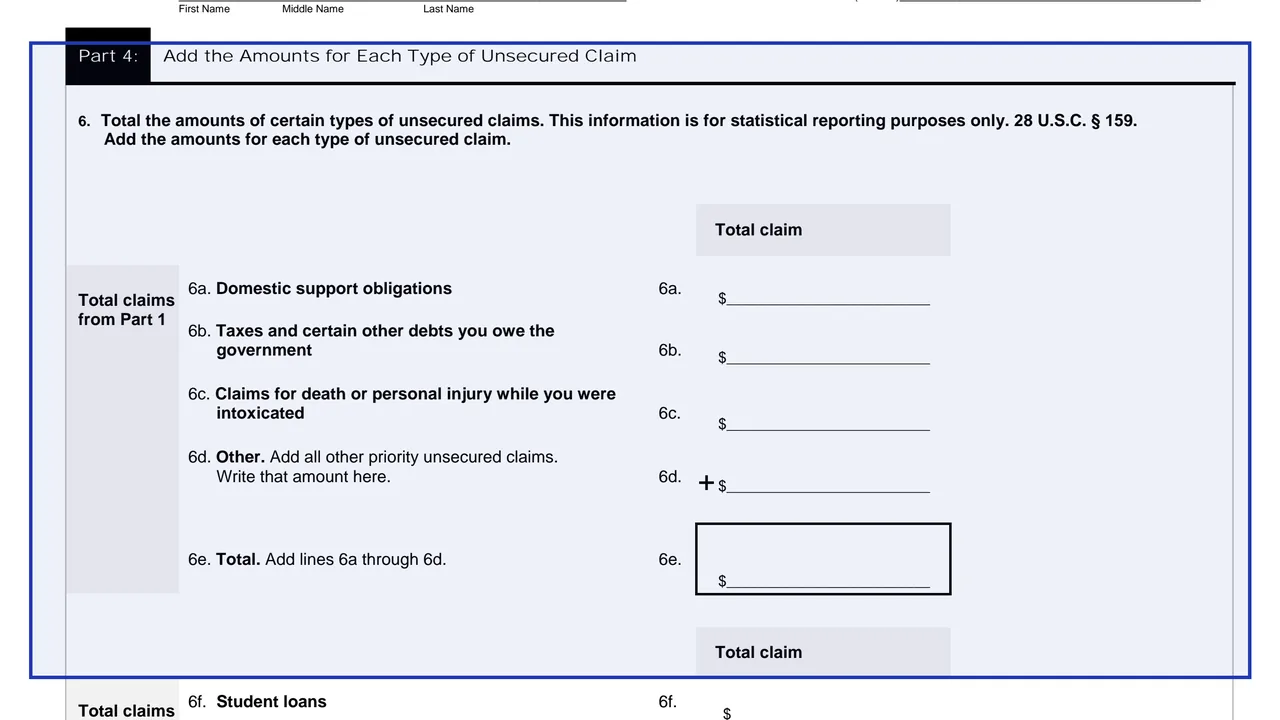
Part 1 lists priority unsecured claims, Part 2 nonpriority unsecured claims, Part 3 others to be notified about a debt already listed, and Part 4 adds up certain types of claims for statistical reporting under 28 U.S.C. § 159. The form says not to include creditors with partially secured claims listed on Schedule D.

This page explains the form in plain words and is not legal advice. You can fill it out free in your browser on this page and download the result without an account.

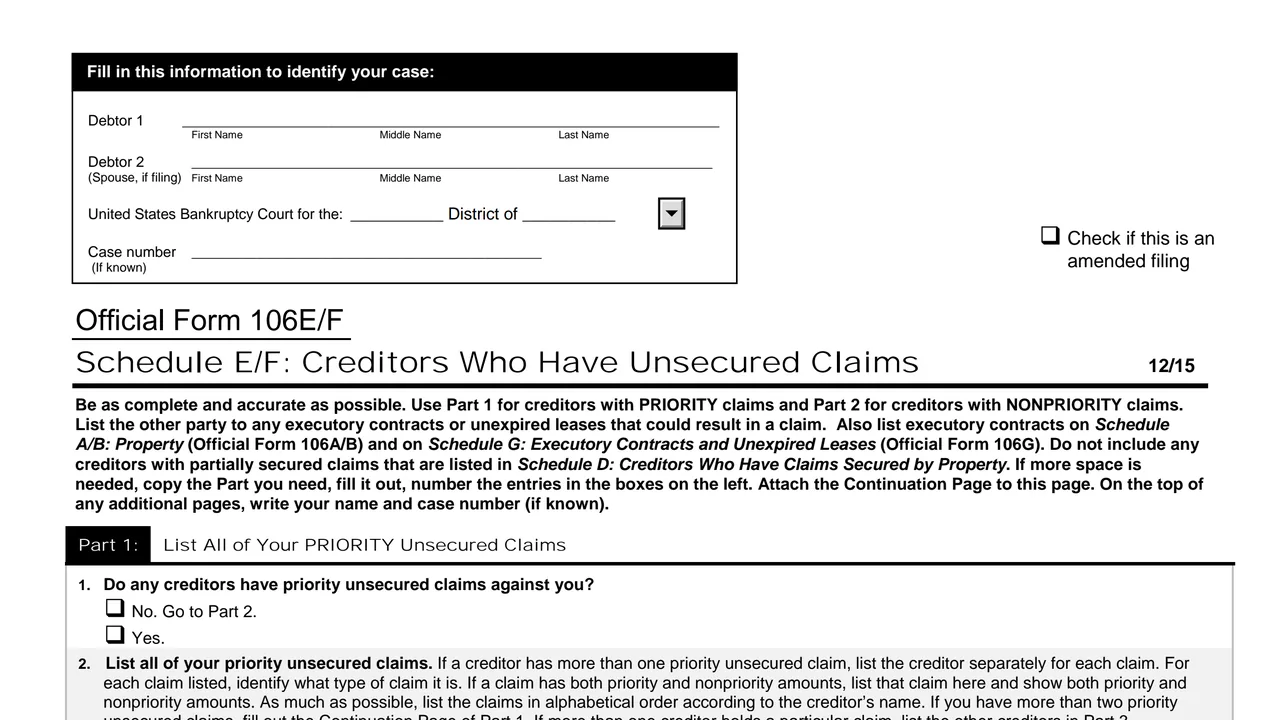
Top of page 1 of Form B 106E/F: Schedule E/F: Creditors Who Have Unsecured Claims (individuals), as printed by COURTS

What's on Form B 106E/F

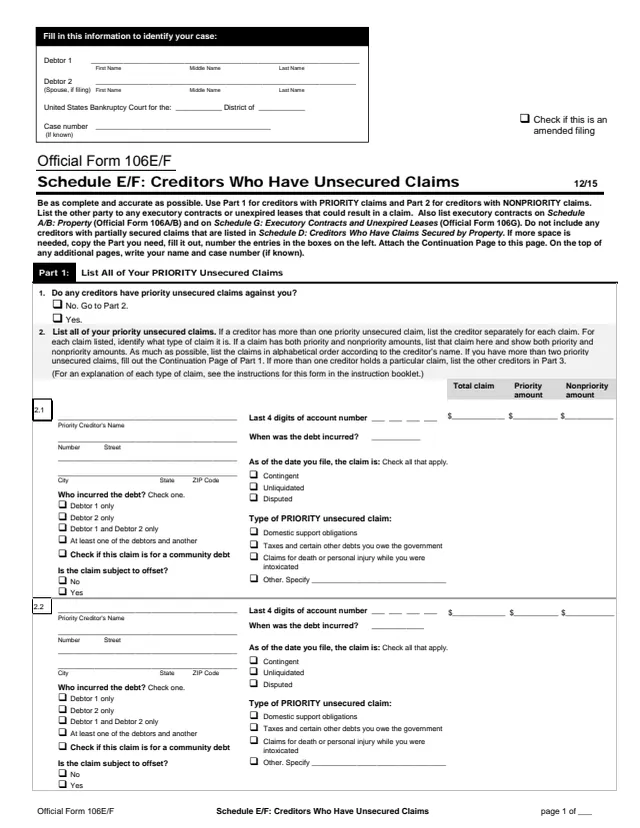
Part 1: Priority unsecured claims

Line 1 asks whether any creditors have priority unsecured claims. Line 2 lists each one: the creditor's name and address, last 4 digits of the account number, when the debt was incurred, and the total, priority and nonpriority amounts.
Claim details

Each entry has boxes for contingent, unliquidated or disputed, who incurred the debt, a community debt box, whether the claim is subject to offset, and the type of claim.

Part 2: Nonpriority unsecured claims

Lines 3 and 4 list each nonpriority claim with its total. Types are student loans, obligations from a separation agreement or divorce not reported as priority claims, debts to pension or profit-sharing plans, and other.

Continuation Pages

Part 1 continues with entries from 2.3 for more than two priority claims, and Part 2 from 4.4 for more than three nonpriority claims.

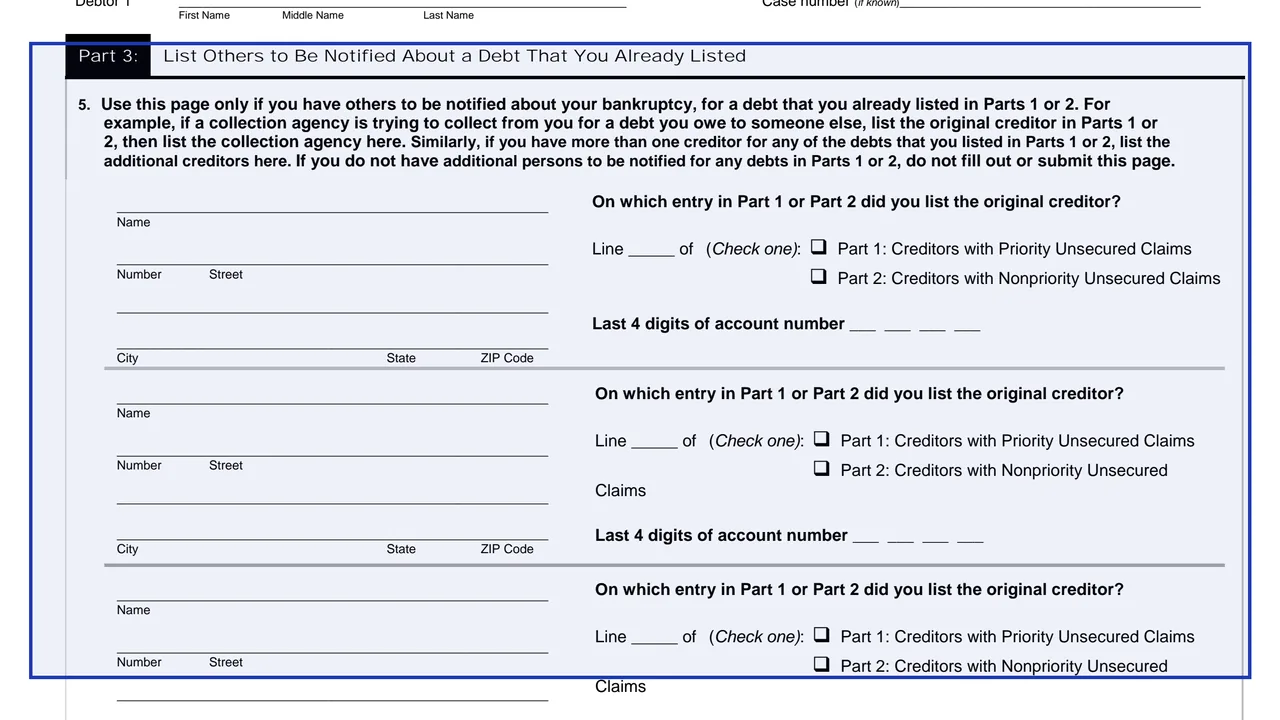
Part 3: Others to be notified

Line 5 lists others to be notified about a debt already listed in Part 1 or Part 2, with the line and part where the original creditor appears and the last 4 digits of the account number.

Part 4: Totals

Line 6 adds 6a to 6d for priority claims (total on 6e) and 6f to 6i for nonpriority claims (total on 6j). The form says this information is for statistical reporting purposes only, citing 28 U.S.C. § 159.

How to fill out Form B 106E/F

  1. 1

    Sort priority and nonpriority claims

    The form says to use Part 1 for creditors with PRIORITY claims and Part 2 for NONPRIORITY claims, list a creditor separately for each claim, and keep alphabetical order by creditor as much as possible.

  2. 2

    Show mixed claims once

    The form says a claim with both priority and nonpriority amounts is listed in Part 1 with both amounts, and that claims already included in Part 1 are not listed again in Part 2.

  3. 3

    Leave out Schedule D claims

    The form says not to include creditors with partially secured claims that are listed on Schedule D.

  4. 4

    List every creditor

    The booklet says every creditor owed is listed, regardless of the amount and even for a debt the debtor plans to pay, including a credit card company even if the bill will be paid in full.

  5. 5

    Add notice parties in Part 3

    List a collection agency or additional creditors for a debt already in Part 1 or 2. The form says that without additional persons to be notified, Part 3 is not filled out or submitted.

  6. 6

    Total Part 4

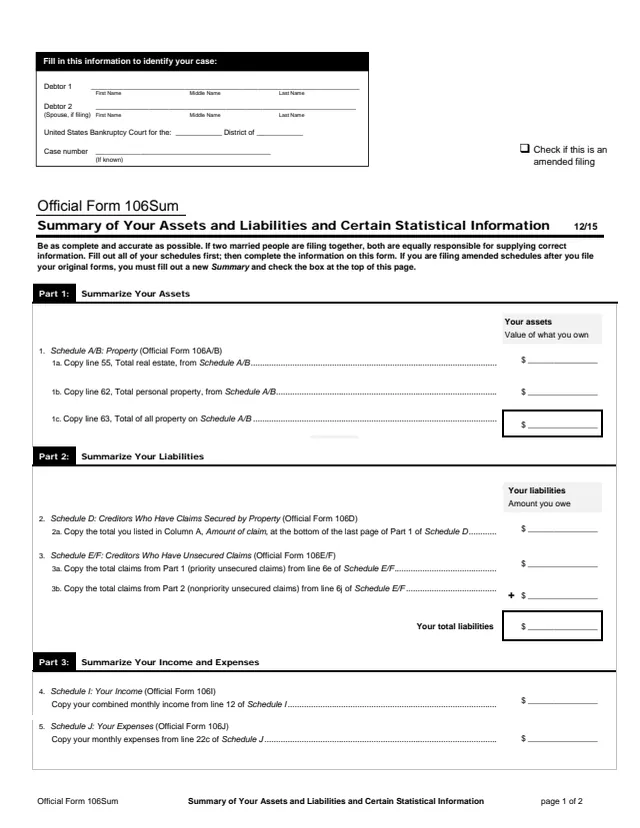
    Add the claim types on lines 6a to 6j. Form B 106 Summary later copies lines 6e and 6j, and lines 6a, 6b, 6c, 6f, 6g and 6h.

Why fill Form B 106E/F on indox

You get the real form, filled in a browser tab, with nothing standing between you and the finished PDF.

  • Fill the form right in your browser, no software to install
  • Free to fill and free to download, with no account
  • The official blank straight from the U.S. Courts, not a copy someone retyped
  • Works on a phone, tablet or computer

Where it is filed, fees and warnings

Where it is filed

With the United States Bankruptcy Court for the district named on page 1, as part of the Schedules of Assets and Liabilities (Official Form 106) that the instruction booklet lists for all individuals who file for bankruptcy.

When

The booklet says these forms are filed either when the bankruptcy case is filed or within 14 days after the Voluntary Petition for Individuals Filing for Bankruptcy (Form 101), and that the case may be dismissed if they are not filed.

Filing fee

The form does not print a fee.

Debts not listed

The booklet says that if a debt is not listed, it may not be discharged.

Privacy

The form asks only for the last 4 digits of account numbers. The booklet says not to list a minor child's full name, only the child's initials and the name and address of the parent or guardian, citing 11 U.S.C. § 112 and Bankruptcy Rule 1007(m) and 9037.

Who uses Form B 106E/F?

  • Debtors with unsecured debts

    The booklet's examples include relatives or friends you owe, an ex-spouse under a divorce decree, a credit card company, a lender even if the loan is cosigned, anyone who has sued or may sue you, and bill collectors.

  • Debtors with priority claims

    Part 1 types are domestic support obligations, taxes and certain other debts owed to the government, claims for death or personal injury while intoxicated, and other. The booklet also names deposits, wages and employee benefit plan contributions.

  • Married couples filing together

    The booklet says both spouses filing together are equally responsible for supplying correct information. Each claim asks who incurred the debt and has a box if the claim is for a community debt.

  • Parties to contracts and leases

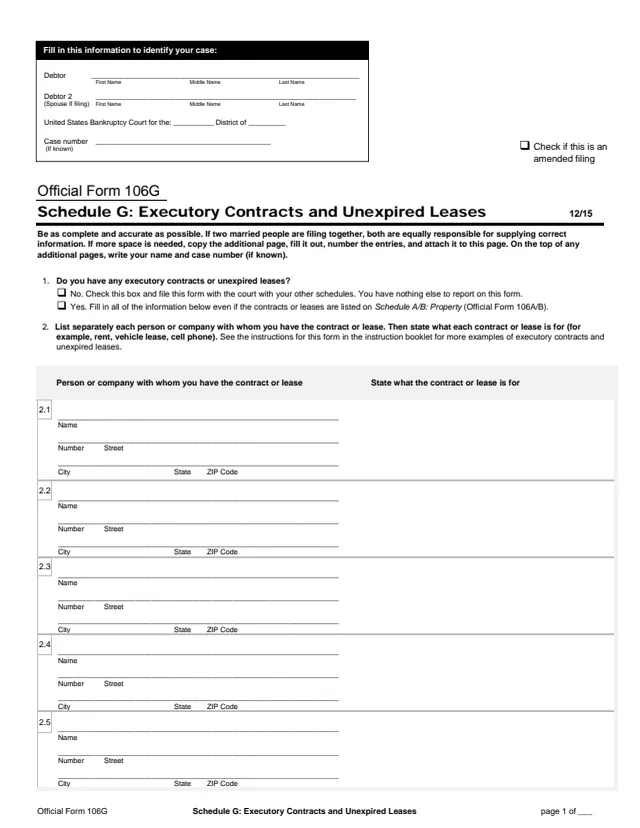
    The form says to list the other party to any executory contracts or unexpired leases that could result in a claim, and to also list executory contracts on Schedule A/B and Schedule G.

  • Not for companies

    The booklet says a bankruptcy for a nonindividual, such as a corporation, partnership, or limited liability company (LLC), uses the forms numbered in the 200 series.

The schedule is for individuals in a bankruptcy case. The form and its instructions name these situations.

Official sources and the blank

Do it all with indox

View all 94 tools

Questions about Form B 106E/F

What is the difference between priority and nonpriority claims?

The booklet says priority unsecured claims are debts the Bankruptcy Code requires to be paid before most other unsecured claims, most commonly certain income tax debts and past due alimony or child support. Nonpriority claims, such as credit card bills, medical bills and educational loans, generally are paid after.

Is a credit card that will be paid in full listed?

Yes. The booklet includes a credit card company even if the bill will be fully paid, and says to list a creditor even when the debtor plans to pay it.

What if one claim is partly priority and partly nonpriority?

The form says to list that claim in Part 1 and show both the priority and nonpriority amounts.
Is a partly secured debt listed on Schedule E/F too?

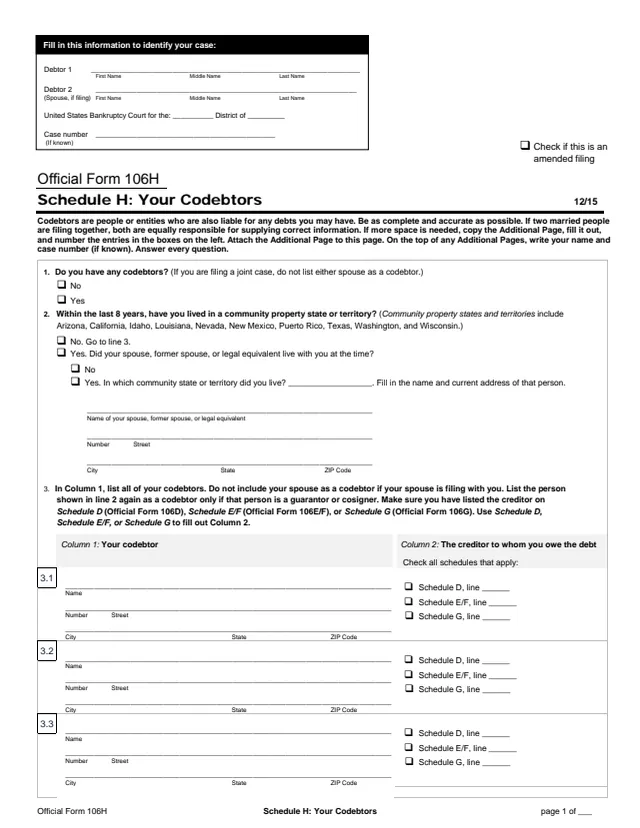
No. The form says not to include creditors with partially secured claims that are listed on Schedule D, and the booklet says such a claim is listed only once, on Schedule D.

Where does a collection agency go?

In Part 3. The form says to list the original creditor in Part 1 or 2, then list the collection agency in Part 3 with the line where the original creditor appears.

Why are student loans counted separately?

Part 4 totals certain types of claims for statistical reporting purposes only, citing 28 U.S.C. § 159. The booklet says the court collects information about specific categories of unsecured claims for statistical reasons.