Case caption
The names of Debtor 1 and Debtor 2 (spouse, if filing), the district of the United States Bankruptcy Court, the case number if known, and a box to mark an amended filing.
B 106H
Schedule H: Your Codebtors (individuals)
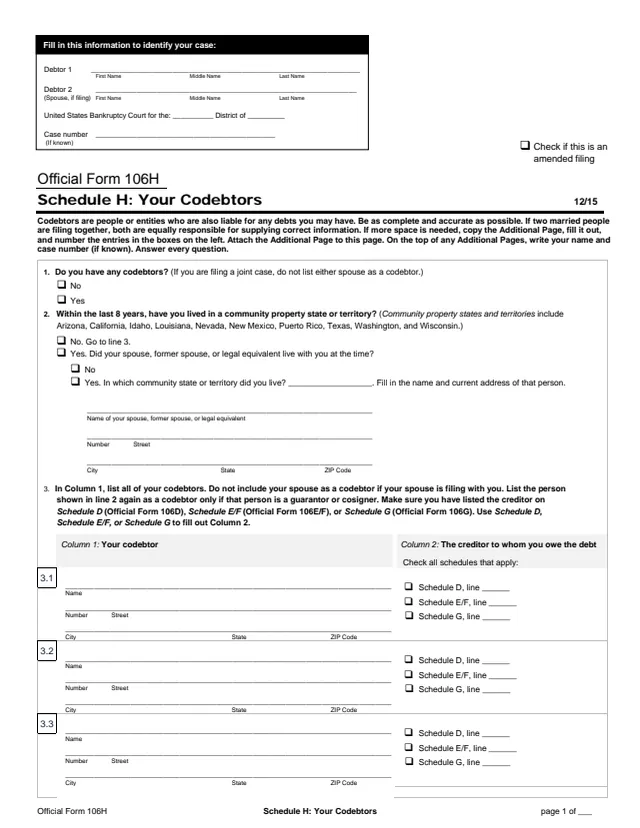
Form B 106H, Schedule H: Your Codebtors, is the Official Bankruptcy Form an individual debtor uses to list codebtors, which the form describes as people or entities who are also liable for any debts you may have. The U.S. Courts list it under Individual Debtors. The current version is dated 12/15, and the U.S. Courts page lists it as effective on December 1, 2015. The page says the form is derived from Official Form 6H, and that Official Bankruptcy Forms are approved by the Judicial Conference and must be used under Bankruptcy Rule 9009.
The form asks whether you have codebtors, whether you lived in a community property state or territory within the last 8 years, and, for each codebtor, the name and address and the schedule and line where the creditor is listed. The committee note says it replaces Official Form 6H for individual debtors and removes Alaska from the listed community property states.
This page explains the form in plain words and is not legal advice. You can fill it out free in your browser on this page and download the result without an account.
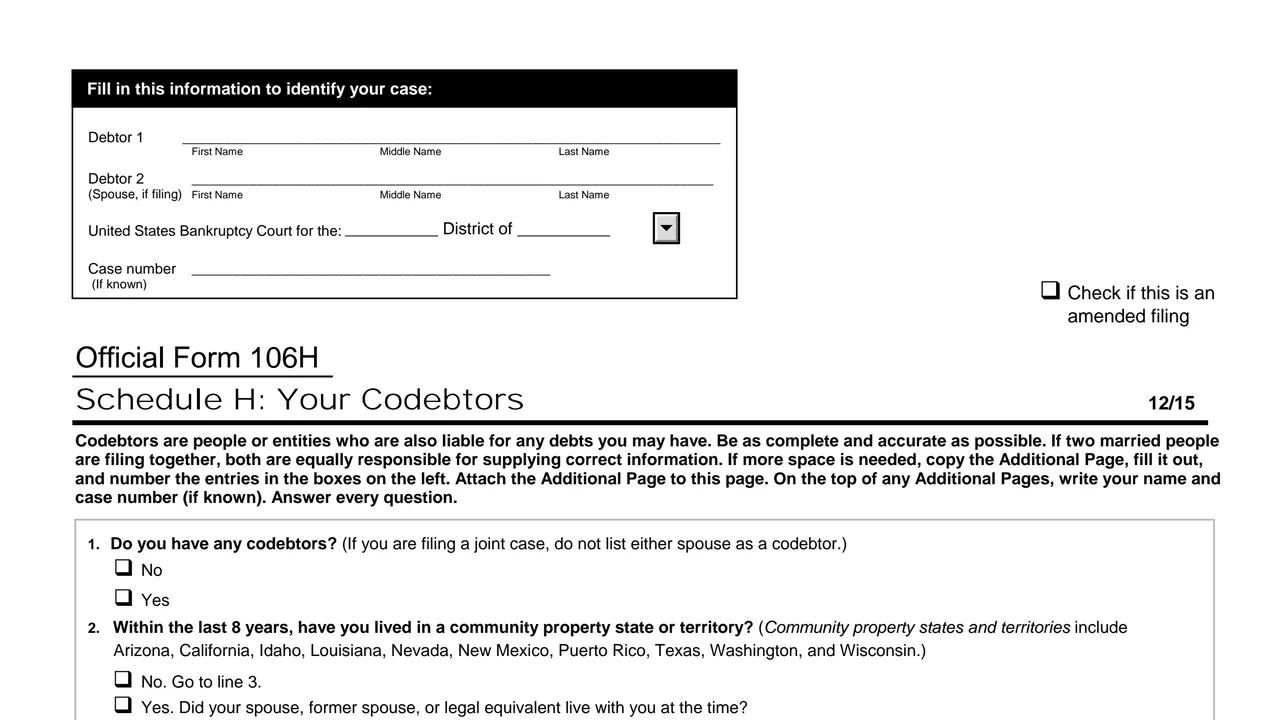
The names of Debtor 1 and Debtor 2 (spouse, if filing), the district of the United States Bankruptcy Court, the case number if known, and a box to mark an amended filing.
A yes or no question. The form says that if you are filing a joint case, do not list either spouse as a codebtor.
Whether you lived in a community property state or territory within the last 8 years, whether a spouse, former spouse or legal equivalent lived with you then, which state or territory, and that person's name and current address.
Column 1 holds each codebtor's name and address. Column 2 points to the creditor by schedule and line number: Schedule D, Schedule E/F or Schedule G, with a box for each that applies.
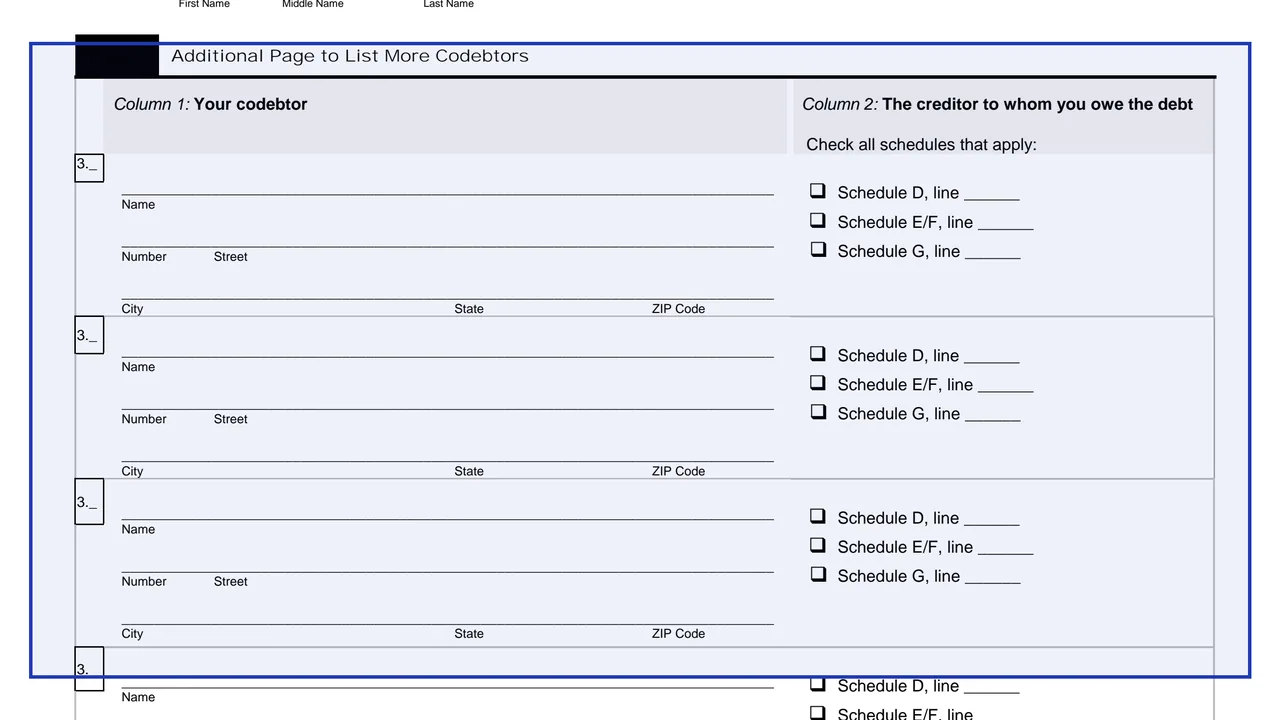
A second page, headed with Debtor 1's name and the case number, has more numbered codebtor entries with the same two columns.
Enter the debtor names, the district and the case number if known, and check the box if this is an amended filing.
The form says to make sure the creditor is listed on Schedule D (Official Form 106D), Schedule E/F (Official Form 106E/F) or Schedule G (Official Form 106G), and to use those schedules to fill out Column 2.
Check yes or no for codebtors and for the community property question. With Yes on line 2, the form asks for the state or territory and the name and current address of that spouse, former spouse or legal equivalent.
The form says not to include a spouse who is filing with you, and to list the person shown in line 2 again as a codebtor only if that person is a guarantor or cosigner.
The form says to copy the Additional Page, number the entries in the boxes on the left, attach it, and write your name and case number (if known) on top. It also says to answer every question.
Schedule H has no signature line. The committee note says the Declaration About an Individual Debtor's Schedules (Official Form 106Dec) is signed by the debtor and filed with the debtor's schedules.
You get the real form, filled in a browser tab, with nothing standing between you and the finished PDF.
With the United States Bankruptcy Court for the district named at the top of the form, as one of the debtor's schedules.
The form does not print a fee.
The instruction booklet lists Schedule H among the forms filed either when the bankruptcy case is filed or within 14 days after the Voluntary Petition (Official Form 101) is filed, and says the case may be dismissed if they are not.
The booklet says filing a bankruptcy case is not private and anyone has a right to see the forms after they are filed, unless the court orders otherwise under 11 U.S.C. § 107. It says to list a minor child only by initials with the parent or guardian's name and address (11 U.S.C. § 112; Bankruptcy Rule 1007(m) and 9037).
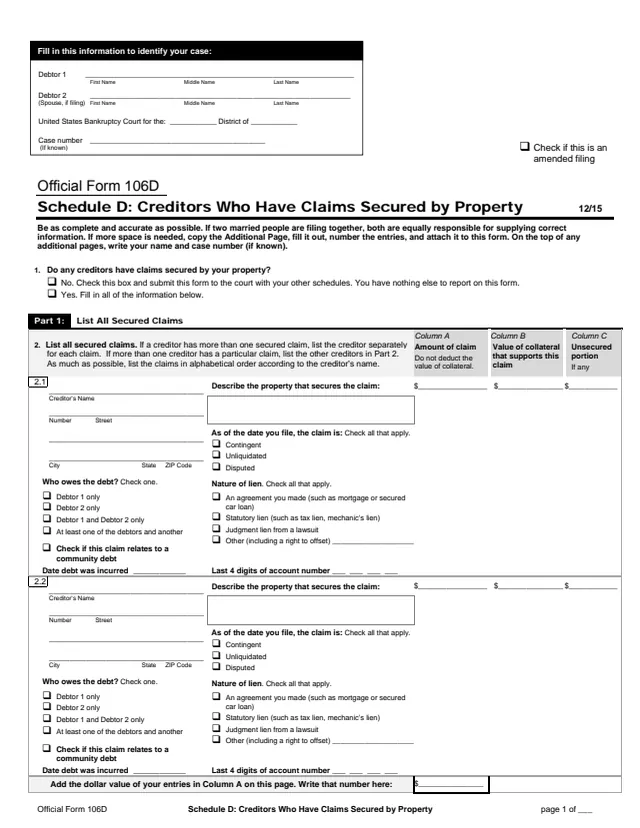
B 106D
186 fields, 3 pages
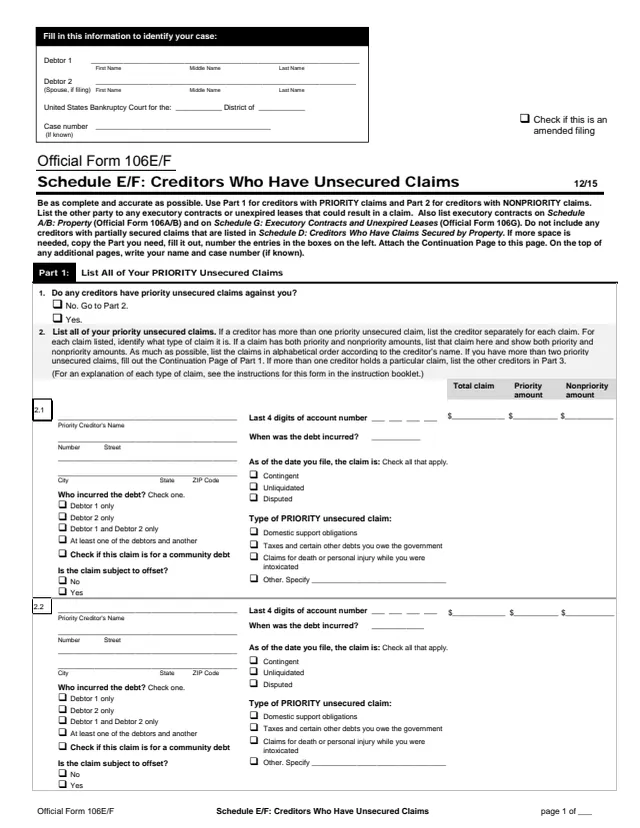
B 106E/F
323 fields, 6 pages
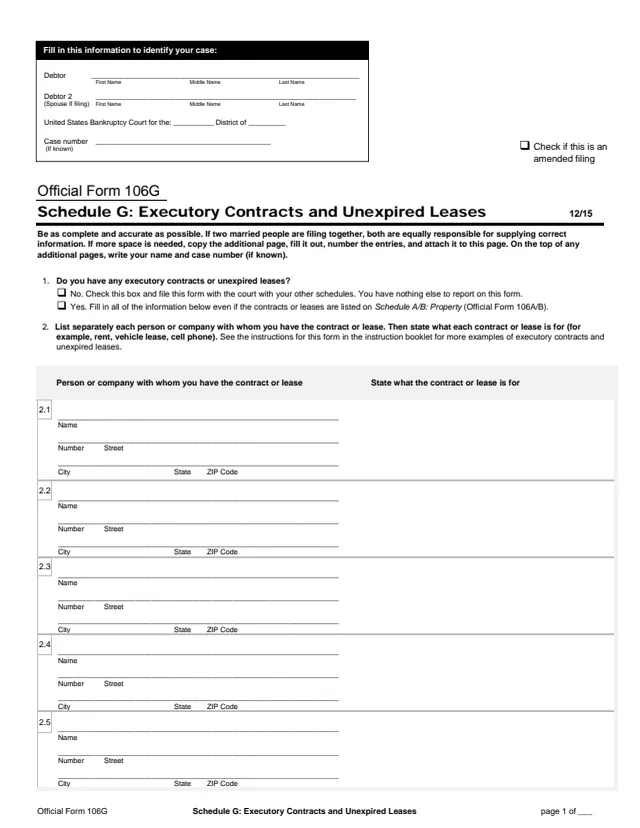
B 106G
99 fields, 2 pages
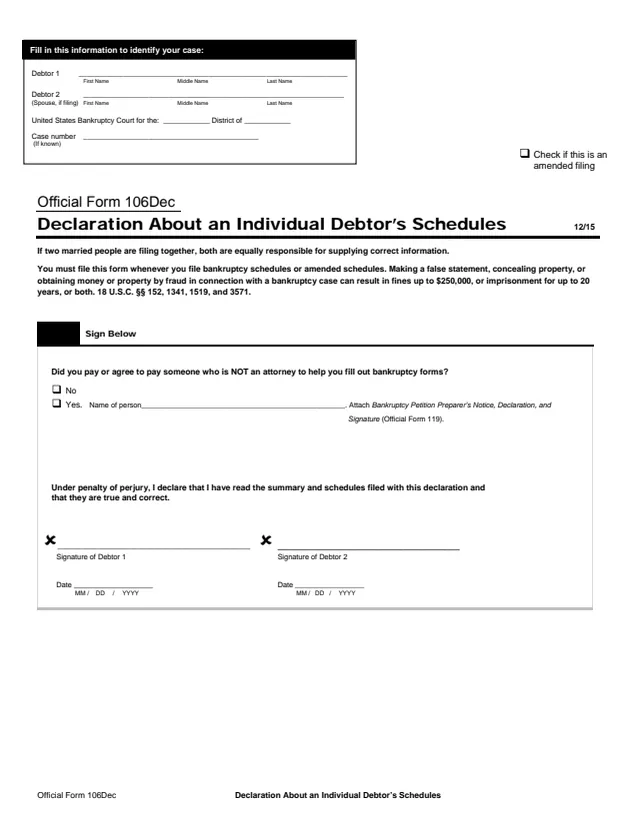
B 106 Declaration
15 fields, 1 page
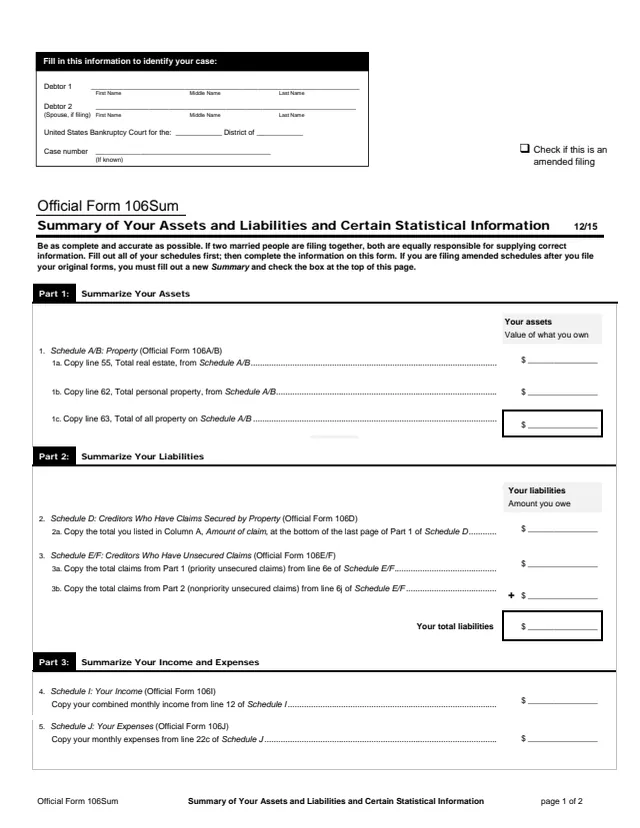
B 106 Summary
28 fields, 2 pages
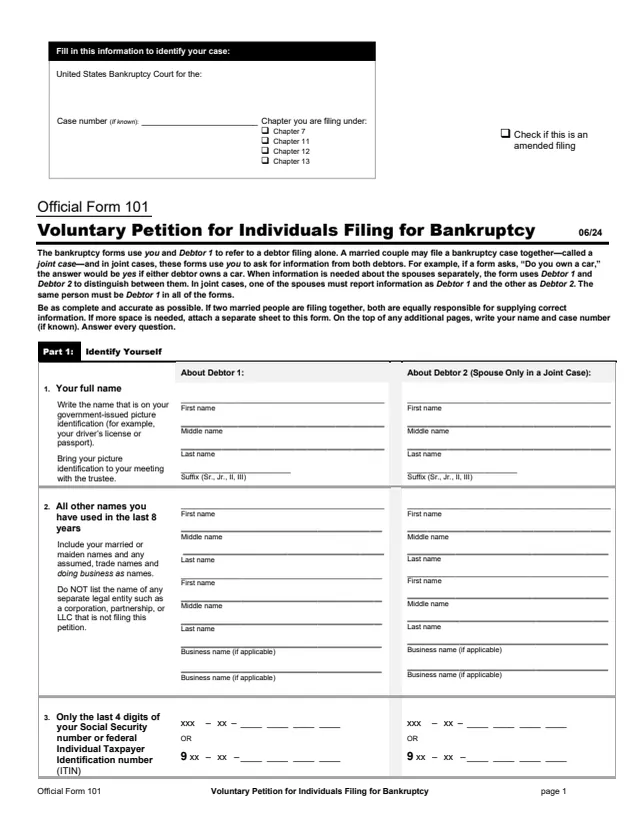
B 101
159 fields, 9 pages
The form is one of the schedules for individuals filing for bankruptcy. The form and the instruction booklet name these situations.
No tool matches that search.
The form describes codebtors as people or entities who are also liable for any debts you may have. The instruction booklet's glossary defines a codebtor as a person or entity that may also be responsible for paying a claim against the debtor.
The form says that if you are filing a joint case, do not list either spouse as a codebtor, and not to include your spouse as a codebtor if your spouse is filing with you.
Arizona, California, Idaho, Louisiana, Nevada, New Mexico, Puerto Rico, Texas, Washington and Wisconsin. The committee note says the form removed Alaska from the listed community property states.
No. Column 2 points to the line on Schedule D, Schedule E/F or Schedule G where the creditor is listed. The committee note says this eliminates the need to list the name and address of the creditor.
The booklet's examples include a nonfiling spouse, even if the spouse is not a cosigner, where the debt is for necessities (such as food or medical care) if state law makes the nonfiling spouse legally responsible for debts for necessities.
The form has no signature line. The committee note says the Declaration About an Individual Debtor's Schedules (Official Form 106Dec) is signed by the debtor and filed with the debtor's schedules.