Case information
Debtor 1, Debtor 2 (spouse, if filing), the United States Bankruptcy Court district, the case number if known, and a box to check if this is an amended filing.
B 106C
Schedule C: The Property You Claim as Exempt (individuals)
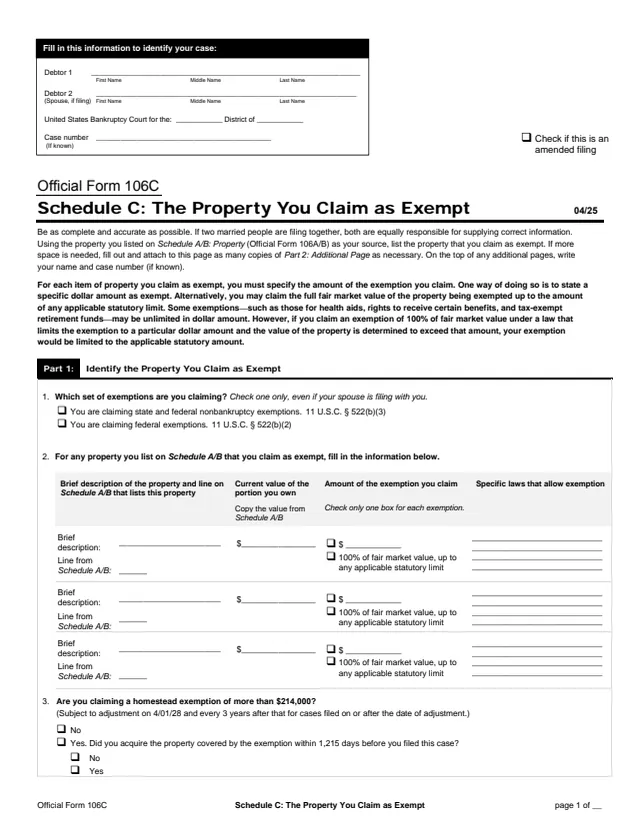
Form B 106C, Schedule C: The Property You Claim as Exempt (individuals), is the Official Bankruptcy Form on which an individual debtor lists the property from Schedule A/B that they claim as exempt. The U.S. Courts list it under Individual Debtors. The current version is dated 04/25. The U.S. Courts page lists it as effective on April 1, 2022 and updated on April 1, 2025, says it is derived from Official Form 6C, and says Official Bankruptcy Forms are approved by the Judicial Conference and must be used under Bankruptcy Rule 9009. The committee note says line 3 was adjusted effective April 1, 2025, as part of the tri-annual dollar adjustments required by 11 U.S.C. § 104.
The 2-page form asks which set of exemptions is claimed, then, for each item, a description and its line on Schedule A/B, the value of the portion owned, the amount of the exemption and the specific laws that allow it. Line 3 asks about a homestead exemption of more than $214,000.
This page explains the form in plain words and is not legal advice. The instruction booklet strongly encourages hiring a qualified attorney for advice on exemptions. You can fill it out free in your browser on this page and download the result without an account.
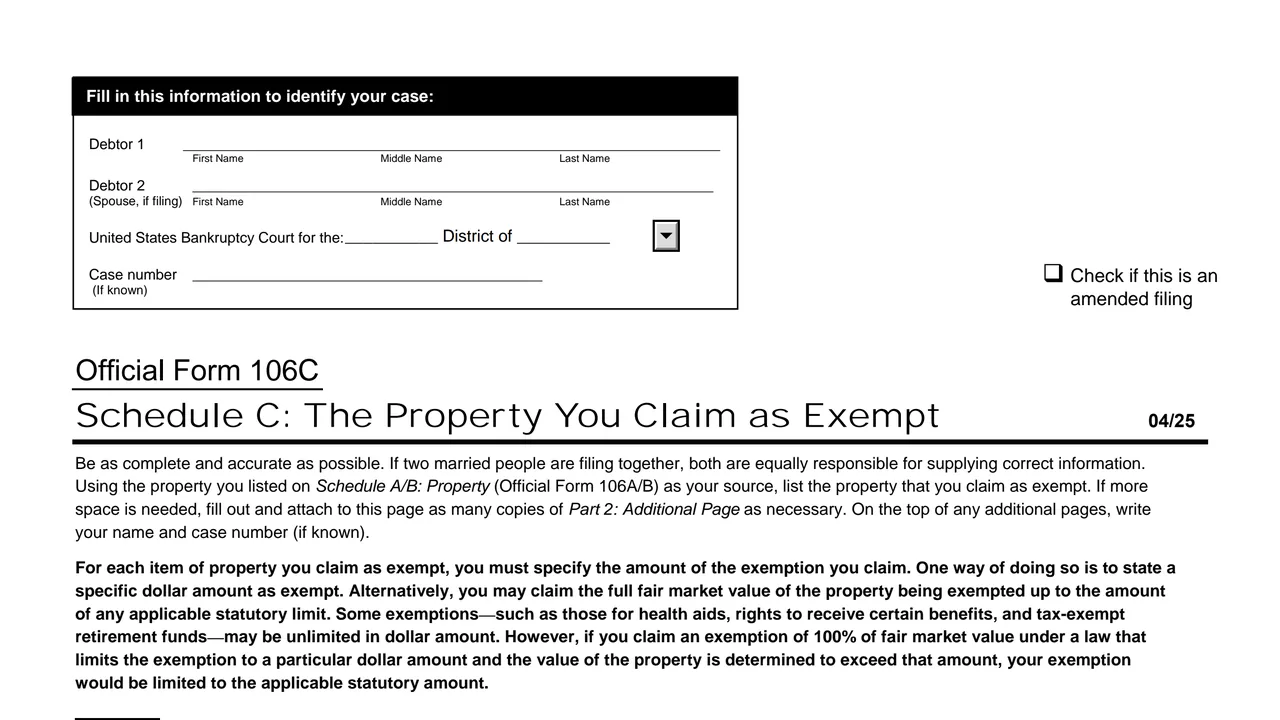
Debtor 1, Debtor 2 (spouse, if filing), the United States Bankruptcy Court district, the case number if known, and a box to check if this is an amended filing.
One box: state and federal nonbankruptcy exemptions, 11 U.S.C. § 522(b)(3), or federal exemptions, 11 U.S.C. § 522(b)(2).
For each item: a brief description and the line on Schedule A/B that lists it, the current value of the portion you own copied from Schedule A/B, the amount of the exemption, and the specific laws that allow the exemption.
One box per exemption: a dollar amount, or 100% of fair market value, up to any applicable statutory limit. The form says some exemptions, such as those for health aids, rights to certain benefits and tax-exempt retirement funds, may be unlimited in dollar amount.
The $214,000 homestead question and the 1,215 days follow-up. The form says the amount is subject to adjustment on 4/01/28 and every 3 years after that for cases filed on or after the date of adjustment.
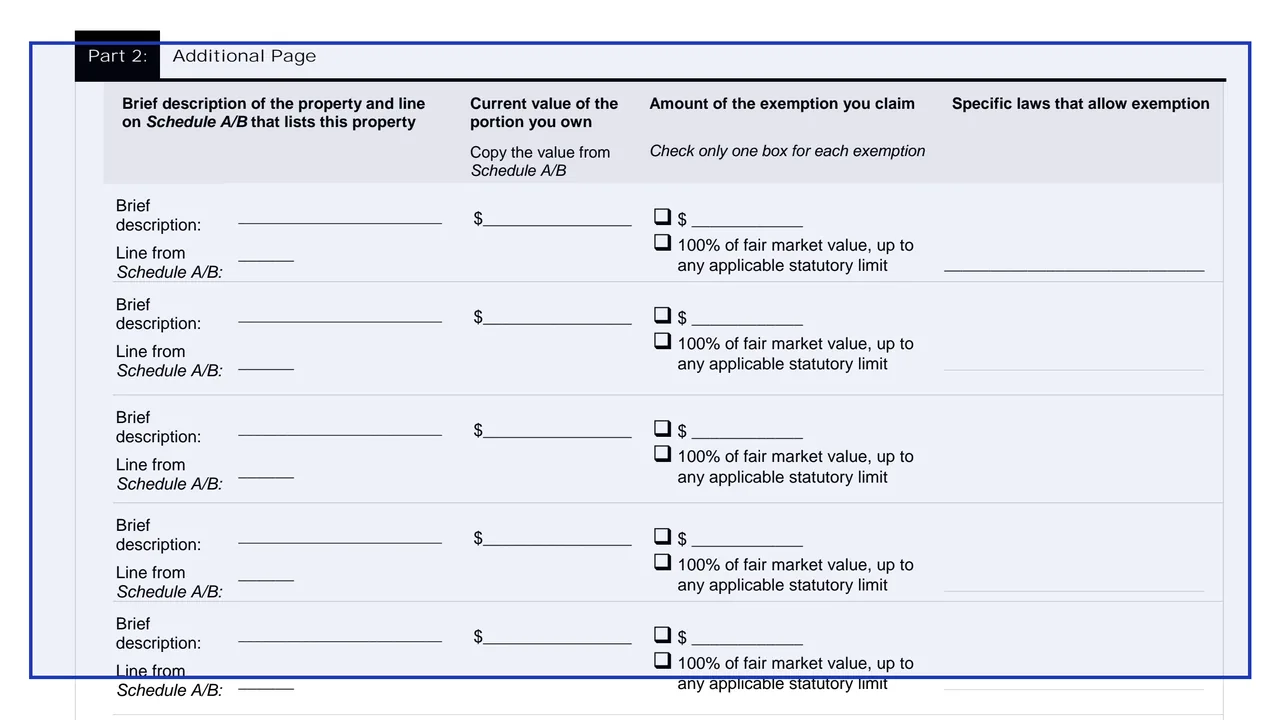
More rows with the same four columns. The form says to attach as many copies as necessary, with your name and case number (if known) at the top.
The form says to use the property listed on Schedule A/B as the source and to copy the value from Schedule A/B. Each row also names the Schedule A/B line that lists the property.
The booklet says the Bankruptcy Code points to the exemptions in the law of the state where the debtor had a legal home for 730 days before filing, and that special rules may apply otherwise.
Check only one box for each exemption. The form says that if 100% of fair market value is claimed under a law with a dollar limit and the value is found to exceed it, the exemption is limited to the statutory amount.
The last column lists the specific laws that allow each exemption. The booklet says to consult a qualified attorney with questions about exemptions.
Line 3 asks about a homestead exemption of more than $214,000 and, for a yes, whether the property was acquired within 1,215 days before the case was filed.
Attach copies of Part 2: Additional Page for more items, with your name and case number (if known) at the top, and fill in the page count in the footer.
You get the real form, filled in a browser tab, with nothing standing between you and the finished PDF.
With the United States Bankruptcy Court for the district named on page 1, as part of the Schedules of Assets and Liabilities (Official Form 106) that the instruction booklet lists for all individuals who file for bankruptcy.
The booklet says these forms are filed either when the bankruptcy case is filed or within 14 days after the Voluntary Petition for Individuals Filing for Bankruptcy (Form 101), and that the case may be dismissed if they are not filed.
The form does not print a fee.
The booklet says that if property is not listed on Schedule C, the trustee may sell it and pay all of the proceeds to creditors, and that property may be lost unnecessarily when exemptions are not claimed.
The line 3 amount is subject to adjustment on 4/01/28 and every 3 years after that. The U.S. Courts page shows the form was updated on April 1, 2025.
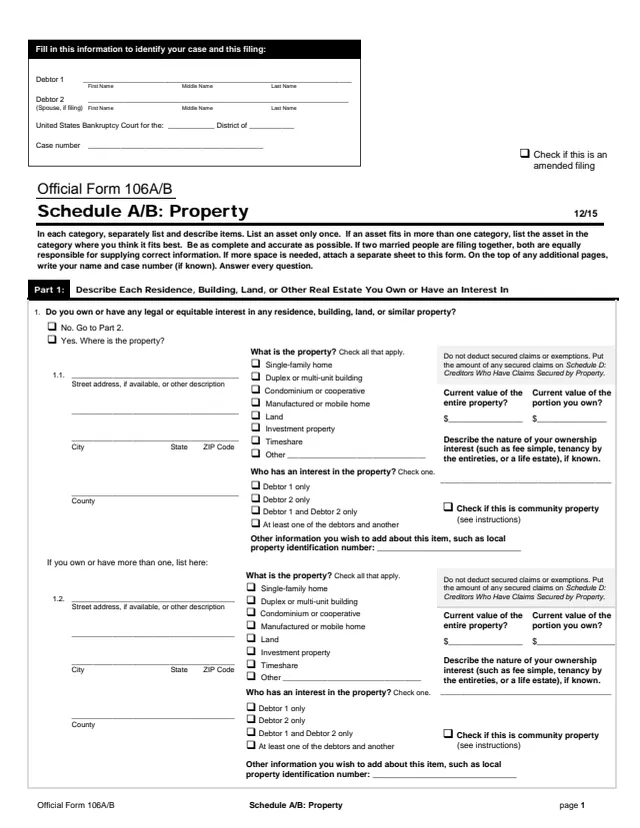
B 106A/B
368 fields, 10 pages
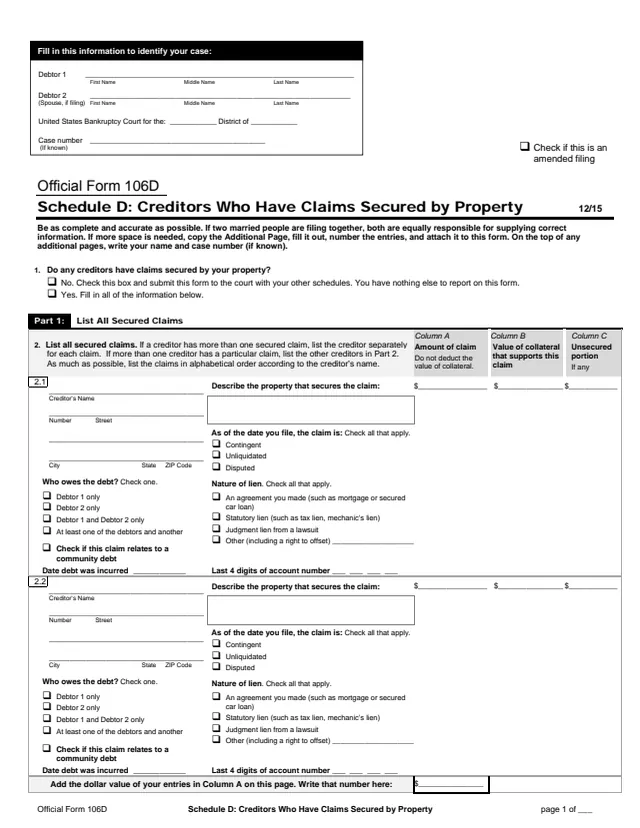
B 106D
186 fields, 3 pages
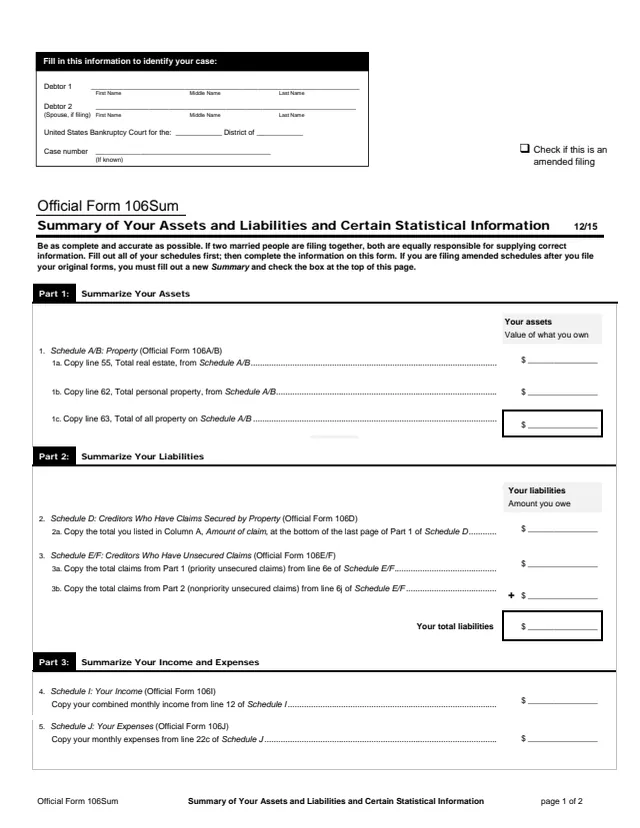
B 106 Summary
28 fields, 2 pages
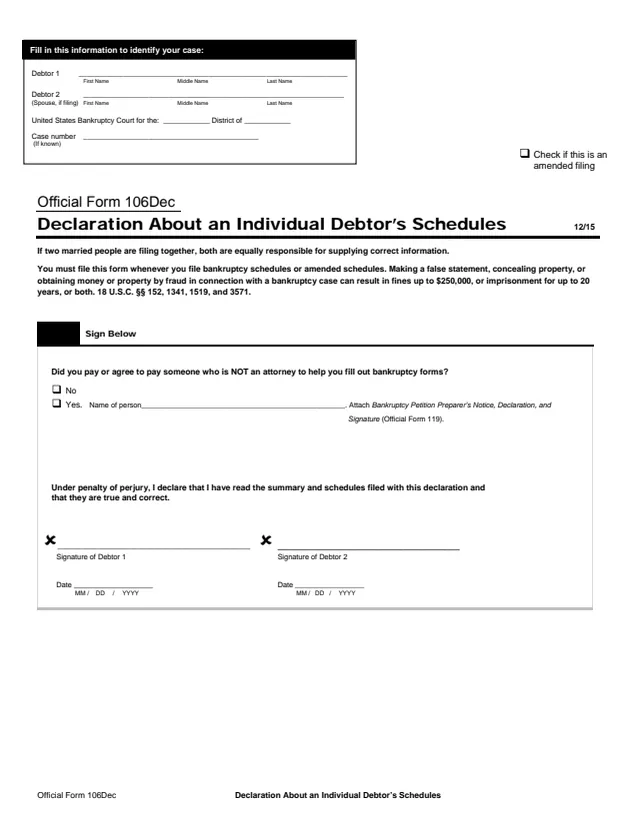
B 106 Declaration
15 fields, 1 page
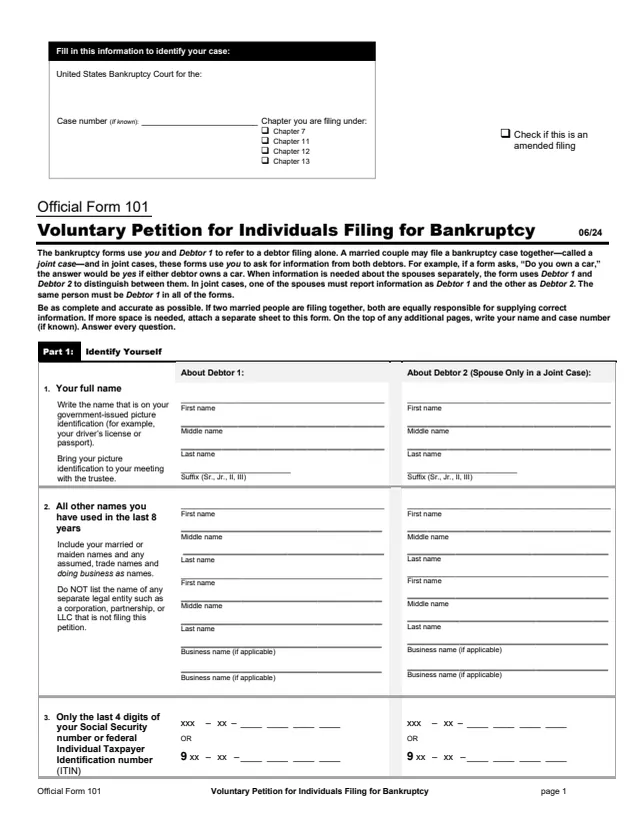
B 101
159 fields, 9 pages
The schedule is for individuals in a bankruptcy case who claim property as exempt. The form and its instructions name these situations.
No tool matches that search.
No. The booklet says exemptions are not automatic and that property is listed on Schedule C to be considered exempt.
Line 1 says to check one only, even if your spouse is filing with you. The booklet says spouses filing together in a state that allows a choice between state and federal sets both use the same set.
It is one of the two ways to state the amount of an exemption. The form says it claims the full fair market value of the property up to any applicable statutory limit, and some exemptions may be unlimited in dollar amount.
This page cannot say. The booklet says exemptions are, in general, determined state by state, that some states permit the exemptions in the Bankruptcy Code (11 U.S.C. § 522), and that special rules may apply without the same home state for 730 days before filing.
The committee note says line 3 was adjusted effective April 1, 2025, as part of the tri-annual dollar adjustments required by 11 U.S.C. § 104. The current form prints $214,000 on line 3.
From Schedule A/B. The form says to copy the current value of the portion you own from Schedule A/B and to give the line on Schedule A/B that lists the property.