Case caption
The debtor names, the district of the United States Bankruptcy Court, the case number if known, and boxes for an amended filing or a supplement showing postpetition chapter 13 expenses as of a date.
B 106J
Schedule J: Your Expenses (individuals)
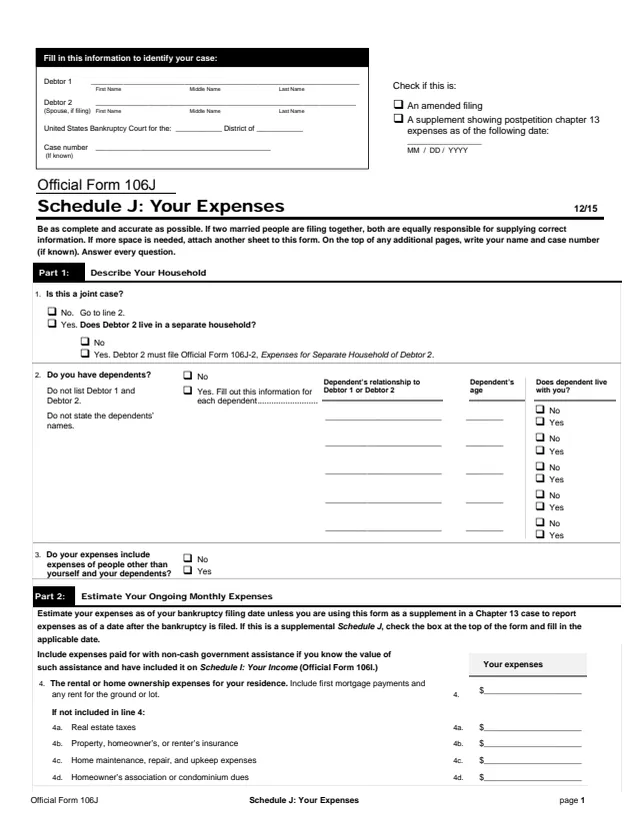
Form B 106J, Schedule J: Your Expenses, is the Official Bankruptcy Form an individual debtor uses to estimate ongoing monthly expenses in a bankruptcy case. The U.S. Courts list it under Individual Debtors. The current version is dated 12/15, and the U.S. Courts page lists it as effective on December 1, 2015. The page says the form is derived from Official Form 6J, and that Official Bankruptcy Forms are approved by the Judicial Conference and must be used under Bankruptcy Rule 9009.
The 3-page form describes the household, including dependents, then lists monthly expenses line by line, from rent or mortgage, utilities and food to insurance, taxes, car payments and support payments. Line 23 subtracts the monthly expenses from the combined monthly income on Schedule I to give monthly net income. The committee note says references to Schedule J-2 and line 22b were added to clarify the calculation in joint cases where Debtor 1 and Debtor 2 maintain separate households.
This page explains the form in plain words and is not legal advice. You can fill it out free in your browser on this page and download the result without an account.
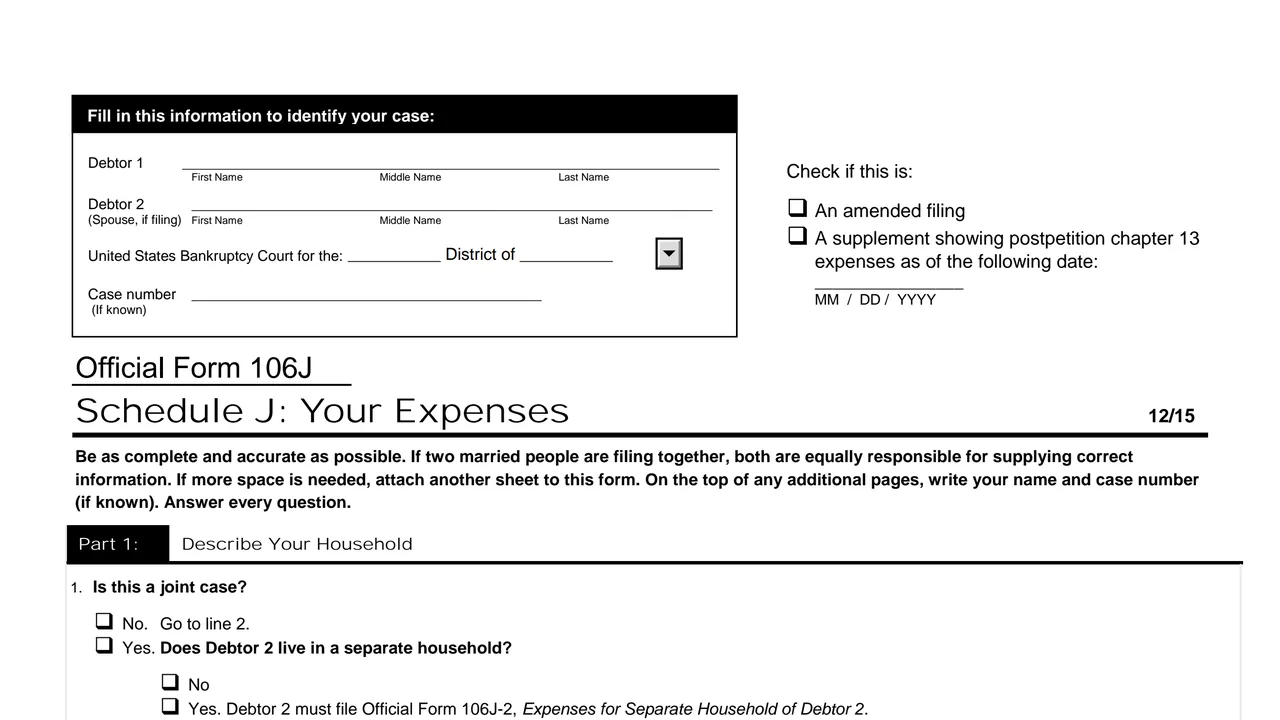
The debtor names, the district of the United States Bankruptcy Court, the case number if known, and boxes for an amended filing or a supplement showing postpetition chapter 13 expenses as of a date.
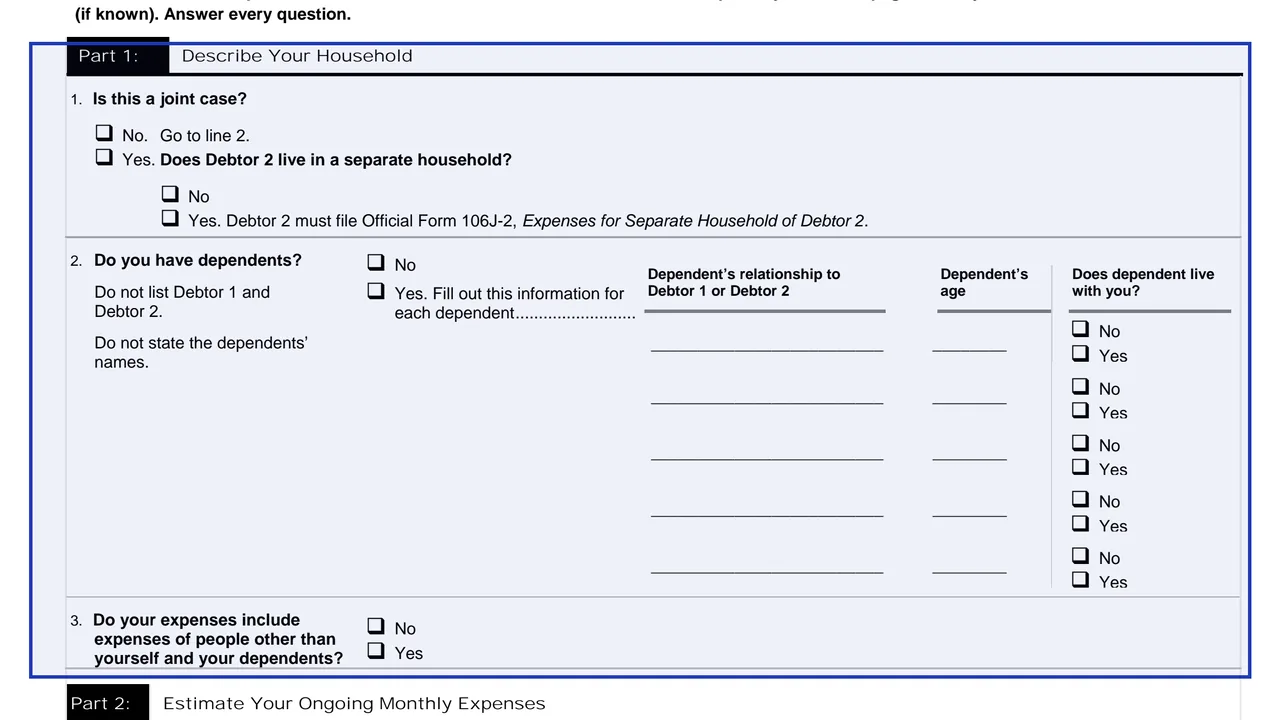
Lines 1 to 3: whether this is a joint case with a separate household for Debtor 2, each dependent's relationship, age and whether the dependent lives with you, and whether expenses include people other than yourself and your dependents.
Rent or home ownership expenses, including first mortgage payments, real estate taxes, insurance, upkeep and association dues, additional mortgage payments such as home equity loans, and utilities.
Food and housekeeping supplies, childcare and education, clothing, personal care, medical and dental, transportation, entertainment, charitable and religious donations, insurance and taxes not deducted from pay.
Car and other installment or lease payments, alimony, maintenance and support not deducted from pay, support for others who do not live with you, expenses for other real property, and other expenses.
Line 22 adds the monthly expenses, including Debtor 2's from Form 106J-2 on line 22b. Line 23 gives monthly net income. Line 24 asks whether you expect expenses to rise or fall within the year after you file.
Enter the debtor names, the district and the case number if known, and check a box if this is an amended filing or a chapter 13 supplement, with its date.
Line 2 says not to list Debtor 1 and Debtor 2 as dependents and not to state the dependents' names. It asks for each dependent's relationship, age and whether the dependent lives with you.
The form says to estimate expenses as of the bankruptcy filing date unless the form is a chapter 13 supplement. The booklet says to show all totals as monthly payments and to write $0 for a line with nothing to report.
The booklet says not to list payments on credit card debts incurred before filing, and not to include business expenses, which are accounted for on Schedule I. Line 12 excludes car payments.
The booklet says not to include expenses that other household members pay directly from income not listed on Schedule I. Its example: list only your share of rent and utilities split with a roommate whose contribution is not on line 11 of Schedule I.
Line 22c adds your expenses and Debtor 2's from Form 106J-2. Line 23 copies line 12 (combined monthly income) from Schedule I and subtracts line 22c.
You get the real form, filled in a browser tab, with nothing standing between you and the finished PDF.
With the United States Bankruptcy Court for the district named at the top of the form, as one of the debtor's schedules.
The form does not print a fee.
The instruction booklet lists Schedule J among the forms filed either when the bankruptcy case is filed or within 14 days after the Voluntary Petition (Official Form 101) is filed, and says the case may be dismissed if they are not.
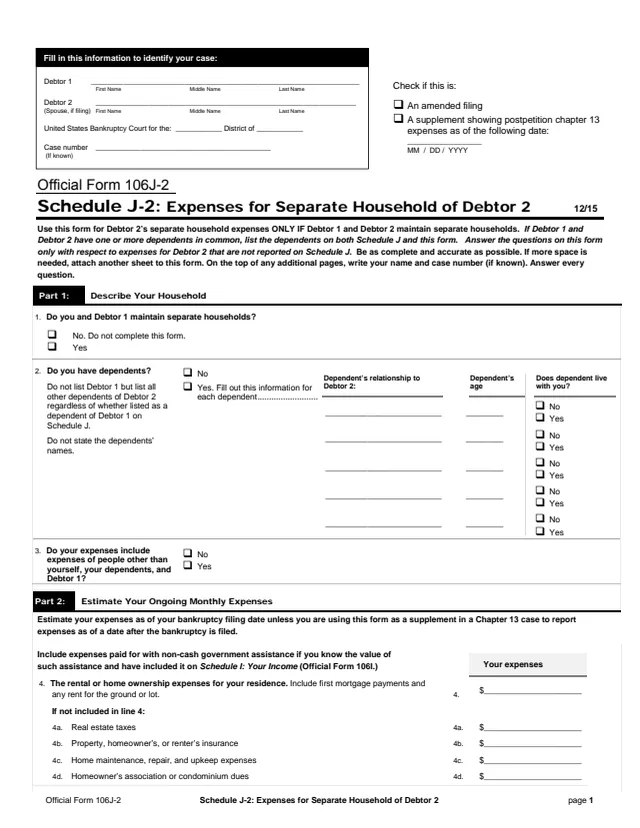
The booklet says that if you are filing jointly and Debtor 1 and Debtor 2 keep separate households, Debtor 2 must complete and include Schedule J-2: Expenses for Separate Household of Debtor 2 (Official Form 106J-2).
The booklet says that if an amended version of Schedule J is filed after the original forms, a new Summary (Official Form 106Sum) is filled out with the box at the top checked.
B 106J-2
73 fields, 3 pages
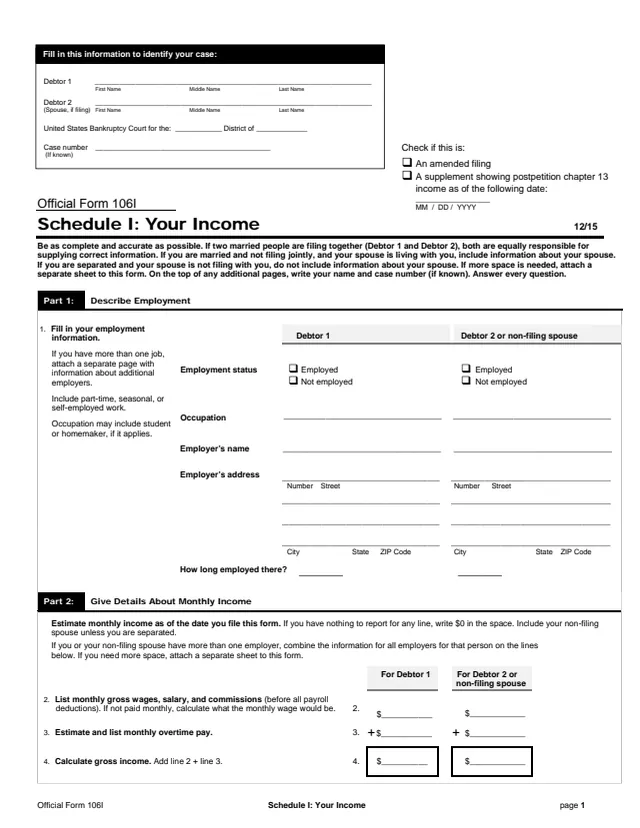
B 106I
85 fields, 2 pages
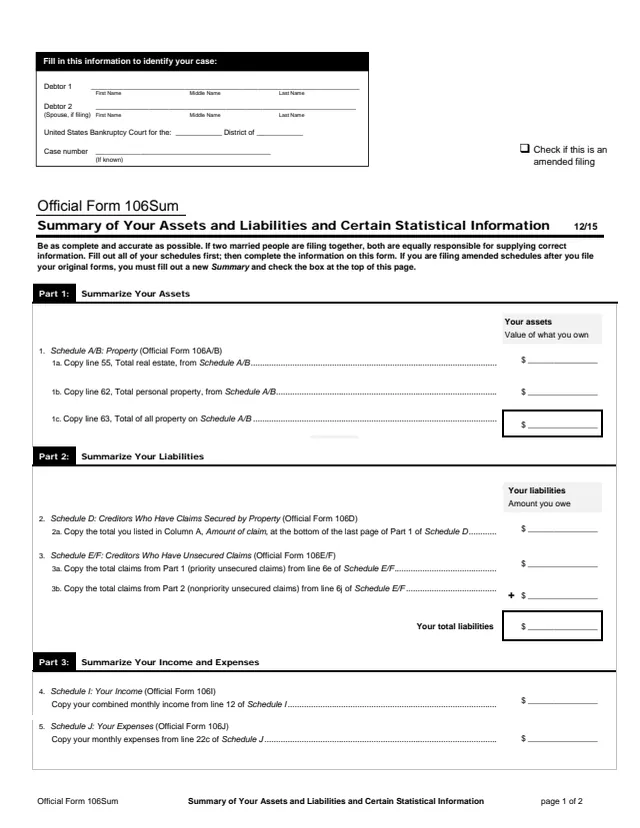
B 106 Summary
28 fields, 2 pages
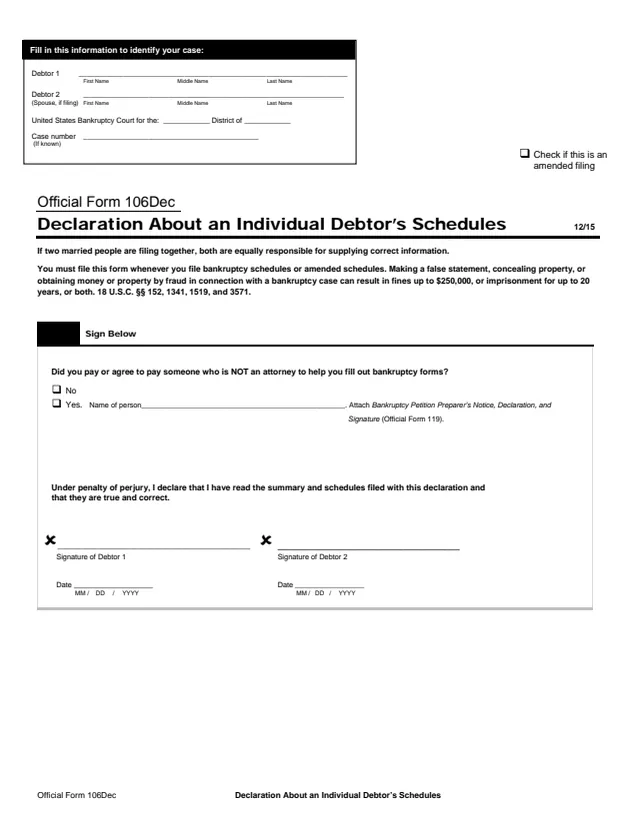
B 106 Declaration
15 fields, 1 page
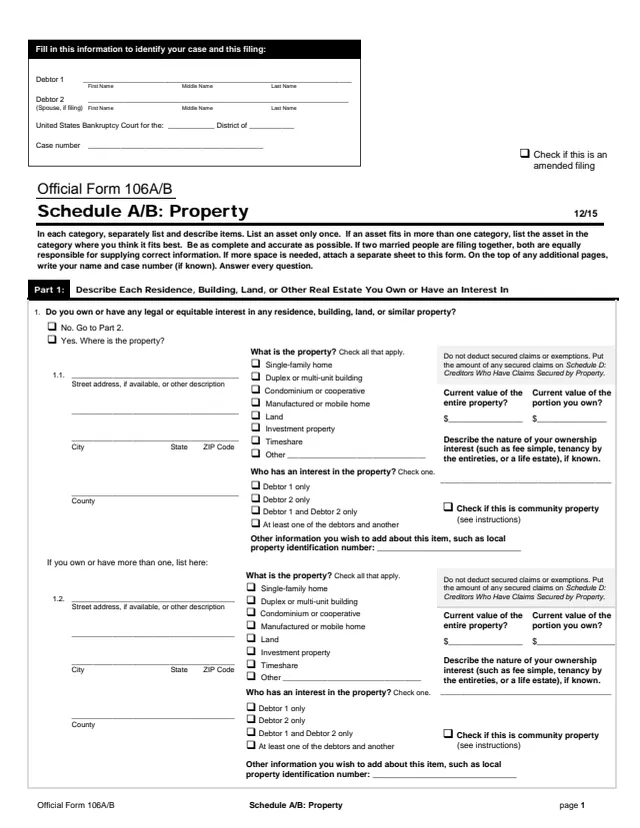
B 106A/B
368 fields, 10 pages
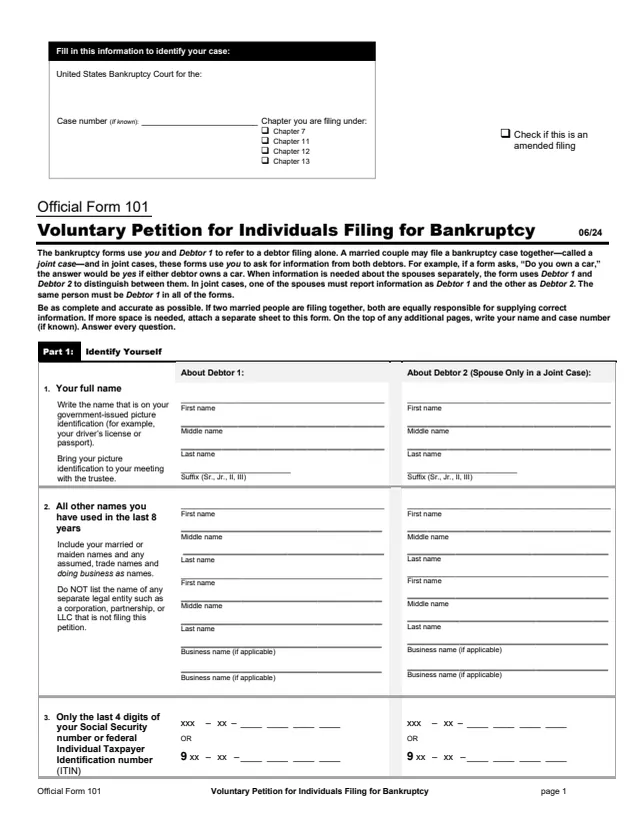
B 101
159 fields, 9 pages
The form is one of the schedules for individuals filing for bankruptcy. The form and the instruction booklet name these situations.
No tool matches that search.
The booklet says that if you are married and filing individually, include your non-filing spouse's expenses unless you are separated. In a joint case where Debtor 2 lives in a separate household, Debtor 2's expenses go on Form 106J-2.
The booklet says not to list as expenses any payments on credit card debts incurred before filing bankruptcy.
The booklet says not to include business expenses on this form, because they are already accounted for as part of determining net business income on Schedule I.
No. Line 2 says not to state the dependents' names. It asks for each dependent's relationship to Debtor 1 or Debtor 2, age, and whether the dependent lives with you.
Line 23 copies line 12 (your combined monthly income) from Schedule I, then subtracts your monthly expenses from line 22c. The form says the result is your monthly net income.
The booklet says a supplemental Schedule J may be completed to file an estimate of expenses in a chapter 13 case for a date after the bankruptcy, by checking the supplement box at the top and filling in the date.
The form has no signature line. The committee note says the Declaration About an Individual Debtor's Schedules (Official Form 106Dec) is signed by the debtor and filed with the debtor's schedules.