Case caption
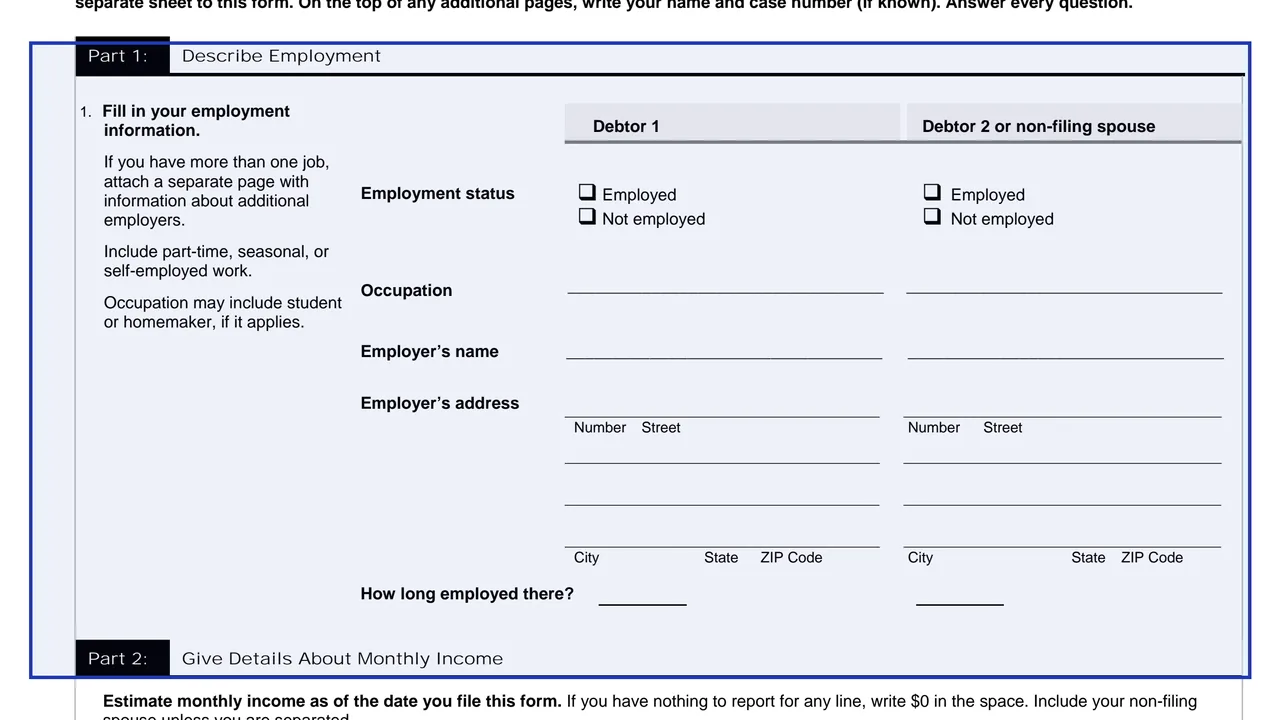
The debtor names, the district of the United States Bankruptcy Court, the case number if known, and boxes for an amended filing or a supplement showing postpetition chapter 13 income as of a date.
B 106I
Schedule I: Your Income (individuals)
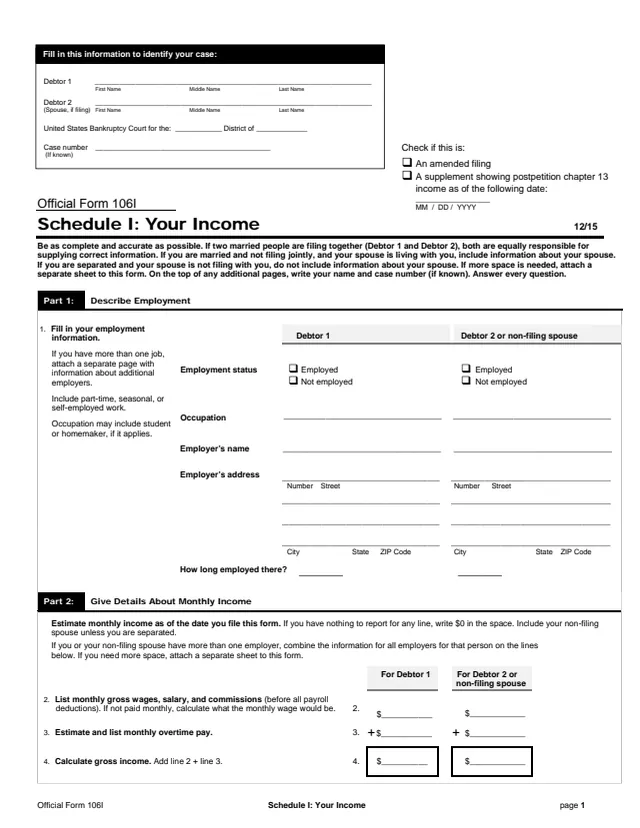
Form B 106I, Schedule I: Your Income, is the Official Bankruptcy Form an individual debtor uses to report employment and monthly income in a bankruptcy case. The U.S. Courts list it under Individual Debtors. The current version is dated 12/15, and the U.S. Courts page lists it as effective on December 1, 2015. The page says the form is derived from Official Form 6I, and that Official Bankruptcy Forms are approved by the Judicial Conference and must be used under Bankruptcy Rule 9009.
The 2-page form has two parts: employment details for Debtor 1 and for Debtor 2 or a non-filing spouse, and monthly income, from wages and payroll deductions to other regular income and contributions from others toward household expenses. Line 12 gives the combined monthly income, which the form says to write on the Summary of Your Assets and Liabilities and Certain Statistical Information, if it applies. A box at the top marks a supplement showing postpetition chapter 13 income.
This page explains the form in plain words and is not legal advice. You can fill it out free in your browser on this page and download the result without an account.
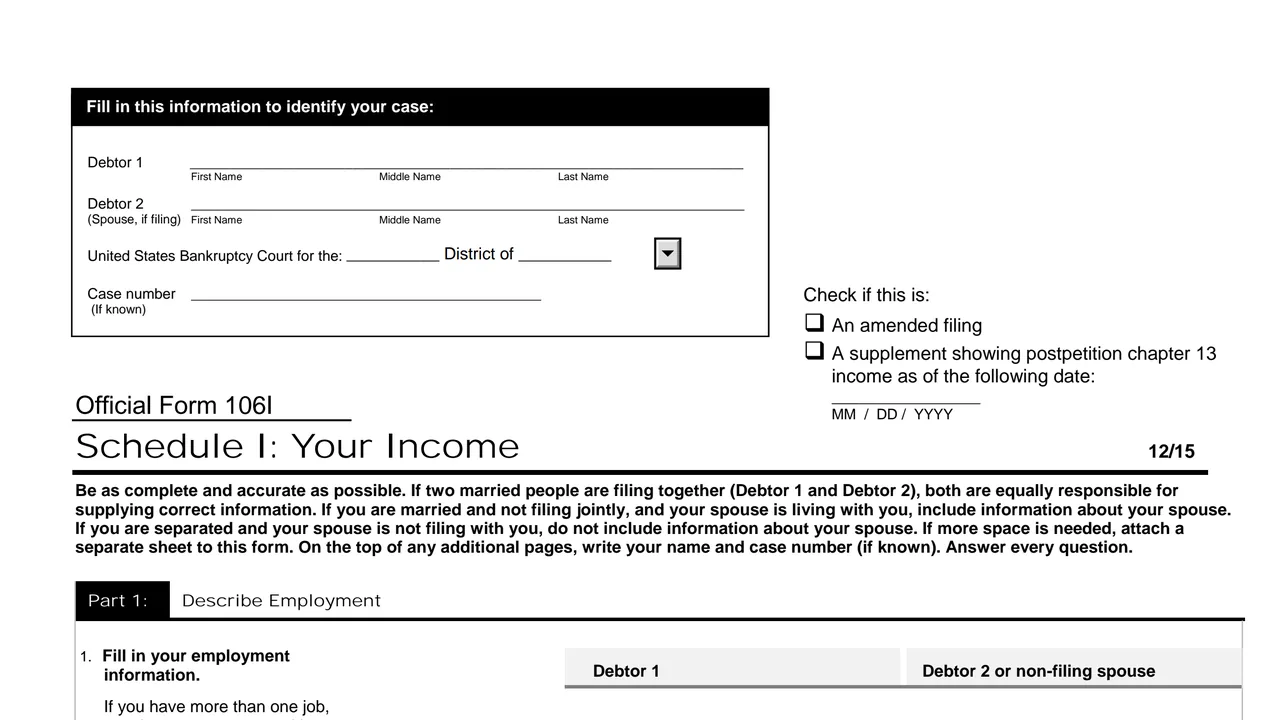
The debtor names, the district of the United States Bankruptcy Court, the case number if known, and boxes for an amended filing or a supplement showing postpetition chapter 13 income as of a date.
Employment status, occupation (which may include student or homemaker), employer's name and address, and how long employed there. Part-time, seasonal or self-employed work is included.
Monthly gross wages, salary and commissions and overtime, then payroll deductions 5a to 5h, such as tax, Medicare and Social Security, retirement contributions and loans, insurance, domestic support obligations and union dues, giving monthly take-home pay.
Net income from rental property or a business, interest and dividends, family support payments, unemployment compensation, Social Security, other government assistance, pension or retirement income, and other monthly income.
Line 10 adds take-home pay and other income for both columns. Line 11 adds regular contributions from others to the expenses on Schedule J. Line 12 gives the combined monthly income.
Whether you expect an increase or decrease within the year after you file this form, with room to explain.
Enter the debtor names, the district and the case number if known, and check a box if this is an amended filing or a chapter 13 supplement, with its date.
Fill in Part 1 for Debtor 1 and for Debtor 2 or the non-filing spouse. The form says to attach a separate page with information about additional employers for more than one job.
The booklet says to show all totals as monthly payments. Its example: $1,000 every week times 52 pay periods is $52,000 a year, and $52,000 divided by 12 is $4,333 monthly income.
The form says to estimate monthly income as of the date you file the form, write $0 in any line with nothing to report, and combine all employers for each person on the lines.
Line 11 includes contributions from an unmarried partner, household members, dependents, roommates and other friends or relatives, but not amounts already in lines 2 to 10 or amounts not available to pay Schedule J expenses.
The form says to write the line 12 amount on the Summary of Your Assets and Liabilities and Certain Statistical Information, if it applies. Schedule J line 23a copies line 12 from Schedule I.
You get the real form, filled in a browser tab, with nothing standing between you and the finished PDF.
With the United States Bankruptcy Court for the district named at the top of the form, as one of the debtor's schedules.
The form does not print a fee.
The instruction booklet lists Schedule I among the forms filed either when the bankruptcy case is filed or within 14 days after the Voluntary Petition (Official Form 101) is filed, and says the case may be dismissed if they are not.
The booklet says Schedule I income may differ from the income on Official Forms 122A-1, 122B and 122C-1, which use a different definition of income and a different period of time.
The booklet says that if an amended version of Schedule I is filed after the original forms, a new Summary (Official Form 106Sum) is filled out with the box at the top checked.
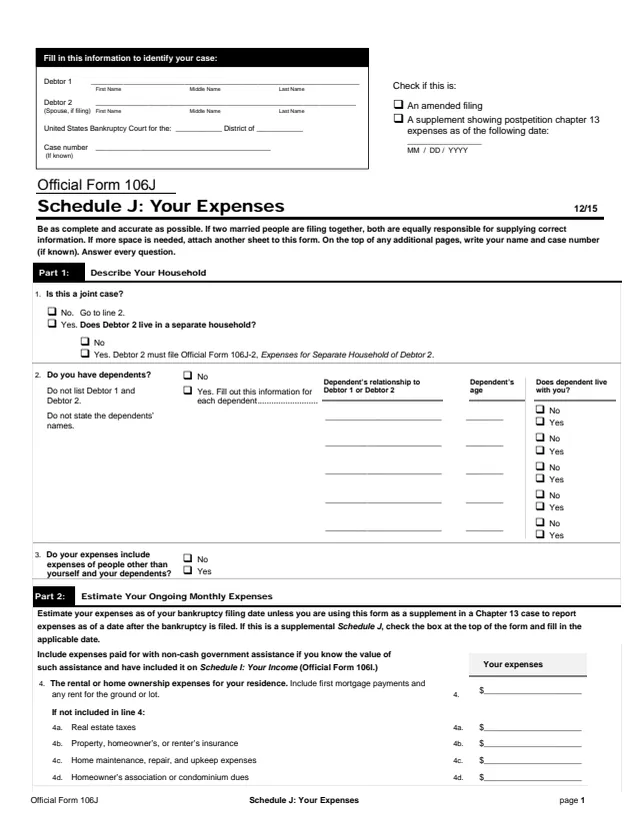
B 106J
79 fields, 3 pages
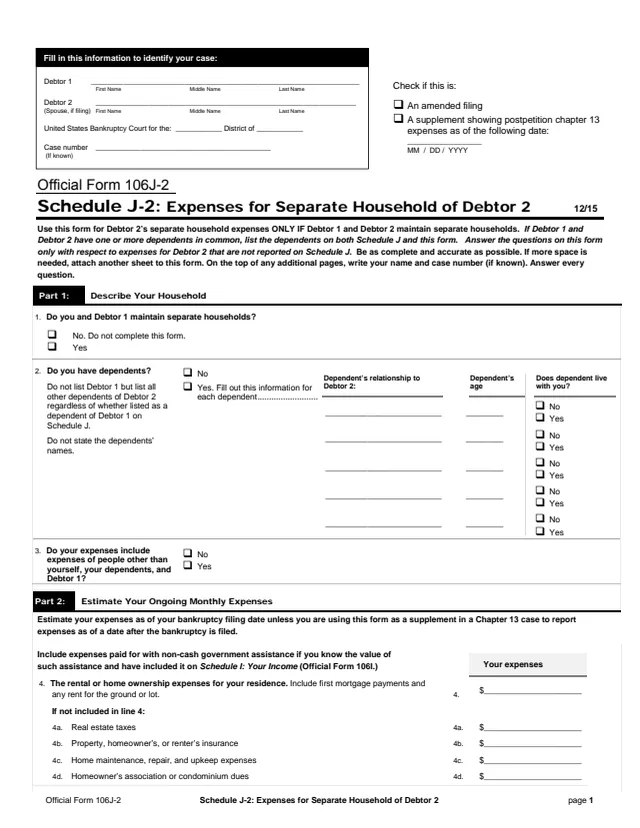
B 106J-2
73 fields, 3 pages
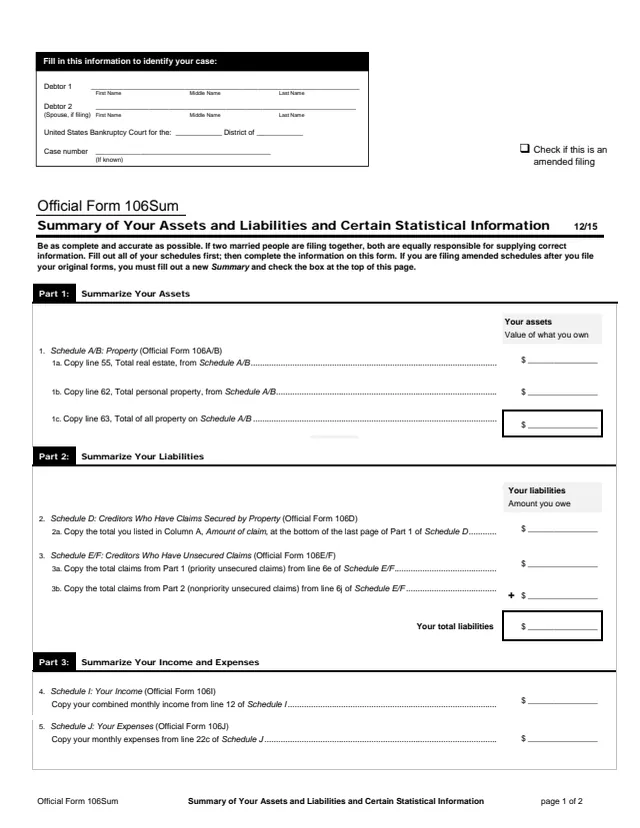
B 106 Summary
28 fields, 2 pages
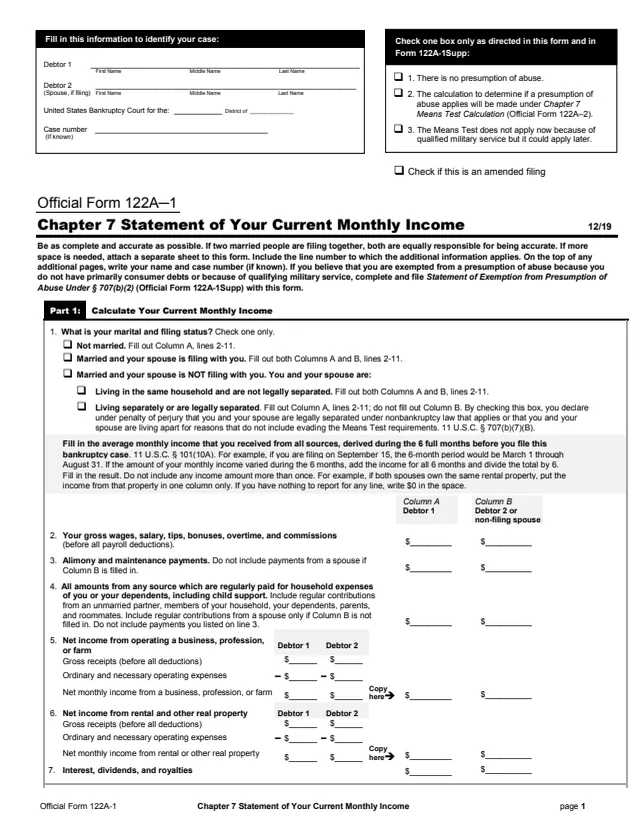
B 122A-1
58 fields, 3 pages
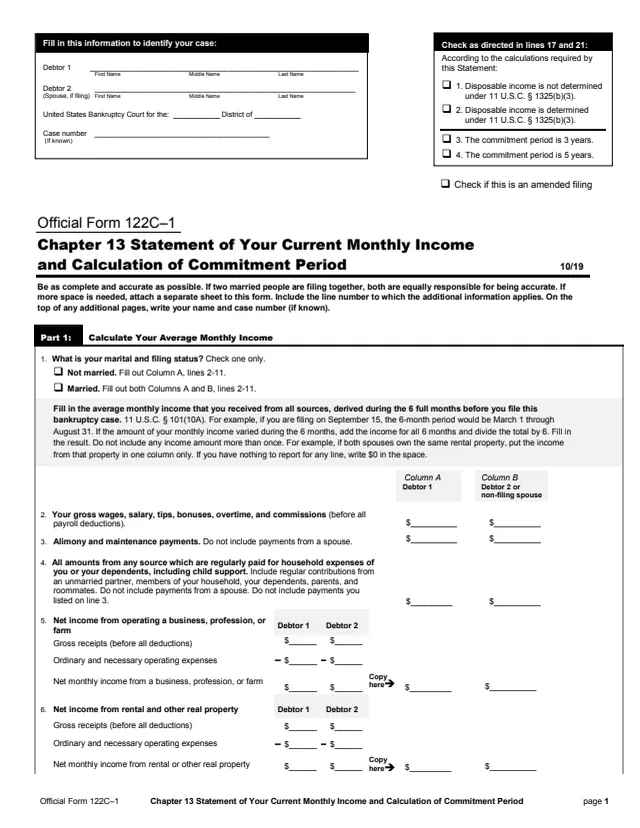
B 122C-1
71 fields, 4 pages
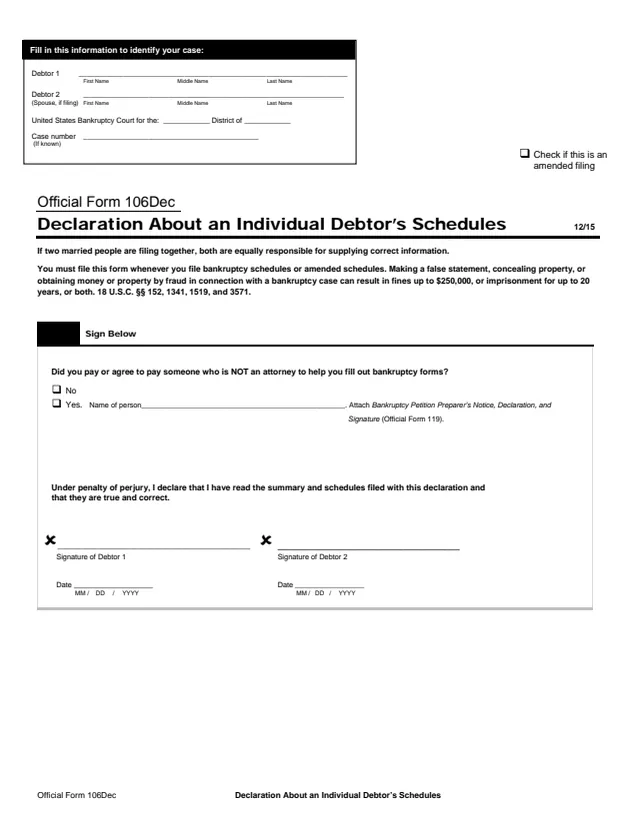
B 106 Declaration
15 fields, 1 page
The form is one of the schedules for individuals filing for bankruptcy. It says whose information goes on it.
No tool matches that search.
The form says that if you are married, not filing jointly and your spouse is living with you, include information about your spouse. If you are separated and your spouse is not filing with you, it says not to include information about your spouse.
The booklet says to show all totals as monthly payments. Its example for irregular payments: $4,000 paid 8 times a year is $32,000 for the year, and $32,000 divided by 12 is $2,667 monthly income.
Not always. The booklet says Schedule I asks about the income you are now receiving, while Official Forms 122A-1, 122B and 122C-1 use a different definition of income for the period before filing, so the amounts may differ.
Regular contributions from others to the expenses on Schedule J. The booklet says that if you have a roommate, divide the rent and utilities, and list only your share of those expenses on Schedule J, the roommate's payments are not listed on line 11.
Line 8f says to include cash assistance and the value (if known) of any non-cash assistance that you receive, such as food stamps (benefits under the Supplemental Nutrition Assistance Program) or housing subsidies.
The booklet says a supplemental Schedule I may be completed to file an estimate of income in a chapter 13 case for a date after the bankruptcy, by checking the supplement box at the top and filling in the date.
The form has no signature line. The committee note says the Declaration About an Individual Debtor's Schedules (Official Form 106Dec) is signed by the debtor and filed with the debtor's schedules.