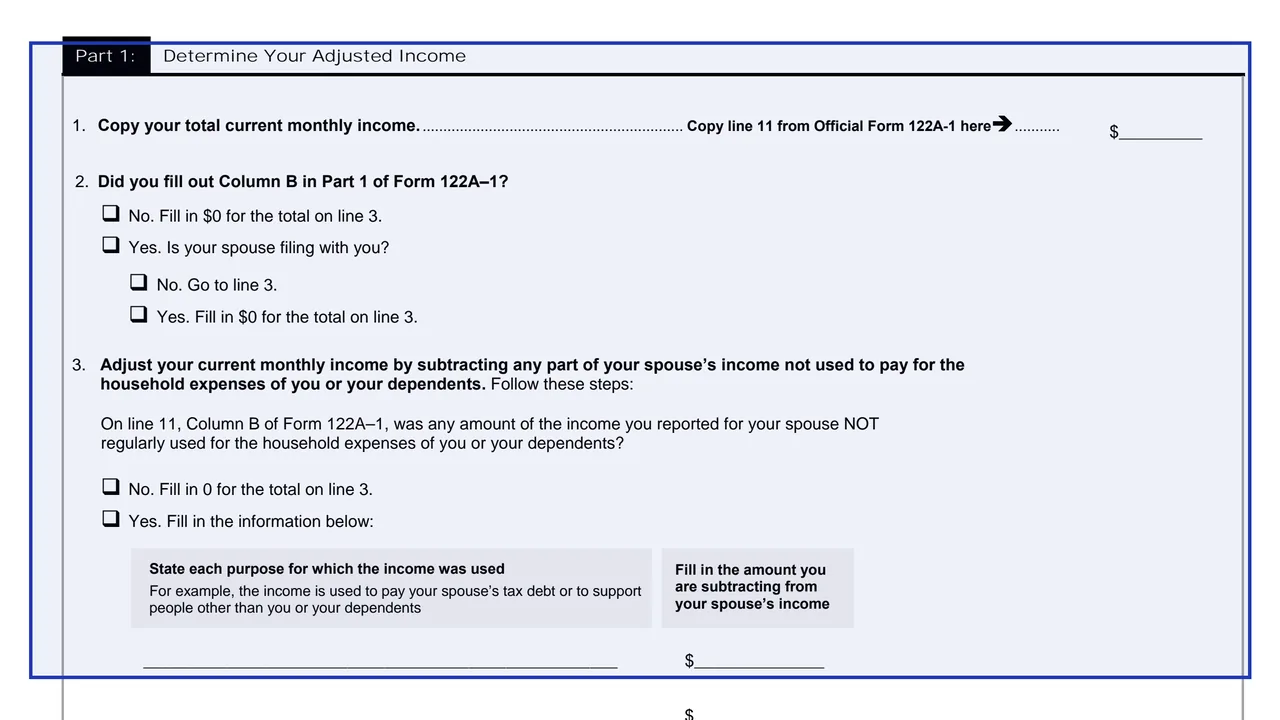
Part 1: Adjusted income (lines 1 to 4)
Line 1 copies line 11 from Form 122A-1. Lines 2 and 3 subtract any part of a non-filing spouse's income not regularly used for household expenses, and line 4 is the adjusted current monthly income.
B 122A-2
Chapter 7 Means Test Calculation
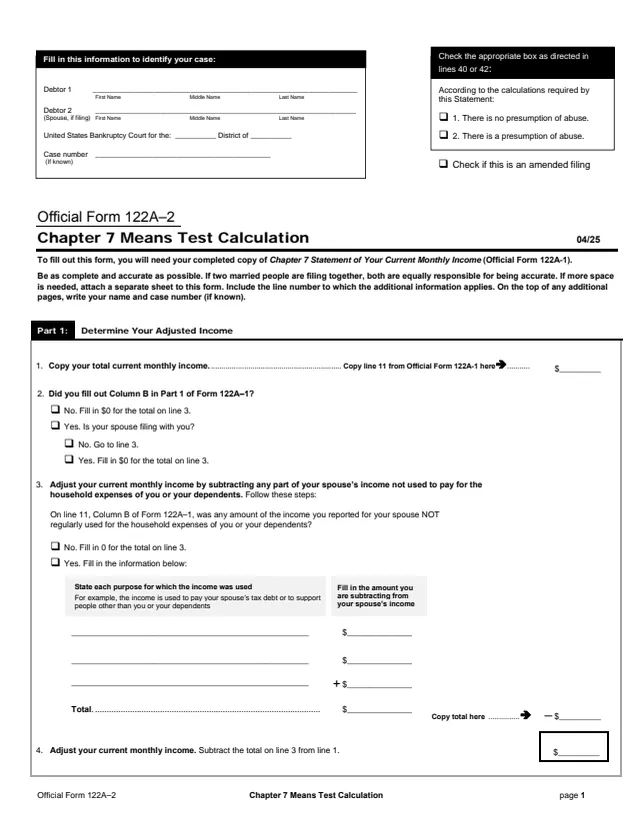
Form B 122A-2, Chapter 7 Means Test Calculation, is an Official Bankruptcy Form that the U.S. Courts list under Means Test Forms. It starts from the current monthly income reported on Form 122A-1, subtracts allowed living expenses and certain debt payments, and works out whether there is a presumption of abuse. The current version is dated 04/25. The U.S. Courts page lists it as updated on April 1, 2025, and effective on April 1, 2022, and says it is derived from Official Form 22A-2.
The separate instructions say this second form is filed when Form 122A-1 shows income above the median, and that the calculations, sometimes called the Means Test, result in an amount available to pay other debts. The committee note says the dollar amounts on lines 29 and 40 were adjusted effective April 1, 2025, as part of the tri-annual dollar adjustments required by 11 U.S.C. § 104.
This page explains the form in plain words and is not legal advice. You can fill it out free in your browser on this page and download the result without an account.
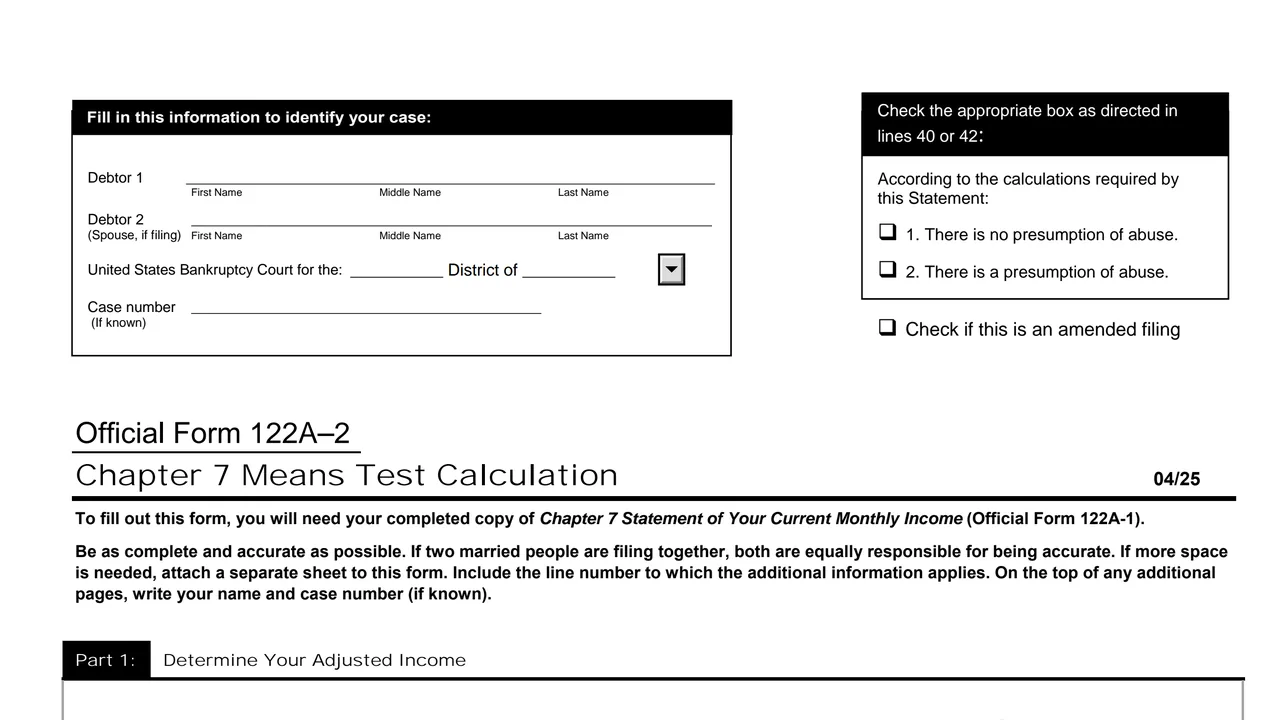
Line 1 copies line 11 from Form 122A-1. Lines 2 and 3 subtract any part of a non-filing spouse's income not regularly used for household expenses, and line 4 is the adjusted current monthly income.
Line 5 counts the people who could be claimed as exemptions on your federal income tax return plus any additional dependents you support. Lines 6 and 7 use the IRS National Standards for food, clothing and other items and for out-of-pocket health care.
Housing and utilities from the U.S. Trustee Program chart, net of mortgage or rent payments, then vehicle operation, ownership or lease costs for up to two vehicles, and public transportation, from the IRS Local Standards.
Taxes, required payroll deductions, term life insurance, court-ordered payments, education, childcare, extra health care and optional telephone services, then health insurance, family care, family violence protection, home energy, school costs, extra food and clothing and charitable gifts.
Average monthly payments on secured debts, cure amounts to keep needed property, past-due priority claims divided by 60, and, for filers eligible for Chapter 13, an average monthly administrative expense. Line 38 adds all deductions.
Line 39 finds monthly disposable income and multiplies it by 60. Lines 40 to 42 compare the total with set dollar amounts and with 25% of nonpriority unsecured debt. Part 4 lists special circumstances, and Part 5 is signed under penalty of perjury.
The form says a completed copy of Form 122A-1 is needed. Line 1 copies its line 11, total current monthly income.
The form says to find the IRS National and Local Standards and the U.S. Trustee Program housing chart online using the link in the separate instructions, and that they may also be at the bankruptcy clerk's office.
For home, vehicle and other secured debts, the form says to add all amounts contractually due to each secured creditor in the 60 months after filing, then divide by 60. The home and vehicle totals repeat on line 33.
If expenses differ from month to month, the form asks for the average. For lines 28 and 29, it says documentation of actual expenses goes to the case trustee, and lines 28 to 30 ask to show the extra amount is reasonable and necessary.
Line 40 points to box 1 when line 39d is less than $10,275 and to box 2 when it is more than $17,150. In between, lines 41 and 42 compare line 39d with 25% of total nonpriority unsecured debt.
Part 4 asks for a detailed explanation and an average monthly amount for each special circumstance, with documentation for the case trustee. Each debtor signs Part 5 under penalty of perjury.
You get the real form, filled in a browser tab, with nothing standing between you and the finished PDF.
The form is filed in the case at the United States Bankruptcy Court, with the district and the case number, if known, at the top. A box marks an amended filing, and extra pages carry the line number, your name and the case number.
Line 29 caps school expenses at $214.58 per child, and line 40 uses $10,275 and $17,150. The form says these are subject to adjustment on 4/01/28, and every 3 years after that. The committee note says they were adjusted effective April 1, 2025.
The instructions give https://www.justice.gov/ust/means-testing for lines 6 to 15, 30 and 36, and https://www.uscourts.gov/administrative-expense-multipliers for the line 36 multiplier in Alabama and North Carolina. They say a public computer may be available at the bankruptcy clerk's office or a public library.
The form and its U.S. Courts page do not print a fee amount for this statement.
Line 27 says that, by law, the court keeps the nature of expenses for protection against family violence confidential.
B 122A-1
58 fields, 3 pages
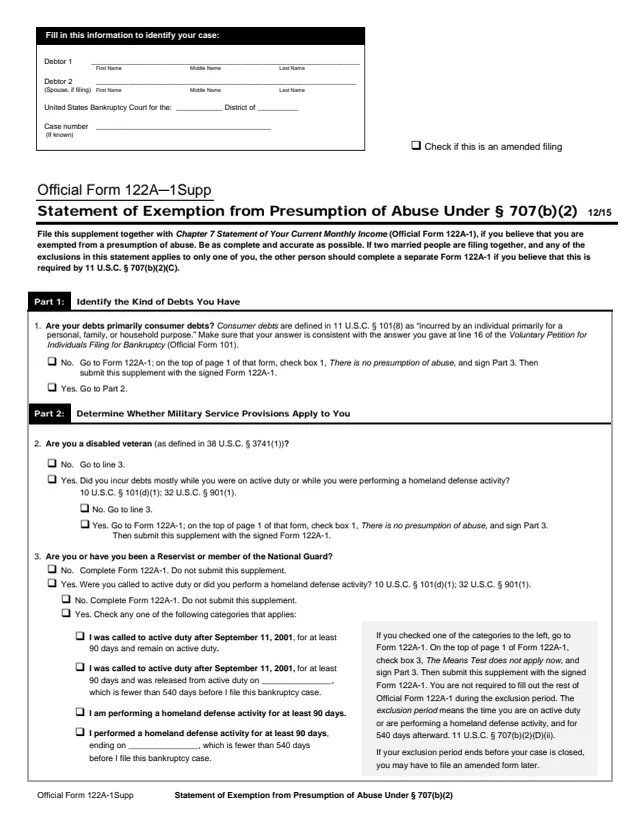
B 122A-1Supp
17 fields, 1 page
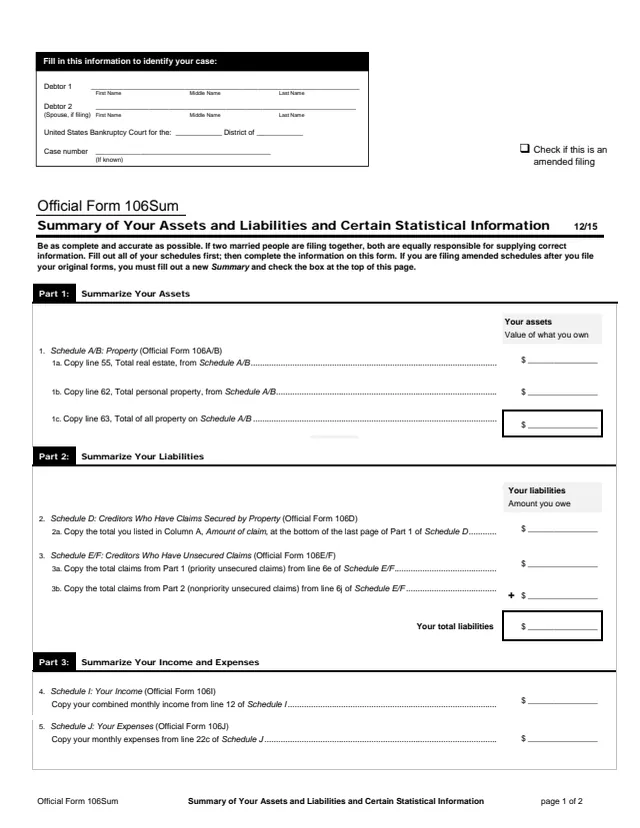
B 106 Summary
28 fields, 2 pages
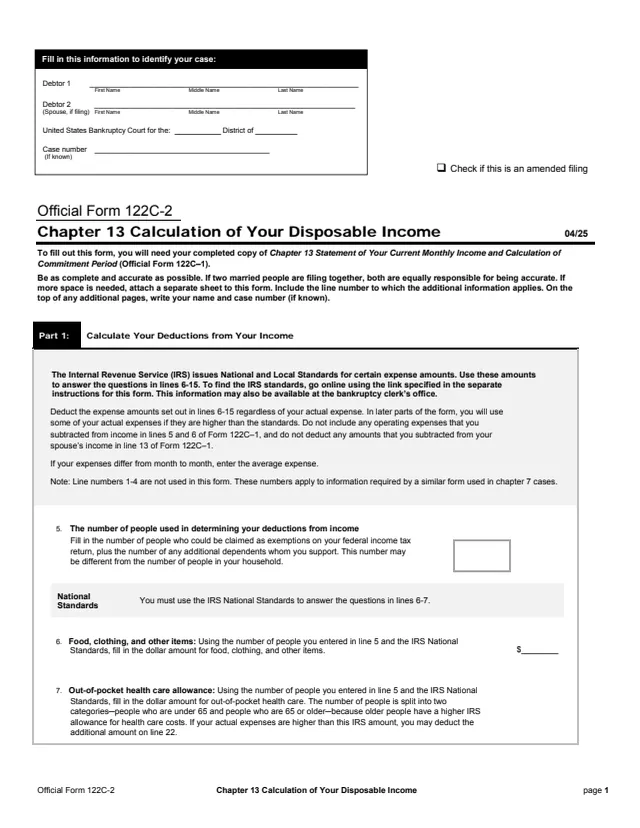
B 122C-2
150 fields, 8 pages
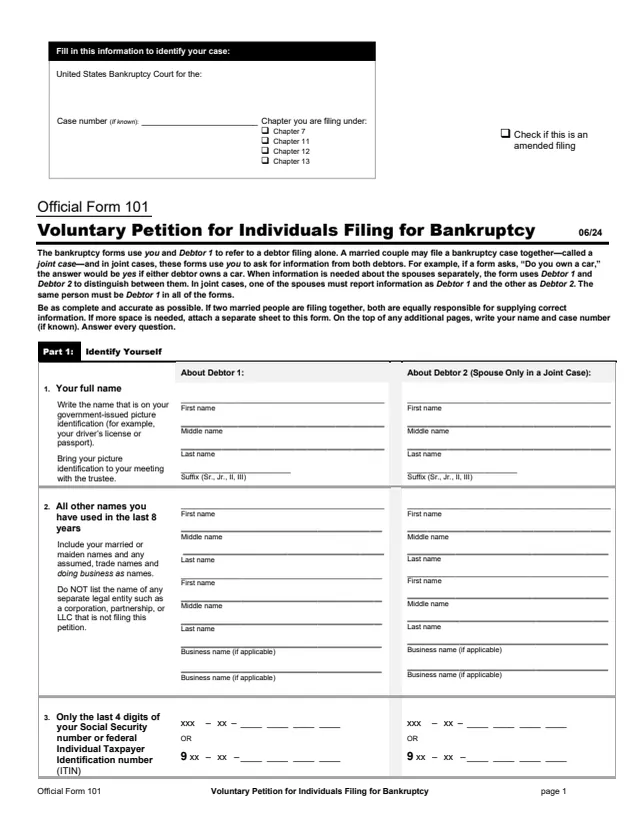
B 101
159 fields, 9 pages
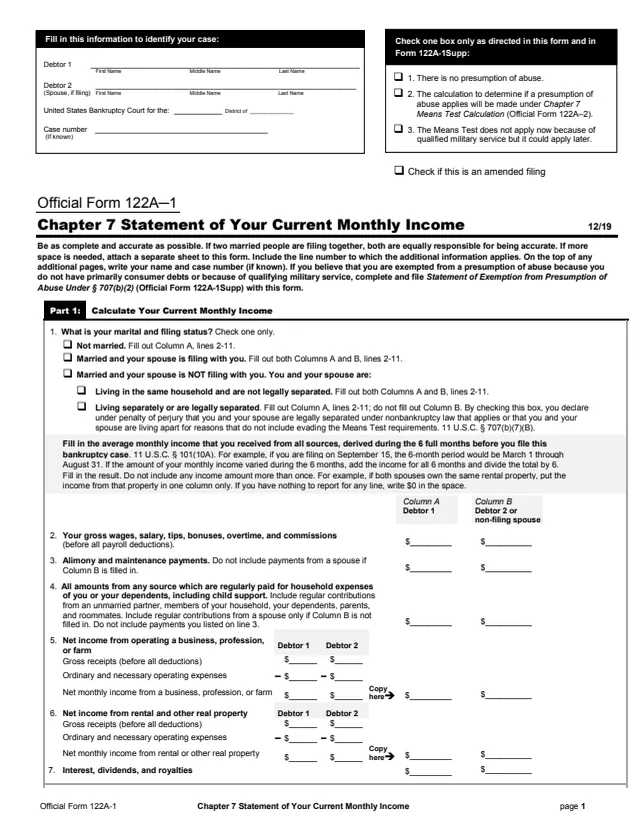
The form is filled out and signed by the debtor in a Chapter 7 case, using a completed copy of Form 122A-1. It names these situations.
No tool matches that search.
The instructions say it is filed when Form 122A-1 shows income above the median for the state. When income is not above the median, they say there is no presumption of abuse and this second form is not filled out.
The instructions say it does not mean someone is actually trying to abuse the bankruptcy system. It means the person is presumed to have enough income that Chapter 7 relief should not be granted, and it may be overcome by showing special circumstances that reduce income or increase expenses.
The form does not print them. It says to go online using the link in the separate instructions, and that they may also be at the bankruptcy clerk's office. The instructions give https://www.justice.gov/ust/means-testing.
Line 39d, monthly disposable income times 60. Less than $10,275 points to box 1, no presumption of abuse. More than $17,150 points to box 2. In between, lines 41 and 42 compare it with 25% of total nonpriority unsecured debt.
Not always. Line 5 counts the people who could be claimed as exemptions on your federal income tax return plus any additional dependents you support, and the form says this number may be different from the number of people in your household.
The form says to add all amounts contractually due to each secured creditor in the 60 months after filing, then divide by 60. The vehicle ownership expense is limited to two vehicles and is not claimed for a vehicle with no loan or lease payments.
Line 27 says that, by law, the court keeps the nature of expenses for protection against family violence confidential.