Caption and opening instructions
Debtor 1, Debtor 2 (spouse, if filing), the district, the case number if known and an amended filing box, followed by who fills out the form, when it is filed and who gets copies.
B 108
Statement of Intention for Individuals Filing Under Chapter 7
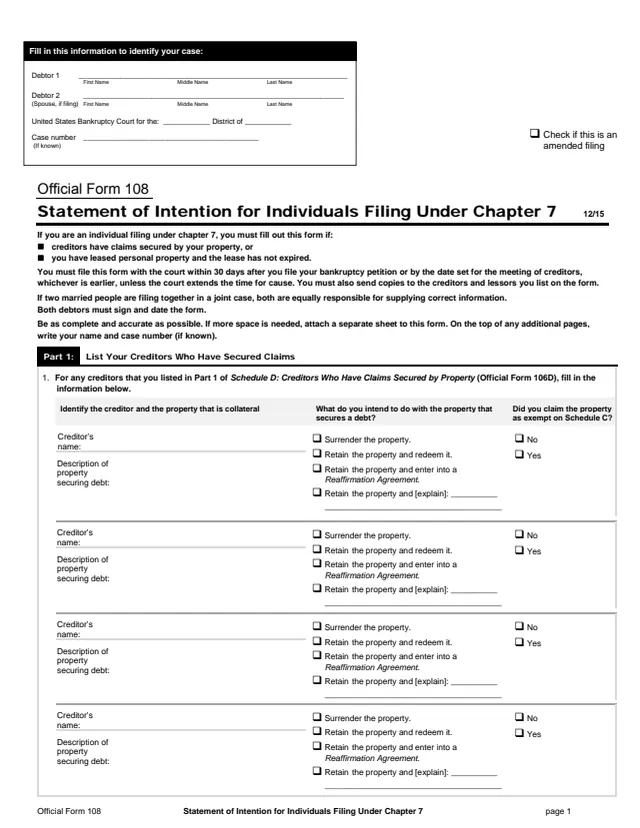
Form B 108, Statement of Intention for Individuals Filing Under Chapter 7, is the Official Bankruptcy Form in which an individual Chapter 7 debtor tells the United States Bankruptcy Court what they intend to do with property that secures a debt and with unexpired personal property leases. The U.S. Courts list it under Individual Debtors. The current version is dated 12/15, and the U.S. Courts page lists it as effective on December 1, 2015. The page also says Official Bankruptcy Forms are approved by the Judicial Conference and must be used under Bankruptcy Rule 9009.
The 2-page form has three parts: secured creditors and the property that is collateral, unexpired personal property leases, and a signature under penalty of perjury. It is derived from former Official Form 8.
This page explains the form in plain words and is not legal advice. You can fill it out free in your browser on this page and download the result without an account.
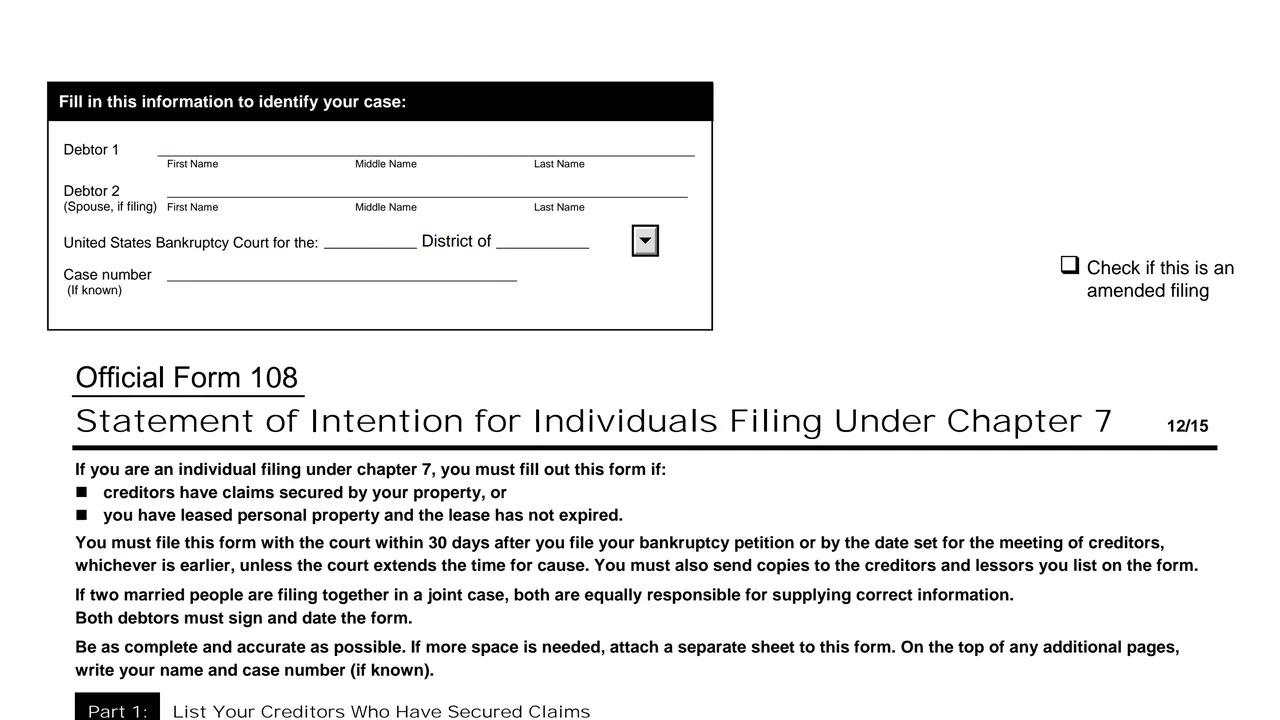
Debtor 1, Debtor 2 (spouse, if filing), the district, the case number if known and an amended filing box, followed by who fills out the form, when it is filed and who gets copies.
For each creditor, the creditor's name and a description of the property securing the debt. There are rows for four creditors.
Four choices for each property: surrender it, retain it and redeem it, retain it and enter into a Reaffirmation Agreement, or retain it and explain. A last column asks whether the property was claimed as exempt on Schedule C.
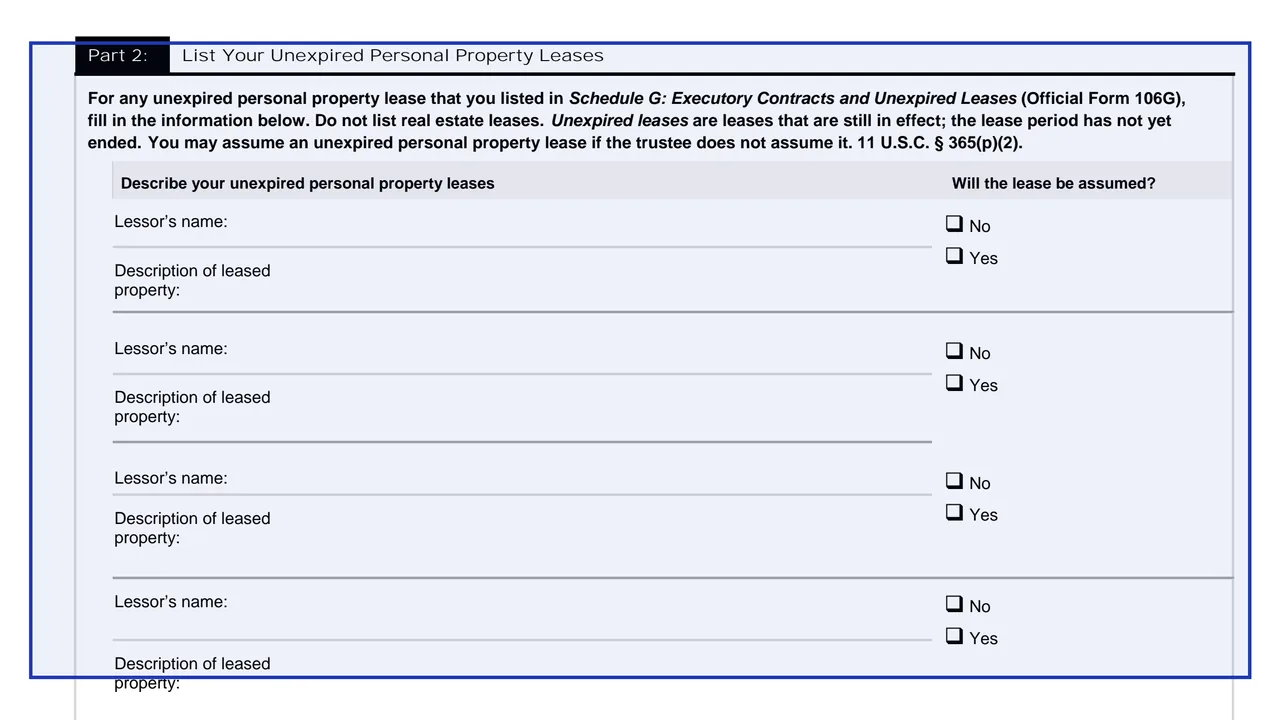
For each lease, the lessor's name, a description of the leased property and whether the lease will be assumed. The form says not to list real estate leases.
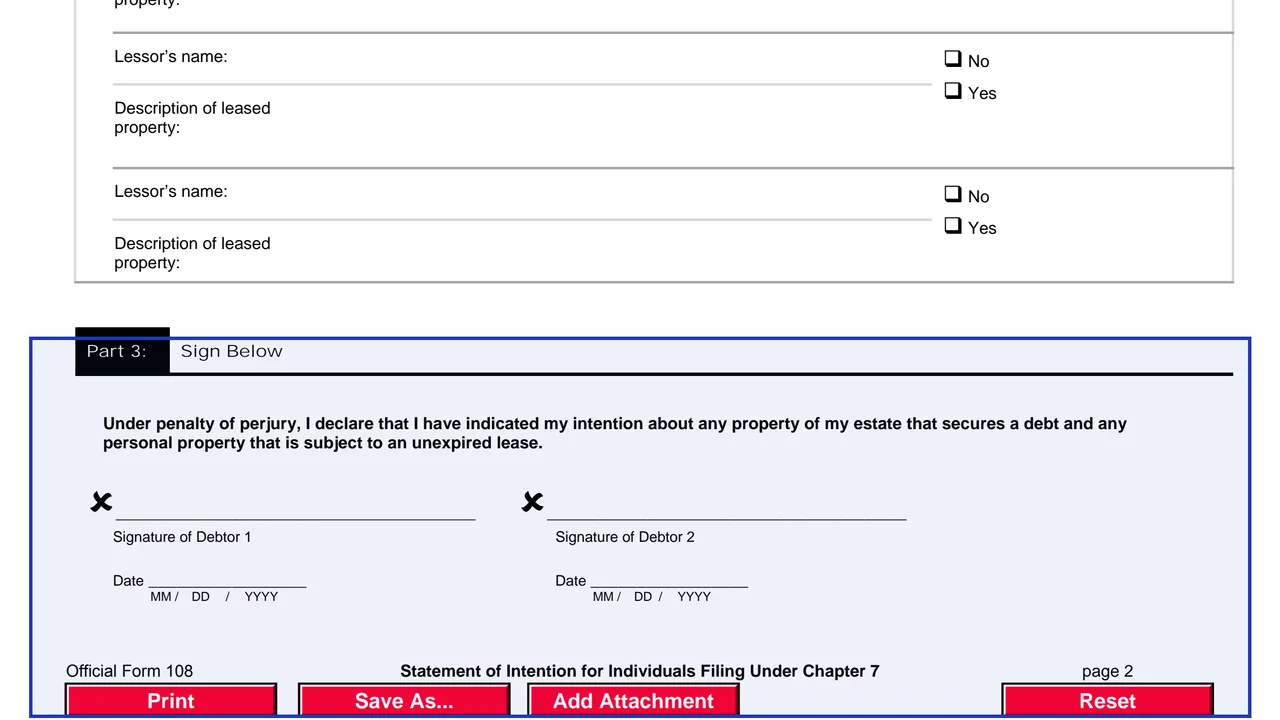
A declaration under penalty of perjury that the debtor has indicated an intention about any property of the estate that secures a debt and any personal property subject to an unexpired lease.
The instructions say to use the information already given on Schedule D (Official Form 106D), Schedule C (Official Form 106C) and Schedule G (Official Form 106G).
For every creditor listed in Part 1 of Schedule D, enter the creditor's name and describe the property that is collateral for the debt.
Choose surrender, redeem, a Reaffirmation Agreement or another option with an explanation, then answer whether the property was claimed as exempt on Schedule C. The instructions describe each option in more detail.
Enter each lessor and the leased property, leave out real estate leases, and check whether the lease will be assumed. The form cites 11 U.S.C. § 365(p)(2).
The form asks for answers that are as complete and accurate as possible. If more space is needed, attach a separate sheet with your name and case number on top.
Each debtor signs and dates Part 3. The form then gives the filing deadline and says to send copies to the creditors and lessors listed.
You get the real form, filled in a browser tab, with nothing standing between you and the finished PDF.
With the United States Bankruptcy Court for the district named at the top of page 1.
The form says it is filed within 30 days after the bankruptcy petition or by the date set for the meeting of creditors, whichever is earlier, unless the court extends the time for cause.
The form says to send copies to the creditors and lessors listed on it. The instructions cite Bankruptcy Rule 1007(b)(2).
The instructions say the Bankruptcy Code provides for early termination of the automatic stay as to personal property if the statement is not timely filed, and that the same applies to an unexpired lease of personal property unless you state that you intend to assume the lease if the trustee does not do so.
The form does not print a fee.
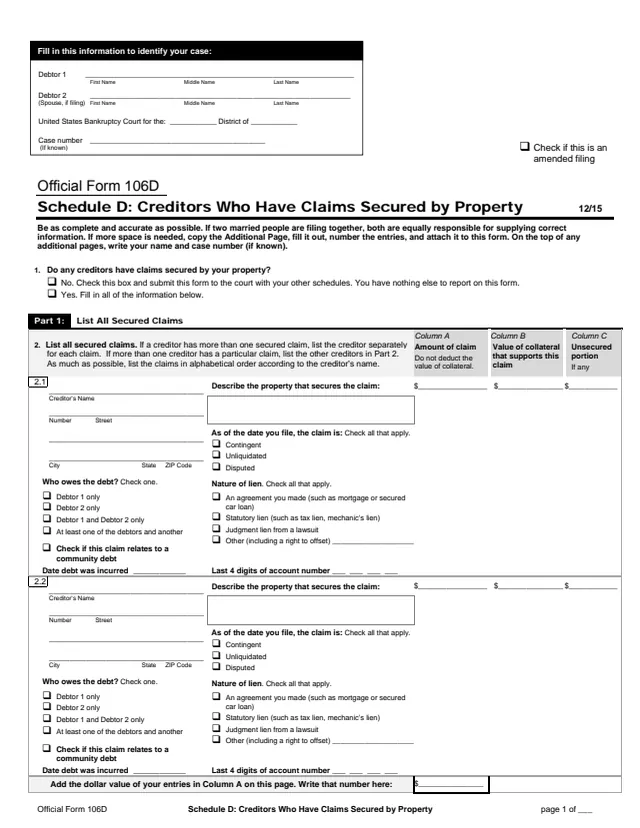
B 106D
186 fields, 3 pages
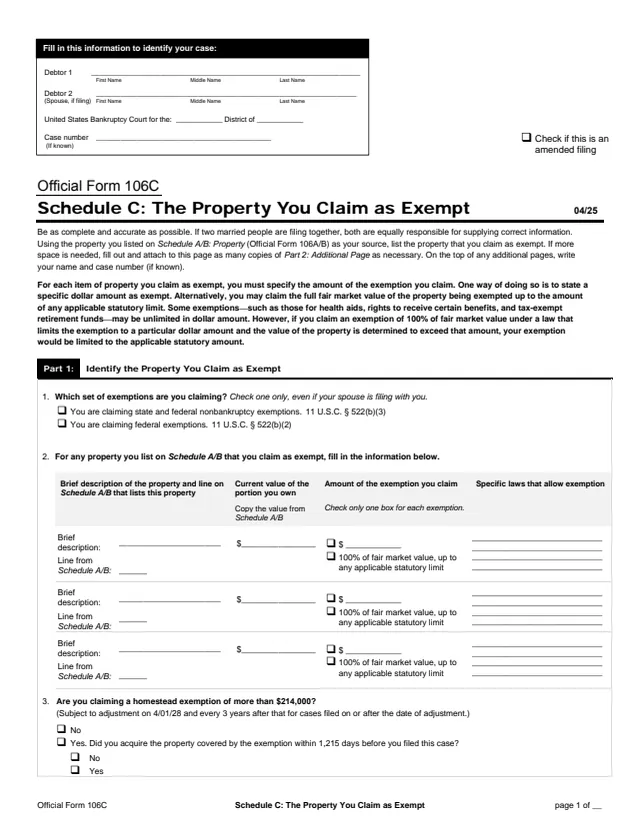
B 106C
104 fields, 2 pages
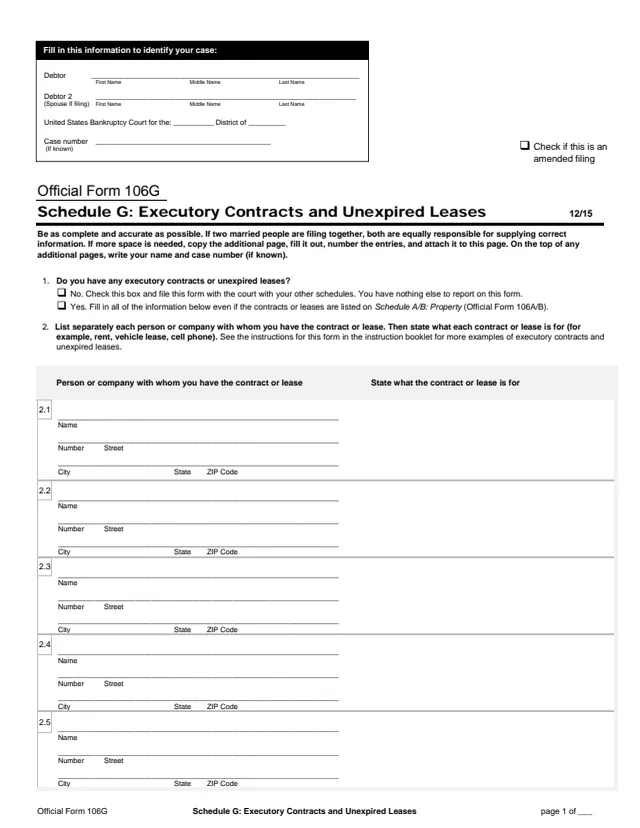
B 106G
99 fields, 2 pages
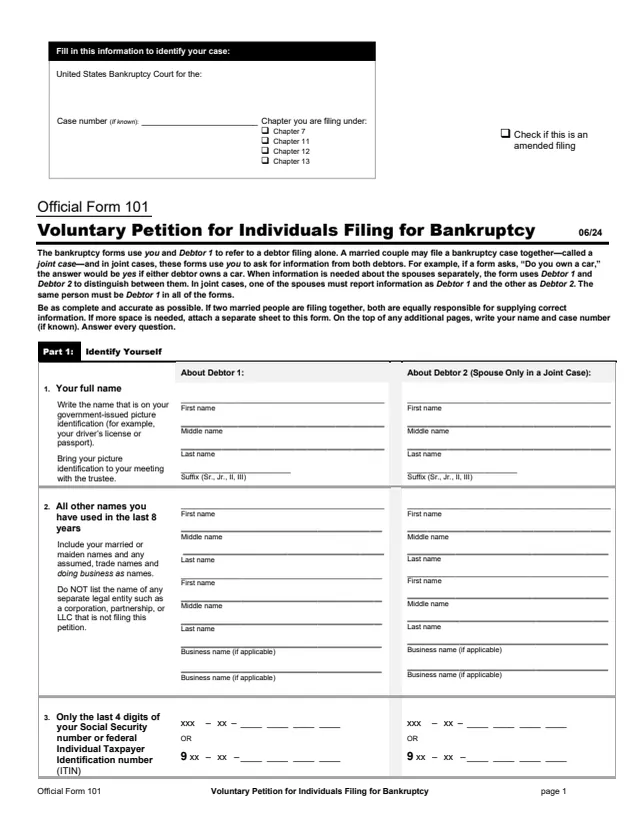
B 101
159 fields, 9 pages
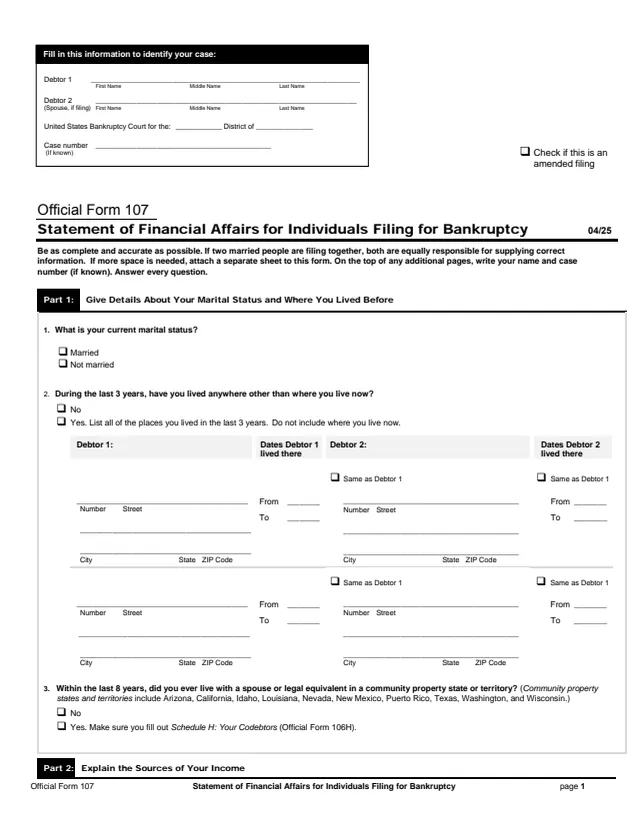
B 107
535 fields, 12 pages
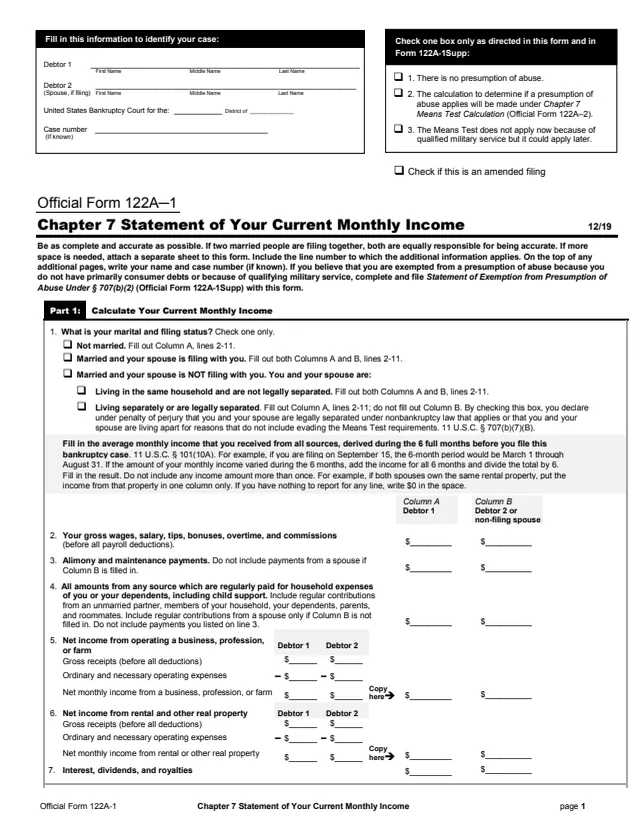
B 122A-1
58 fields, 3 pages
The form says an individual filing under chapter 7 fills it out in two situations. The instructions say not to fill it out for a case under chapter 11, 12 or 13.
No tool matches that search.
The form says an individual filing under chapter 7 fills it out if creditors have claims secured by their property, or if they have leased personal property and the lease has not expired. The instructions say not to fill it out for a case under chapter 11, 12 or 13.
The form says within 30 days after the bankruptcy petition is filed or by the date set for the meeting of creditors, whichever is earlier, unless the court extends the time for cause.
Surrender the property, retain it and redeem it, retain it and enter into a Reaffirmation Agreement, or retain it and explain. The instructions say these include redeeming under 11 U.S.C. § 722 and reaffirming under 11 U.S.C. § 524.
The instructions say reaffirming means deciding to remain legally obligated to pay a debt so that you can keep the property securing it, and that it is done by signing a Reaffirmation Agreement with the creditor and following the proper procedure.
No. Part 2 is for unexpired personal property leases listed in Schedule G, and the form says not to list real estate leases.
The court, and the form says to send copies to the creditors and lessors listed on it.
Yes. The form says both debtors sign and date it, and that both are equally responsible for supplying correct information.