Section 1: About you
Social Security Number or Medicare Number, name, name at birth, sex, date of birth, state or country of birth, mailing address, permanent residence address and phone number.
CMS-43
Application for Part A (Hospital Insurance) and Part B (Medical Insurance) for People with End-Stage Renal Disease
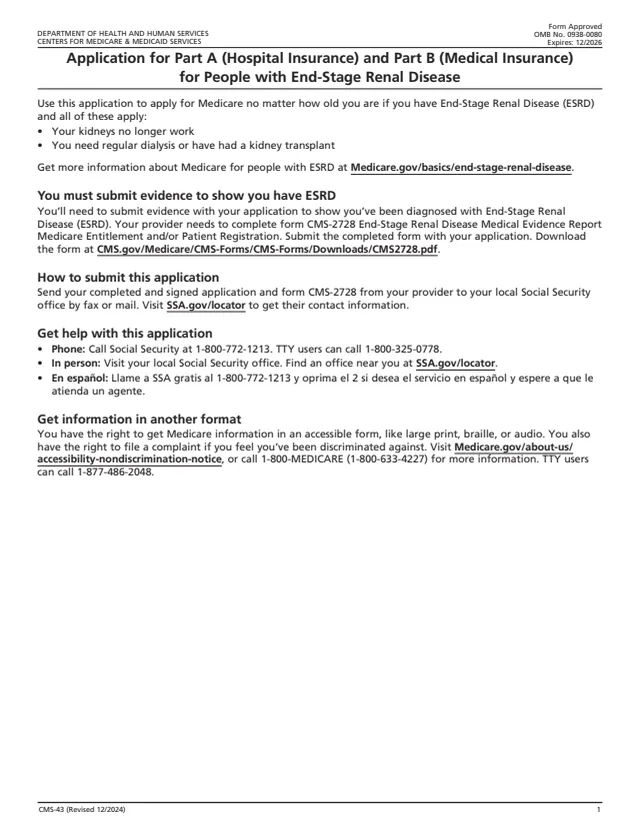
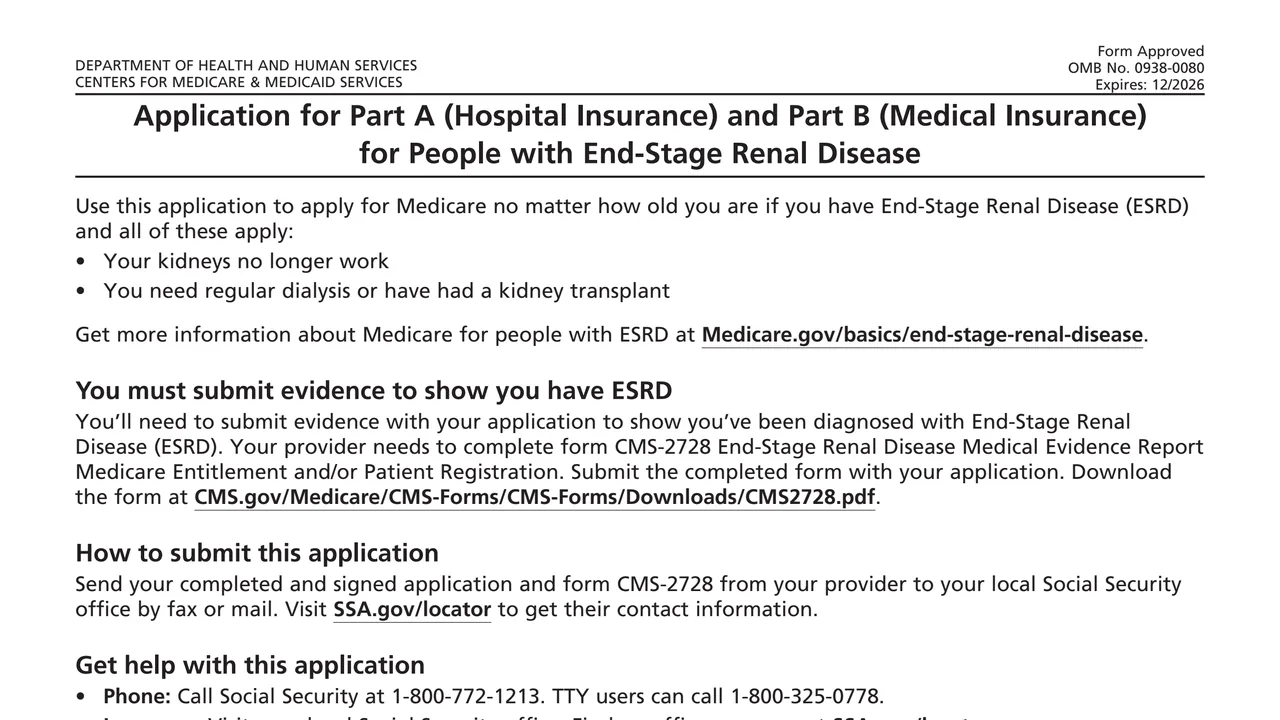
Form CMS-43 is the Application for Part A (Hospital Insurance) and Part B (Medical Insurance) for People with End-Stage Renal Disease from the Centers for Medicare & Medicaid Services. The form says it is used to apply for Medicare no matter how old you are if you have End-Stage Renal Disease (ESRD) and your kidneys no longer work and you need regular dialysis or have had a kidney transplant.
The application has eight sections: information about you, earnings and work history, citizenship, marital status, medical history, enrollment in Part B, remarks and signatures. The form says evidence of the ESRD diagnosis goes with it: form CMS-2728, the End-Stage Renal Disease Medical Evidence Report, completed by your provider.
The completed, signed application and form CMS-2728 go to your local Social Security office by fax or mail, and the CMS page adds that they can be submitted in person. You can fill it out free in your browser on this page and download the result without an account.
Social Security Number or Medicare Number, name, name at birth, sex, date of birth, state or country of birth, mailing address, permanent residence address and phone number.
Total earnings last year and expected this year, railroad work of 5 years or more by you, a spouse or parents, and parent details for a dependent child.
Whether you are a U.S. citizen, lawfully present or a resident, the dates, and where you lived for the last 5 years.
Completed only if you are using a spouse or former spouse's record: current spouse details, and former marriages that lasted 10 or more years or ended in death.
Dialysis start and end dates, self-dialysis training, kidney transplant dates, and any related hospital stay the month before the transplant.
Whether you want Part B and, in some cases, a choice of first month of coverage, a remarks space for extra information, and signatures with a witness block.
Pages 1 and 2 hold instructions and notes. The application itself starts on page 3.
The form says your provider completes form CMS-2728, the ESRD Medical Evidence Report, and that it is submitted with the application.
Enter your identifying information, earnings and work history, and citizenship and residence details. Extra addresses go in Section 7 Remarks.
Section 4 is only for applicants using a spouse or former spouse's record. Section 5 asks for dialysis, training and transplant dates.
Item 6a asks whether you want to sign up for Part B and notes a monthly premium. Item 6b lists start month choices if the application is processed more than 5 months after you first meet the requirements.
The form asks for a written signature (do not print) and the date. An application signed by mark (X) also needs a witness's name, signature and date.
Fax or mail the application and form CMS-2728 to your local Social Security office. The CMS page says they can also be submitted in person. Find an office at SSA.gov/locator.
You get the real form, filled in a browser tab, with nothing standing between you and the finished PDF.
To your local Social Security office by fax or mail, or in person according to the CMS page. Visit SSA.gov/locator for contact information. The CMS address in the PRA statement is not for applications.
The form says to submit form CMS-2728 from your provider with the application, and gives CMS.gov/Medicare/CMS-Forms/CMS-Forms/Downloads/CMS2728.pdf as the download location.
The form says the application may be retroactive for up to 12 months, and that a medical determination is required to show you have ESRD and meet the transplant or regular dialysis requirements.
The form says a group health plan pays first for the first 30 months after you become eligible for Medicare because of ESRD. It says Part B has a monthly premium, deducted from Social Security, Railroad Retirement or OPM benefit payments if you receive them. It does not list amounts.
Social Security: 1-800-772-1213, TTY 1-800-325-0778, with Spanish service by pressing 2. Medicare information in large print, braille or audio is available through 1-800-MEDICARE (1-800-633-4227), TTY 1-877-486-2048.
The form estimates an average of 10 minutes per response, including reviewing the instructions and gathering the information.
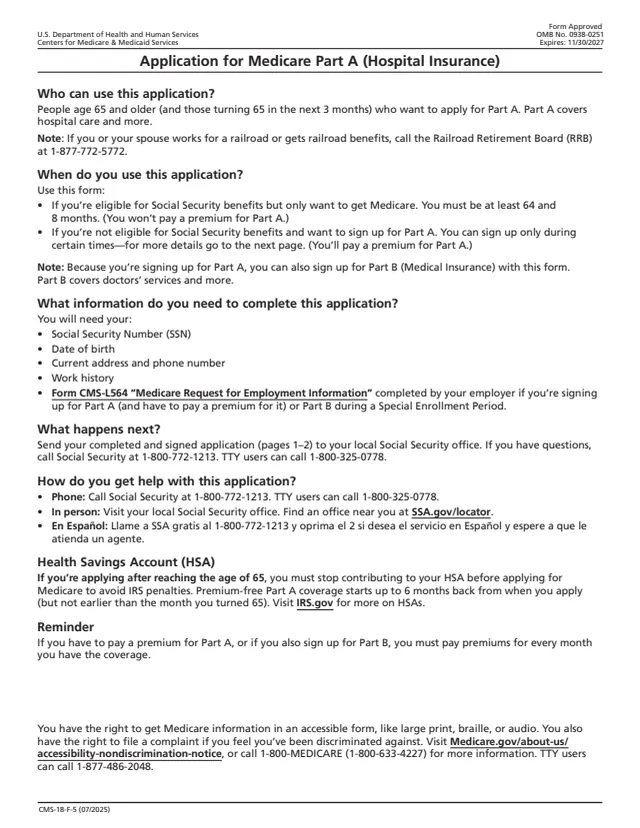
CMS-18-F-5
127 fields, 7 pages
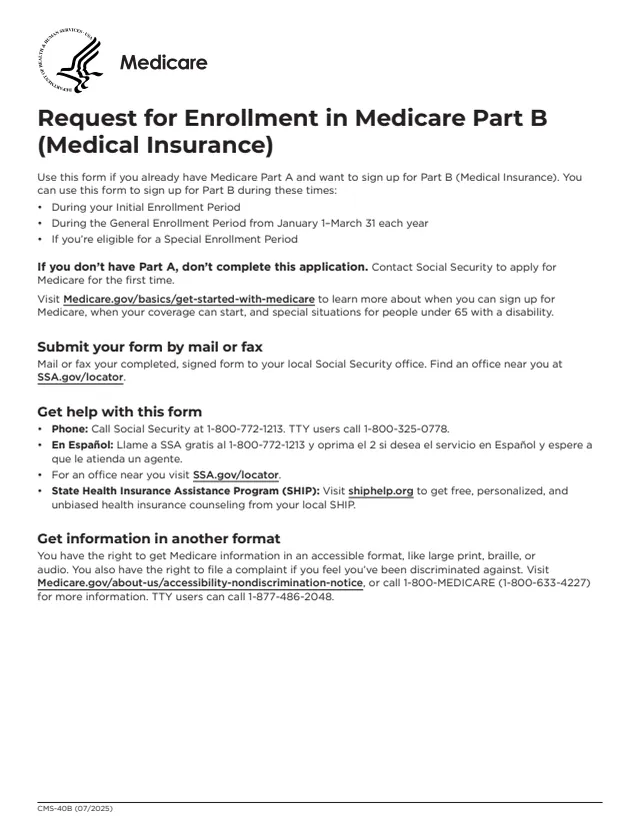
CMS-40B
47 fields, 3 pages
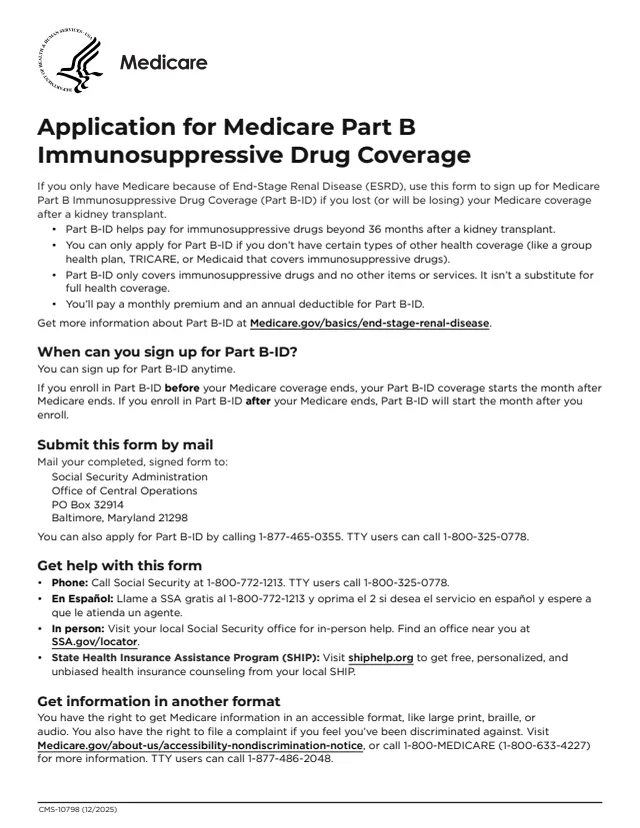
CMS-10798
32 fields, 3 pages
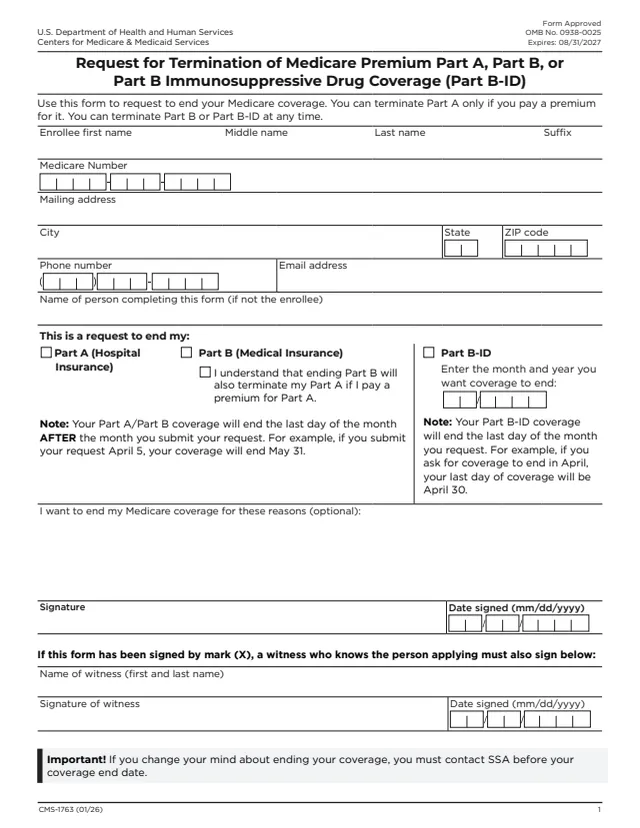
CMS-1763
29 fields, 2 pages
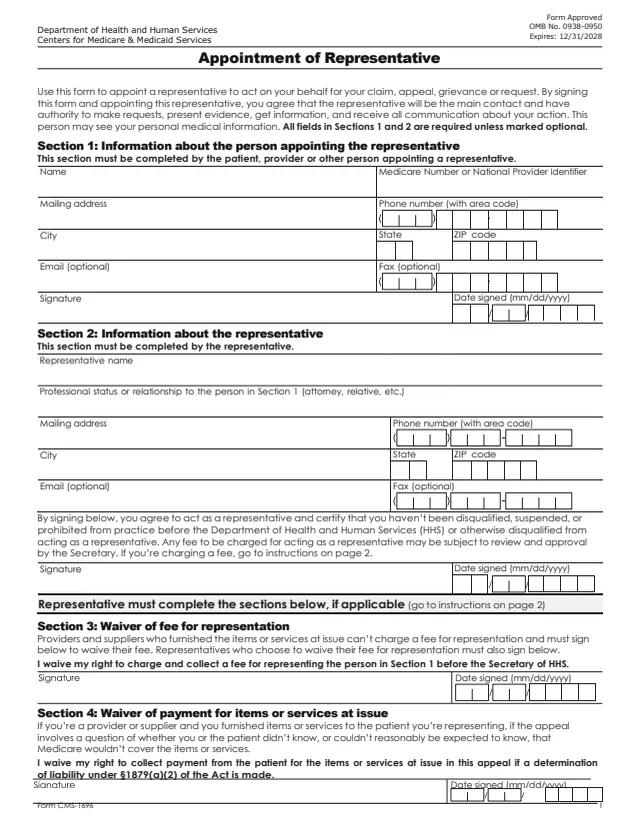
CMS-1696
40 fields, 2 pages
The form is for people with ESRD, of any age. Page 2 lists the work history it is based on.
No tool matches that search.
The form says it is for people of any age who have End-Stage Renal Disease, whose kidneys no longer work and who need regular dialysis or have had a kidney transplant. Page 2 lists the work history requirements under Social Security or the Railroad Retirement Board, including for a spouse or dependent child.
The form says to submit form CMS-2728, the End-Stage Renal Disease Medical Evidence Report, completed by your provider, along with the application.
The form says to send the signed application and form CMS-2728 to your local Social Security office by fax or mail. The CMS page adds that you can visit the office in person. Find one at SSA.gov/locator.
The form says the application may be retroactive for up to 12 months.
The form says that if the application is processed within 5 months after the first month you meet the requirements, coverage starts that first month. Otherwise you choose the earliest possible month, the month the application is filed or the month it is processed.
The form says to complete Section 4 only if you are using your spouse or former spouse's work record or insured status to qualify for Medicare.
The form says that if you only have Medicare because of ESRD, coverage ends 36 months after a successful kidney transplant. It describes a separate immunosuppressive drug benefit and gives 1-877-465-0355 to sign up.