Heading
Name, employer identification number, address, RRB number, and a box to check if this is a final return.
CT-1
Employer's Annual Railroad Retirement Tax Return
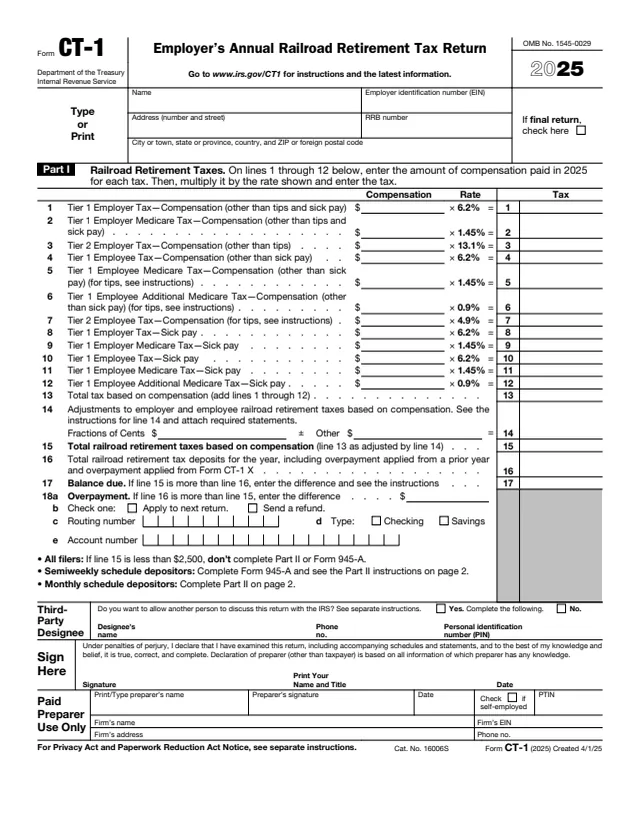
Form CT-1 is used to report taxes imposed by the Railroad Retirement Tax Act (RRTA). The instructions say to file it if you paid one or more employees compensation subject to tax under the RRTA, and that federal income tax withheld from employees' wages and other compensation is reported on Form 941 or, if applicable, Form 944 instead.
The 2025 form has Part I, Railroad Retirement Taxes, with lines 1 to 12 for the Tier 1, Tier 1 Medicare, Tier 1 Additional Medicare, and Tier 2 taxes on compensation and sick pay, followed by the total, adjustments, deposits, balance due, and overpayment. Part II is the record of railroad retirement tax liability for monthly schedule depositors. Page 3 holds Form CT-1(V), the payment voucher.
The employer, or a payer of sick pay, completes and signs it. You can fill out Form CT-1 free in your browser on this page and download it without an account.
Name, employer identification number, address, RRB number, and a box to check if this is a final return.
Compensation times the printed rate for each tax: Tier 1 Employer 6.2%, Tier 1 Employer Medicare 1.45%, Tier 2 Employer 13.1%, Tier 1 Employee 6.2%, Tier 1 Employee Medicare 1.45%, Tier 1 Employee Additional Medicare 0.9%, and Tier 2 Employee 4.9%.
The Tier 1 employer, employee, Medicare, and Additional Medicare taxes on sick pay, at the same printed rates.
Total tax, adjustments for fractions of cents and other items, total taxes, deposits for the year, balance due, and overpayment with the choice to apply it to the next return or have it refunded by direct deposit.
A monthly summary of Tier 1 and Tier 2 tax liability by quarter, completed only by monthly schedule depositors when line 15 is $2,500 or more.
Third-party designee, signature, and paid preparer areas on page 1, then Form CT-1(V), Payment Voucher, on page 3.
Enter compensation other than tips and sick pay, multiply by the rate, and enter the tax. The instructions say lines 1 and 8 combined may not be more than $176,100 per employee, and line 3 takes no more than $130,800 per employee.
Include tips reported by employees. For 2025 the instructions say Tier 1 Employee tax stops at $176,100, Tier 1 Employee Medicare tax has no limit, Additional Medicare withholding applies above $200,000, and Tier 2 Employee tax covers the first $130,800.
Enter a fractions of cents adjustment, credits for overpaid penalty or interest from earlier years, and uncollected employee tax on tips. The instructions say prior period adjustments go on Form CT-1 X, and a statement explains any adjustment other than fractions of cents.
Line 16 is total deposits, including overpayments applied from Form CT-1 X or the 2024 return. If line 15 is larger, the difference goes on line 17; if line 16 is larger, on line 18a. The instructions say never to make an entry on both.
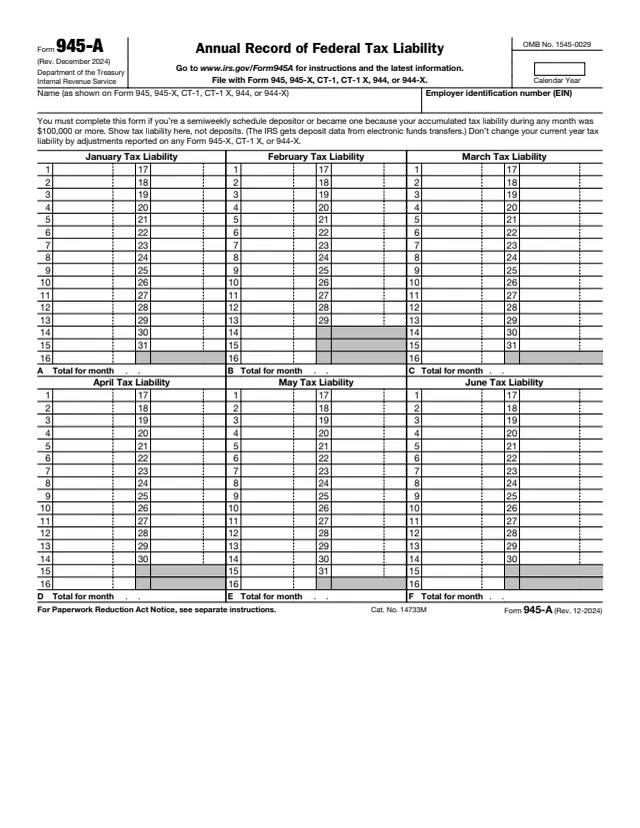
If line 15 is less than $2,500, Part II and Form 945-A are skipped. Monthly schedule depositors fill Part II, and line V equals line 15. Semiweekly schedule depositors, or those who accumulated $100,000 or more on any day in a deposit period, use Form 945-A instead.
The instructions list who signs: the owner of a sole proprietorship, a principal officer of a corporation, a responsible partner, member, or officer, the owner of a single-member LLC, or the fiduciary of a trust or estate. An authorized agent with a valid power of attorney may also sign.
You get the real form, filled in a browser tab, with nothing standing between you and the finished PDF.
The instructions say to send Form CT-1 to Department of the Treasury, Internal Revenue Service Center, Kansas City, MO 64999-0048.
The instructions for the 2025 form say to file Form CT-1 by March 2, 2026.
The form says federal tax deposits are made by electronic funds transfer, through EFTPS or an IRS business tax account. Form CT-1(V) is not used for deposits.
The voucher says to pay with the return only when line 15 is less than $2,500 and paid in full with a timely return, or as a monthly schedule depositor under the accuracy of deposits rule. A check is made payable to United States Treasury with the EIN, Form CT-1, and 2025 on it.
Check the final return box and attach a statement with the last date compensation was paid, where the records will be kept and who keeps them, and any transferee's name, address, and date of transfer.
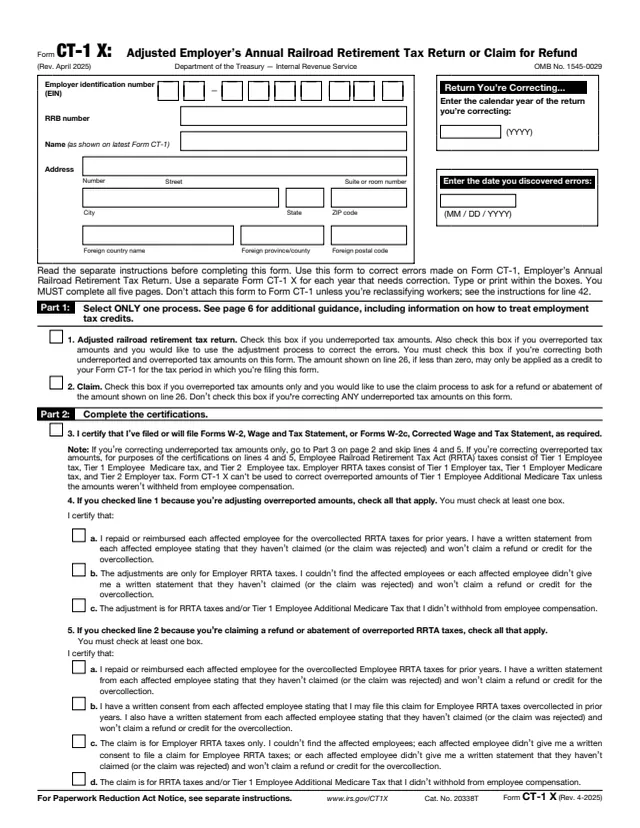
The instructions say errors on a filed Form CT-1 are corrected on Form CT-1 X, which is filed separately, and an address change uses Form 8822-B.
945-A
748 fields, 2 pages
CT-1
330 fields, 6 pages
941
116 fields, 3 pages
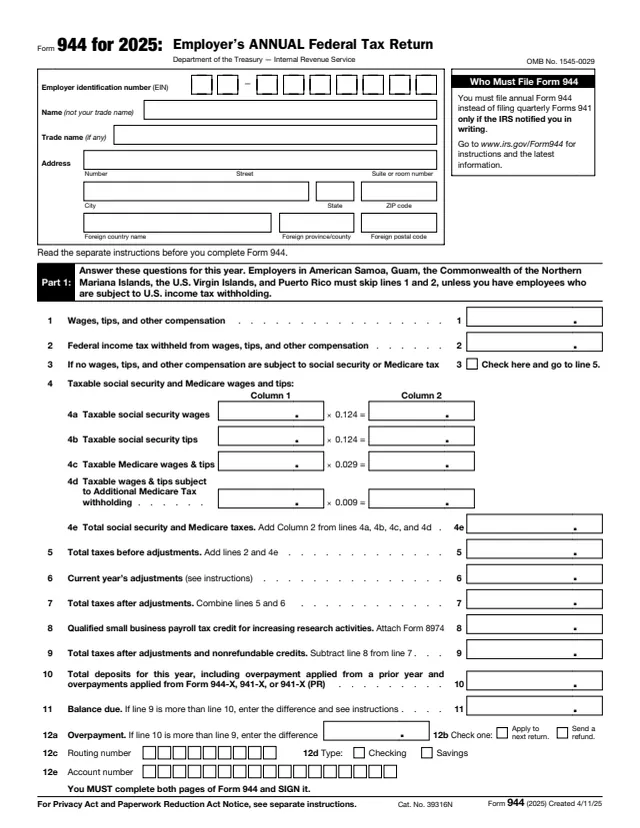
944
114 fields, 3 pages
W-2
568 fields, 11 pages
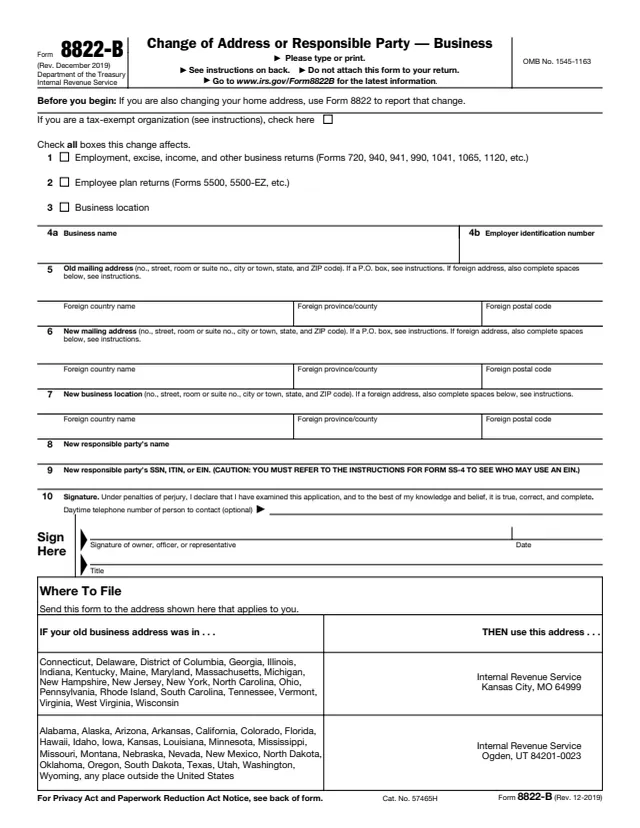
8822-B
22 fields, 2 pages
The instructions say to file Form CT-1 if you paid one or more employees compensation subject to tax under the RRTA. The terms employer and employee are defined in section 3231.
No tool matches that search.
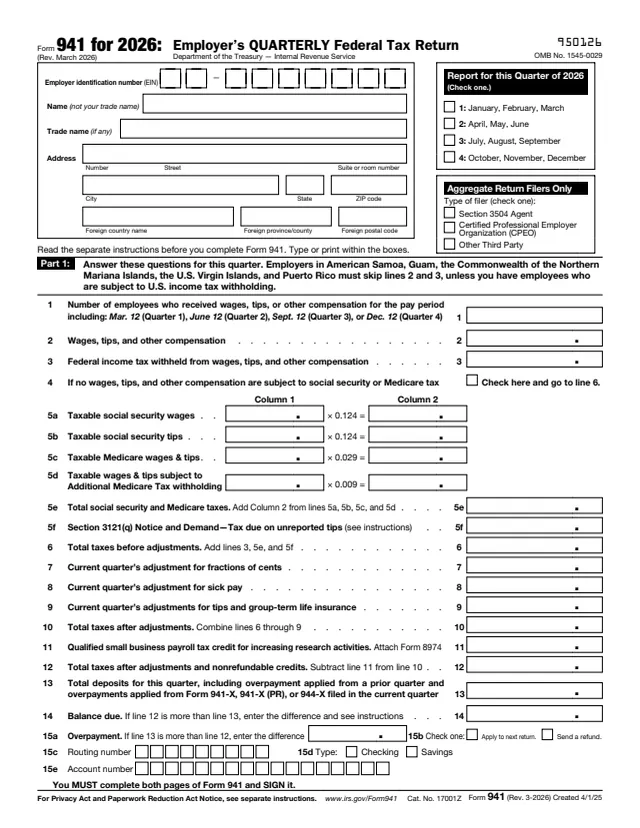
No. The instructions say to use Form 941 or, if applicable, Form 944 to report federal income taxes withheld from employees' wages and other compensation.
6.2% for Tier 1 employer and employee tax, 1.45% for Tier 1 Medicare, 0.9% for Tier 1 Employee Additional Medicare, 13.1% for Tier 2 Employer, and 4.9% for Tier 2 Employee.
The instructions say that after the first Form CT-1, a return is filed for each year, even if no taxable compensation was paid, until a final return is filed.
It depends on line 15 for the lookback period, the second calendar year before. For 2026, the instructions say $50,000 or less in 2024 means a monthly schedule depositor, and more than $50,000 a semiweekly schedule depositor.
The instructions say employers don't pay employer railroad retirement taxes on tips, but employee railroad retirement tax is collected on cash tips employees report.
Yes, through the Third-Party Designee section, with the designee's name, phone number, and any five digits they choose as a PIN. The instructions say the authorization expires 1 year from the return's due date, without regard to extensions.