Part I: U.S. transferor
Name and identifying number, whether the transferee is a specified 10%-owned foreign corporation that is not a controlled foreign corporation, questions 2a to 2d for corporate transferors, and 3a to 3d for partners.
926
Return by a U.S. Transferor of Property to a Foreign Corporation
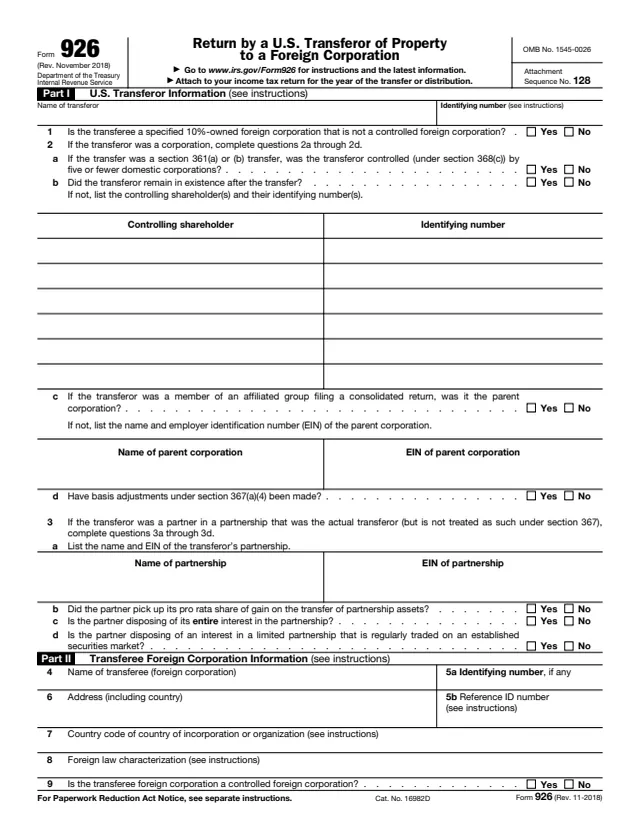
Form 926, Return by a U.S. Transferor of Property to a Foreign Corporation, reports certain transfers of tangible or intangible property to a foreign corporation, as required by section 6038B. The instructions say: "Generally, a U.S. citizen or resident, a domestic corporation, or a domestic estate or trust must complete and file Form 926 to report certain transfers of property to a foreign corporation that are described in section 6038B(a)(1)(A), 367(d), or 367(e)."
The form has four parts: the U.S. transferor, the transferee foreign corporation, the property transferred (cash, other property, and intangible property subject to section 367(d)), and additional information about the transfer. The form says to attach it to the income tax return for the year of the transfer or distribution. The instructions say all information goes in English and all amounts in U.S. dollars.
You can fill it out free in your browser on this page and download the result without an account.
Name and identifying number, whether the transferee is a specified 10%-owned foreign corporation that is not a controlled foreign corporation, questions 2a to 2d for corporate transferors, and 3a to 3d for partners.
Lines 4 to 9: name, identifying number or reference ID number, address, country code, foreign law characterization, and whether it is a controlled foreign corporation.
Cash, then stock and securities, inventory, other property and property with built-in loss, each with date of transfer, description, fair market value, cost or other basis and gain recognized. Lines 10 to 13 follow.
Intangible property subject to section 367(d), with useful life, arm's length price and income inclusion for the year of transfer, then lines 14a to 15.
Space for the descriptions and explanations the instructions call for, such as a general description of the transfer and the consideration received.
Line 16 interest before and after, line 17 type of nonrecognition transaction, lines 18a to 18d, line 19 change in entity classification, and lines 20a to 21 on distributions under section 367(e).
Enter the transferor's SSN (individuals) or EIN (all others). Check Yes on line 1 for a specified 10%-owned foreign corporation that is not a controlled foreign corporation. For a controlled foreign corporation, the instructions say to check No on line 1 and Yes on line 9.
Line 5b needs a reference ID number only when line 5a has no EIN. It is alphanumeric, with no special characters or spaces, up to 50 characters, and stays the same year to year. On line 7, enter the two-letter country code.
If cash was the only property transferred, line 10 says to skip the rest of Part III and go to Part IV. Otherwise enter each property's date of transfer, description, fair market value, adjusted basis and gain recognized.
List each section 367(d) intangible separately. Enter "indefinite" for an indefinite useful life, plus the arm's length price, basis and income inclusion, and explain them in the supplemental section.
Describe the transfer and any wider transaction, the parties, and the consideration received. Label each entry with its Section, column, row and line, and complete every entry space before attaching extra sheets.
Enter the interest held before and after, the type of nonrecognition transaction (for example section 332, 351, 354, 356, or 361), and answer lines 18 to 21, attaching the statements those lines call for.
You get the real form, filled in a browser tab, with nothing standing between you and the finished PDF.
The instructions say Form 926 is filed with the U.S. transferor's income tax return (or, if applicable, exempt organization return) for the tax year that includes the date of the transfer.
The instructions list exceptions, such as certain exchanges under section 354 or 356, generally a domestic corporation's section 355 distribution of domestic corporation stock, and certain stock transfers where the transferor owned less than 5% of the foreign corporation afterward.
10% of the fair market value of the property at the time of the transfer, limited to $100,000 unless the failure was due to intentional disregard. It does not apply with reasonable cause and no willful neglect.
The instructions say a 40% penalty may be imposed on an underpayment from an undisclosed foreign financial asset understatement.
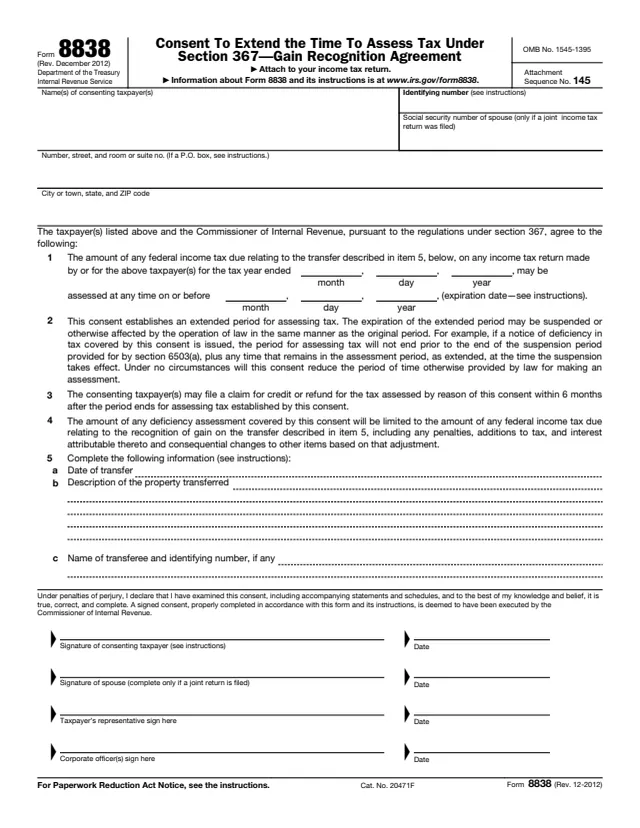
The instructions mention FinCEN Form 114 (FBAR) and Form 8838 for a transferor that enters into a gain recognition agreement.
The instructions name the transferors who file it. Form 926 goes to the IRS with the transferor's income tax return.
No tool matches that search.
The instructions say generally a U.S. citizen or resident, a domestic corporation, or a domestic estate or trust files it to report certain transfers of property to a foreign corporation.
No. The instructions say the domestic partners of the partnership, not the partnership itself, file Form 926, each for its proportionate share of the property.
When the person holds at least 10% of the voting power or value right after the transfer, or transferred more than $100,000 in cash in the 12-month period ending on the transfer date.
The form says to attach it to the income tax return for the year of the transfer or distribution.
The instructions give 10% of the property's fair market value at the time of the transfer, limited to $100,000 unless the failure was due to intentional disregard.
A number the transferor assigns to the foreign corporation when no EIN is entered on line 5a. The instructions say there is no need to apply to the IRS for one.
The instructions say spouses may file Form 926 jointly, but only if they file a joint income tax return.