Part I: General Information
For all filers: mailing and foreign addresses, country of tax residence, initial or annual statement, expatriation date, countries of citizenship, how U.S. citizenship was acquired and green card dates.
8854
Initial and Annual Expatriation Statement
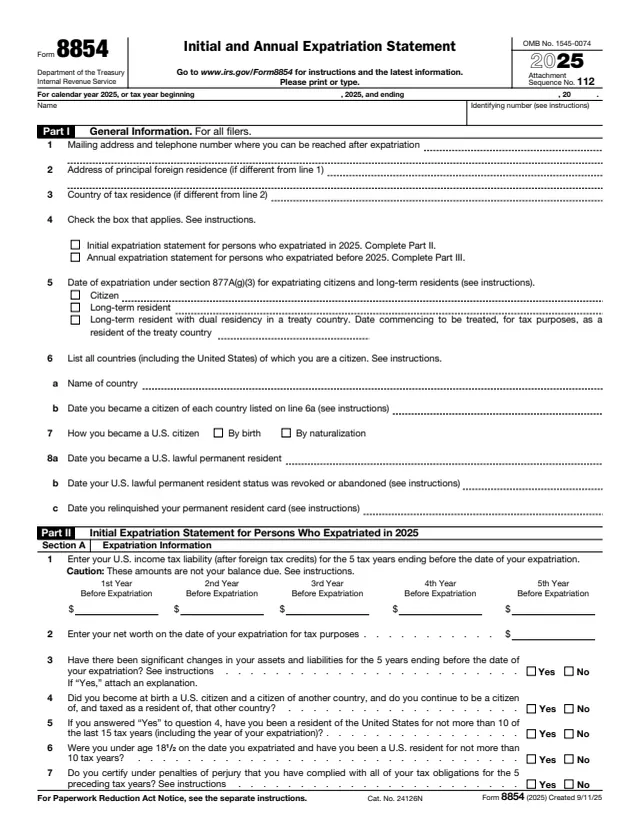
Form 8854, Initial and Annual Expatriation Statement, is filed by individuals who gave up U.S. citizenship or ended long-term residency. The IRS About page says expatriation tax provisions apply to U.S. citizens who have relinquished their citizenship and long-term residents who have ended their residency, and that the form is used by individuals who have expatriated on or after June 4, 2004.
The instructions say expatriates use the form to certify compliance with tax obligations in the 5 tax years before expatriation and to meet their initial and annual information reporting obligations under section 6039G. Part I is for all filers. Part II is the initial statement for persons who expatriated in 2025, with expatriation information, a balance sheet, property owned on the expatriation date and the election to defer tax. Part III is the annual statement for persons who expatriated before 2025.
This page has the 2025 form. The PDF can be filled out free in the browser on this page and downloaded without an account.
For all filers: mailing and foreign addresses, country of tax residence, initial or annual statement, expatriation date, countries of citizenship, how U.S. citizenship was acquired and green card dates.
Expatriation information: U.S. income tax liability for the 5 tax years before expatriation, net worth, and yes or no questions that end with the certification of 5 years of tax compliance.
A balance sheet of the fair market value and U.S. adjusted basis of assets, and the amount of liabilities, as of the expatriation date, ending with net worth on line 25.
Property owned on the expatriation date: deferred compensation items, specified tax deferred accounts, nongrantor trusts, and the deemed sale of mark-to-market property.
The election to defer tax under section 877A(b), with lines 2 to 5 figuring the tax eligible for deferral.
Annual statement lines for property with deferred tax, eligible deferred compensation distributions and nongrantor trust distributions, then the signature and paid preparer section.
Check whether this is the initial statement for an expatriation in 2025, which continues to Part II, or the annual statement for an earlier expatriation, which continues to Part III.
The instructions say the expatriation date is the date U.S. citizenship is relinquished or long-term residency ends, and they list the events that set each date.
Enter the tax liability, after foreign tax credits, for each of the 5 years. The form cautions that these amounts are not the balance due. Line 7 is the yes or no certification of compliance for the 5 preceding tax years.
List values in U.S. dollars as of the expatriation date. The instructions say good-faith estimates of fair market value and basis can be used and formal appraisals are not required.
The form lists three cases in which Section C is not completed, for example when the average tax liability was not more than $206,000.00, net worth was under $2 million and line 7 of Section A was answered Yes.
Section D applies only with an election to defer tax, which the instructions say calls for a tax deferral agreement with the IRS and adequate security. The instructions say the form is not valid unless it is signed.
You get the real form, filled in a browser tab, with nothing standing between you and the finished PDF.
The instructions say to attach the initial Form 8854 to the income tax return (Form 1040, 1040-SR or 1040-NR) for the year that includes the expatriation date, and to file the return by its due date.
The instructions say to send Form 8854 to the address below by the date Form 1040-NR (or Form 1040 or 1040-SR) would have been due, including extensions.
Internal Revenue Service, 3651 S IH35, MS 4301 AUSC, Austin, TX 78741. The instructions say the original initial or annual Form 8854 goes to this address.
In a year with a required return, the annual Form 8854 is attached to that return and a copy, marked "Copy," is sent to the Austin address.
The instructions say a person required to file who fails to file, or files incomplete or incorrect information, owes a penalty of $10,000 for that year unless the failure is due to reasonable cause and not willful neglect.
The instructions note that FinCEN Form 114 (FBAR) and Form 8938 may also be required for anyone who was a U.S. person for any portion of 2025.
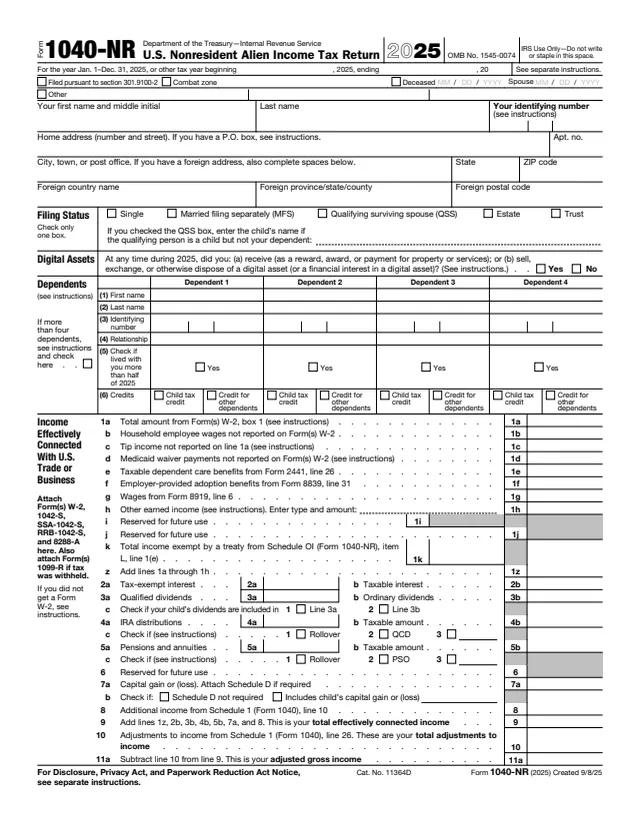
1040-NR
171 fields, 2 pages
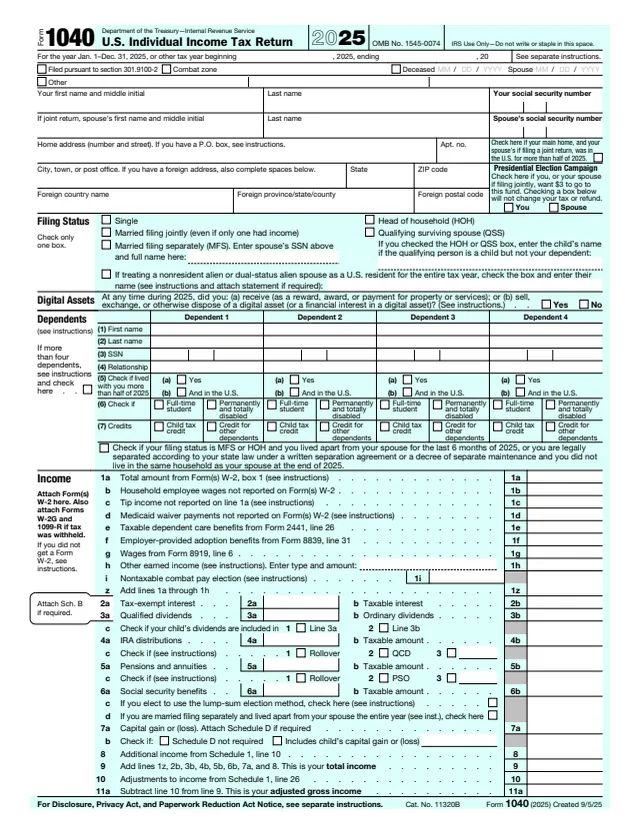
1040
199 fields, 2 pages
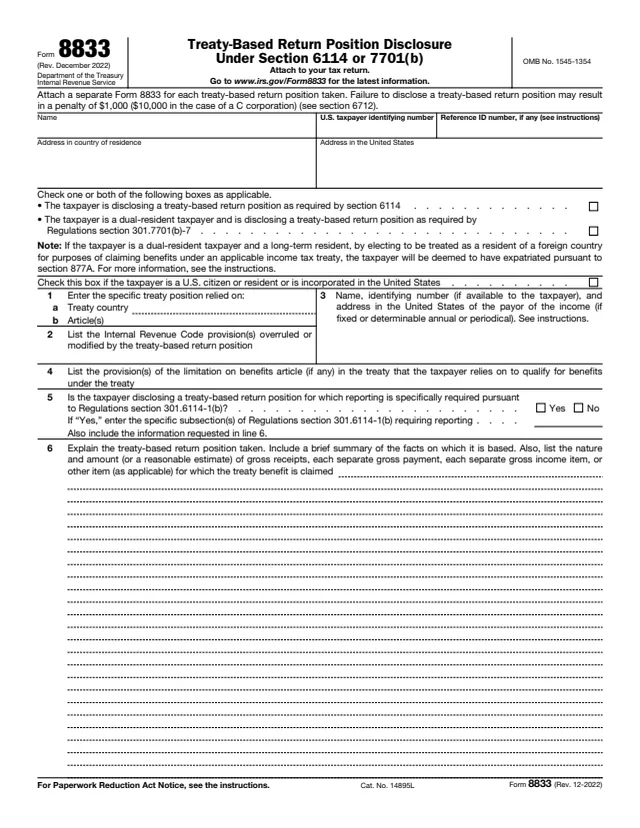
8833
41 fields, 5 pages
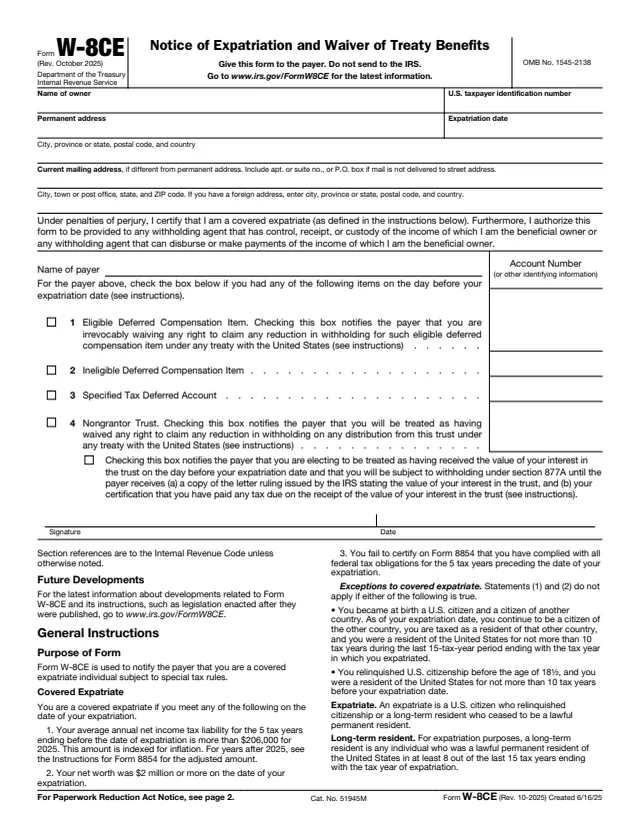
W-8CE
17 fields, 2 pages
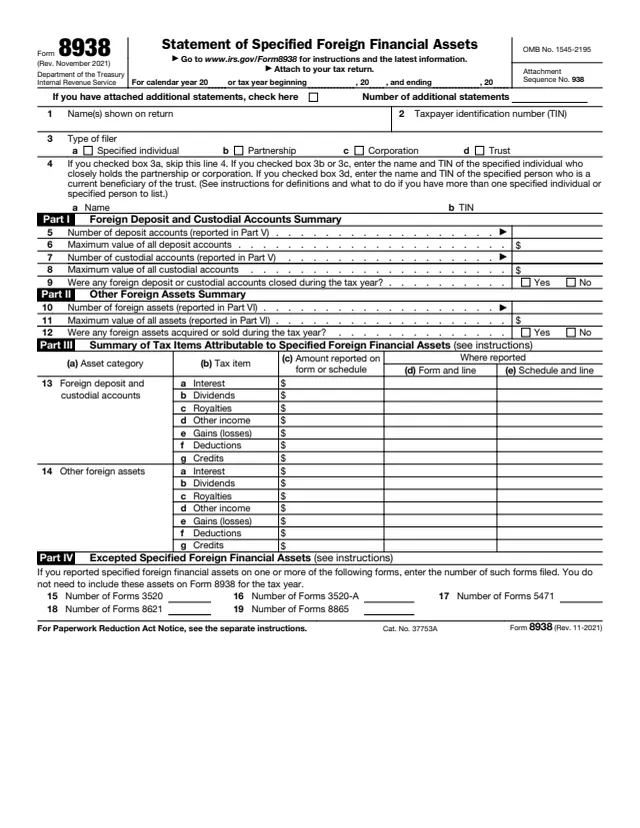
8938
131 fields, 2 pages
The individual who expatriated files it, with an income tax return or on its own. A paid preparer, if any, signs in the preparer section.
No tool matches that search.
The instructions say a long-term resident was a lawful permanent resident of the United States in at least 8 of the last 15 tax years ending with the year that status ended.
The instructions list three tests for those who expatriated after June 16, 2008: average annual net income tax liability above $206,000, net worth of $2 million or more, or failing to certify 5 years of tax compliance on Form 8854.
The instructions say a covered expatriate is taxed on net unrealized gain as if property were sold for its fair market value on the day before the expatriation date. For 2025, the gain is reduced, but not below zero, by $890,000.
The instructions describe an irrevocable election made property by property, with a tax deferral agreement, adequate security such as a bond, interest on the deferred tax, and a waiver of treaty rights that would block assessment or collection.
The instructions say the penalty is $10,000 for the year, unless the failure is due to reasonable cause and not willful neglect.
The instructions say a U.S. citizen or resident who receives a gift or bequest from a covered expatriate may be subject to the section 2801 tax.