Header and foreign entity lines
Name and identifying number shown on the return, plus the foreign entity's name, EIN and reference ID number when the form relates to an information return such as Form 5471.
8275
Disclosure Statement
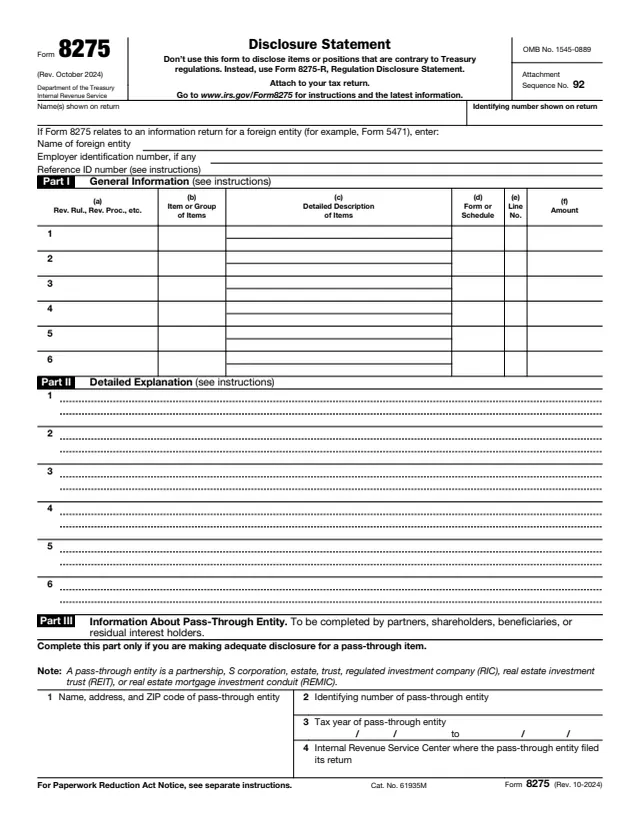
Form 8275 is the IRS Disclosure Statement. The instructions say it is used by taxpayers and tax return preparers to disclose items or positions, except those taken contrary to a regulation, that are not otherwise adequately disclosed on a tax return to avoid certain penalties. A position contrary to Treasury regulations goes on Form 8275-R, Regulation Disclosure Statement, instead.
The form is attached to the tax return. Part I lists each item with its rule, description, form, line and amount. Part II explains the facts, Part III identifies a pass-through entity when the item comes from one, and Part IV on page 2 continues the explanations. The instructions also list penalty portions, such as negligence, that disclosure cannot avoid.
You can fill out Form 8275 free in your browser on this page and download it without an account.
Name and identifying number shown on the return, plus the foreign entity's name, EIN and reference ID number when the form relates to an information return such as Form 5471.
Six rows with columns (a) to (f): Rev. Rul., Rev. Proc. or other rule, item or group of items, detailed description, form or schedule, line number and amount.
Six numbered spaces for the facts behind each item listed in Part I.
For partners, shareholders, beneficiaries or residual interest holders: the entity's name, address, identifying number, tax year and the IRS service center where it filed.
Page 2 gives more space for Parts I and II, with the matching part and line number.
The form says not to use it for items or positions contrary to Treasury regulations. Those go on Form 8275-R.
Enter the name and number shown on the return. For a position related to a foreign entity, the instructions say to use the same reference ID number entered on the information return, with a separate Form 8275 for each foreign entity.
Column (a) identifies any rule the position is contrary to. Column (b) names the item, column (c) describes it fully, and columns (d) to (f) give the form, line and amount. Similar items with the same treatment can be described as a group.
The instructions say to describe the relevant facts so the IRS can identify the item, its amount and the nature of the controversy. They say attaching a document such as an acquisition agreement instead is not adequate disclosure.
Only for a pass-through item. For line 4, the instructions say partners and S corporation shareholders can find the service center on their Schedule K-1, or enter e-file if the entity filed electronically.
Use Part IV or continuation sheets showing the name and identifying number for more space, then attach the form to the original return.
You get the real form, filled in a browser tab, with nothing standing between you and the finished PDF.
The form says to attach it to the tax return. The instructions say to file it with the original return and keep a copy, and that it may be possible to file it with an amended return.
The instructions say carryover and carryback items are disclosed for the year they originated, while recurring items such as depreciation expense are disclosed for each year they occur.
The instructions call for a separate Form 8275 for items from each pass-through entity and for each foreign entity.
The instructions list penalty portions disclosure cannot avoid, including negligence, disregard of regulations, tax shelter items and substantial or gross valuation misstatements.
The instructions say it is generally 20% of the portion of a tax underpayment it applies to, and 40% or 50% in the cases they list.
For a position contrary to a rule that relates to a reportable transaction, the instructions also point to Form 8886, Reportable Transaction Disclosure Statement.
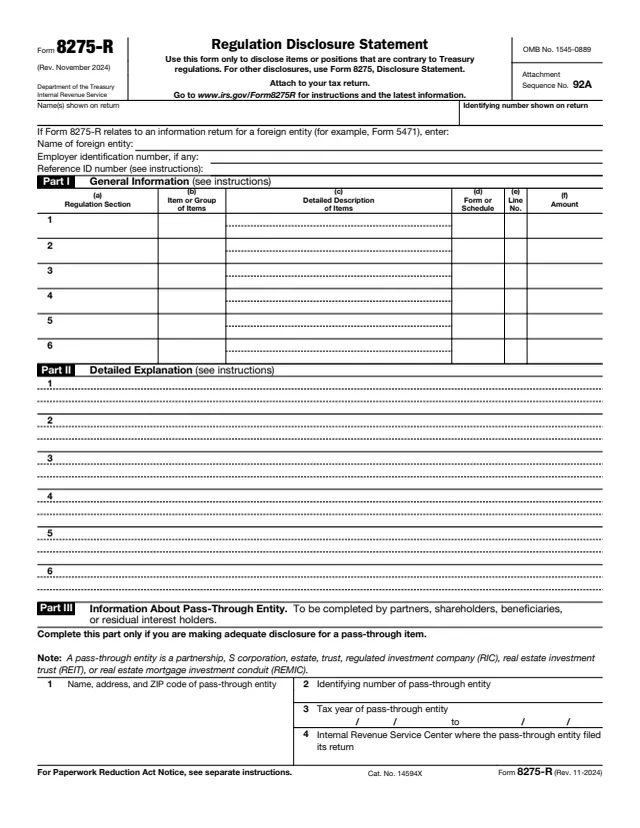
8275-R
102 fields, 2 pages
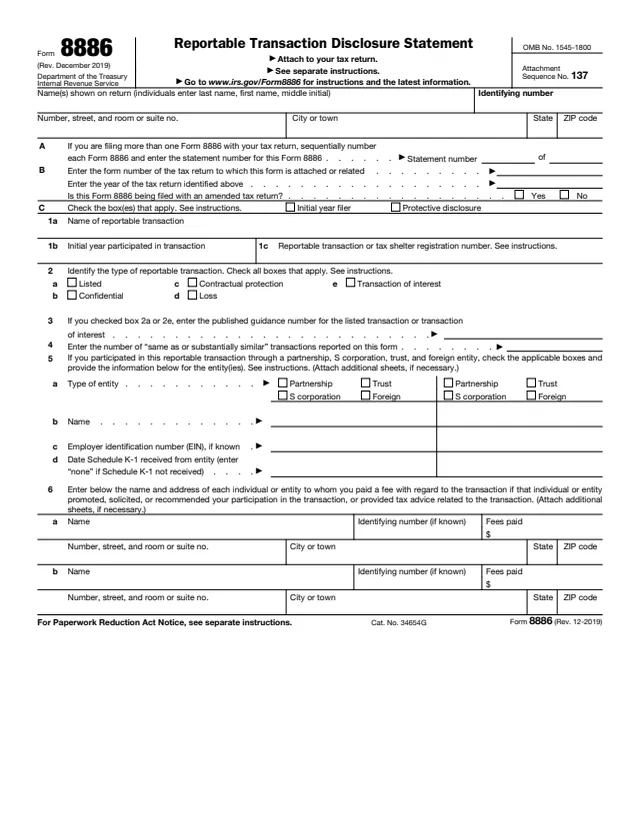
8886
98 fields, 2 pages
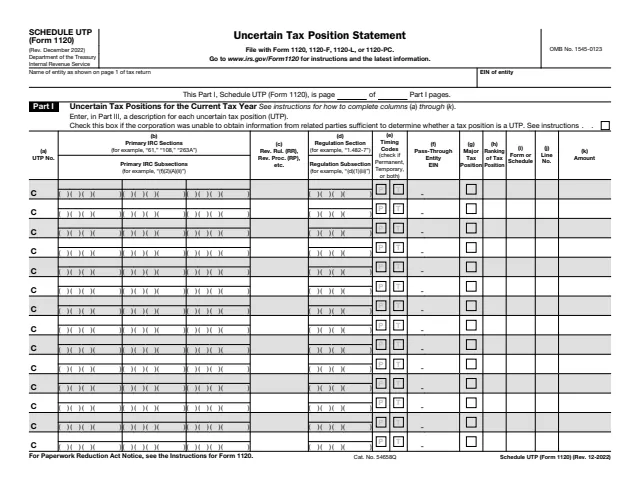
1120 Sch. UTP
1,060 fields, 3 pages
5471
437 fields, 6 pages
1040
33 fields, 1 page
1065
111 fields, 1 page
The instructions say Form 8275 is filed by individuals, corporations, pass-through entities and tax return preparers, attached to the return it relates to.
No tool matches that search.
The instructions say Form 8275 is filed by individuals, corporations, pass-through entities and tax return preparers.
Form 8275 is for items or positions not otherwise adequately disclosed. The form says positions contrary to Treasury regulations go on Form 8275-R, Regulation Disclosure Statement.
No. The form says to attach it to the tax return, and the instructions say to file it with the original return.
The instructions say that if Form 8275 isn't completed and attached to the return, the disclosure won't be considered valid even if the information is given another way, such as a letter.
The instructions say an annual revenue procedure lists items considered adequately disclosed on the return itself, and those don't need Form 8275.
The instructions say disclosure should be made on the entity's return. If it isn't, the partner or shareholder can disclose using Part III, with a separate form for each entity.