Decedent information
The decedent's name as it appears on Form 706 and the decedent's Social Security number.
706 Sch. Q
Credit for Tax on Prior Transfers
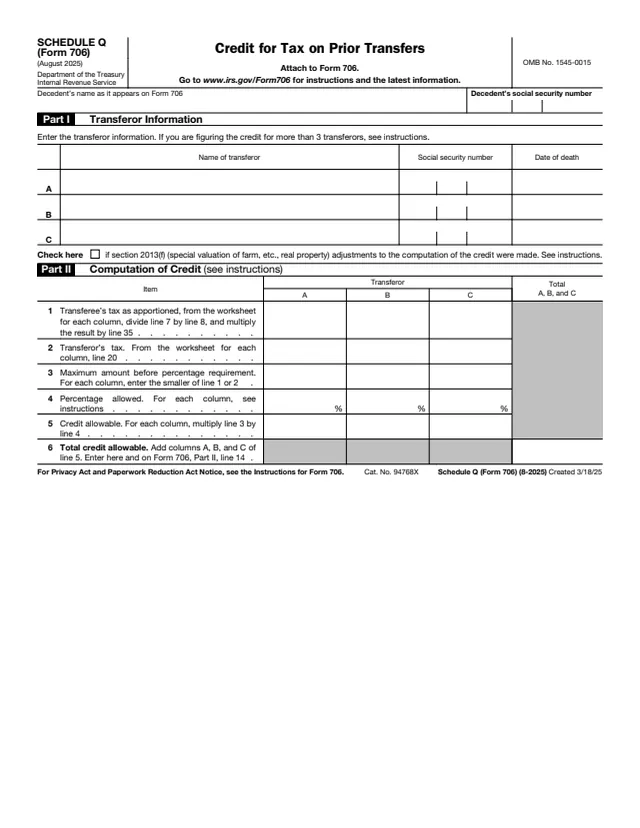
Schedule Q (Form 706) is used to claim a credit for a prior transfer, the IRS About Form 706 page says. It is attached to Form 706, the estate tax return the executor of a decedent's estate uses to figure the estate tax. The Instructions for Form 706 say to complete Schedule Q and file it with the return if the estate claims a credit on Form 706, Part II, line 14.
The instructions call the decedent for whose estate the return is filed the transferee. If the transferee received property from a transferor who died within 10 years before or 2 years after the transferee, a credit is allowable for all or part of the federal estate tax paid by the transferor's estate for the transfer. Part I lists up to three transferors, and Part II computes the credit from a worksheet printed in the instructions.
You can fill out Schedule Q (Form 706) free in your browser on this page and download it without an account.
The decedent's name as it appears on Form 706 and the decedent's Social Security number.
Rows A, B and C for each transferor's name, Social Security number and date of death, plus a box for section 2013(f) special valuation adjustments.
The transferee's tax as apportioned and the transferor's tax, both from the worksheet, then the smaller of the two for each column.
The percentage allowed for each transferor, and the credit allowable, which is line 3 multiplied by line 4.
Columns A, B and C of line 5 added together. The schedule says to enter it here and on Form 706, Part II, line 14.
The instructions provide a Worksheet for Schedule Q to figure the limits. They say most Part I worksheet figures come from the transferor's Form 706, and the worksheet is kept for records, not filed.
Enter each transferor's name, SSN and date of death. For more than three transferors, the instructions say to use more than one worksheet and Part I, and combine the totals.
The instructions say to check the box if the transferor's estate elected special-use valuation and the section 2032A(c) additional estate tax was imposed up to 2 years after the decedent's death.
For line 1, divide worksheet line 7 by line 8 and multiply by line 35. Enter worksheet line 20 on line 2. Line 3 is the smaller of lines 1 and 2.
The instructions give the percent by years between dates of death when the transferor died first: 100 up to 2 years, then 80, 60, 40 and 20, and none after 10 years.
Multiply line 3 by line 4 for each column, then add the columns on line 6 and carry the total to Form 706, Part II, line 14.
You get the real form, filled in a browser tab, with nothing standing between you and the finished PDF.
The schedule says "Attach to Form 706." The total on line 6 is also entered on Form 706, Part II, line 14.
The Form 706 instructions say Form 706 is filed within 9 months after the date of the decedent's death, and Form 4768 is used to apply for an automatic 6-month extension of time to file.
The Form 706 instructions give Department of the Treasury, Internal Revenue Service, Kansas City, MO 64999. The About page points to Filing estate and gift tax returns for the latest address.
The instructions say the Worksheet for Schedule Q does not need to be filed with Form 706, but should be kept for records.
The instructions say that if a credit is claimed for tax on prior transfers, Schedule Q is completed before Schedule P (Form 706).
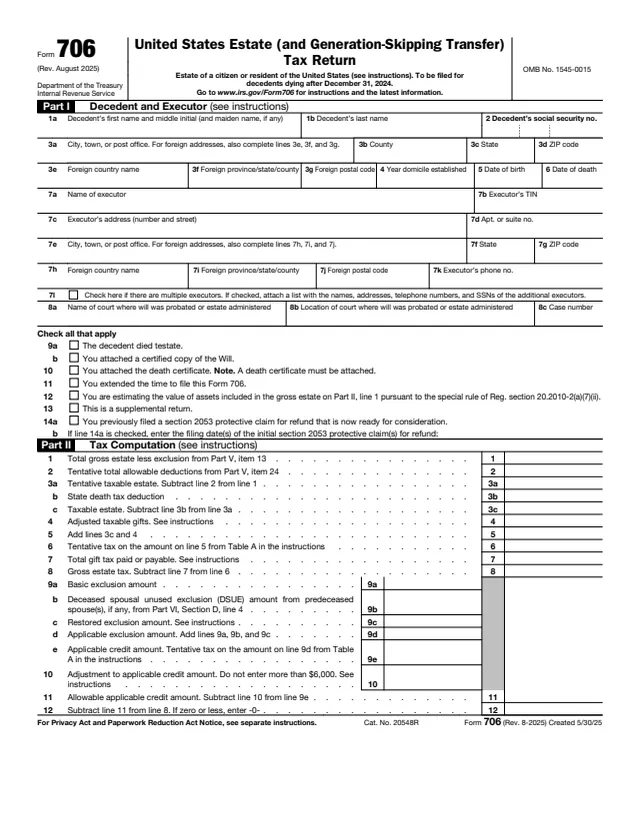
706
316 fields, 5 pages
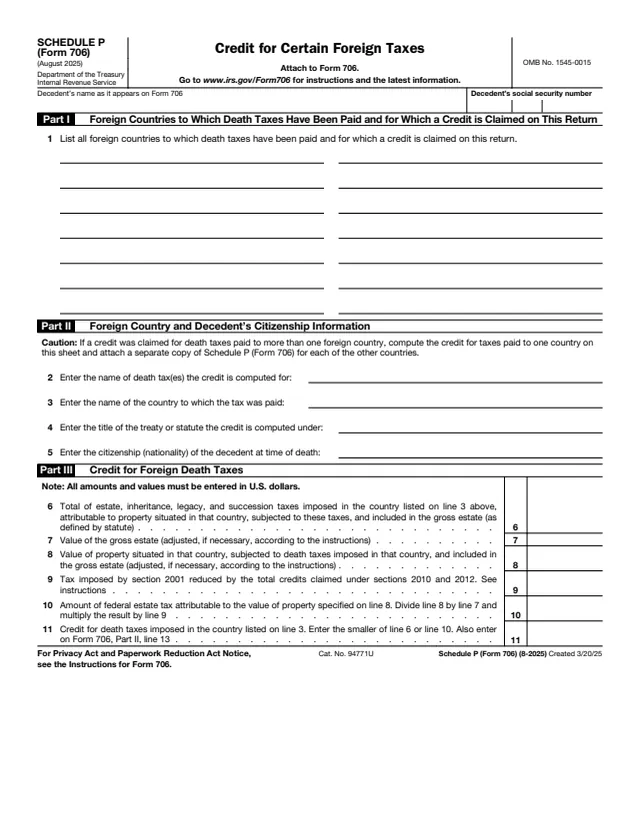
706 Sch. P
26 fields, 1 page
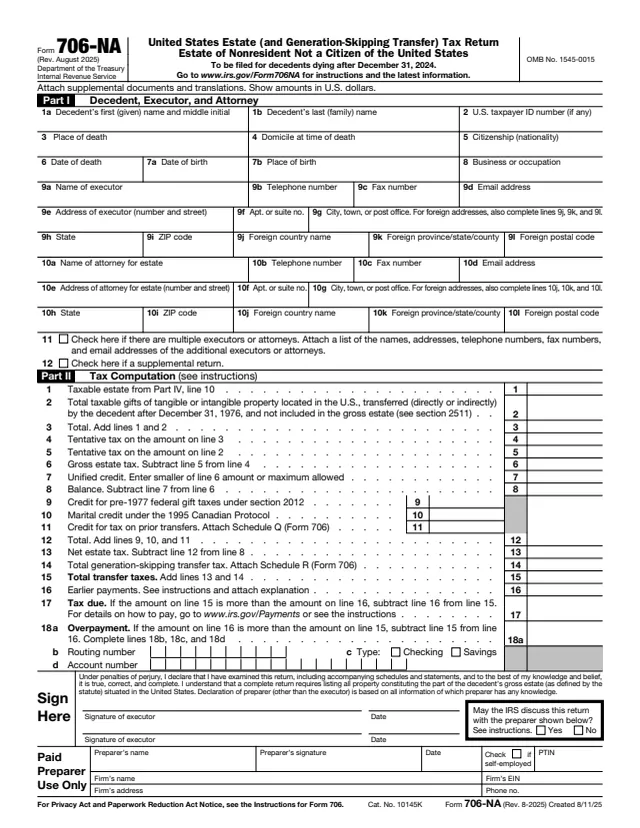
706-NA
259 fields, 3 pages
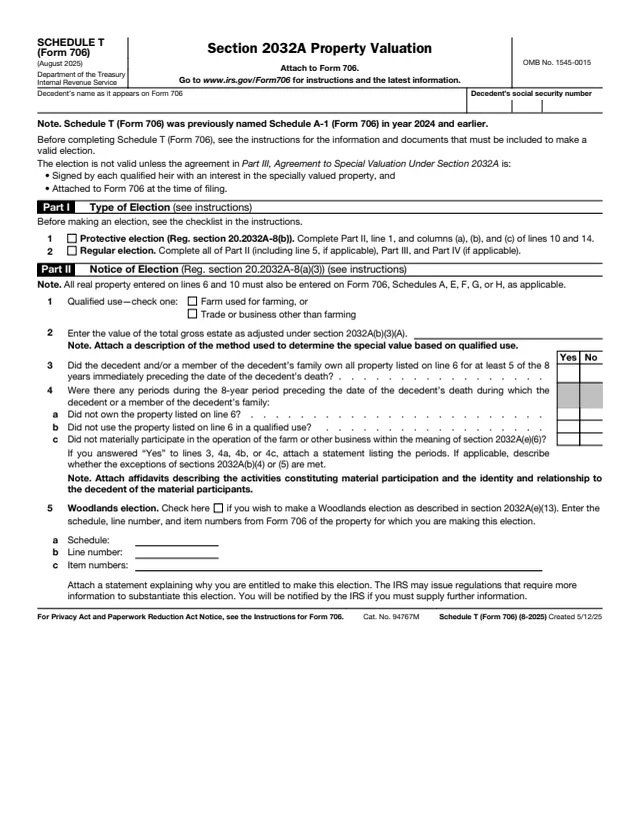
706 Sch. T
858 fields, 8 pages
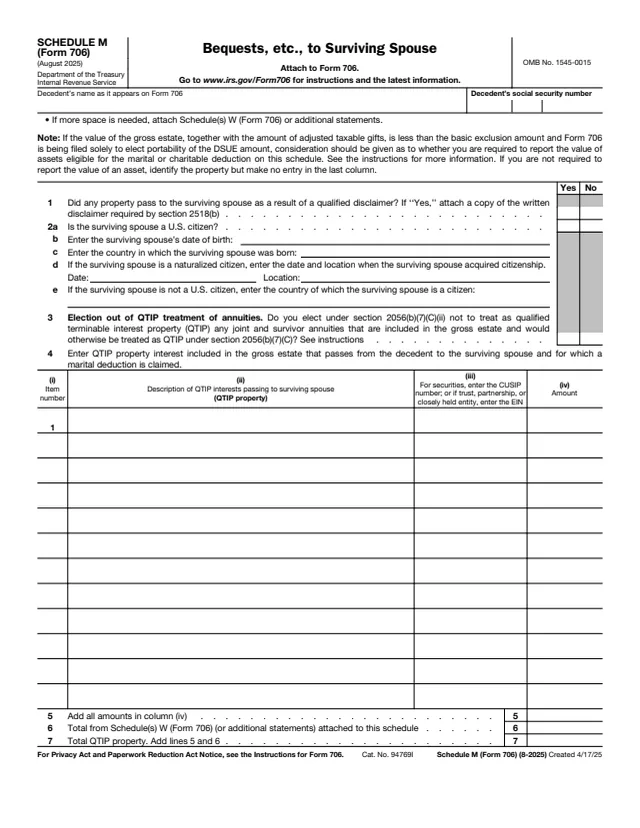
706 Sch. M
157 fields, 2 pages
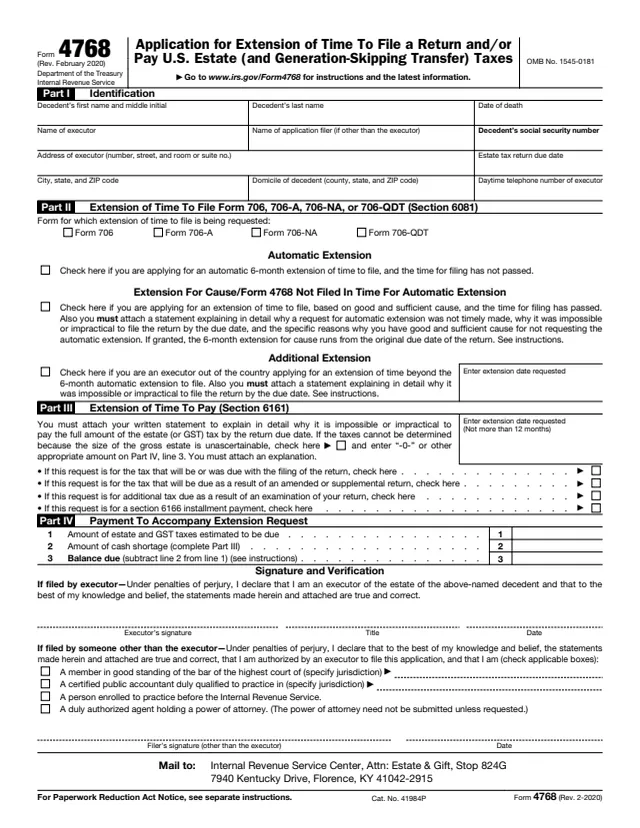
4768
35 fields, 1 page
The schedule is completed for a decedent's estate as part of Form 706 and goes to the IRS with that return. It is not an individual income tax form.
No tool matches that search.
The About Form 706 page says it is used to claim a credit for a prior transfer. The credit is for federal estate tax paid by a transferor's estate on property the decedent received.
The instructions say the transferee is the decedent for whose estate this return is filed.
The instructions say a credit is allowable if the transferor died within 10 years before or 2 years after the transferee.
The instructions say there is no requirement that the property be identified in the transferee's estate or exist on the date of the transferee's death.
No. The instructions say the worksheet does not need to be filed with Form 706, but should be kept for records.
Three, in columns A, B and C. For more, the instructions say to use more than one worksheet and Part I and combine the totals.