Decedent information
The decedent's name as it appears on Form 706 and the decedent's Social Security number.
706 Sch. H
Powers of Appointment
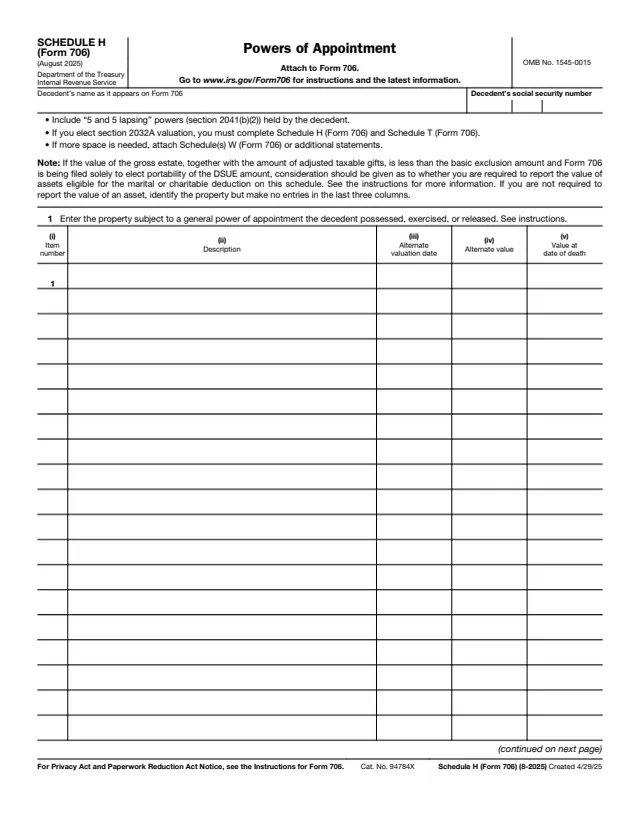
Schedule H (Form 706), Powers of Appointment, is part of Form 706, the return the executor of a decedent's estate uses to figure the estate tax, the IRS About Form 706 page says. The page says that if the decedent ever possessed, exercised, or released any general power of appointment, this schedule is used to report the powers of appointment.
The instructions say Schedule H is completed and filed with the return if the answer to Form 706, Part IV, line 14 is Yes. Its line 1 table lists the property subject to a general power of appointment the decedent possessed, exercised or released, with columns for the item number, a description, the alternate valuation date, the alternate value and the value at the date of death. The total goes on Form 706, Part V, item 8. The schedule also says to include "5 and 5 lapsing" powers under section 2041(b)(2) held by the decedent.
This page has the August 2025 edition. The PDF can be filled out free in the browser on this page and downloaded without an account.
The decedent's name as it appears on Form 706 and the decedent's Social Security number.
Bullets on including "5 and 5 lapsing" powers, tying a section 2032A election to Schedule T (Form 706) and using Schedule W (Form 706) for more space, plus a note on portability-only returns.
Property subject to a general power of appointment the decedent possessed, exercised or released, with columns (i) item number, (ii) description, (iii) alternate valuation date, (iv) alternate value and (v) value at date of death.
Page 2 continues the line 1 table with the same five columns before the totals.
Line 2 adds column (iv) or column (v), as applicable, line 3 holds totals from attached Schedule W (Form 706) or statements, and line 4 is the total entered on Form 706, Part V, item 8.
The instructions define a general power of appointment as one exercisable in favor of the decedent, the decedent's estate, the decedent's creditors or the creditors of the decedent's estate, with listed exceptions.
The listed exceptions include a power limited by an ascertainable standard relating to health, education, support or maintenance, and a power exercisable only with the creator of the power or a person with a substantial adverse interest.
The instructions say property is included if the decedent exercised or released a general power in a way that, had it been the decedent's own property, would make it includible as a transfer with a retained life estate, a transfer taking effect at death or a revocable transfer.
When a power is exercisable only with another person and also in that person's favor, the instructions say to divide the value of the property by the number of persons, including the decedent, in whose favor it is exercisable.
If the decedent ever possessed a power of appointment, attach a certified or verified copy of the instrument granting it and of any instrument exercising or releasing it. The instructions say this applies even when the power is contended not to be general.
Add column (iv) or (v) on line 2, enter any Schedule W totals on line 3, and carry the line 4 total to Form 706, Part V, item 8. Columns (iii) and (iv) are used only if alternate valuation was elected on Part III, line 1.
You get the real form, filled in a browser tab, with nothing standing between you and the finished PDF.
The schedule says "Attach to Form 706." Its total is entered on Form 706, Part V, item 8.
The Form 706 instructions say Form 706 is filed within 9 months after the date of the decedent's death, and Form 4768 is used to apply for an automatic 6-month extension of time to file.
The Form 706 instructions give Department of the Treasury, Internal Revenue Service, Kansas City, MO 64999. The About page points to Filing estate and gift tax returns for the latest address.
The instructions say copies of the instruments granting, exercising or releasing a power of appointment are filed with the return.
The schedule says to attach Schedule W (Form 706) or additional statements if more space is needed.
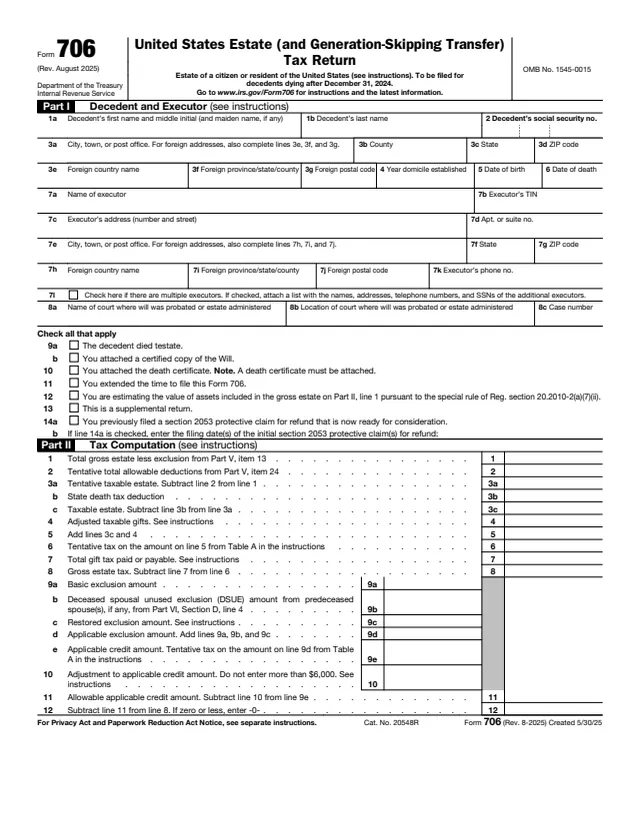
706
316 fields, 5 pages
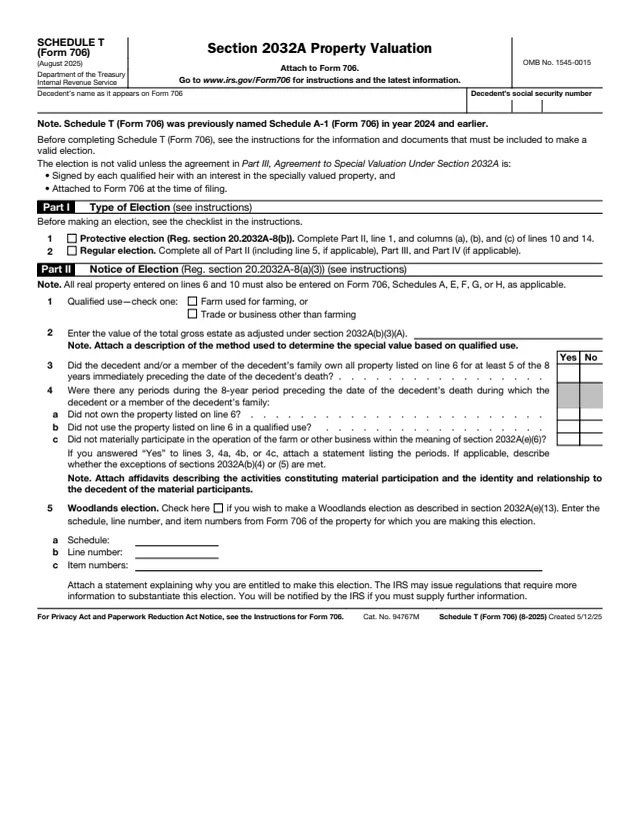
706 Sch. T
858 fields, 8 pages
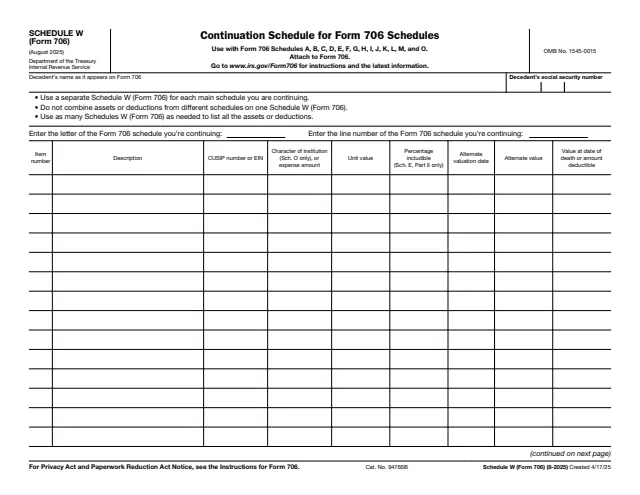
706 Sch. W
303 fields, 2 pages
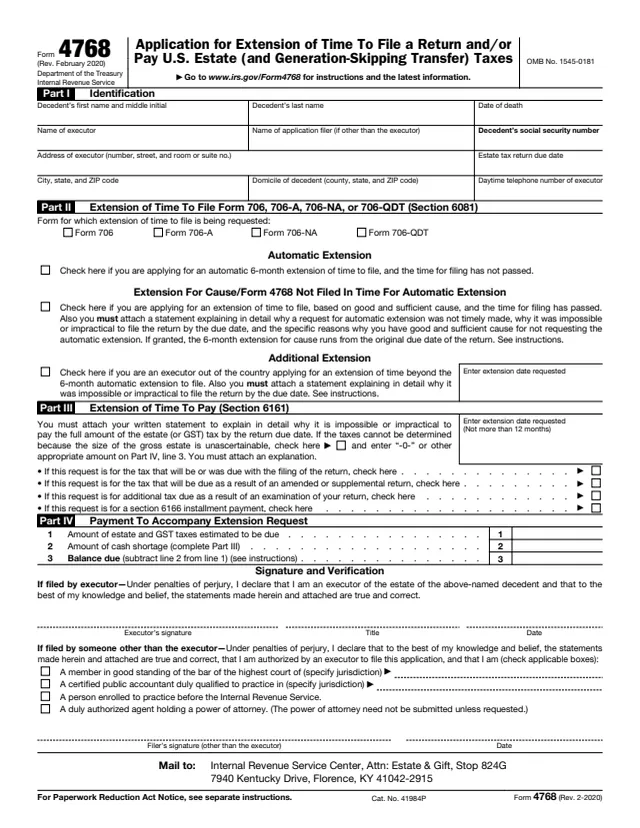
4768
35 fields, 1 page
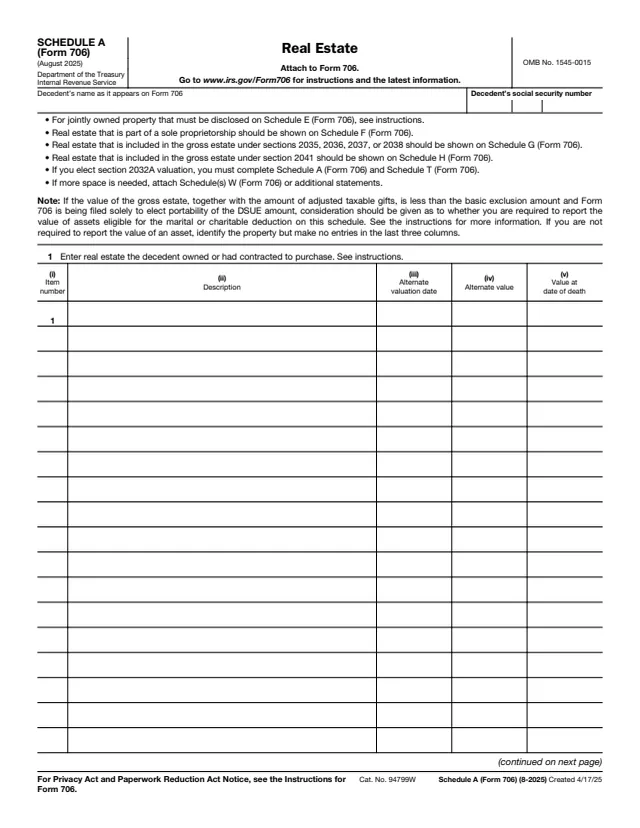
706 Sch. A
223 fields, 2 pages
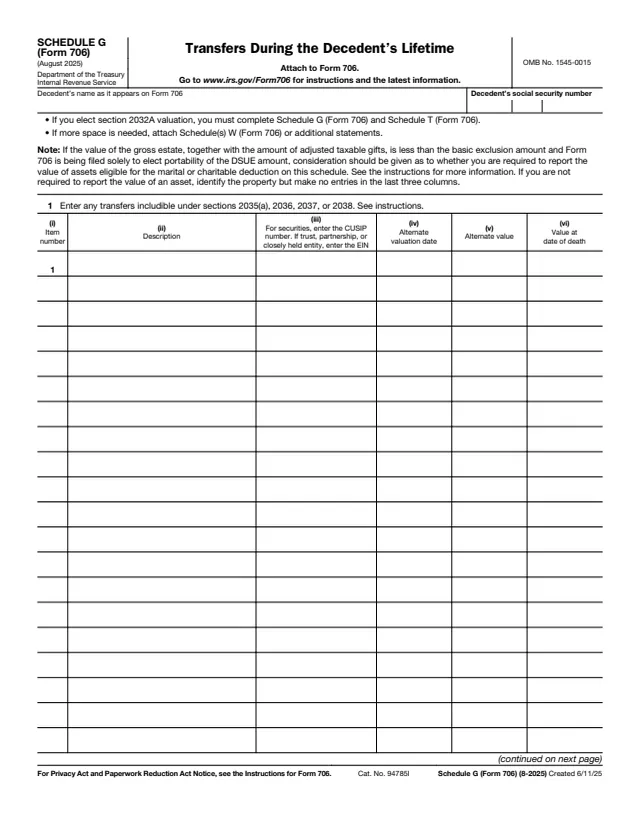
706 Sch. G
268 fields, 2 pages
The schedule is completed for a decedent's estate as part of Form 706 and goes to the IRS with that return. It is not an individual income tax form.
No tool matches that search.
The About Form 706 page says that if the decedent ever possessed, exercised, or released any general power of appointment, this schedule is used to report the powers of appointment.
The instructions say it is completed and filed with the return if the answer to Form 706, Part IV, line 14 is Yes.
The instructions say a power of appointment determines who will own or enjoy the property subject to the power and when. The power is created by someone other than the decedent.
The instructions say a power to manage, invest or control assets, or to allocate receipts and disbursements, when exercised only in a fiduciary capacity, is not a power of appointment.
The schedule says to include them under section 2041(b)(2). The instructions say a lapse counts as a release only to the extent the property is more than the greater of $5,000 or 5% of the total value of the assets that could have satisfied the power.
The instructions say a power created by will is generally considered created on the date of the testator's death, and one created by an inter vivos instrument on the date the instrument takes effect.