Part I: General Information
Lines 1 to 8: the qualified heir's name, SSN and address, the decedent's name and SSN as on Form 706, the date of death, the commencement date and a box for a section 1016(c) election to increase basis.
706-A
United States Additional Estate Tax Return
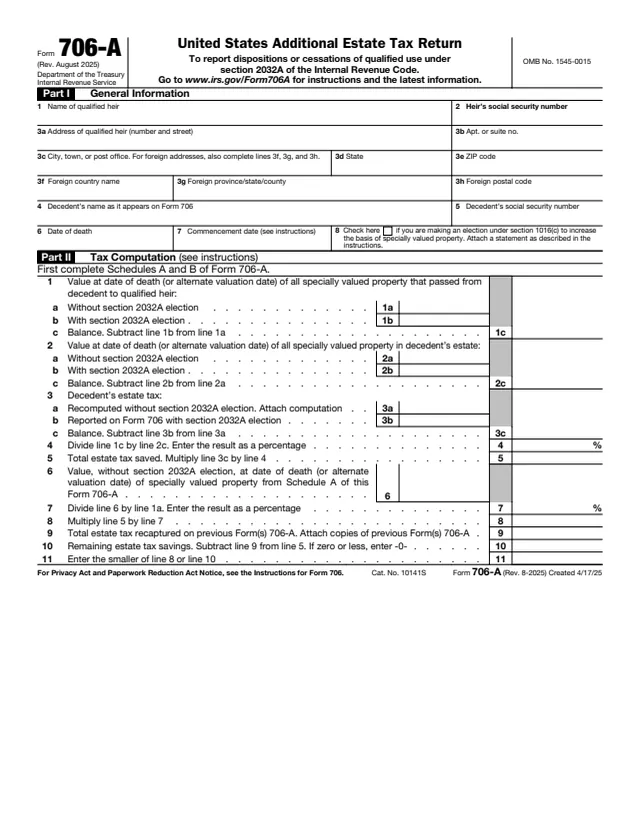
Form 706-A is the United States Additional Estate Tax Return. The IRS About page says an heir files this form to report the additional estate tax imposed by Internal Revenue Code section 2032A(c) for an early disposition of specially valued property or for an early cessation of a qualified use of specially valued property.
The instructions define specially valued property as farm or closely held business property that the executor elected to value at actual use rather than fair market value (FMV) on Form 706, the estate tax return filed for the decedent. The instructions say the recapture tax is limited to the tax savings attributable to the property actually disposed of, or for which qualified use ceased.
The form has a Part I for general information, a Part II tax computation and Schedules A, B and C. You can fill it out free in your browser on this page and download the result without an account.
Lines 1 to 8: the qualified heir's name, SSN and address, the decedent's name and SSN as on Form 706, the date of death, the commencement date and a box for a section 1016(c) election to increase basis.
Compares values and estate tax with and without the section 2032A election to figure the total estate tax saved, then subtracts tax recaptured on earlier Forms 706-A.
Brings in totals from Schedules A and B, figures the additional estate tax on line 19 and holds section 1016(c) interest on line 20, followed by the signature area and the Paid Preparer Use Only section.
Disposition of Specially Valued Property or Cessation of Qualified Use: each interest in chronological order with its Form 706 schedule, line and item, description, date, amount received or FMV and special use value.
Involuntary Conversions or Exchanges: a box for conversion or exchange, then each qualified replacement or exchange property with its description and cost or FMV.
Dispositions to Family Members of the Qualified Heir: each transferee's name, SSN and relationship, and the property transferred. The form says each transferee's agreement to be personally liable is attached.
Enter the qualified heir's details and the decedent's name and SSN as they appear on Form 706. Line 7 is the commencement date, the date the heir began using the property in a qualified use. Line 8 is checked only for the section 1016(c) basis election, with the statement the instructions describe attached.
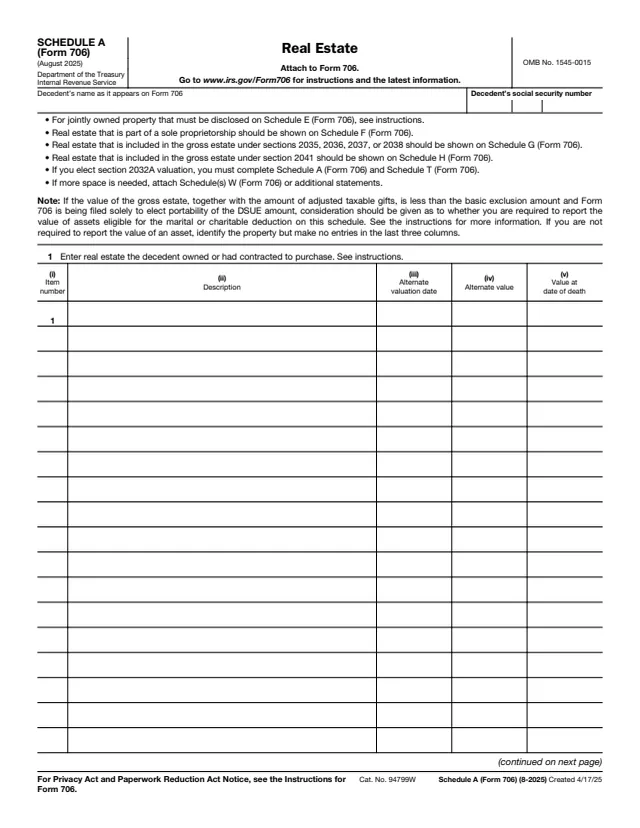
List every specially valued interest disposed of or no longer in qualified use that was not reported on an earlier Form 706-A. Column (g) is the amount realized in an arm's length transaction, otherwise the FMV. Column (h) is the special-use value reported on Form 706.
For an involuntary conversion, enter the cost of the replacement property. For an exchange, enter its FMV. The instructions say a return reporting a conversion or exchange is not used for other cessations or dispositions.
Line 3a is the estate tax recomputed without the section 2032A election, with the computation attached. Line 19 is the additional estate tax. For a fully nontaxable conversion or exchange, the instructions say to write "nontaxable" on line 19.
A disposition to a family member goes here only if the return is filed on time and the transferee's agreement to be personally liable is attached. The instructions point to Schedule T (Form 706) for a format. Otherwise it goes on Schedule A.
The qualified heir signs and dates the return under penalties of perjury. A paid preparer adds their name, signature, PTIN and firm details. The Yes box lets the IRS discuss the return with that preparer.
The instructions say to complete the form in this order: Part I, Schedules A and B, Part II, then Schedule C. Amounts use the values and estate tax the executor reported on Form 706, or the agreed values if the IRS completed its audit.
You get the real form, filled in a browser tab, with nothing standing between you and the finished PDF.
The instructions say to file Form 706-A and pay any additional taxes due within 6 months after the taxable disposition or cessation of the qualified use, unless an extension of time has been granted.
Form 4768 applies for an automatic extension of time to file. The instructions say to check the "Form 706-A" box in Part II of Form 4768.
Department of the Treasury, Internal Revenue Service Center, Kansas City, MO 64999. With a private delivery service, the instructions give Internal Revenue Submission Processing Center, 333 W. Pershing Rd., Kansas City, MO 64108.
The instructions list EFTPS, same-day wire, check and cash. A check is made payable to "United States Treasury" with the qualified heir's SSN and "Form 706-A" written on it.
To change a filed return, the instructions say to file another Form 706-A with "Supplemental Information" across the top of page 1, a statement of what changed and a copy of the original.
The instructions say the additional estate tax may be assessed until 3 years after the IRS receives notice that the qualified heir disposed of the property or ceased to use it for the qualified use.
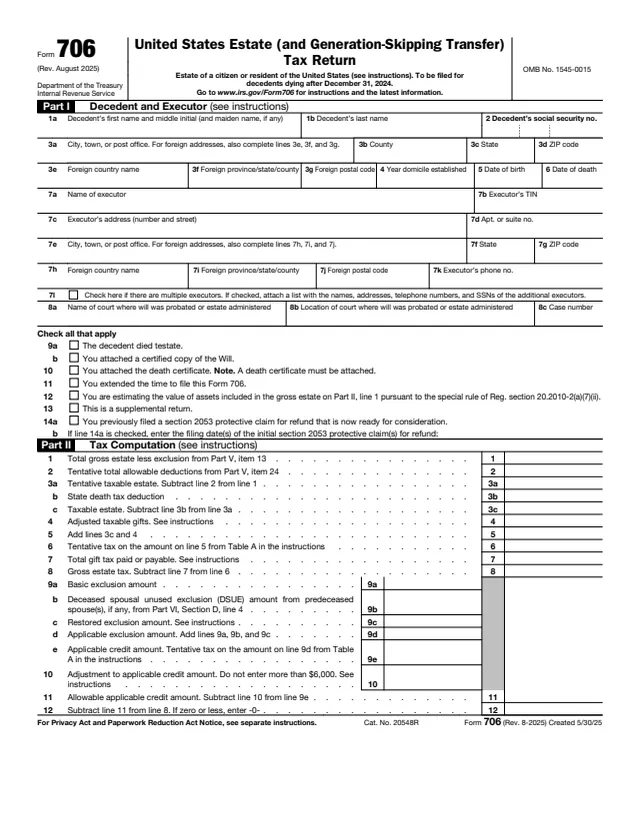
706
316 fields, 5 pages
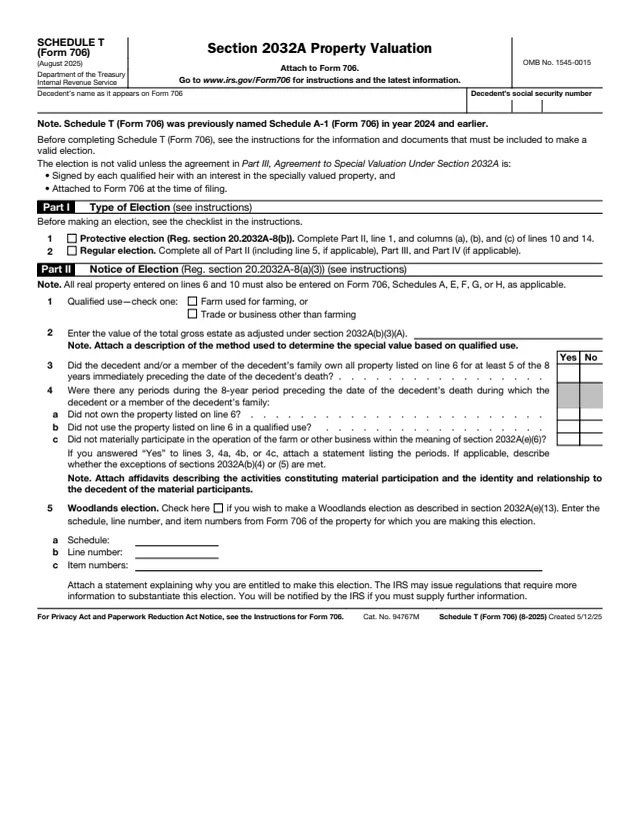
706 Sch. T
858 fields, 8 pages
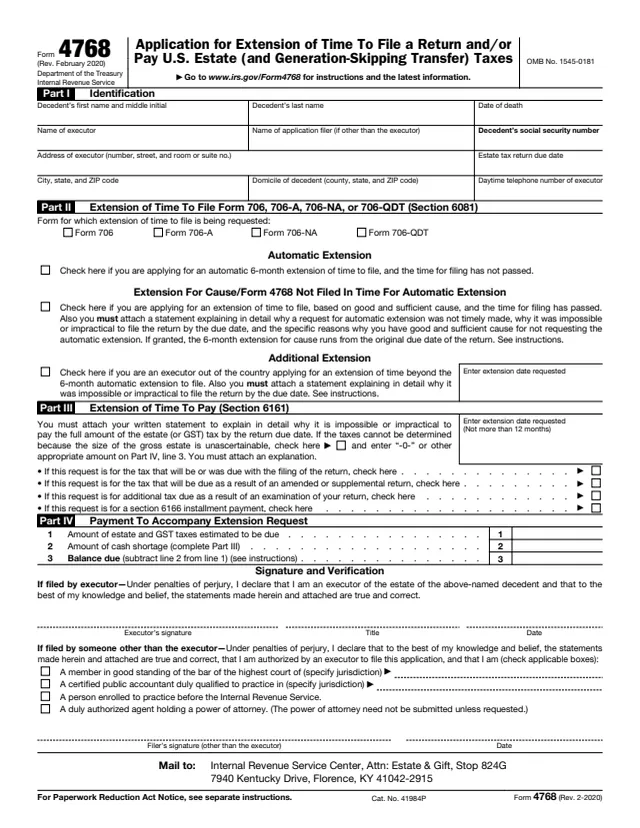
4768
35 fields, 1 page
2848
92 fields, 2 pages
706 Sch. A
223 fields, 2 pages
The instructions say the qualified heir files the form and signs it. One Form 706-A covers only one qualified heir.
No tool matches that search.
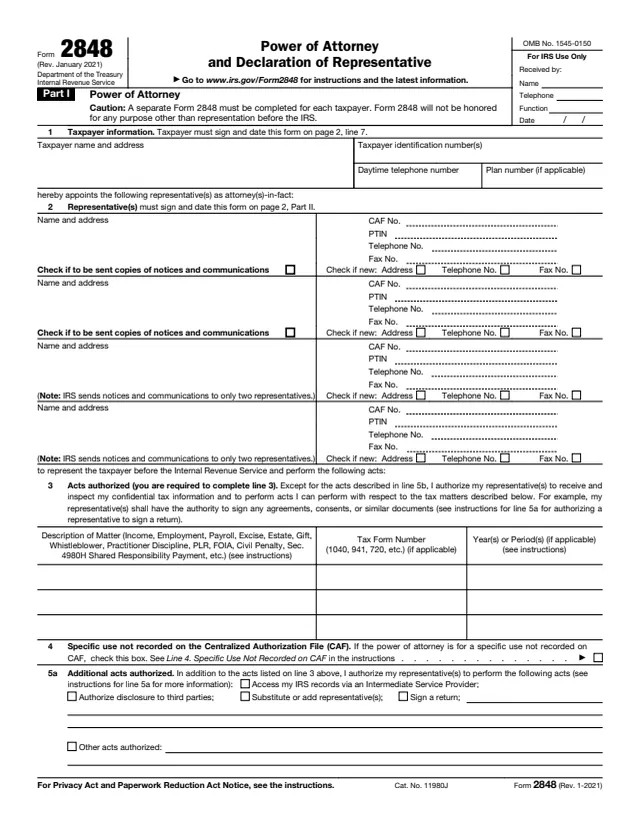
The instructions say the qualified heir signs the return. A paid preparer also signs in the Paid Preparer Use Only area. Form 2848 can authorize another person to act for the taxpayer before the IRS.
The instructions say the qualified heir files when there was any taxable event even if no tax is ultimately due, and for any involuntary conversion or exchange even if it is nontaxable.
The instructions describe it as farm or closely held business property that the executor elected on Form 706 to value at actual use rather than fair market value.
It is the date the qualified heir begins using the property in a qualified use. The instructions say not starting a qualified use in the 2 years after the decedent's death is not a cessation, and the 10-year recapture period is extended by the time before that date.
No. The instructions say the form is filed for only one qualified heir, and each heir involved in a disposition, cessation, conversion or exchange files a separate form.
The instructions give Department of the Treasury, Internal Revenue Service Center, Kansas City, MO 64999, and a separate street address for private delivery services.