Header
Name of recipient of distribution and identifying number.
4972
Tax on Lump-Sum Distributions
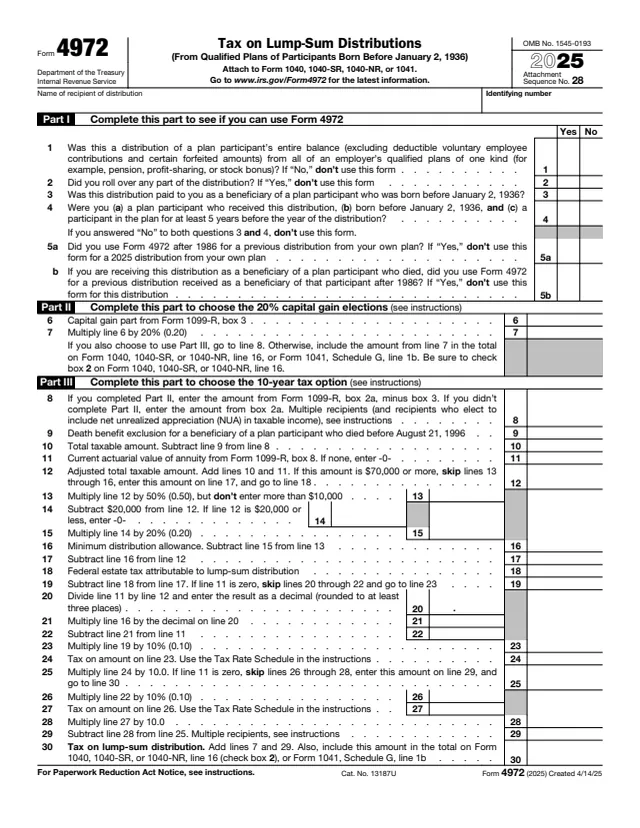
Form 4972 figures the tax on a qualified lump-sum distribution from a qualified plan using the 20% capital gain election, the 10-year tax option, or both. The form's subtitle says it is for distributions from qualified plans of participants born before January 2, 1936.
The instructions say these are special formulas used to figure a separate tax on the distribution, paid once for the year the distribution is received, not over the next 10 years. The separate tax is added to the regular tax figured on other income. The amounts come from the Form 1099-R the payer sends.
The form is attached to Form 1040, 1040-SR, 1040-NR or 1041, and its instructions are printed on pages 2 to 4 of the PDF. This page covers the 2025 form. You can fill out Form 4972 free in your browser on this page and download the result without an account.
Name of recipient of distribution and identifying number.
Yes or no questions on lines 1 through 5b about the entire balance, rollovers, the participant's birth date, 5 years of participation and earlier use of Form 4972.
Line 6 takes the capital gain part from Form 1099-R, box 3, and line 7 multiplies it by 20% (0.20).
Lines 8 through 29 work from the taxable amount, death benefit exclusion, annuity value, minimum distribution allowance and federal estate tax to the tax figured with the Tax Rate Schedule.
Adds lines 7 and 29. The form says to include it on Form 1040, 1040-SR or 1040-NR, line 16 (check box 2), or Form 1041, Schedule G, line 1b.
The instructions carry an NUA Worksheet, a Death Benefit Worksheet, a multiple recipients worksheet and the Tax Rate Schedule used on lines 24 and 27.
Enter the recipient's name and identifying number. The instructions say to add qualified distributions for the same participant and file a separate form for each participant. Spouses filing jointly who each received one file a separate form for each spouse.
Answer lines 1 through 5b. The form says not to use it if line 1 is "No", if line 2 is "Yes", if both lines 3 and 4 are "No", or if line 5a or 5b is "Yes" for that distribution.
Enter the amount from Form 1099-R, box 3, on line 6, or use the NUA Worksheet or Death Benefit Worksheet when they apply. Multiply by 20% on line 7. Leave line 6 blank and go to Part III when not making the election.
Enter box 2a (minus box 3 if Part II was completed). Line 9 is the death benefit exclusion for a beneficiary of a participant who died before August 21, 1996, line 11 the annuity value from box 8, and lines 13 to 16 the minimum distribution allowance.
Enter any federal estate tax attributable to the distribution on line 18. Multiply by 10% on line 23, find the tax in the Tax Rate Schedule on line 24, and multiply it by 10.0 on line 25. Lines 26 to 28 repeat this for any annuity value.
Add lines 7 and 29. Include the result on Form 1040, 1040-SR or 1040-NR, line 16 with box 2 checked, or on Form 1041, Schedule G, line 1b, and attach Form 4972.
You get the real form, filled in a browser tab, with nothing standing between you and the finished PDF.
The instructions say to attach Form 4972 to Form 1040 or 1040-SR (individuals), Form 1040-NR (nonresident aliens), or Form 1041 (estates or trusts).
The form can go with an original or amended return. For an amended return, the instructions give a window of generally 3 years after the original return was filed or 2 years after the tax was paid, whichever is later.
The instructions say that after 1986 Form 4972 can be used only once for each plan participant. More than one lump-sum distribution for the same participant in 1 tax year is combined on a single form.
If Part III is used, the instructions say not to include any part of the distribution on Form 1040, 1040-SR or 1040-NR, lines 5a and 5b, or on Form 1041, line 8.
For filers other than individuals, the form estimates 19 min. for recordkeeping, 1 hr., 36 min. for learning about the law or the form, 2 hr., 7 min. for preparing it and 20 min. for copying, assembling and sending it.
1099-R
257 fields, 9 pages
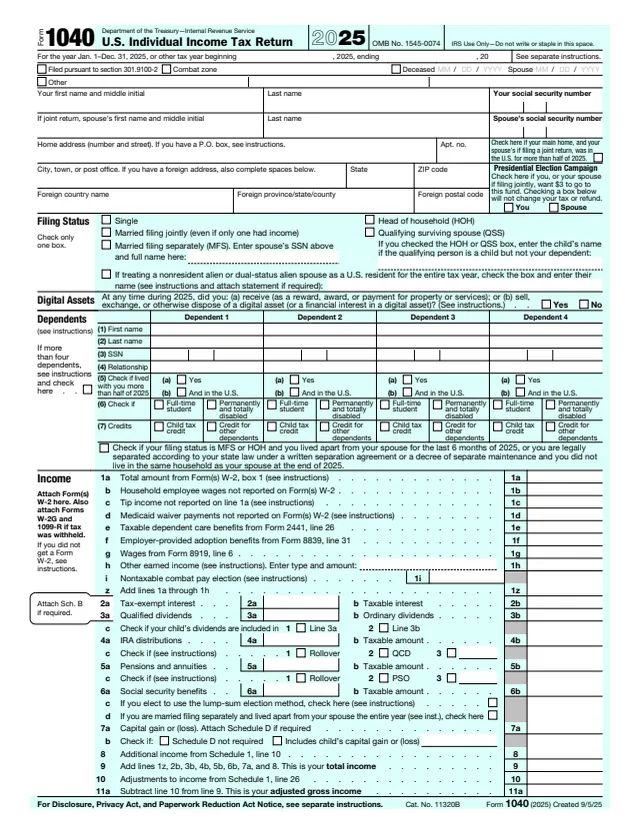
1040
199 fields, 2 pages
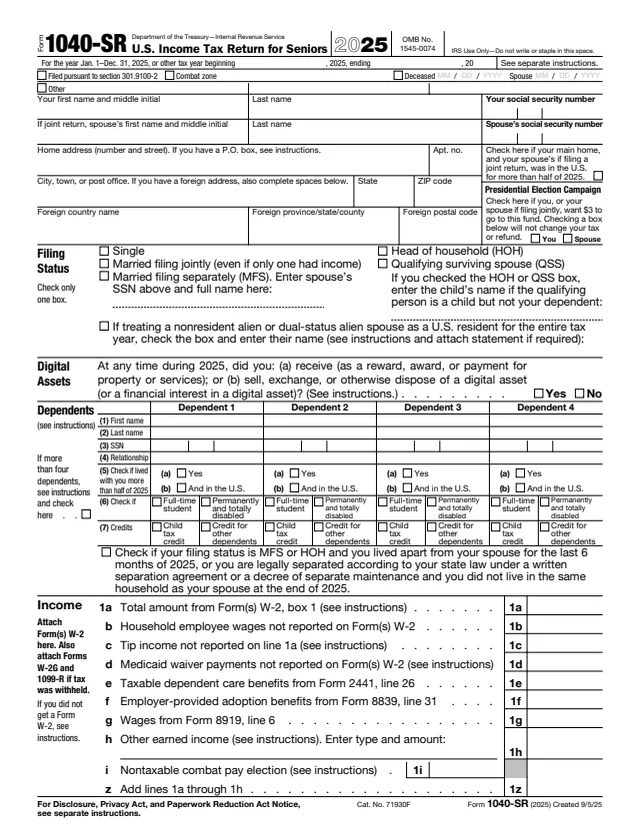
1040-SR
200 fields, 4 pages
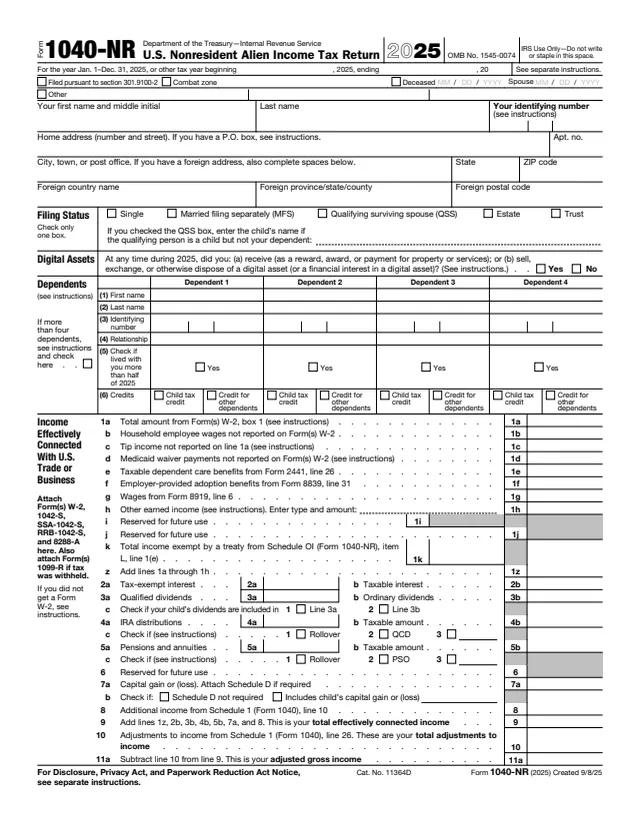
1040-NR
171 fields, 2 pages
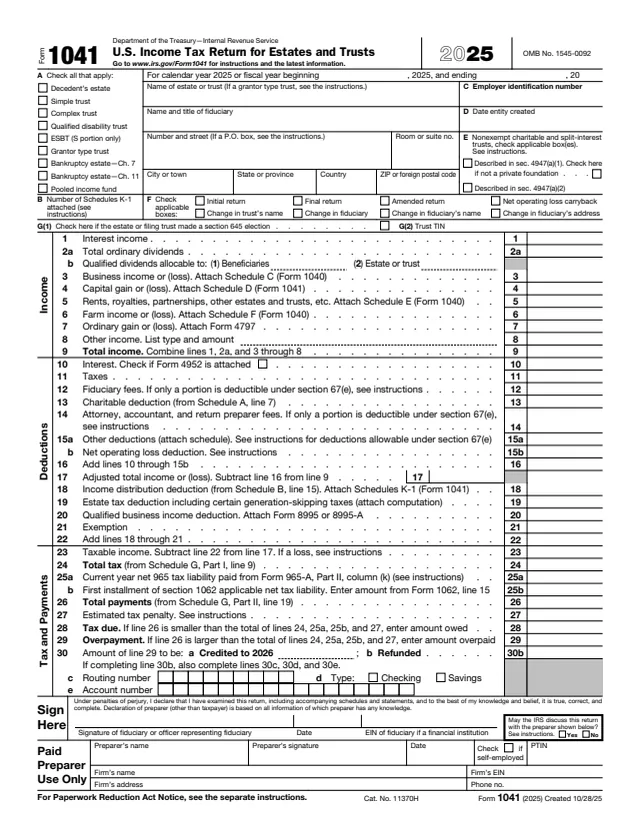
1041
173 fields, 3 pages
The recipient of the distribution completes the form and attaches it to their own return. Part I asks the questions that decide whether the form applies.
No tool matches that search.
The instructions say it is the distribution or payment in 1 tax year of a plan participant's entire balance from all of an employer's qualified plans of one kind, such as pension, profit-sharing or stock bonus plans. The participant was born before January 2, 1936.
The instructions list a distribution from an IRA among the distributions that are not qualified lump-sum distributions.
Part II applies a 20% rate to the capital gain portion shown in Form 1099-R, box 3. The instructions say only the taxable amount from pre-1974 participation qualifies for capital gain treatment.
No. The instructions say the tax is paid only once, for the year the distribution is received, not over the next 10 years.
After 1986, only once for each plan participant, according to the instructions. An election as a beneficiary does not affect an election for distributions from your own plan.
Line 30 is included on Form 1040, 1040-SR or 1040-NR, line 16 with box 2 checked, or on Form 1041, Schedule G, line 1b.