Part I: Required Annual Payment
Lines 1 to 5. Total tax, less personal holding company tax, look-back interest and the credit for federal tax paid on fuels, compared with the tax on the 2024 return. Line 5 is the smaller amount.
2220
Underpayment of Estimated Tax by Corporations
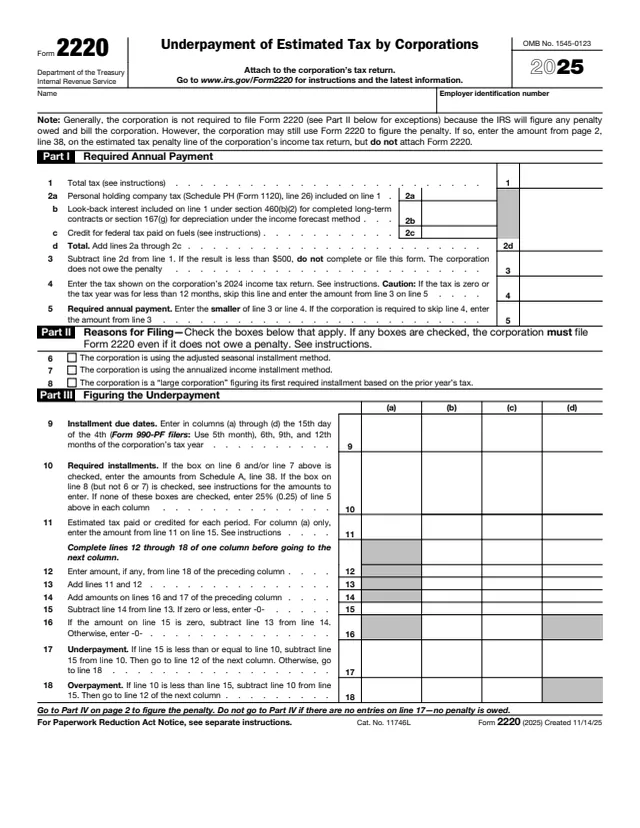
Form 2220 is the IRS form a corporation uses to work out the penalty for underpaying estimated tax. The instructions say corporations (including S corporations), tax-exempt organizations subject to the unrelated business income tax, and private foundations use it to determine whether they are subject to the penalty and, if so, the amount for the period that applies.
This page covers the 2025 form. The form notes that generally the corporation is not required to file Form 2220, because the IRS will figure any penalty owed and bill the corporation. The corporation may still use it to figure the penalty. Part II lists three reasons for filing: the adjusted seasonal installment method, the annualized income installment method, and a large corporation figuring its first required installment from the prior year's tax.
When it is filed, Form 2220 is attached to the corporation's income tax return, such as Form 1120. You can fill out Form 2220 free in your browser on this page and download the result without an account.
Lines 1 to 5. Total tax, less personal holding company tax, look-back interest and the credit for federal tax paid on fuels, compared with the tax on the 2024 return. Line 5 is the smaller amount.
Lines 6, 7 and 8: boxes for the adjusted seasonal installment method, the annualized income installment method, and a large corporation using the prior year's tax for its first installment.
Lines 9 to 18 in four columns, one per installment: due dates, required installments, payments made, and the underpayment or overpayment carried to the next column.
Lines 19 to 38 count the days each underpayment was outstanding in each rate period and apply the rate. Line 38 is the penalty.
The adjusted seasonal installment method, usable only if the base period percentage for any 6 consecutive months is at least 70%, and the annualized income installment method.
Lines 32 to 38 pick the smaller of the method amount or the regular installment for each column. Line 38 goes to page 1, line 10.
Enter the total tax, generally from Form 1120, line 31, then the amounts on lines 2a to 2c. The form says that if line 3 is less than $500, do not complete or file it.
Enter the tax shown on the 2024 return, figured the same way as line 3. If that tax was zero or the tax year was under 12 months, skip line 4. Line 5 is the smaller of lines 3 and 4.
Check each box that applies. The instructions say that if Schedule A is used for any payment due date, it is used for all payment due dates.
Enter the 15th day of the 4th, 6th, 9th and 12th months of the tax year. With no Part II box, line 10 is 25% of line 5 in each column. Line 11 holds estimated payments. Finish one column before the next.
Only if line 17 shows an underpayment. Line 19 is the payment date or the 15th day of the 4th month after the tax year ends, whichever is earlier. Count the days in each period and apply the rate.
Add columns (a) through (d) of line 37. Enter the total on line 38 and on Form 1120, line 34, or the comparable line of the corporation's other income tax return.
You get the real form, filled in a browser tab, with nothing standing between you and the finished PDF.
If a Part II box is checked, the instructions say to attach Form 2220 to the income tax return and check the box on Form 1120, page 1, line 34, or the comparable line of Form 1120-C, 1120-L, 1120-S or another return.
The form says the corporation may use Form 2220 only to figure the penalty. It then enters the line 38 amount on the estimated tax penalty line of its return but does not attach the form.
The instructions say a corporation will not have to pay a penalty if the tax on its 2025 return, the Part I, line 3 amount, is less than $500.
The 2025 form prints 7% (0.07) for periods through 3/31/2026. For later quarters it prints an asterisk: the rate is published quarterly in an IRS News Release and a Revenue Ruling, and the form lists 800-829-4933 for rate information.
The instructions say the penalty is figured separately for each installment due date, so a corporation may owe a penalty for an earlier date even if it later paid enough, and even if it is due a refund.
For tax years beginning in 2025, the instructions say the IRS will continue to waive the penalty for estimated tax attributable to the corporate alternative minimum tax. Affected corporations still file the 2025 Form 2220, as Notice 2025-27 describes.
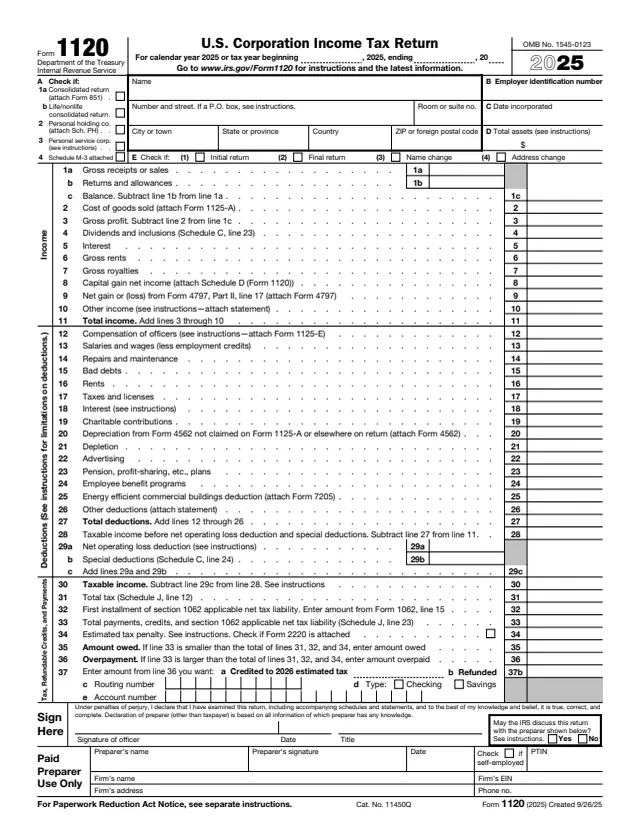
1120
481 fields, 6 pages
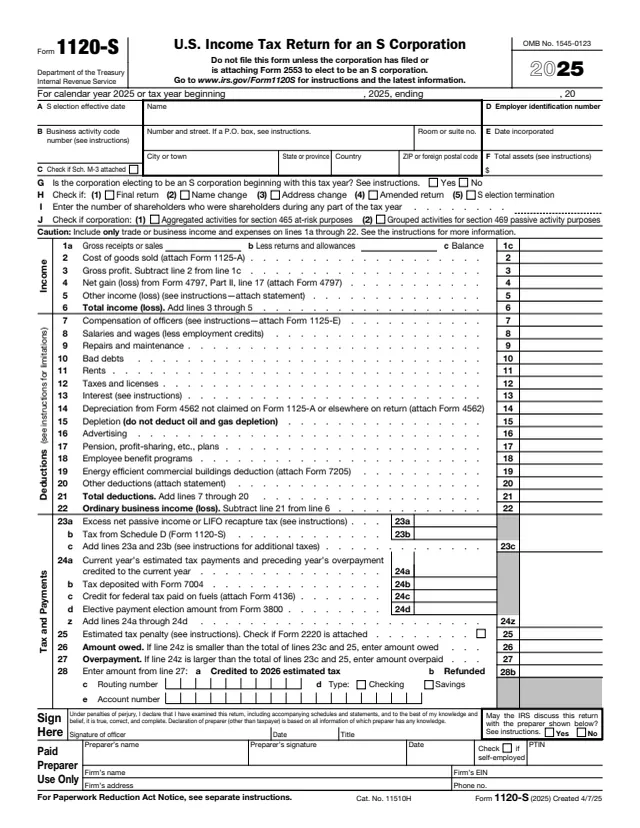
1120-S
390 fields, 5 pages
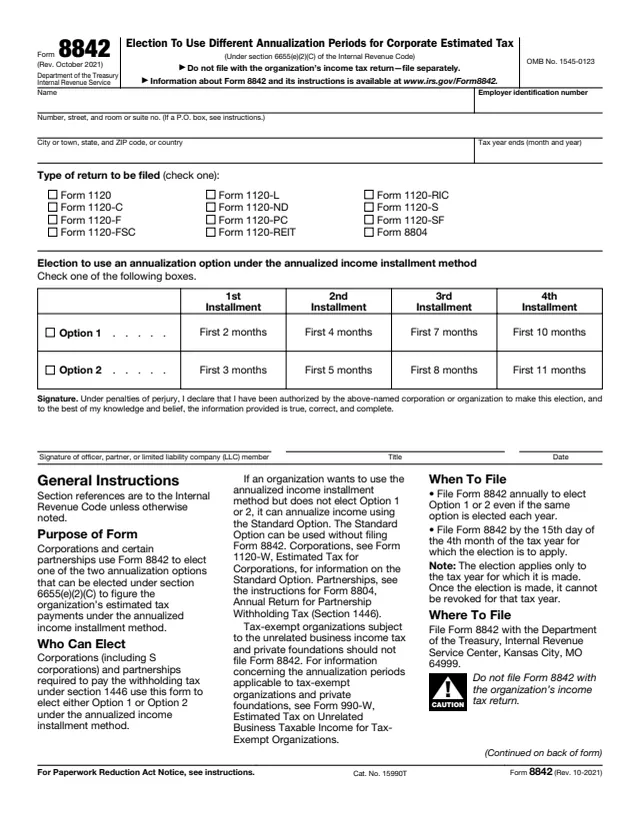
8842
20 fields, 2 pages
990-PF
1,147 fields, 13 pages
990-T
128 fields, 2 pages
1120
114 fields, 2 pages
The form is completed by the corporation or organization that owed estimated tax, and it goes to the IRS with that entity's own income tax return. It is not an individual's form.
No tool matches that search.
No. The form says that generally the corporation is not required to file it, because the IRS will figure any penalty owed and bill the corporation. It is filed when a box in Part II applies.
The instructions define it as a corporation, other than an S corporation, that had taxable income of $1 million or more for any of the 3 tax years immediately before the 2025 tax year.
The instructions say a corporation can use it only if its base period percentage for any 6 consecutive months of the tax year is 70% or more. The instructions give a ski shop and an amusement park as examples.
Yes. The instructions say the penalty is figured separately for each installment due date, and this is true even if the corporation is due a refund when its return is filed.
Line 38 of Form 2220. The form says to enter the total there and on Form 1120, line 34, or the comparable line for other income tax returns.
The instructions say Option 1 or Option 2 annualization periods on Schedule A, line 20, can be used only if the corporation elected them by filing Form 8842 by the due date of the first required installment.