Header and parties
Spaces for the reply reference, the taxpayer ID number, the organization's name and address, and the IRS name.
15721
Consent to Suspend the Period to Conduct a Church Tax Examination
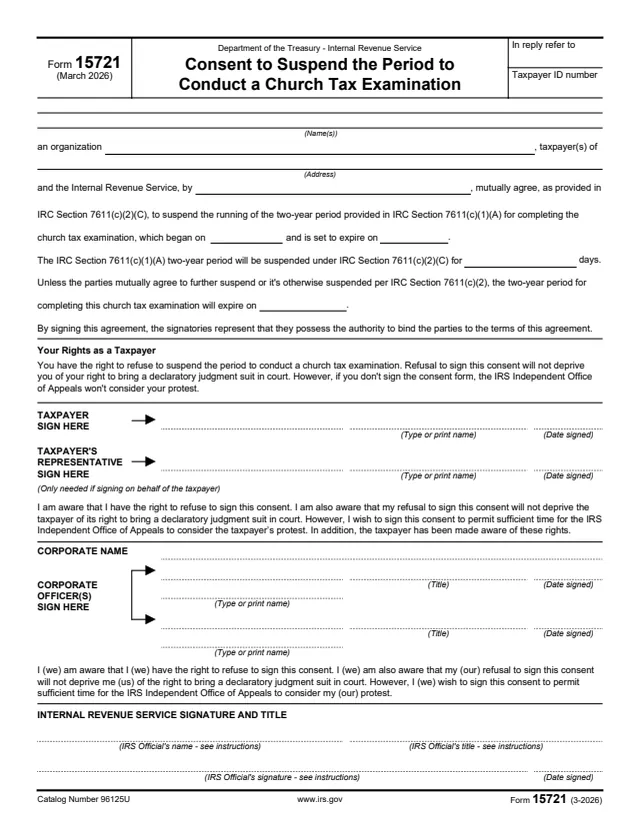
Form 15721 is the Consent to Suspend the Period to Conduct a Church Tax Examination. On it, the taxpayer organization and the Internal Revenue Service mutually agree, as provided in IRC Section 7611(c)(2)(C), to suspend the running of the two-year period in IRC Section 7611(c)(1)(A) for completing a church tax examination.
The form records when the examination began, when it is set to expire, the number of days of suspension and the new expiration date. It is signed by the taxpayer, by its representative when one signs on its behalf, by corporate officers when the taxpayer is a corporation, and by a delegated IRS official.
The form says the taxpayer has the right to refuse to suspend the period, and that refusing does not deprive it of the right to bring a declaratory judgment suit in court. It also says that if the consent is not signed, the IRS Independent Office of Appeals won't consider the protest. You can fill out the PDF free in your browser on this page and download it without an account.
Spaces for the reply reference, the taxpayer ID number, the organization's name and address, and the IRS name.
The date the church tax examination began and the date the two-year period is set to expire.
The number of days the two-year period is suspended under IRC Section 7611(c)(2)(C), and the date it will then expire.
A statement of the right to refuse, the right to bring a declaratory judgment suit, and the effect on an Appeals protest.
Signature lines with printed name and date for the taxpayer and, when signing on its behalf, the taxpayer's representative.
The corporate name with officer signatures and titles, then the IRS official's name, title, signature and date.
Enter the reply reference and taxpayer ID number, the organization's name and address, and the IRS name.
Enter the date the examination began, the date it is set to expire, the number of days of suspension, and the date the two-year period will expire after the suspension.
The form explains the right to refuse to sign and what refusing means for a declaratory judgment suit and for an Appeals protest.
The taxpayer signs, or a representative signs on its behalf with a power of attorney that specifically authorizes it, and enters the printed name and date.
For a corporation, enter the corporate name, then each authorized officer's printed name, title, signature and date.
The delegated IRS official completes their name, title, signature and date.
You get the real form, filled in a browser tab, with nothing standing between you and the finished PDF.
The form is an agreement between the taxpayer and the IRS. The downloaded form prints no mailing address or fax number.
Unless the parties agree to further suspend it or it is otherwise suspended per IRC Section 7611(c)(2), the form says the two-year period expires on the date written on it.
By signing, the signatories represent that they possess the authority to bind the parties to the terms of the agreement.
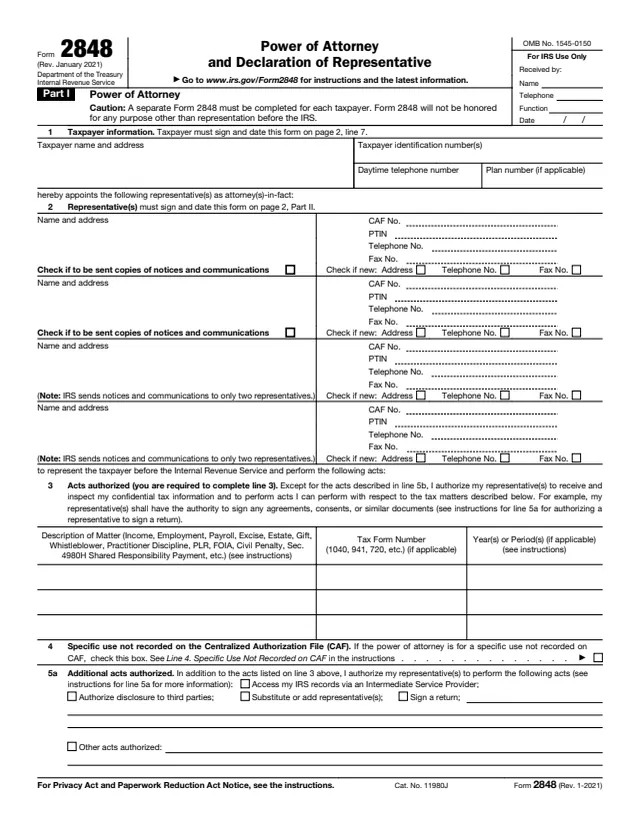
The instructions say a representative's power of attorney that was not previously filed is included with the form.
The form says that if the consent is not signed, the IRS Independent Office of Appeals won't consider the protest.
The form is an agreement between an organization under a church tax examination and the IRS. It is not a form an individual files on their own.
No tool matches that search.
It suspends the running of the two-year period in IRC Section 7611(c)(1)(A) for completing a church tax examination, for the number of days written on the form.
The form says the taxpayer has the right to refuse, and refusing does not deprive it of the right to bring a declaratory judgment suit in court.
The form says the IRS Independent Office of Appeals won't consider the protest if the consent is not signed.
A delegated IRS official. The instructions name Group Managers, Exempt Organization Examinations, under Delegation Order 7-3.
The instructions say an attorney or agent of the taxpayer may sign when the action is specifically authorized by a power of attorney.