Taxpayer details
Taxpayer identification numbers, an In reply refer to box, the taxpayer names and the address.
921
Consent to Extend the Time to Assess Tax
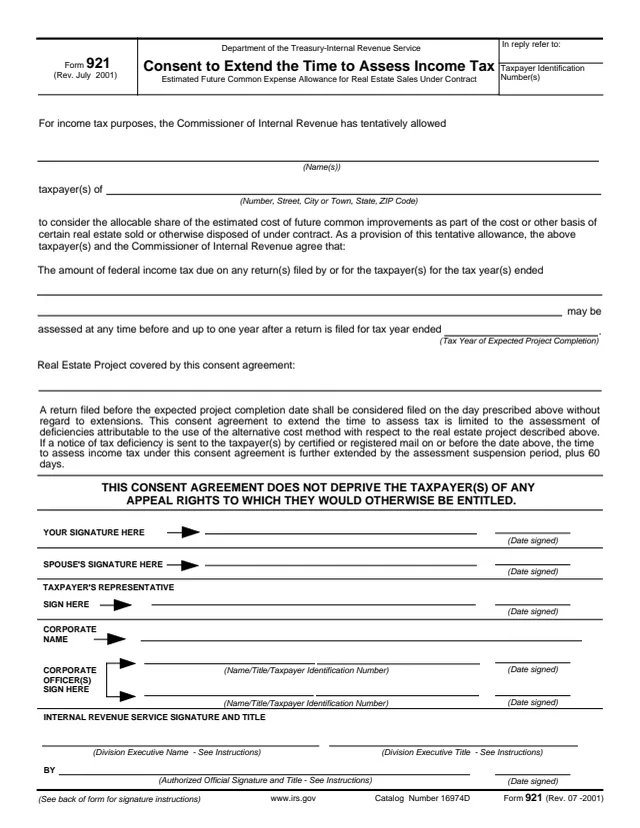
Form 921, Consent to Extend the Time to Assess Income Tax, is an agreement between taxpayers and the Commissioner of Internal Revenue. Its subtitle is Estimated Future Common Expense Allowance for Real Estate Sales Under Contract.
The form says the Commissioner has tentatively allowed the named taxpayers to treat the allocable share of the estimated cost of future common improvements as part of the cost or other basis of real estate sold under contract. In return, tax on the listed years may be assessed at any time before and up to one year after a return is filed for the tax year of expected project completion. The back page says it is used to apply for an extension in accordance with Revenue Procedure 92-29 and its successors.
The taxpayers or their representative sign, and an authorized IRS official signs for the IRS. You can fill out Form 921 free in your browser on this page and download it without an account.
Taxpayer identification numbers, an In reply refer to box, the taxpayer names and the address.
The tax years covered, and the tax year of expected project completion that sets the end of the assessment period.
A space for the real estate project covered by the consent agreement.
The consent is limited to deficiencies from the alternative cost method, and a notice of deficiency extends it by the suspension period plus 60 days.
Lines for the taxpayer, spouse, taxpayer's representative, corporate name and officers, and the IRS official with division executive name and title.
Instructions for taxpayers on who signs, and instructions for IRS employees by division.
Review the names, address, tax years, completion year and project on page 1. The instructions say signatures match the names as they appear on the form.
The taxpayer signs and dates. For years with a joint return, the spouse also signs and dates.
An attorney or agent signs on the representative line when a power of attorney specifically authorizes it, and includes the power of attorney if not already filed.
For a corporation, enter the corporate name, and each authorized officer signs with name, title and taxpayer identification number.
The instructions ask the taxpayer to sign and return both the original and the copy of Form 921.
The IRS enters the division executive's name and title, and an authorized official signs and dates.
You get the real form, filled in a browser tab, with nothing standing between you and the finished PDF.
The form says tax for the listed years may be assessed at any time before and up to one year after a return is filed for the tax year of expected project completion.
The form says a return filed before the expected project completion date is considered filed on the day prescribed, without regard to extensions.
If a notice of tax deficiency is sent by certified or registered mail on or before the date above, the form says the time to assess is further extended by the assessment suspension period, plus 60 days.
The form says the consent agreement does not deprive the taxpayers of any appeal rights to which they would otherwise be entitled.
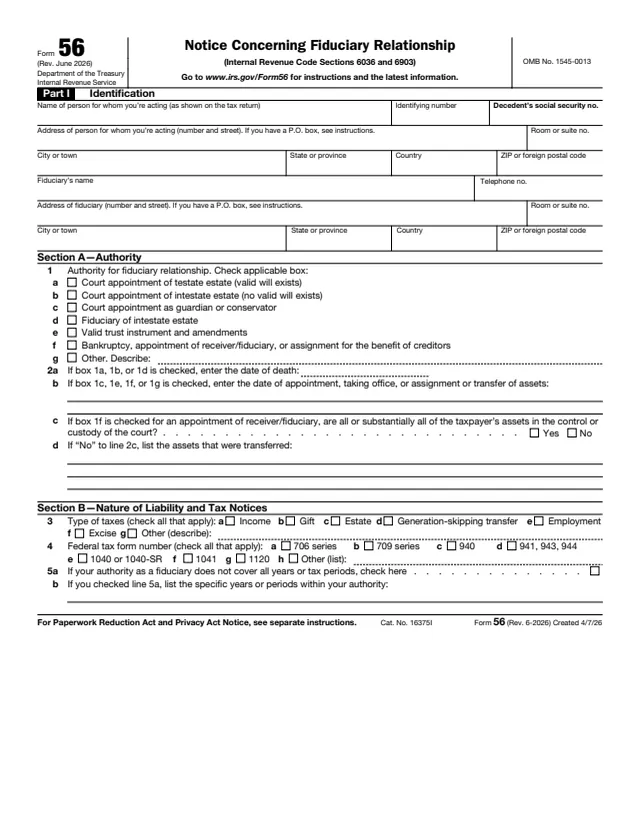
The instructions say a fiduciary (executor, administrator, trustee, etc.) includes a completed Form 56, Notice Concerning Fiduciary Relationship, if one has not already been filed.
The form prints no mailing address. It has an In reply refer to box for the IRS reference.
No tool matches that search.
The time to assess income tax for the listed years, up to one year after a return is filed for the tax year of expected project completion. It is limited to deficiencies from the alternative cost method for the project described.
The form says the Commissioner has tentatively allowed the taxpayers to treat the allocable share of the estimated cost of future common improvements as part of the basis of real estate sold under contract.
The form says the consent agreement does not deprive the taxpayers of any appeal rights to which they would otherwise be entitled.
The officers duly authorized to sign on behalf of the corporation, with the corporation's name and each officer's title.
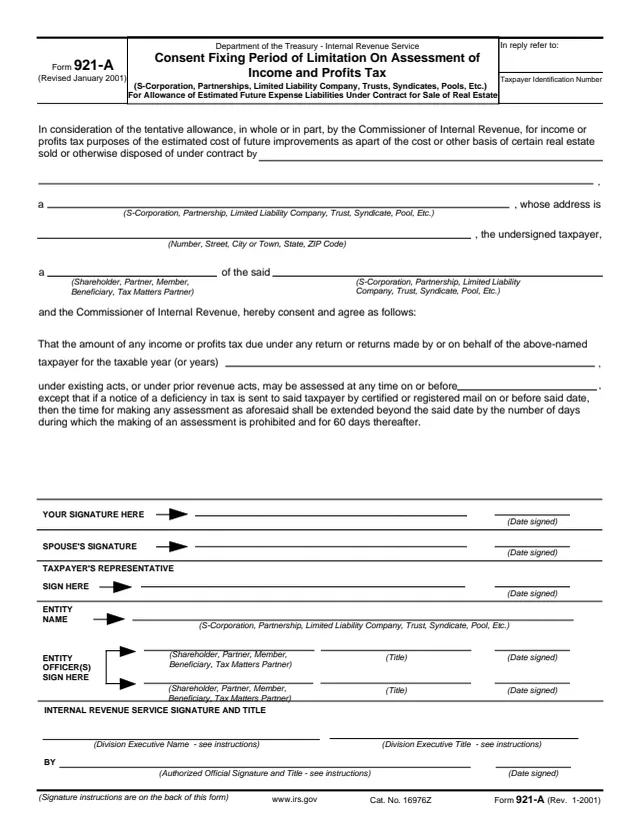
The instructions say a TEFRA partnership uses Form 921-P, and an entity not subject to TEFRA, such as an S corporation, partnership, LLC or trust, uses Form 921-I.
Yes, if a power of attorney specifically authorizes it. The instructions ask for the power of attorney to be included if it has not been filed.