Header boxes
Name of the corporation (the common parent, if consolidated), EIN and four boxes: non-consolidated return, consolidated return (Form 1120 only), mixed 1120/L/PC group, and dormant subsidiaries schedule attached.
1120 Sch. M-3
Net Income (Loss) Reconciliation for Corporations With Total Assets of $10 Million or More
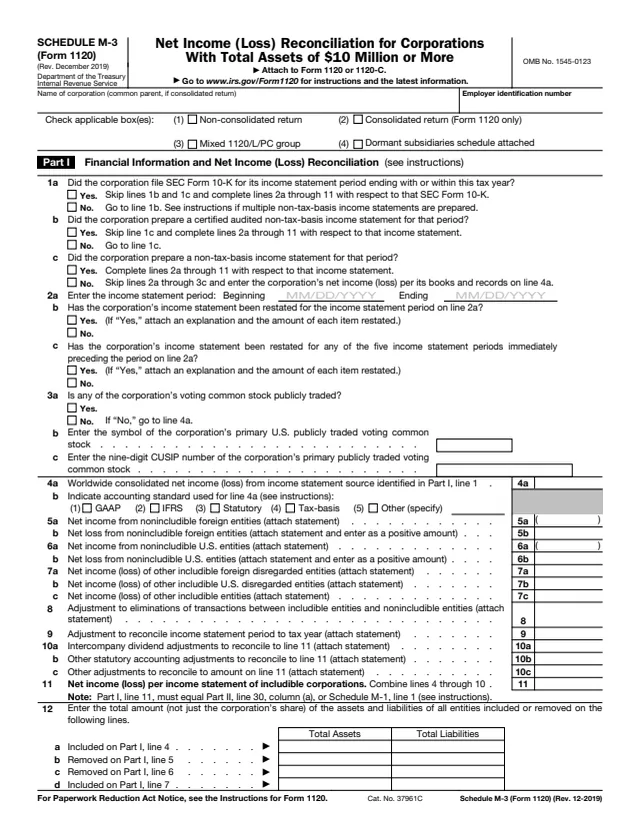
Schedule M-3 (Form 1120) is the Net Income (Loss) Reconciliation for Corporations With Total Assets of $10 Million or More. The About page says corporations file it to answer questions about their financial statements and reconcile financial statement net income (loss) for the corporation to net and taxable income on Form 1120. Part I asks about the income statement and arrives at net income (loss) per income statement of includible corporations on line 11. Parts II and III reconcile that amount, item by item, to taxable income on Form 1120, page 1, line 28.
The schedule says to attach it to Form 1120 or 1120-C. The instructions say a corporation or group filing Form 1120 that reports total assets on Schedule L at the end of the tax year that equal or exceed $10 million files Schedule M-3 instead of Schedule M-1, and that a corporation filing Form 1120 or 1120-C that is not required to file it may file it voluntarily.
This page hosts the December 2019 revision; the instructions linked here were revised in June 2025. You can fill it out free in your browser on this page and download the result without an account.
Name of the corporation (the common parent, if consolidated), EIN and four boxes: non-consolidated return, consolidated return (Form 1120 only), mixed 1120/L/PC group, and dormant subsidiaries schedule attached.
Which income statement is used (SEC Form 10-K, certified audited, other non-tax-basis, or books and records), the income statement period, any restatements, and the stock symbol and CUSIP number if voting common stock is publicly traded.
Worldwide consolidated net income (loss) and the accounting standard used, then removals and additions for nonincludible and other includible entities and other adjustments, arriving at net income (loss) of includible corporations on line 11.
Total assets and total liabilities (not just the corporation's share) of all entities included or removed on Part I, lines 4, 5, 6 and 7.
Lines 1 to 30 in four columns: income (loss) per income statement, temporary difference, permanent difference, and income (loss) per tax return. Items include foreign and U.S. dividends, partnership income, interest income, cost of goods sold and asset dispositions.
Lines 1 to 39 with the same four columns, for items such as income tax expense, interest, equity-based compensation, meals and entertainment, fines and penalties, charitable contributions, amortization and depreciation.
The instructions say Part I is completed for any tax year the corporation files Schedule M-3. Check box (1), (2) or (3), as applicable, and box (4) if a dormant subsidiaries schedule is attached.
Answer lines 1a to 1c in order. If SEC Form 10-K was filed for the period, check Yes on line 1a and use that income statement. If line 1c is No, skip lines 2a through 3c and enter net income (loss) per books and records on line 4a.
Report worldwide consolidated net income (loss) on line 4a, remove nonincludible entities on lines 5 and 6, and add other includible entities on line 7, attaching the statements each line asks for. The form notes that line 11 equals Part II, line 30, column (a), or Schedule M-1, line 1.
For each line in Parts II and III, column (a) is the amount included on Part I, line 11, and column (d) the amount included in taxable income on Form 1120, page 1, line 28. The instructions say a difference is split into its temporary part in column (b) and permanent part in column (c).
Items listed on the schedule are reported on their own line even with no difference. The instructions say an item with no difference that no line describes goes on Part II, line 28, and amounts from reportable transactions go on Part II, line 12.
A filer with at least $50 million total assets completes the whole schedule. The instructions say a required filer under $50 million, or a voluntary filer, completes it entirely or completes Part I and uses Schedule M-1 instead of Parts II and III.
You get the real form, filled in a browser tab, with nothing standing between you and the finished PDF.
The schedule says to attach it to Form 1120 or 1120-C. The instructions give the address for the return and all attachments: Department of the Treasury, Internal Revenue Service Center, Ogden, UT 84201-0012.
The instructions say a Form 1120 filer required to file Schedule M-3 generally also files Schedule B (Form 1120), Additional Information for Schedule M-3 Filers, with exceptions for filers under $50 million in assets and voluntary filers.
The instructions say total assets on Schedule L, line 15, column (d), are the same total assets reported in the non-tax-basis financial statements, if any, used for Schedule M-3, and Schedule M-2, line 2, equals Schedule M-3, Part I, line 11.
Any statement required to support a line item is attached when Schedule M-3 is filed. For a consolidated return, detailed Part II and Part III statements are attached for each separate entity.
The instructions say a corporation that filed Schedule M-3 for the preceding tax year but reports total consolidated assets under $10 million at the end of the current tax year is not required to file it for the current year.
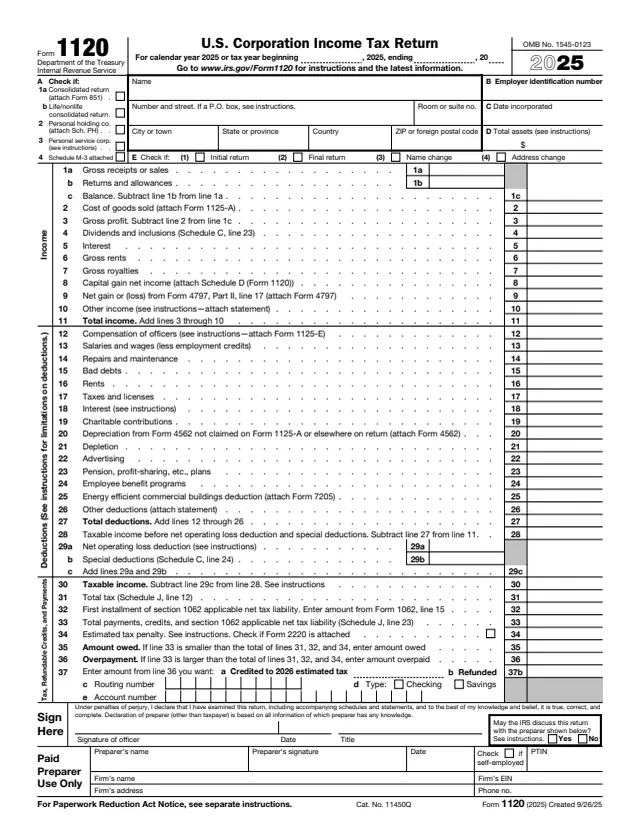
1120
481 fields, 6 pages
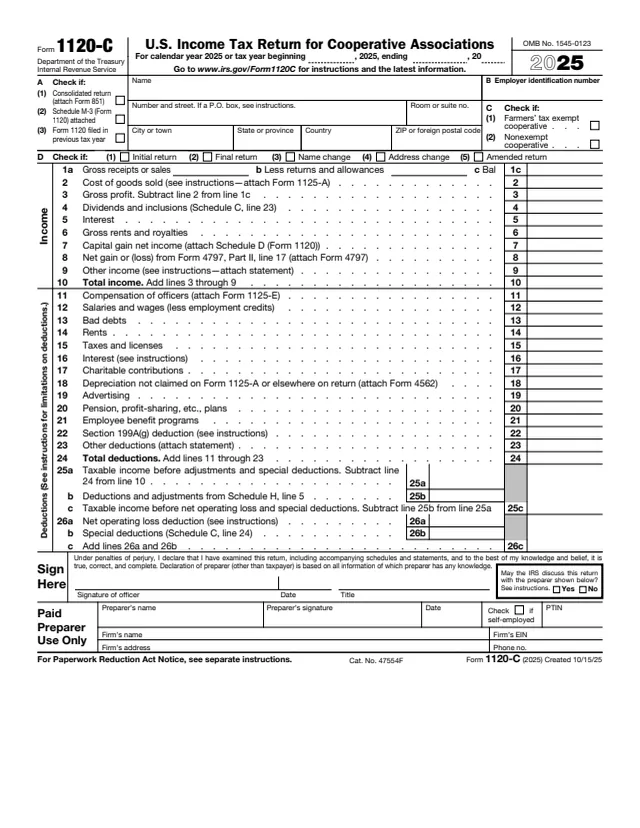
1120-C
449 fields, 5 pages
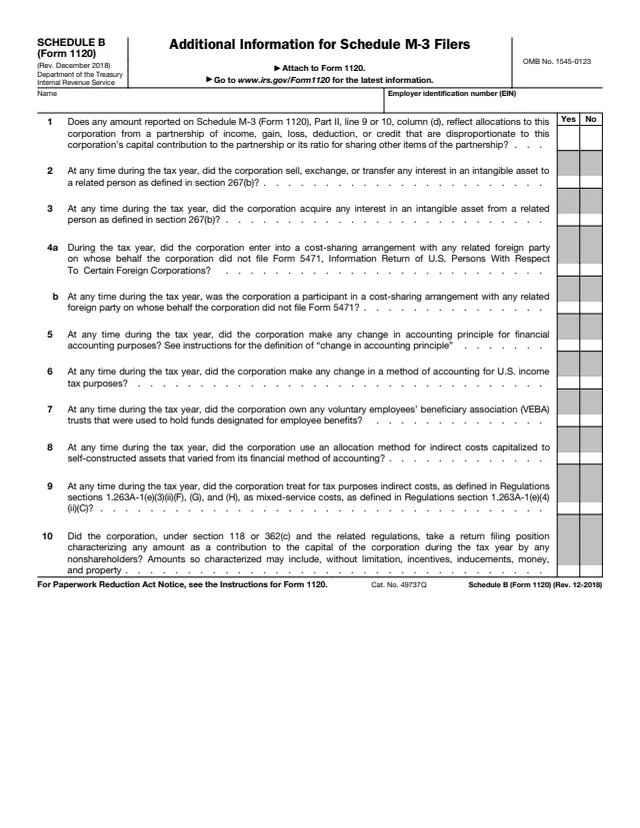
1120 Sch. B
24 fields, 2 pages
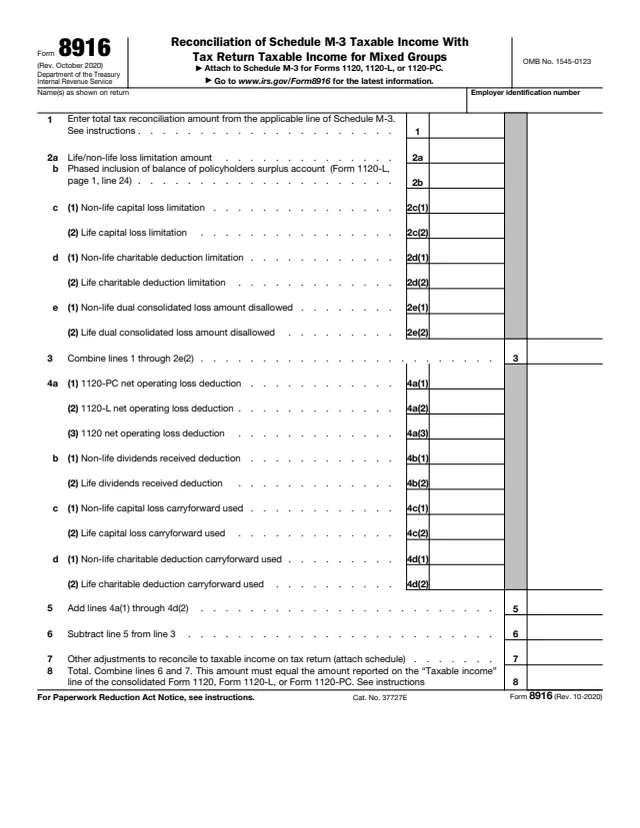
8916
25 fields, 2 pages
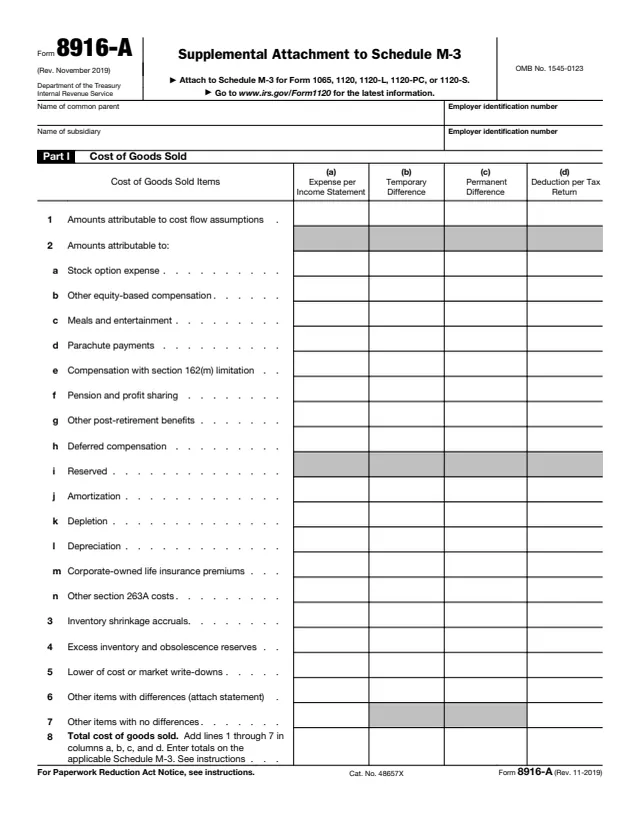
8916-A
140 fields, 4 pages
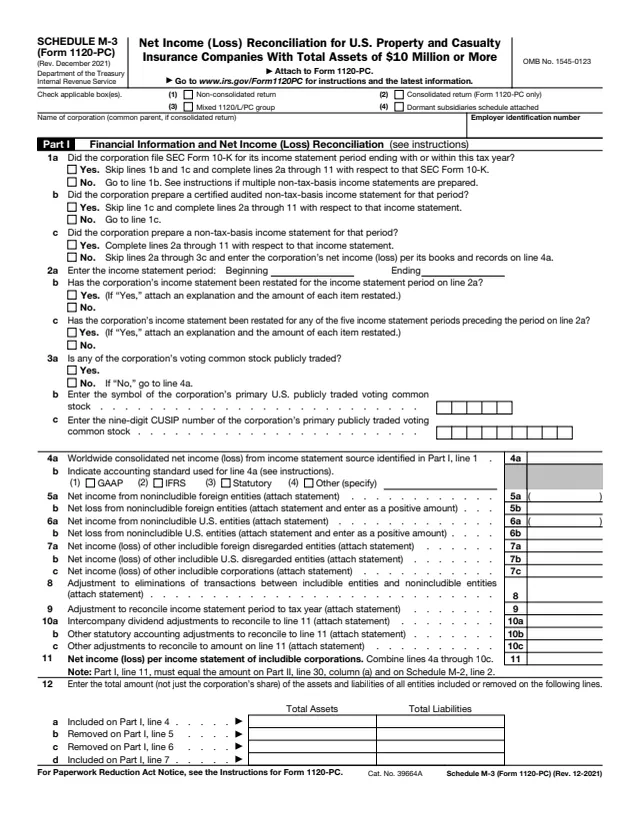
1120-PC Sch. M-3
383 fields, 3 pages
The corporation, or the parent of a consolidated group, completes it and files it with its Form 1120 or Form 1120-C.
No tool matches that search.
Corporations and consolidated groups filing Form 1120 that report total assets of $10 million or more on Schedule L, and Form 1120-C cooperatives over the same threshold. Others filing Form 1120 or 1120-C may file it voluntarily.
The instructions say a required filer files Schedule M-3 instead of Schedule M-1. A filer under $50 million in assets may complete Part I and use Schedule M-1 in place of Parts II and III.
Column (b) holds the temporary part of a difference between the book and tax amounts, and column (c) the permanent part. If it cannot be determined whether a difference will reverse, the instructions say to report it in column (c).
The instructions say there are separate Schedules M-3 for Forms 1065, 1120-S, 1120-F, 1120-PC and 1120-L, and none is required for Forms 1120-REIT, 1120-RIC, 1120-H and 1120-SF.
With Form 1120 or 1120-C and all attachments, to the Internal Revenue Service Center, Ogden, UT 84201-0012, as the instructions list.
A consolidated group parent may attach a statement with the name and EIN of an includible corporation that had no activity and no amounts to report, instead of blank Parts II and III for it, and check box (4).